

Greatest Companies · Episode 15 · General Electric
▶ Watch on YouTube🎵 Listen on Spotify
Also available on Apple Podcasts · Amazon Music · iHeart Radio
The most famous industrial company in the world cannot pay its bills.
Not because it lacks the money. On paper it is enormous, profitable, triple-A rated, a fixture of every pension fund and every list of the world’s great corporations. The problem is subtler and far more dangerous than insolvency. Every single day, this company borrows tens of billions of dollars in short-term IOUs called commercial paper, debt that matures in weeks or even days, and every single day it pays off the old IOUs by selling new ones. It is a perpetual motion machine that runs on one thing: the willingness of the market to keep lending, every morning, forever.
And in the autumn of the financial crisis, after Lehman Brothers collapses and fear rolls through the credit markets like a blackout crossing a power grid, that willingness simply evaporates. The market that has lent General Electric its lifeblood every day for years stops answering the phone. Behind closed doors, GE’s chief executive privately warns the United States Treasury Secretary that the company is worried it cannot roll over its short-term debt. In public, the message stays calm. The triple-A is sacred. The commercial paper needs are being met. In private, the symbol of American business is staring at the possibility that it cannot fund itself.
What saves it is not its turbines or its jet engines. What saves it is a phone call to Omaha and a change of the rules in Washington. Warren Buffett agrees to send three billion dollars. The federal government agrees to stand behind the debt. The company that electrified the twentieth century is rescued, in the end, by the same emergency machinery built to catch failing banks. Because by 2008, in every way that mattered to its survival, General Electric had quietly become one.
To understand how the bluest blue chip on Earth ended up one frozen market away from extinction, you have to understand that its fragility was not bad luck. It was built, deliberately, by people who were celebrated for building it.
📄 Free Download · Company Research Sheet
General Electric Research Sheet (PDF)
The moat, the meltdown, the Legendary Scorecard, the timeline, and the Move, Money and Mind lessons from this story. Free, no email required.
The World Before GE
General Electric was not founded so much as assembled, in 1892, out of the electric empire Thomas Edison had built and a rival concern called Thomson-Houston, stitched together with the money and will of the financier J. P. Morgan. From the start it was less a company than an institution. It made the light bulbs that lit the cities, the generators that powered them, the locomotives, the X-ray machines, the jet engines, the turbines, the refrigerators. When the Dow Jones Industrial Average was created at the end of the nineteenth century, GE was one of its first members, and it would stay on that index, the last of the original group still standing, for more than a hundred years.
For generations, GE was the company that taught America how to be a corporation. Its management school produced chief executives for the rest of the country the way a great university produces graduates. To own GE stock was not really to make a bet. It was to own a piece of the nation’s industrial spine, a holding so safe that widows and pension funds reached for it precisely because it seemed incapable of failing. Hold that reputation in your mind, because it is the raw material from which the trap was built. A company nobody questions can do dangerous things for a very long time before anyone looks closely.
The Man Who Built the Myth
The legend of modern GE has a single author: Jack Welch.
When Welch took over as chief executive in 1981, the eighth person to hold the job in GE’s long history, the company was a sprawling, profitable, slow-moving giant worth around fourteen billion dollars. Welch, a chemical engineer with a doctorate and a ferocious competitive streak, looked at that giant and saw fat. Over his first few years he sold or shut whole divisions, divesting more than a hundred business units and cutting roughly a quarter of the workforce, well over a hundred thousand jobs. The press gave him a nickname he claimed to hate: Neutron Jack, after the bomb said to kill the people while leaving the buildings standing.
His doctrine was brutally simple and endlessly imitated. Every business GE owned had to be number one or number two in its market, or it would be fixed, closed, or sold. He pressed a quality religion called Six Sigma through every factory. He forced managers to rank their people and fire the bottom tenth every year. And the results, for two decades, were staggering. Revenue grew from under thirty billion dollars to roughly one hundred thirty billion. The stock compounded at around twenty percent a year, far ahead of a roaring market. By the time Welch retired in 2001, GE’s market value had risen from about fourteen billion dollars to more than four hundred billion, and near its 2000 peak it was, by many counts, the single most valuable company in the world, worth on the order of six hundred billion dollars.
Welch was named manager of the century. His memoir was a bestseller. He was also, relentlessly, a dealmaker, buying and selling scores of businesses to feed Wall Street’s expectations. He acquired RCA, and with it the NBC television network. He bought the brokerage Kidder Peabody, which promptly entangled GE in an insider-trading scandal. The pattern was set early: when the industrial businesses could not produce the growth the story demanded, GE reached for acquisitions and for finance. And the engine quietly powering a great deal of that celebrated growth was not a factory at all.
The Decision That Defined Everything: GE Capital
Somewhere in the heart of this industrial colossus, Welch and his team made a discovery that would eventually decide GE’s fate. The company had a financing arm, built originally to help customers buy GE’s expensive machines. But that arm could do something the factories could not. Because it sat inside General Electric, with GE’s pristine triple-A credit rating behind it, it could borrow money more cheaply than almost any pure financial institution on the planet. And it could then lend that cheap money out, into real estate, credit cards, leasing, insurance, anything that paid more than it cost to borrow, and book the difference as profit.
This is the hinge of the whole story. A finance business earns the spread between what it pays to borrow and what it earns to lend. GE Capital’s cost of borrowing was kept artificially low by the reputation of the industrial company it lived inside. So GE Capital was, in effect, printing profit out of GE’s good name. And those profits had a second, seductive use. Financial earnings are flexible in a way that turbine sales are not. You can time a gain here, a reserve there, to smooth the bumps. GE Capital became the tool that let GE deliver to Wall Street, with almost supernatural consistency, exactly the earnings it had promised, quarter after quarter after quarter.
Decision Point: you are running General Electric.
It is the height of your prestige, and you understand precisely what GE Capital can do. You face a choice:
A. Keep the finance arm small and disciplined, a genuine support to the industrial business.
B. Grow it aggressively, because it is the easiest, fastest profit in the entire enterprise and it makes your numbers look magnificent.
C. Tell your shareholders, plainly, that the smooth and beautiful earnings they love are being manufactured by a hidden bank riding on the parent’s credit.
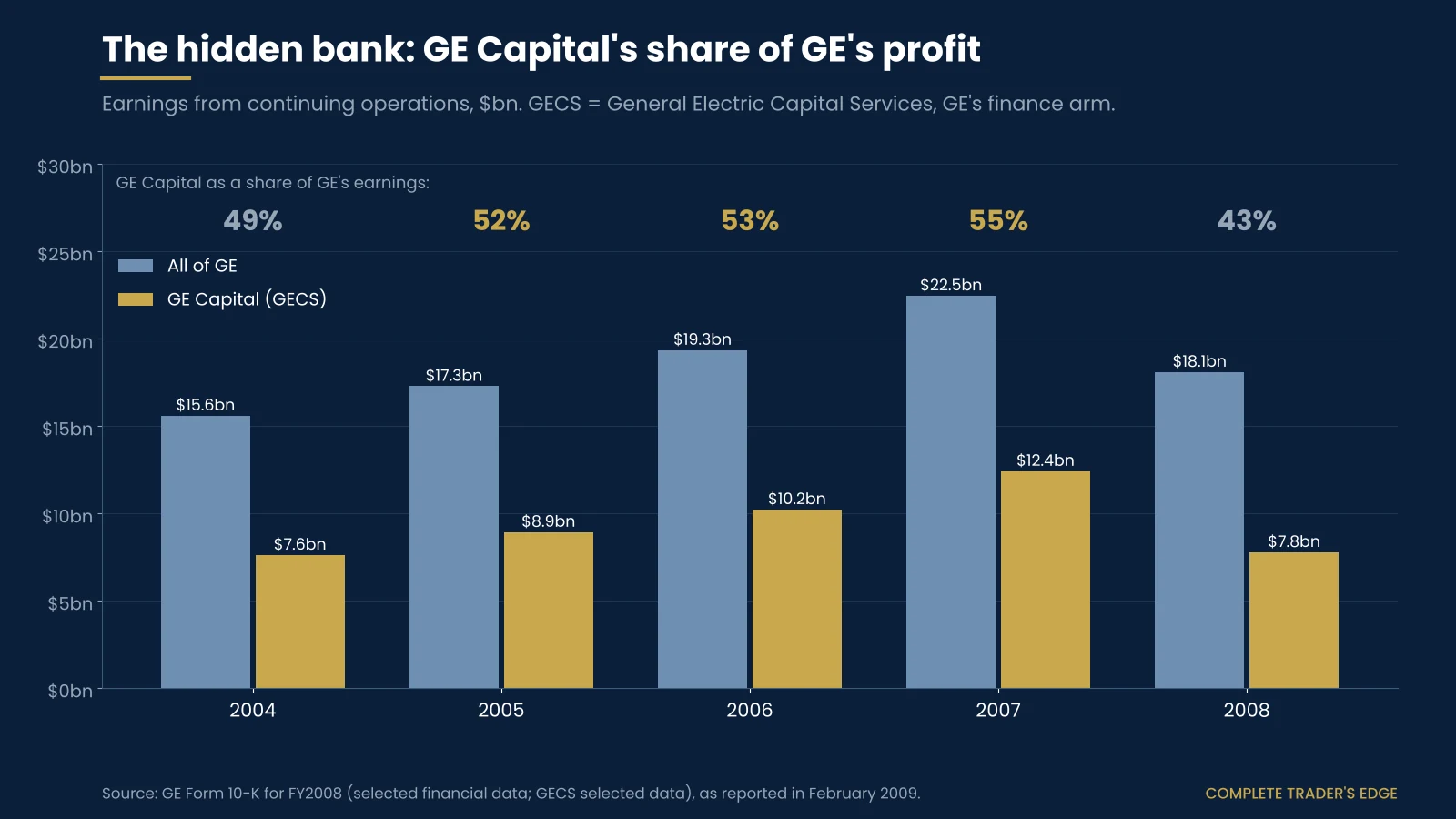
Most rational, ambitious managers in that seat chose B. So did GE. By the 2000s, GE Capital alone produced more than half of the company’s total profits. The few who would have chosen A, who would have refused the easy money because they understood the hidden risk, would have run a less impressive company and looked, for years, like fools. The market does not reward the person who turns down free money before the trap is sprung. It punishes them. This is a thought experiment about incentives, not investment advice.
The genius of the move was real. So was the danger, and the danger was structural. GE was now funding a giant lending operation with short-term commercial paper, borrowing short while lending long. That is precisely the fragility that destroys banks: borrow short, lend long, and pray the short-term market never closes. Banks at least are regulated, watched, and backstopped. GE Capital was a bank wearing an industrial company’s clothes, and almost nobody was watching it as one.
The Near-Death Moment
Jack Welch handed the company to his chosen successor, Jeff Immelt, in 2001, days before the September 11 attacks. Immelt inherited the myth, the prestige, and the machine. He also inherited the trap, fully built and fully loaded. For a few years it held. The commercial paper rolled over every morning as it always had.
Then, in September 2008, Lehman Brothers failed and the short-term credit markets froze. The daily miracle that kept GE Capital funded stopped happening. The stock, which had traded around forty dollars a year earlier, collapsed into the twenties and kept falling. Immelt, who had told investors there was no need to raise new equity, reversed himself within days. On the first of October, GE announced it would sell at least twelve billion dollars of new stock to the public and, in a separate private deal, three billion dollars of preferred stock to Warren Buffett’s Berkshire Hathaway.
The terms told the whole story to anyone willing to read them. The preferred stock paid a punishing ten percent dividend, about the most expensive capital a healthy company could possibly raise. Berkshire also took warrants to buy three billion dollars of GE common stock at a strike of $22.25. Buffett’s public words were warm. GE, he said, was the symbol of American business to the world. But the price he extracted was the price you charge a desperate borrower, and both men knew it.
Even that was not enough. As the crisis deepened, GE Capital needed the kind of help that only governments give to banks. The Federal Deposit Insurance Corporation ran a program to guarantee the debt of financial institutions, and at first GE did not qualify. Behind the scenes, GE lobbied, the Treasury Secretary leaned on the FDIC’s chair, and the rules were changed to let GE in. By the following summer, the federal government was guaranteeing more than seventy billion dollars of GE’s debt, much of it the very commercial paper that had nearly killed it. The symbol of American capitalism had been saved by the safety net stretched under Wall Street.
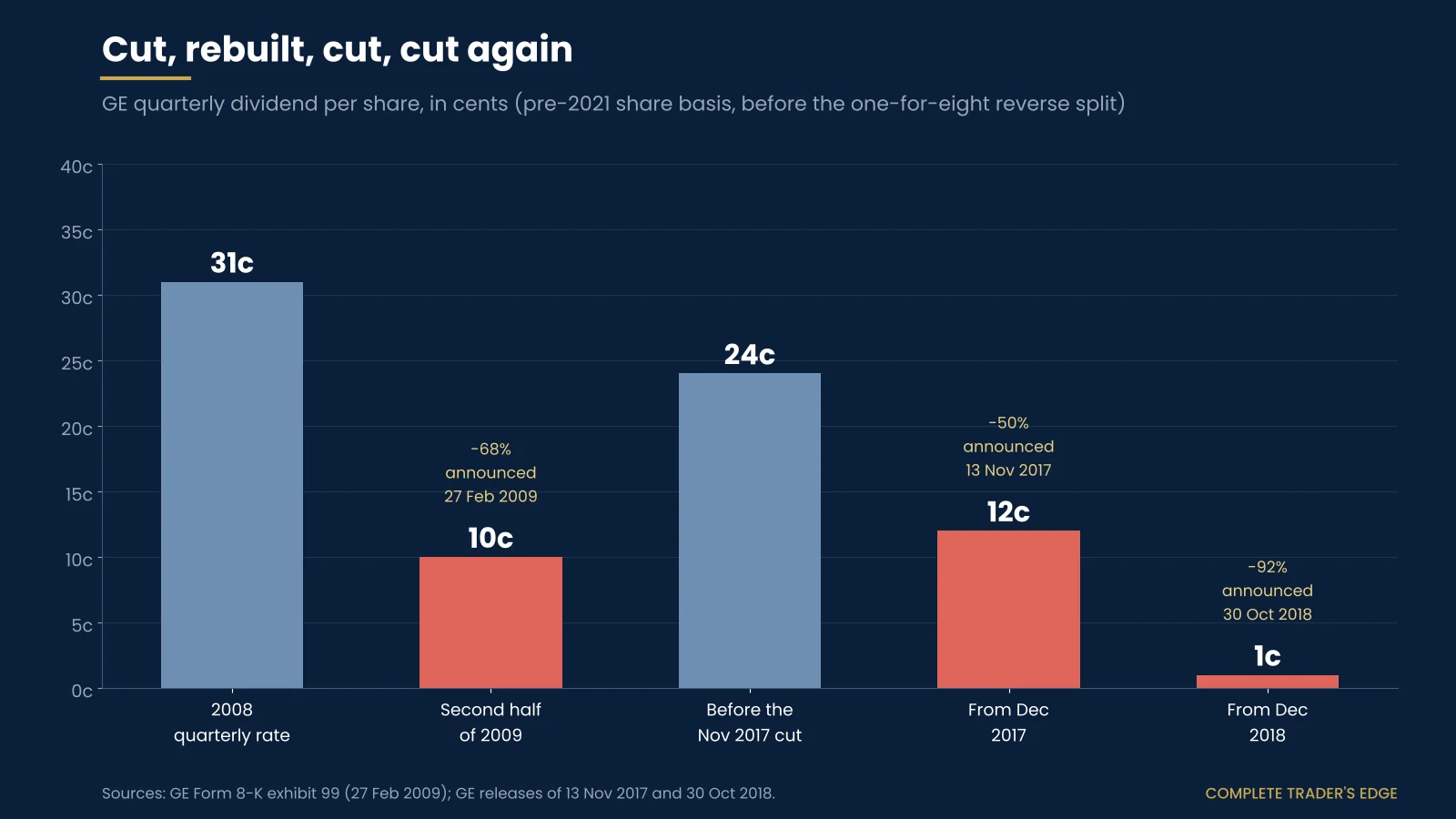
Then came the part that broke faith with a century of shareholders. GE had paid a dividend every quarter since 1899. In February 2009 it cut that dividend for the first time since 1938, from thirty-one cents to ten, a sixty-eight percent reduction, to conserve cash and protect a credit rating it was about to lose anyway. The triple-A that had been the foundation of the entire GE Capital model, the cheap-borrowing magic at the center of the machine, was stripped away. The thing that made the trap profitable was gone. Only the trap remained.
What Everyone Got Wrong
The story of GE is really a story of beliefs that everyone held, that everyone admired, and that everyone got backwards.
Mistake #1: “Diversification makes GE safer.” Reality: The conglomerate structure did not reduce risk; it hid it. Bundling jet engines, turbines, scanners, and a giant bank into one entity meant no investor could see clearly what any single piece was worth, or how fragile the whole had become.
Mistake #2: “The triple-A balance sheet is GE’s fortress.” Reality: The triple-A was the mechanism of the danger. It let GE Capital borrow cheaply and grow into a shadow bank funded by short-term paper. The fortress wall was load-bearing for the trap.
Mistake #3: “Hitting the number every quarter proves GE is the best-run company in the world.” Reality: Earnings that smooth were a warning, not a virtue. Real industrial businesses are lumpy. The supernatural consistency was evidence of the financial engineering that was hollowing the company out.
Mistake #4: “GE is too important and too permanent to fail.” Reality: Permanence was a story, reinforced by prestige and a worshipped CEO, and the strength of the story is exactly why nobody looked underneath until the company was being rescued by Buffett and the government in the same month.
The Moat That Became the Trap
Here is the part that makes General Electric one of the most instructive stories anywhere in markets.
A company can survive a crisis and still be doomed by what the crisis reveals. GE survived 2008. It did not recover. Through the 2010s, as the broader market roared to new highs, GE ground lower. Immelt spent years selling off the dangerous finance arm, but the industrial businesses left behind had been starved during the years when the easy money came from finance. The power division collapsed into losses, driven by a single catastrophic deal: the roughly ten-billion-dollar purchase of the French company Alstom’s power business in 2015, a giant bet on fossil-fuel turbines made just as the world turned toward renewables. In 2018, GE wrote down about twenty-two billion dollars of goodwill, most of it tied to Alstom, more than twice what it had paid, and drew an SEC accounting investigation. Leadership churned: Immelt stepped down in 2017, his successor John Flannery halved the dividend and was ousted within little more than a year. That same year, after more than a hundred years, General Electric was removed from the Dow Jones Industrial Average, the last of the original members to go, dropped because its share price had fallen so far it no longer fit an index of the country’s leading companies.
So GE did something it had never done in its history. It hired a chief executive from outside the company. Larry Culp, who had built his reputation running the industrial group Danaher, took over a firm drowning in debt. He cut the dividend that had survived the Depression down to a single penny. In 2021 the company executed a one-for-eight reverse stock split, the financial equivalent of pulling a sheet over the old numbers. And then Culp did the only thing that could actually free the value trapped inside GE. He took it apart.
The decision was almost heretical to anyone raised on the gospel of the great conglomerate. The whole theory of GE had been that bigness and diversification were strengths. Culp’s conclusion was the reverse: that the conglomerate structure itself was the problem, that it hid weakness, subsidized failure, and stopped investors from ever seeing what each business was truly worth. The cure was separation. In January 2023, GE spun off its healthcare business as GE HealthCare. On the second of April, 2024, it split the rest in two, launching GE Vernova to hold the energy and power businesses and leaving GE Aerospace, the jet-engine business, as the legal successor that still trades under the ticker GE. The conglomerate that Edison started and Welch glorified had ceased to exist.
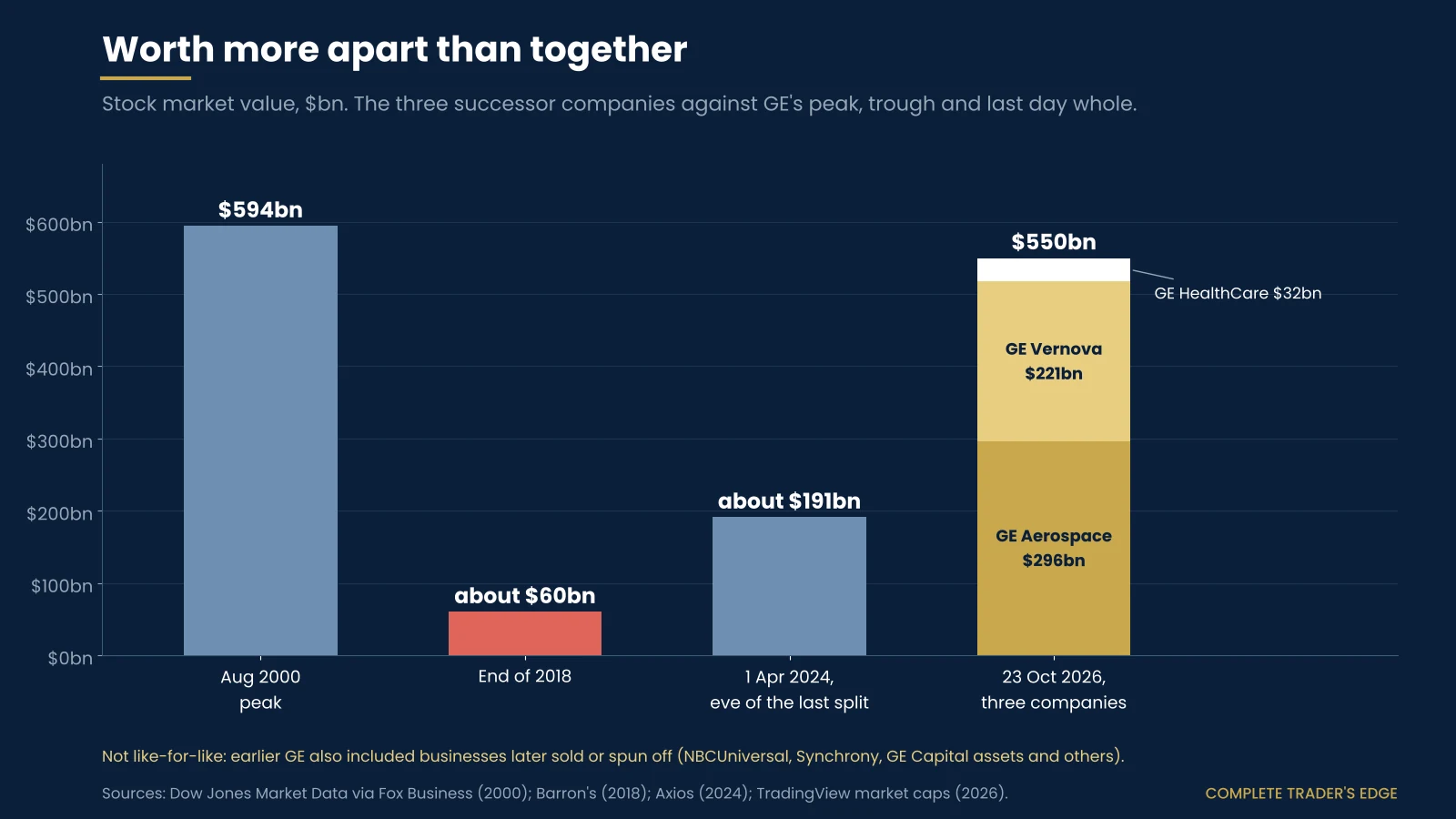
And then the freed pieces did something remarkable. They began, almost immediately, to be worth far more apart than they had ever been worth together. The single act that created the most value for GE’s long-suffering owners in a generation was not a product, a market, or an acquisition. It was demolition. The value had been there all along, locked inside the structure, suppressed by the very conglomerate form that was supposed to be GE’s great advantage. The diversification preached as a moat was, by the end, a discount. The scale that looked like strength was camouflage for rot. Every element the market once celebrated as GE’s competitive advantage was, turned over, the thing that trapped it. That is what we mean by a cautionary moat: a structure that looks like protection and is actually a cage. It keeps competitors out, and it keeps discipline out too.
The Wealth, and the Drawdown Almost Nobody Survived Whole
Consider the investor who did exactly what conventional wisdom said was safe. Near the peak in the summer of 2000, you put your money into General Electric, the most valuable and most admired company on Earth, a stock your parents might have called the closest thing to a sure thing. You were not chasing a fad. You were buying permanence.
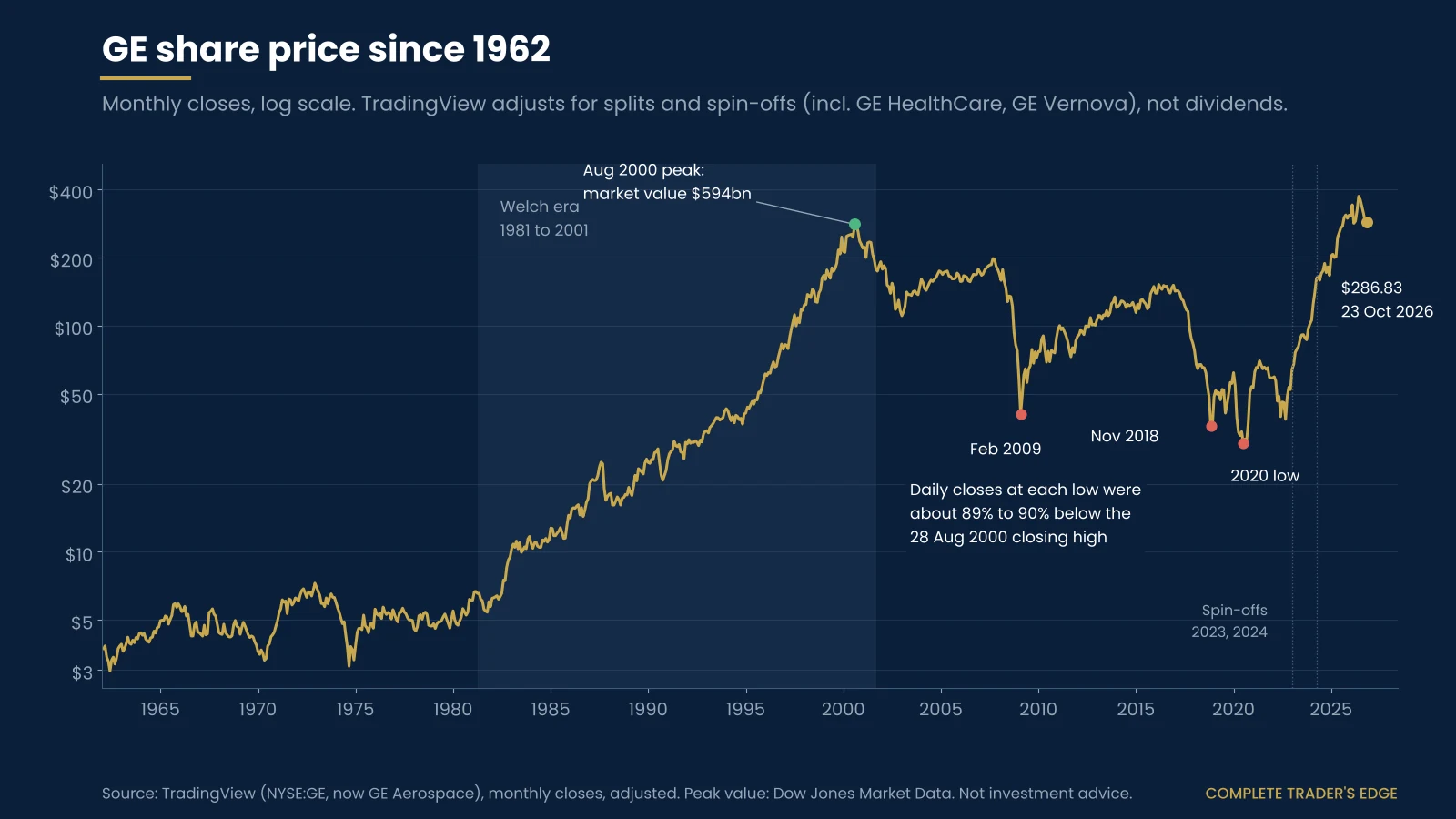
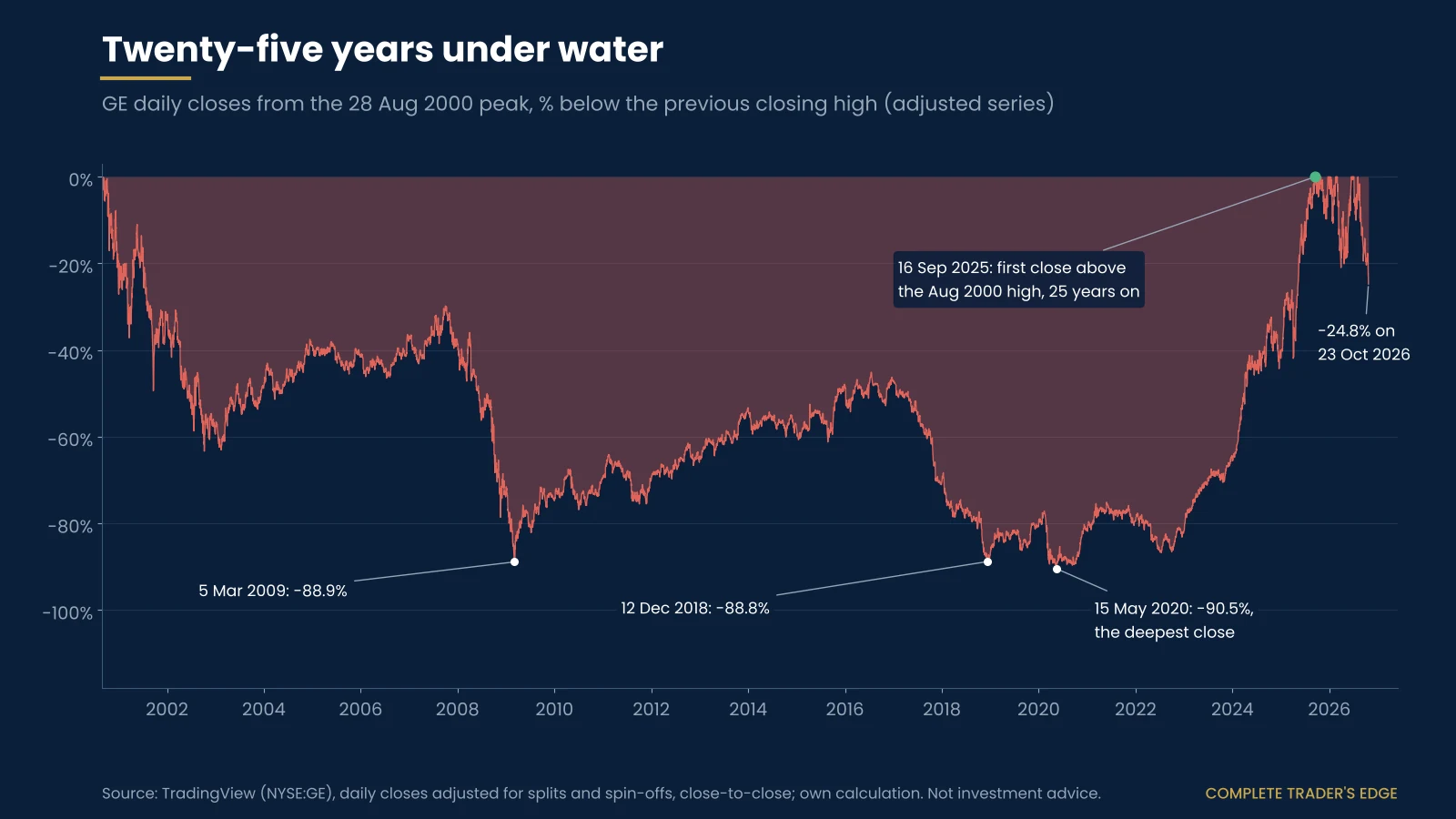
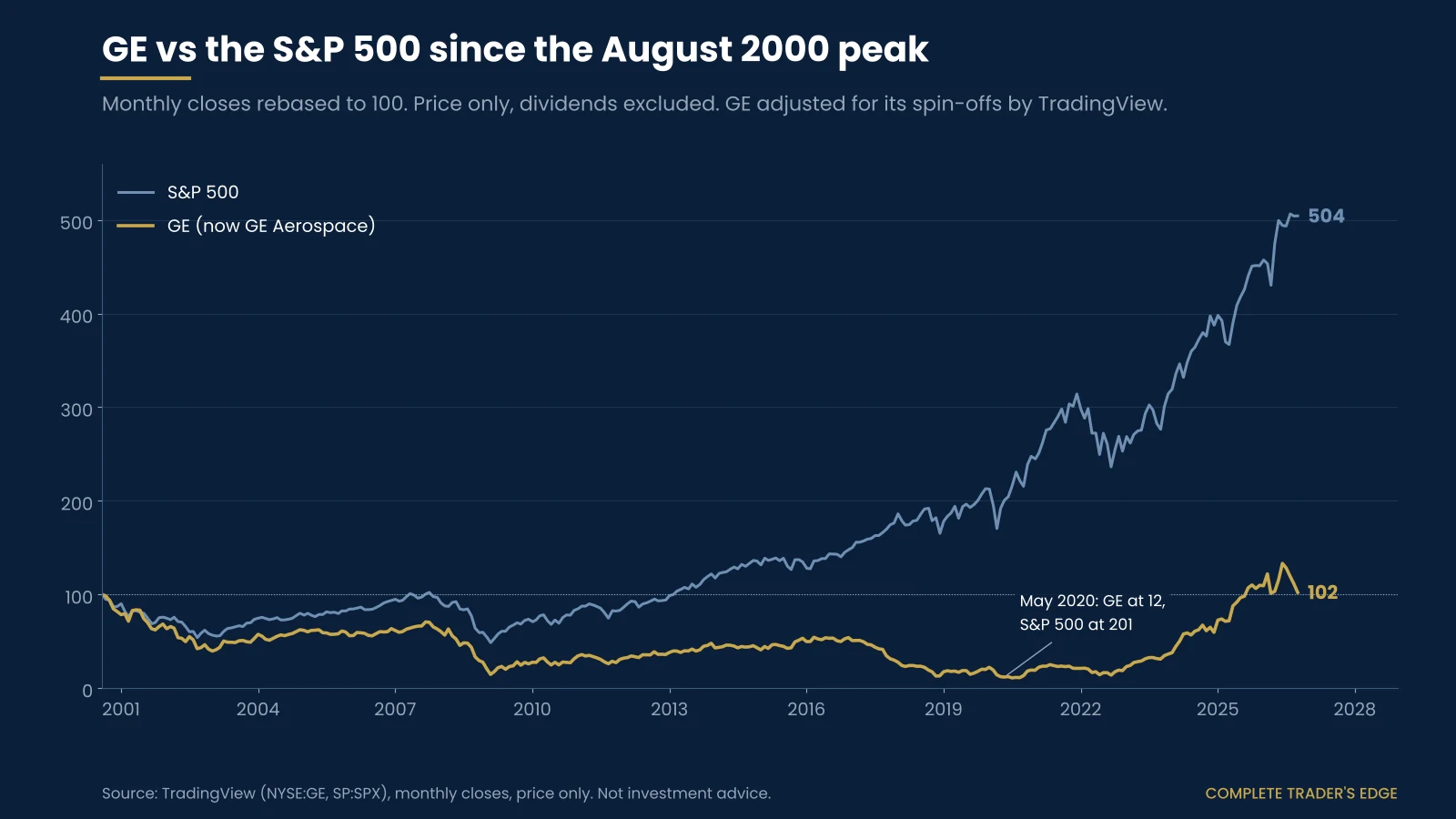
Over the next eighteen years you watched that permanence dissolve. The stock lost the great majority of its value, on the order of ninety percent from peak to trough on a split-adjusted basis, finding its lows in the wreckage of 2009, again at the end of 2018, and lowest of all in May 2020. The dividend you bought it for, the steady quarterly cheque that had arrived without fail since the nineteenth century, was cut, and cut, and finally cut to a penny. The credit rating evaporated. The company was thrown out of the index it had helped to found. And the only thing that eventually made you something close to whole was the company breaking itself into pieces, two decades later, by which time most of the original believers were long gone.
The Alternative Timeline
What if the commercial-paper market had stayed frozen one week longer in October 2008, before the Buffett deal and the federal guarantee landed? GE Capital’s funding model depended on selling fresh short-term debt every single day. A sustained buyers’ strike, with no Berkshire vote of confidence and no FDIC backstop, could have forced the kind of fire-sale of assets that turns a liquidity scare into genuine insolvency. This is a clearly hypothetical thought experiment, and no figures here are claimed as fact, but it underlines the real point: the most admired company in the world was close enough to the edge that a rescue built for banks was what pulled it back.
The Drawdowns You’d Have Survived
The lesson is not in any single crash but in the shape of the decline: slow, grinding, and aimed squarely at the trust that made you buy.
| Episode | What happened | Could you have held? |
|---|---|---|
| 2000 peak to 2009 low | About an 89% decline on daily closes (split- and spin-off-adjusted) as GE Capital nearly failed and the dividend and triple-A were cut | A violent crash inside a financial panic; brutal, but at least obvious |
| 2009 to 2018 | A long structural underperformance while the market soared; power division collapses; removed from the Dow | The hardest kind to hold: a quiet, multi-year erosion of a thing you were told was unbreakable |
| 2018 to 2021 | Dividend cut to a penny; a one-for-eight reverse split; an outsider CEO brought in to save the company | Capitulation; most original believers were already gone |
| 2023 to 2024 | The breakup finally re-rates the parts far above the whole | Redemption arrives only for those who survived all of the above, or who bought near the bottom |
Why This Matters to Investors
The Greatest Companies Thesis
Every legendary company begins with an idea that looks improbable.
Every one survives a stretch where failure looks inevitable.
Every one eventually reaches a point where success looks obvious.
The opportunity exists only in the space between the second and third.
General Electric is the photographic negative of that thesis, and that is exactly why it belongs in this collection. A handful of companies create most of the market’s wealth, and they never look obvious early. But the mirror image is also true and far less discussed: a handful of companies destroy enormous wealth precisely when they look safest, and they never look dangerous early either. The asymmetry that makes legendary companies legendary, a small chance of an enormous payoff available only to those who can survive the stretch where it looks like certain death, has a dark twin. The “safe” blue chip can deliver a long, slow, certain death dressed up as permanence. Studying GE is pattern recognition, not history. It trains you to find the trap inside the fortress before the market freezes.
Lessons in Order of Depth
On the surface: the Method
Beware earnings that are too smooth. A business that delivers Wall Street’s exact number every quarter for years is not necessarily a better business; it may simply have found a way to manufacture the appearance of one. GE’s flawless consistency was admired for decades and was, in the end, evidence of the financial engineering that hollowed it out. A real industrial business is lumpy, and a suspiciously smooth one deserves more scrutiny, not less.
Below the surface: the Money
The funding structure is the company. GE looked like an industrial giant and was, in the part that nearly killed it, a bank that borrowed short and lent long while funding itself on the kindness of the overnight market. Cheap leverage borrowed against a great reputation is the most seductive and most dangerous money there is, because it works beautifully right until the market closes, and then it works not at all. Look past the brand and the income statement to how the thing is actually financed, because that is where the fragility lives.
Below that: the Mind
Be most suspicious of the company nobody questions and the leader everyone worships. GE’s invulnerability was a story so strong, so reinforced by prestige and by a celebrated CEO, that for years almost no one looked hard at what was underneath. The consensus “safe” holding, the one held precisely because no one feels any need to examine it, is often where the largest hidden risks quietly accumulate.
At the deepest level: the question it leaves us
Every advantage eventually has the chance to become a trap, because the very thing that protects you also insulates you from the discipline that kept you sharp. GE’s scale kept rivals out and kept reality out at the same time. So the deepest question General Electric poses is one every successful enterprise, and every successful person, must eventually face: how do you tell the difference between a moat that is protecting you and a cage that is slowly killing you? The hard answer GE’s history suggests is that you often cannot tell from the inside, that the cage feels exactly like a fortress right until the day the market freezes or the index drops you, and that sometimes the only way to free the value is to have the courage to tear down the very structure you spent a century building.
The Legendary Scorecard
Eight fixed categories, each scored out of ten. The overall is an editorial verdict, a judgment, and explicitly not a weighted average.
| Category | Score | Note |
|---|---|---|
| Founder Vision | 9 | Edison’s origins and Welch’s reinvention were genuinely visionary |
| Innovation | 9 | A century of real engineering, from light bulbs to jet engines |
| Execution | 6 | Brilliant operationally, then undone by financial engineering |
| Moat | 5 | Looked impregnable; was a cage that hid decay |
| Capital Allocation | 3 | The defining failure: a finance arm funded short, plus value-destroying deals |
| Wealth Creation | 6 | Enormous for early holders; a generation-long loss for those who bought the peak |
| Durability | 3 | The conglomerate did not survive; only the broken-up pieces did |
| Historical Importance | 10 | The defining American corporation, and the defining cautionary tale |
| Overall Legendary | 6.0 | Editorial verdict: indispensable to study, precisely as a warning |
At a Glance
| Origin | Formed in 1892 from Edison General Electric and Thomson-Houston, financed by J. P. Morgan |
| The status | One of the original Dow components; for over a century the bluest of blue chips |
| The myth-maker | Jack Welch (CEO 1981 to 2001); grew GE from about $14B to over $400B |
| The hidden engine | GE Capital, more than half of profits by the 2000s, borrowing cheap on GE’s triple-A |
| The near-death | Oct 2008: commercial paper froze; ~$12B equity raise, $3B Buffett preferred at 10%, FDIC debt guarantee |
| The break | First dividend cut since 1938 (down 68%) and loss of the triple-A, both in 2009 |
| The fall | Removed from the Dow in 2018; dividend cut to a penny; outsider Larry Culp brought in |
| The cure | Three-way breakup: GE HealthCare (2023), then GE Vernova and GE Aerospace (April 2, 2024) |
| Status | Conglomerate dissolved; GE Aerospace (NYSE: GE) is the legal successor |
The General Electric Timeline
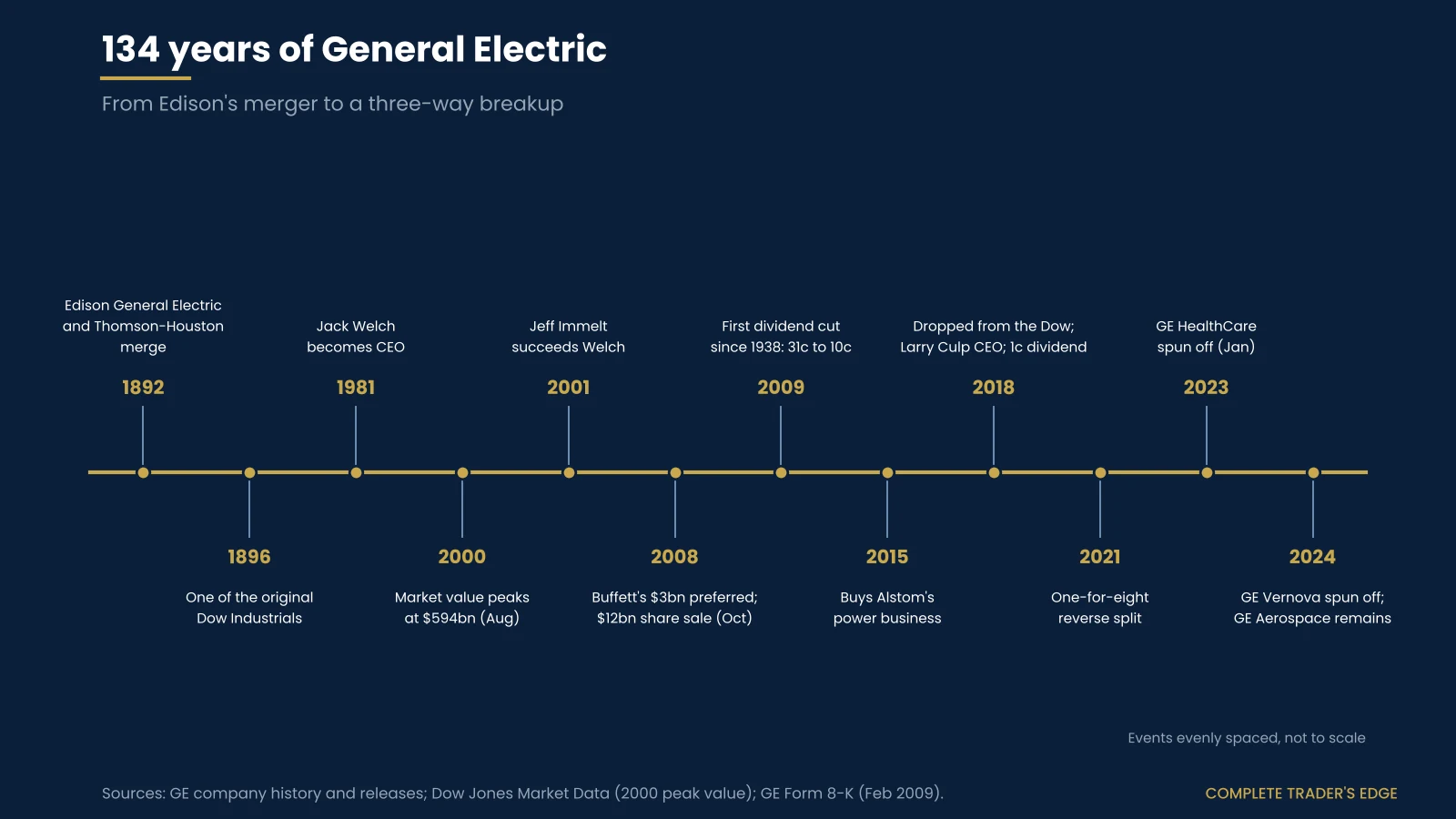
- 1892: Edison General Electric and Thomson-Houston merge to form GE, backed by J. P. Morgan.
- 1896: GE is one of the original components of the Dow Jones Industrial Average.
- 1981: Jack Welch becomes CEO; GE is worth about $14 billion.
- 1980s to 1990s: Welch builds GE Capital into the company’s profit engine and grows GE into the world’s most valuable company.
- 2000: GE peaks near $600 billion in market value.
- 2001: Welch retires; Jeff Immelt takes over.
- September 2008: Lehman fails; the commercial-paper market freezes.
- October 1, 2008: GE raises about $12 billion in equity and sells $3 billion of preferred stock to Warren Buffett at a 10% dividend.
- 2009: The FDIC guarantees tens of billions of GE debt; GE cuts its dividend for the first time since 1938 and loses its triple-A rating.
- 2018: GE is removed from the Dow; Larry Culp becomes the first outsider CEO; the dividend is cut to a penny.
- 2021: GE executes a one-for-eight reverse split.
- January 2023: GE HealthCare is spun off.
- April 2, 2024: GE Vernova and GE Aerospace launch as separate companies, completing the breakup.
- 2026: The three pieces together are worth far more than the conglomerate’s final value.
Key Numbers
Founded: 1892 | Peak value: ~$600B (2000), then the world’s most valuable company | Value at breakup: ~$191B | Max drawdown: ~90% peak-to-trough (daily closes, Aug 2000 to May 2020, split- and spin-off-adjusted) | Dividend: uninterrupted from 1899, first cut since 1938 came in 2009, down to one penny by 2018 | The rescue: $3B Buffett preferred at 10% plus a ~$12B equity raise and an FDIC backstop, October 2008 | The breakup: three companies by April 2, 2024. Current valuations are fast-moving and should be checked against live data.
Related Reading
If General Electric is the company that nearly drowned in 2008, the next two stories show the other faces of that same crisis and that same lesson. Read how Berkshire Hathaway turned the panic into one of the great opportunistic deals in history, lending GE the three billion dollars that helped save it. Compare GE’s reinvention by demolition with Microsoft, which reinvented itself from the inside without breaking apart. And for the wider mechanics of the meltdown that exposed GE Capital, see our Market Mayhem account of the 2008 global financial crisis. For the underlying principle, visit our hub on competitive moats and how to tell a fortress from a cage.
Go Deeper
The Complete Trader’s Edge book builds the full Mind, Method, and Money framework that turns stories like this into a repeatable way of reading any company. If GE taught you to look for the trap inside the fortress, the book teaches you the discipline to act on what you find.
★ Now in Kindle, Paperback & Hardcover
Greatest Companies
This story is one of fifty-one. The full book reads every legendary company through a single lens — Moat, Meltdown, Machine — from Standard Oil to SpaceX. Fifty-one companies, eight kinds of moat, one framework.
Kindle · $9.99 →
Paperback · $24.99 →
Hardcover · $34.99 →
Explore the Book →
This article is part of the Greatest Companies series, adapted from the book Greatest Companies, now available on Kindle.
Frequently Asked Questions
Why did General Electric almost collapse in 2008?
GE’s finance arm, GE Capital, funded itself by selling tens of billions of dollars of short-term debt called commercial paper, rolling it over daily. When the credit markets froze after Lehman Brothers failed, GE could no longer reliably refinance that debt. It survived only after raising about $12 billion in equity, selling $3 billion of preferred stock to Warren Buffett, and receiving a federal guarantee on tens of billions of its debt.
What was GE Capital and why was it so dangerous?
GE Capital was General Electric’s financial-services arm. Because it sat inside a triple-A rated industrial company, it could borrow extremely cheaply and lend at a profit, eventually generating more than half of GE’s total earnings. The danger was structural: it borrowed short and lent long, the same fragility that destroys banks, but without a bank’s regulation or backstop.
Did GE ever recover its old value?
Not as a conglomerate. The stock lost roughly 90% of its peak value, the dividend was cut to a penny, and GE was removed from the Dow in 2018. Value was only unlocked when the company broke itself into three separate businesses. The freed pieces, taken together, are now worth far more than the conglomerate was on the eve of the split.
What companies did General Electric split into?
GE separated into three independent public companies. GE HealthCare was spun off in January 2023. GE Vernova, holding the energy and power businesses, and GE Aerospace, the jet-engine business, launched on April 2, 2024. GE Aerospace is the legal successor and still trades under the ticker GE.
What is the main investing lesson from General Electric?
That the “safe” blue chip everyone trusts can be the most dangerous holding of all. GE’s scale, diversification, and triple-A balance sheet looked like a moat but functioned like a cage, hiding fragility behind prestige. The lesson is to examine how a company is actually financed and to be most skeptical of the business nobody questions.
 The Complete Trader's Edge
The full Mind · Method · Money framework. 70 chapters.
View on Amazon →
 Market Mayhem
400 years of bubbles, crashes, and the pattern that keeps repeating.
Buy on Amazon →
 Greatest Companies
How the world's greatest companies were built — and what traders learn from them.
View on Amazon →
 Greatest Traders
Eighty-six lives that explain the markets — Livermore to Madoff, told with the losses left in.
View on Amazon →