

Greatest Companies · Episode 17 · Tesla
▶ Watch on YouTube🎵 Listen on Spotify
Also available on Apple Podcasts · Amazon Music · iHeart Radio
It is the last week of December 2008, and Tesla is hours from death.
The financial world is in freefall. Lehman Brothers has collapsed, credit has frozen everywhere, and the appetite for funding a money-losing startup that builds expensive electric sports cars is, reasonably, close to zero. Tesla has burned through its cash. A planned hundred-million-dollar funding round has fallen apart. The company has already laid off a quarter of its staff. Its chief executive, a software entrepreneur named Elon Musk who made his fortune at PayPal, has poured essentially his entire personal wealth into two companies at once, this one and a rocket company called SpaceX, and both are running out of money at the same time, in the worst financial crisis since the Great Depression. He faces a brutal choice about which of his two ventures to let die, and he refuses to choose. He puts the last of everything into both.
The Tesla round closes, by most tellings, in the final hours it possibly could, right around Christmas. The company lives to see January. A few years later it will be worth more than Ford and General Motors combined, more than a trillion dollars, the most valuable car company that has ever existed. That a company can travel from that December to this is the entire lesson of Tesla, and it is worth holding both pictures in your mind at once, because Tesla is never just one of them. It is always, at the same time, the miracle and the near-corpse.
To understand how improbable the whole thing was, you have to go back to a moment when almost everyone who knew anything about cars agreed that what Tesla set out to do was impossible.
📄 Free Download · Company Research Sheet
Tesla Research Sheet (PDF)
The moat, the meltdown, the Legendary Scorecard, the timeline, and the Move, Money and Mind lessons from this story. Free, no email required.
The Bet Nobody Sane Would Make
Tesla Motors was founded in 2003, and not by Elon Musk. It was founded by two engineers, Martin Eberhard and Marc Tarpenning, who named it after the inventor Nikola Tesla and who shared a single heretical conviction: that an electric car did not have to be a slow, ugly, guilt-driven appliance, the golf-cart-with-a-conscience the industry assumed was the ceiling of the category. It could instead be fast, beautiful, and desirable, a car people wanted rather than tolerated. In 2004 a wealthy young entrepreneur fresh from the sale of PayPal led their first serious round of funding, became the company’s largest investor and chairman, and over the following years its driving force and, from 2008, its chief executive. His name was Elon Musk.
The strategy was deliberately, almost arrogantly counterintuitive. The conventional wisdom said you reach the mass market by building a cheap small car first. Tesla did the opposite. It would build an extremely expensive, low-volume sports car for rich early adopters, the Roadster, use the revenue and credibility to build a less expensive luxury sedan, and use that in turn to fund a genuinely affordable mass-market car. Start at the top, climb down. The Roadster arrived in 2008, built on the bones of a Lotus chassis, priced around a hundred and nine thousand dollars, capable of roughly two hundred and forty-five miles on a charge and acceleration that embarrassed petrol sports cars. It proved the heresy: electric could be thrilling. The first one off the line went to Musk himself.
What it did not do was make money. Building cars is one of the most capital-hungry, unforgiving businesses on Earth, a graveyard of ambitious startups, and Tesla was a tiny company trying to do it from scratch while inventing much of the technology as it went. Which is how it arrived at that near-death December of 2008, and how it would arrive at a second one a decade later. Both times, the thing that kills lesser companies, the sheer brutal cost of the bet, nearly killed Tesla. Both times, it didn’t.
Surviving the First Death
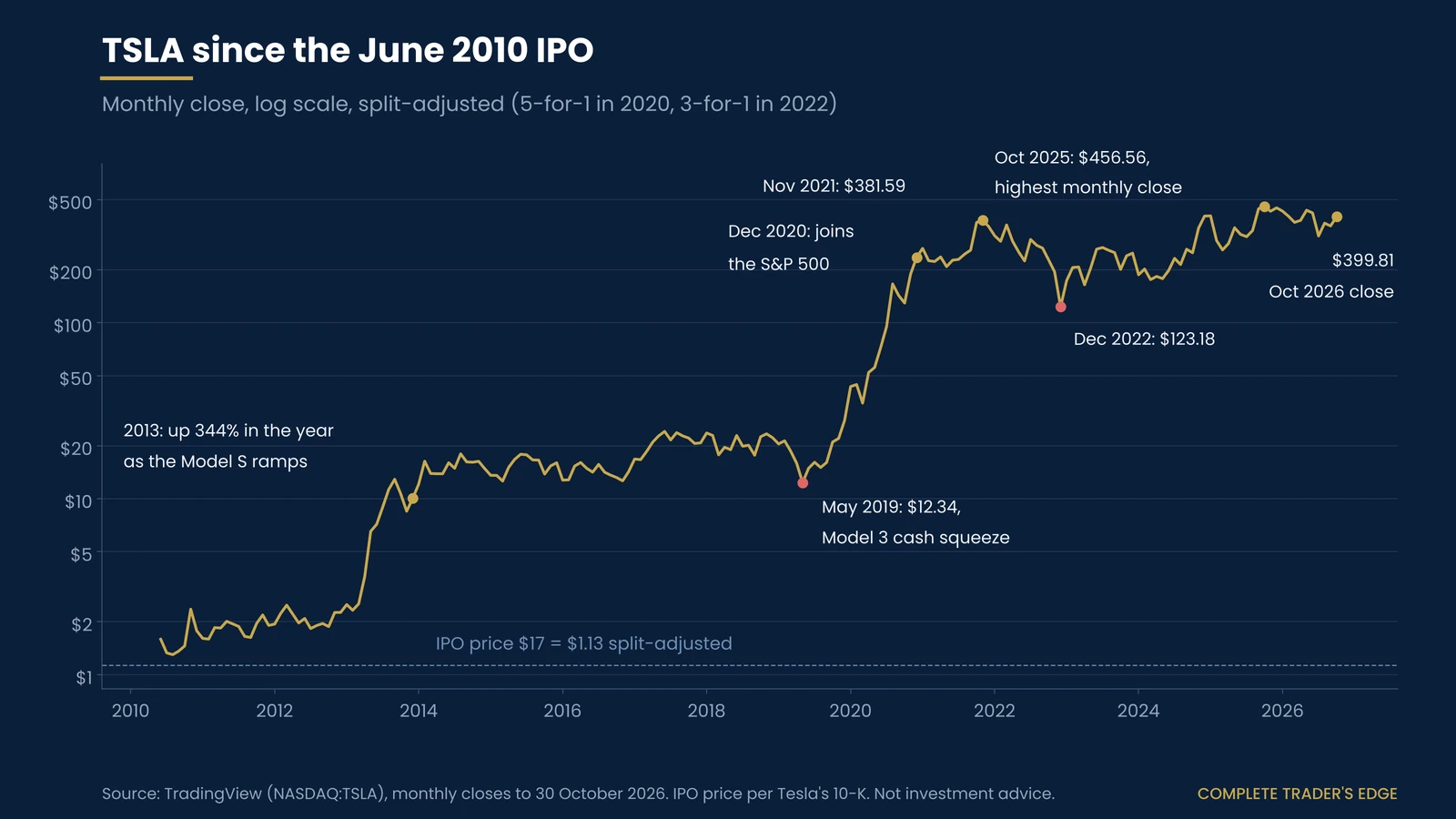
The 2008 escape was not the end of the danger, only the beginning of a long climb. In 2009, Daimler took a roughly ten percent stake for fifty million dollars, a vote of confidence from an incumbent that mattered enormously, and the US Department of Energy extended a loan of around four hundred and sixty-five million dollars that gave Tesla the working capital to build its next car. In June 2010 Tesla went public on the Nasdaq at seventeen dollars a share, raising about two hundred and twenty-six million dollars and becoming the first American carmaker to hold an IPO since Ford in 1956. The market valued the whole company at a little over two billion dollars. Hold that number; it matters later.
It is worth pausing on how close the 2008 collapse came, and on the parallel drama beside it. In the same stretch of months, Musk’s other company, the rocket venture SpaceX, had failed three times to reach orbit and was down to the money for a single final attempt. That fourth launch succeeded, and a lifeline contract from NASA followed at the end of the year, rescuing SpaceX in almost the same hours Tesla’s funding closed. One man had bet two fortunes on two industries everyone considered sealed shut to newcomers, cars and rockets, and very nearly lost both inside a single quarter. That he saved both looks, in hindsight, like destiny and felt, at the time, like a coin landing on its edge. The lesson is not that audacity is rewarded, because far more often it is punished. It is that survival, scraped out by whatever means, is the precondition for everything that follows.
Then came the products that turned a curiosity into a force. The Model S, launched in 2012, was not a compromise that happened to be electric; it was, by wide agreement, simply one of the best cars in the world that also happened to be electric. It won awards, rewired expectations, and made Tesla aspirational. The company layered on the things the incumbents could not easily copy: a national network of fast Superchargers that solved range anxiety, over-the-air software updates that made the car improve after you bought it, and a direct-sales model that bypassed the dealers entirely. Tesla was not selling a car. It was selling membership in the future, and the brand it built on that promise became its deepest and most durable moat.
From that beachhead, Tesla did the genuinely hard thing: it scaled. It built enormous factories it called Gigafactories, first in Nevada for batteries, then a remarkably fast-built plant in Shanghai that cracked open the vast Chinese market, then Berlin and Texas. It pushed relentlessly on manufacturing cost and on making the battery, the single most expensive part of an electric car, cheaper and better. The Model 3 and the Model Y that followed were not luxury statements but volume cars, and the Model Y in particular went on to become, for a time, the best-selling car of any kind in the world. Tesla had completed the journey its original plan had sketched: from a six-figure toy for enthusiasts to a genuinely mass-market product, manufactured at a scale that would have been fantasy for the company that nearly died in 2008. The incumbents who had spent years insisting electric cars were a niche were now scrambling to electrify their entire lineups, chasing a company a fraction of their age.
The Moat, and the Man Who Is Both Its Engine and Its Risk
Tesla’s moat is unusual and genuinely contested. Part of it is brand, an aspirational pull as strong as any in the world, the rare car badge that signals values and identity rather than just status. Part of it is scale and cost, the hard-won ability to manufacture electric cars and batteries at a price and volume no pure rival could match for years, reinforced by a Supercharger network so dominant it was effectively adopted as the American industry standard. And part of it is a data flywheel, millions of cars on the road feeding the software that Tesla hopes will one day deliver full autonomy.
But the single most important fact about Tesla’s moat is also its single greatest risk, and they are the same fact: Elon Musk. The vision, the relentlessness, the willingness to bet everything twice, the genius for narrative that lets Tesla raise capital and command a valuation no normal carmaker could dream of, all of it flows from one extraordinary and volatile individual. A moat built on a founder’s brilliance is a moat with a single point of failure, and as Tesla’s own later story would show, the same man who built the brand could damage it, and the market that priced in his vision could be whipsawed by his behavior. No company illustrates more sharply that a founder can be simultaneously the greatest asset and the gravest risk on the balance sheet.
Decision Point: it is 2018, and you own Tesla.
The company has bet everything on the Model 3, the affordable car its entire fifteen-year strategy was building toward. The factory is a nightmare. The CEO is sleeping on the floor, the company is burning cash trying to ramp production, and it is, by his own later account, within single-digit weeks of running out of money. Short-sellers are circling. Then the founder tweets that he has “funding secured” to take the company private, draws a securities-fraud charge, and loses the chairmanship. You face a choice:
A. Sell. It has never made an annual profit, it is in “production hell,” and its founder just got sanctioned for a tweet. Every sensible signal says get out.
B. Hold a money-losing carmaker on the bet that if it survives the ramp, it changes the world.
C. Wait for proof of profitability before committing, and accept you will buy much higher if it works.
This is a thought experiment about conviction under uncertainty, not investment advice. The investors who held through 2018 were rewarded on a scale almost nothing else in the era could match. But that was knowable only in hindsight, and the case to sell was intelligent and loud. Distinguishing the visionary who is early from the fool who is wrong is the hardest problem there is.
The Vindication, and the Trillion-Dollar Peak
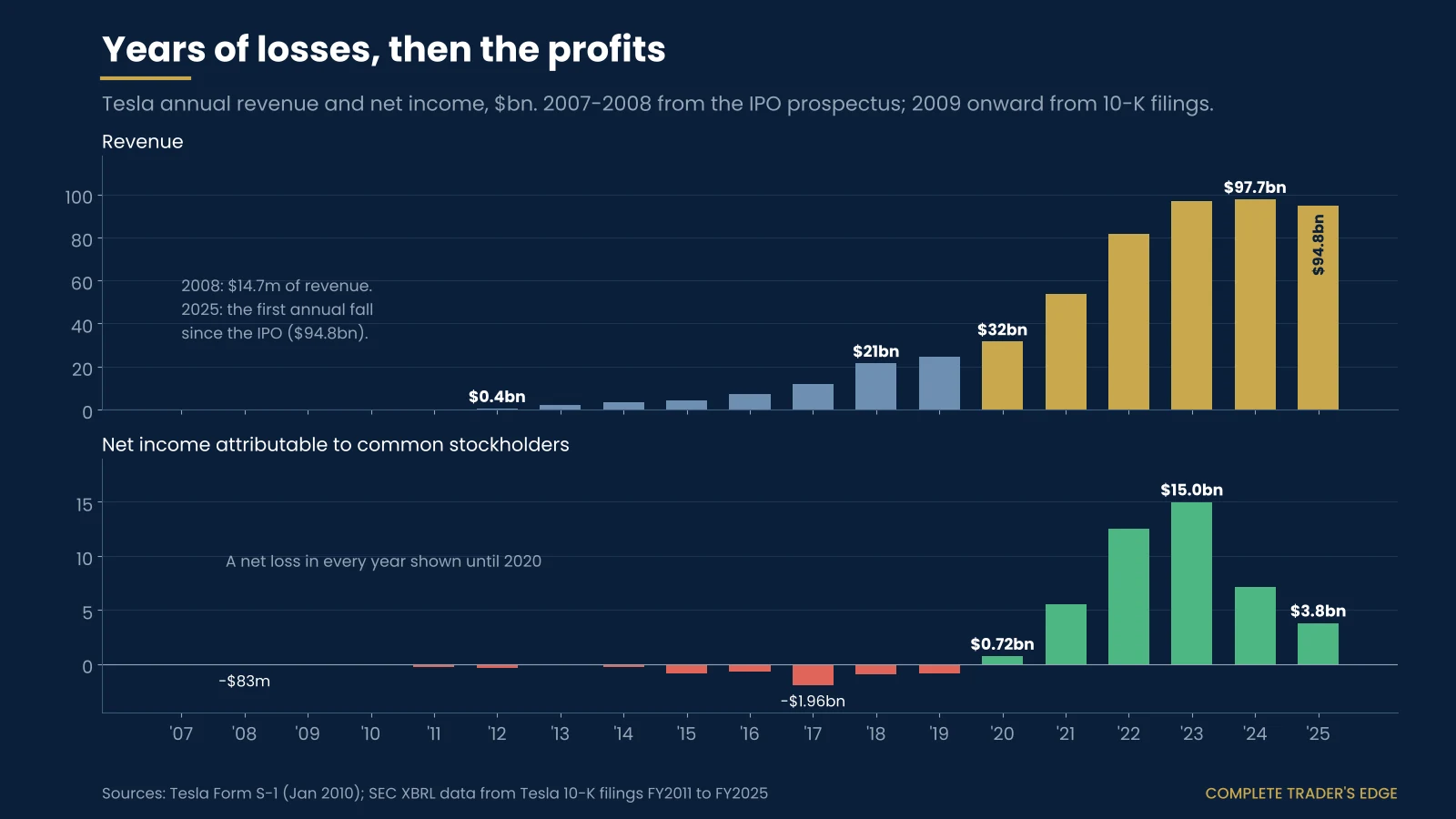
Tesla survived the ramp. The Model 3 became one of the best-selling cars on the planet. And then the numbers turned. In 2020, after seventeen years of losses, Tesla posted its first full year of profit. The same year it was added to the S&P 500, the largest company ever admitted to the index, a formal acknowledgment that the upstart had arrived. And then the stock did something that still beggars belief. Fed by the profits, by a global rush into electric vehicles, by Musk’s gravitational pull on retail investors, and by the low-rate exuberance of the moment, Tesla’s value went vertical. In October 2021 it crossed a trillion dollars, becoming the most valuable automaker in history by a margin so wide it was almost comic, worth more than the next dozen carmakers combined despite making a small fraction of their cars. The man who had been borrowing rent money in 2008 was, for a time, the richest person alive.
This is the moment to be most careful. A thing that has gone up that far, that fast, on that much narrative, is carrying expectations that no company, however brilliant, can always meet. The peak was real. It was also a setup.
The Drawdowns You’d Have Survived
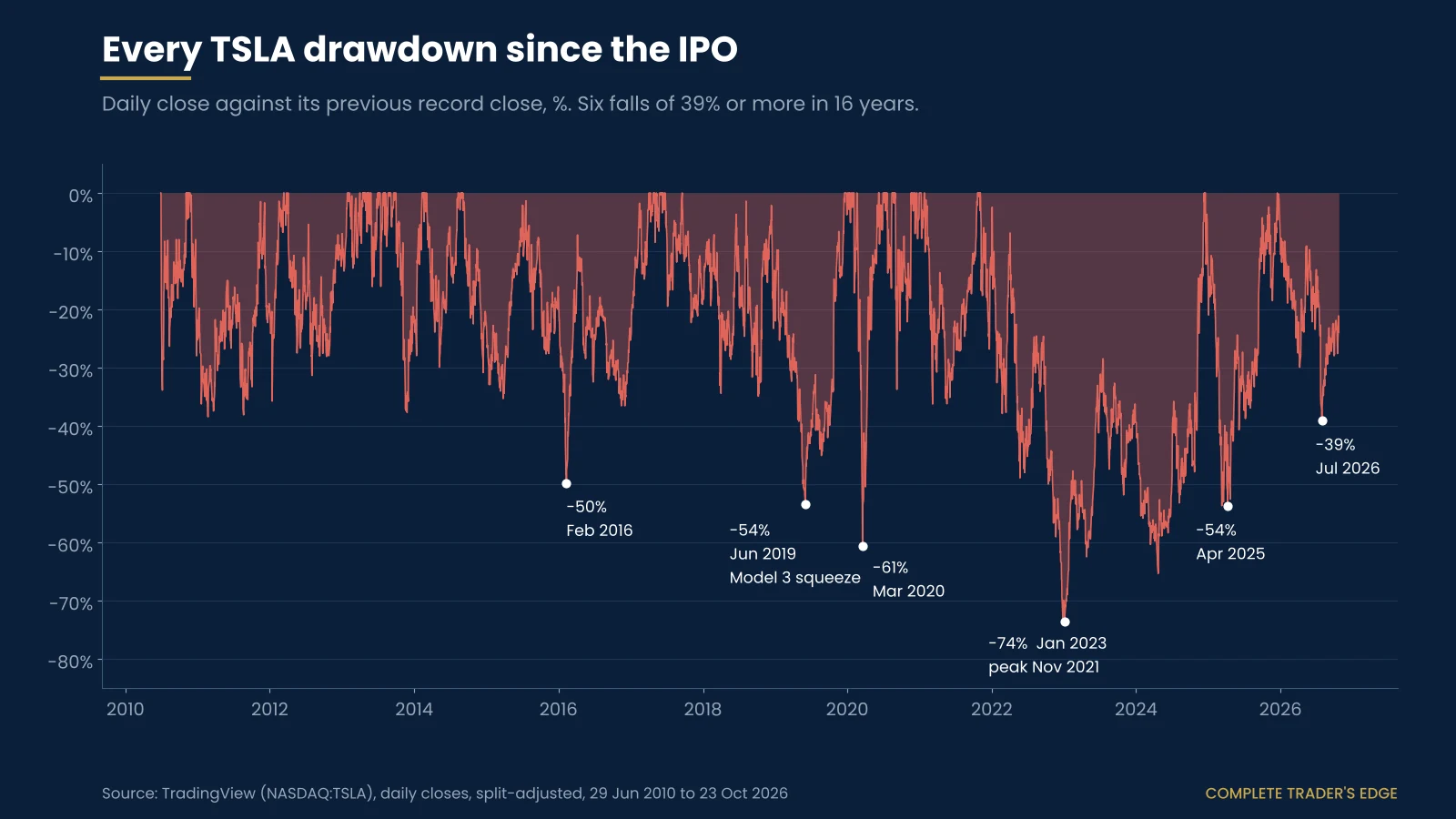
Owning Tesla has never been a smooth ride. It has been one of the most violently volatile great stocks of the age, and the wealth it created was available only to those who could withstand the testing.
| Episode | What happened | Could you have held? |
|---|---|---|
| Dec 2008 | Days from bankruptcy in the financial crisis; saved by a last-minute round | Pre-IPO, but the company itself nearly ceased to exist |
| 2017-2018 | Model 3 “production hell,” within weeks of running out of cash; the “funding secured” affair | The case to sell was loud and intelligent; holders were vindicated |
| 2022 | The stock fell ~65% (over $700B lost) amid rate hikes, EV competition, and the Twitter takeover | A drawdown severe enough to break most conviction |
| Early 2025 | Fell ~50% as Musk’s politics triggered a brand backlash and a sales slide, especially in Europe | The brand’s greatest asset, damaged by the man who built it |
| Late 2025 | Surged to fresh highs on robotaxi and AI optimism | Recovery, on a new and unproven thesis |
The pattern is the point. To capture Tesla’s extraordinary returns, you had to hold through a sixty-five percent collapse, and then a fifty percent collapse, and resist the overwhelming, intelligent-sounding case to sell at each bottom. It is the same lesson the Amazon and Nvidia stories teach, written in even larger letters: the market does not hand out generational returns for free. It charges for them in volatility.
What Everyone Got Wrong
Tesla is a museum of confident beliefs that turned out to be exactly backwards.
Mistake #1: “A Silicon Valley startup can never master car manufacturing.” Reality: It was brutally hard and nearly fatal, but Tesla learned to build cars at scale and forced the entire industry to follow it into electric.
Mistake #2: “Electric cars are slow, ugly compromises.” Reality: The Roadster and Model S made electric the desirable, high-performance choice, inverting two decades of assumptions.
Mistake #3: “Tesla will go bankrupt.” (2008, and again in 2018) Reality: It came within days, then weeks, of exactly that, and survived both times. Short-sellers betting on collapse were, collectively, incinerated.
Mistake #4: “The founder’s brilliance is pure upside.” Reality: The same singular founder who saved the company twice also, in 2025, damaged its brand and its sales through his own conduct. The key man is both the engine and the risk.
The Honest Present
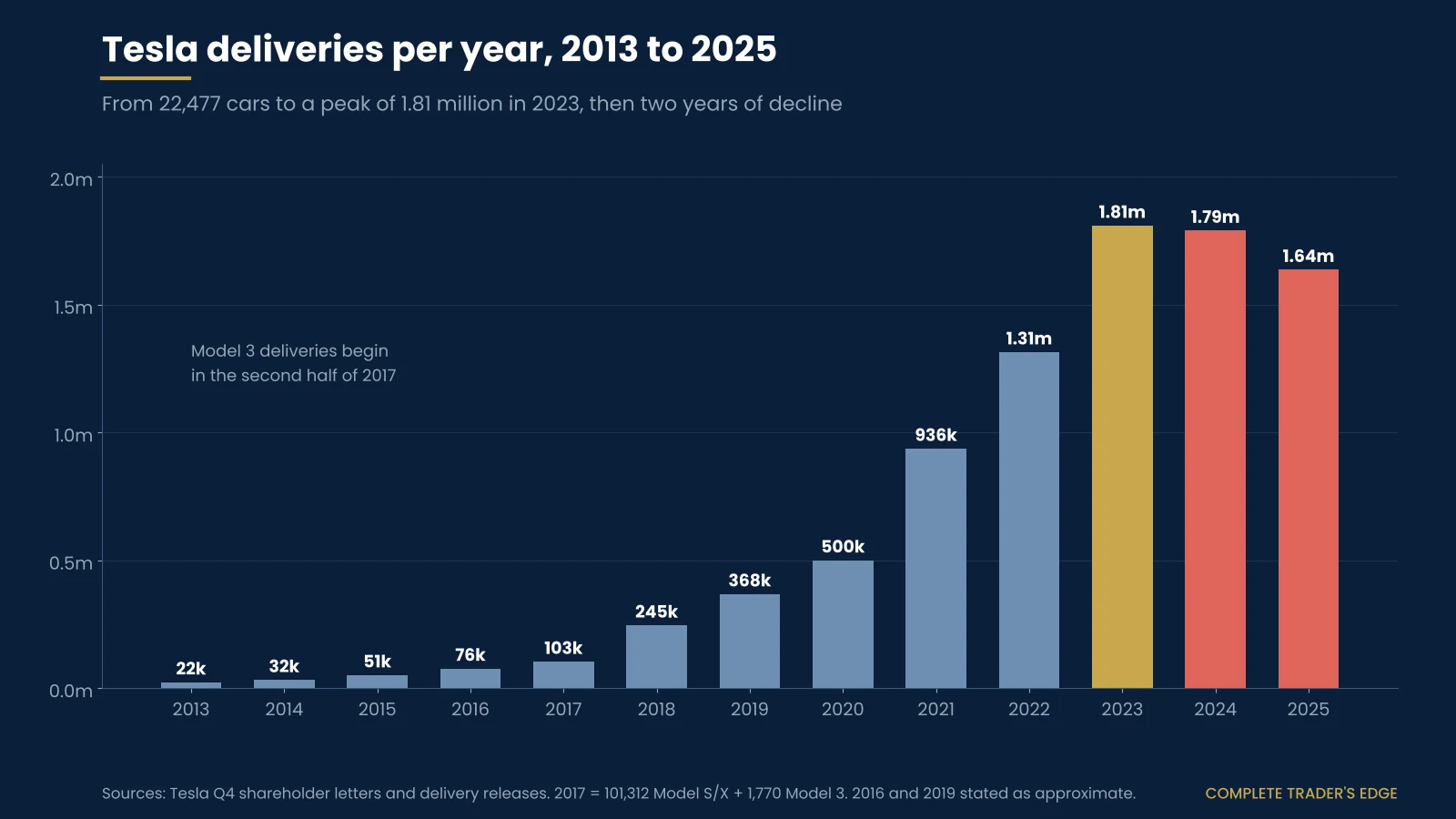
The framework demands honesty about the present, and the present is genuinely uncertain, which is exactly why Tesla cannot be told as a simple triumph. In 2025, for the first time as a public company, Tesla’s annual revenue actually fell. Its vehicle deliveries dropped, and the Chinese champion BYD overtook it to become the world’s largest maker of electric vehicles. The brand damage from Musk’s politics was real and measurable. In response, Tesla made its boldest and riskiest pivot yet: it began winding down older models, redirected itself toward autonomy and humanoid robots, launched a small robotaxi pilot, and effectively told the market that its future is no longer about selling more cars than anyone else but about cracking self-driving and robotics.
What makes the present so hard to judge is that Tesla’s enormous valuation no longer rests on the cars at all. It rests on a promise: that Tesla will solve full self-driving and deploy a fleet of autonomous robotaxis, and that its humanoid robot, Optimus, will open a market larger than cars ever were. If that promise comes true, even a trillion-and-a-half-dollar price could one day look cheap. If it does not, the company is valued at more than four hundred times its trailing earnings, a price that makes sense only for a business about to grow into a completely different scale. Sceptics, including some famous short-sellers, point to that gap, to heavy shareholder dilution, and to a proposed pay package for Musk reported to be worth as much as a trillion dollars, and argue the stock is priced on faith. Believers point to a track record of doing precisely the things the sceptics swore were impossible. Both camps have been right before. That is the unresolved tension at the heart of Tesla in 2026, and it is why the honest answer to whether Tesla is a great company or an overvalued one is, maddeningly, that it is somehow both at once.
By 2026 the company is worth around a trillion and a half dollars again, but on earnings so modest relative to that price that the valuation rests almost entirely on a future that does not yet, at scale, exist. Tesla today is not a finished legend. It is a company that has already done the impossible twice and is now betting everything, again, on doing it a third time. The story is still being written, and it could still go either way. For the latest quarter, see our Tesla Q3 2026 earnings breakdown: revenue of $28.05 billion, an operating margin of 2.6% and 1.74 million FSD subscriptions.
Why This Matters to Investors
The Greatest Companies Thesis
Every legendary company begins with an idea that looks improbable.
Every one survives a stretch where failure looks inevitable.
Every one eventually reaches a point where success looks obvious.
The opportunity exists only in the space between the second and third.
No company in this collection illustrates the thesis more vividly than Tesla, because Tesla lived the entire arc twice, in public, with the obituary already written. The years when the idea looked insane and the years when bankruptcy looked inevitable were the same years, and the investors who could hold through them captured a return that those who waited for the future to look obvious never could. Studying Tesla is not about admiring Elon Musk or buying the stock. It is pattern recognition: learning to recognize the shape of a world-changing bet while it is still indistinguishable from a delusion, and learning the harder truth that capturing such returns requires surviving drawdowns that feel, in the moment, like proof you were wrong.
Lessons in Order of Depth
On the surface: the Method
The basis of competition can be redefined by an outsider willing to ignore the industry’s settled wisdom. The incumbents optimized the gasoline car; Tesla changed what a car was, treating it as software and battery and brand rather than engine and dealership. The deepest opportunities often sit exactly where the experts agree something is impossible, because consensus impossibility is what keeps the giants from trying.
Below the surface: the Money
Survival is the first and non-negotiable job of capital. Tesla’s entire fortune exists only because the company did not die in December 2008 or in 2018, and everything downstream, the trillion-dollar valuation, the generational returns, depended on simply staying alive. And those returns were available only to investors who could stomach repeated fifty- and sixty-five-percent drawdowns without capitulating. Reward and volatility were not separable; they were the same thing seen from two angles.
Below that: the Mind
Tesla is the purest study in conviction under sustained public ridicule. For most of its life the smart, credentialed, respectable opinion was that Tesla was a joke, a bubble, or a fraud, and that opinion was loud, constant, and occasionally correct about the near-term facts. Holding through it required a temperament that has little to do with analysis. And the mirror lesson: the founder whose unshakeable conviction saved the company is the same founder whose impulsiveness later endangered it, the eternal double edge of betting on a singular human being.
At the deepest level: the question it leaves us
Tesla forces the hardest question in investing and in life: how to tell the difference between conviction and delusion, between the visionary who is early and the fool who is simply wrong, when from the outside, and often from the inside, they look identical. The man borrowing rent money in 2008 to fund two doomed companies was, by every reasonable measure, deluded, and he became one of the most consequential builders of his time. The unsettling truth is that the line between the greatest bet of a generation and a catastrophic mistake is often invisible until long after it has been crossed, that surviving long enough to find out which one you made is itself the rarest skill, and that the same audacity which makes a company immortal can, in the next act, threaten it. Tesla has crossed that line twice. Whether it crosses it a third time, with robotaxis and robots, no one yet knows.
The Legendary Scorecard
Eight fixed categories, each scored out of ten. The overall is an editorial verdict, a judgment, and explicitly not a weighted average.
| Category | Score | Note |
|---|---|---|
| Founder Vision | 10 | About as visionary as it gets: electric cars, energy, and now autonomy |
| Innovation | 9 | Redefined the car, batteries, manufacturing, and charging; autonomy still unproven |
| Execution | 7 | Extraordinary survival and manufacturing ramp, chronic missed timelines |
| Moat | 6 | Strong brand, charging, and cost, but eroding: BYD overtook EV volume; 2025 brand damage |
| Capital Allocation | 7 | Survived two near-deaths and raised capital brilliantly; heavy dilution and distraction |
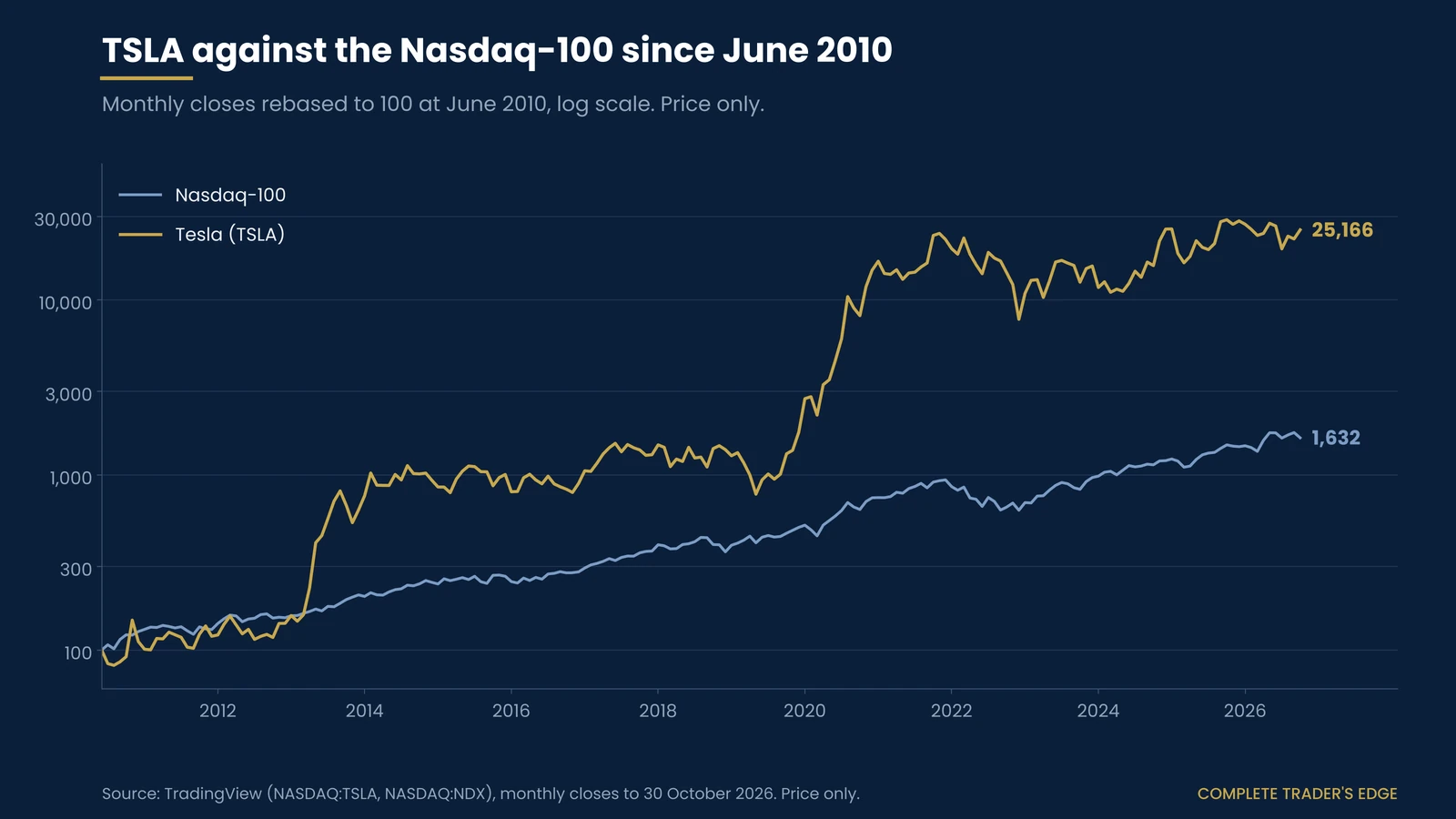
| Wealth Creation | 9 | Roughly 350x from the IPO by October 2026, among the great wealth creators, brutally volatile |
| Durability | 7 | Survived twice and still leads, but faces real competition and key-man risk |
| Historical Importance | 9 | Forced the entire auto industry electric and defined an era |
| Overall Legendary | 8.0 | Editorial verdict: a genuine legend, held back from the very top by valuation and key-man risk |
At a Glance
| Origin | Founded in 2003 by Martin Eberhard and Marc Tarpenning; named after Nikola Tesla |
| The founder-financier | Elon Musk led the 2004 round, became chairman, and was CEO from 2008 |
| The strategy | Start at the top (the Roadster), climb down to a mass-market car |
| First near-death | December 2008, days from bankruptcy before a last-minute round |
| The IPO | 2010, at $17 a share; the first US carmaker to go public since Ford in 1956 |
| The breakthrough | The Model S (2012); Gigafactories and the Model Y took it to mass scale |
| Second near-death | Model 3 “production hell” (2017-2018), within weeks of running out of cash |
| The vindication | First annual profit and S&P 500 entry (2020); a $1 trillion valuation (2021) |
| The drawdowns | ~65% in 2022, ~50% in early 2025; among the most volatile mega-caps ever |
| The present | First revenue decline in 2025, overtaken in EV volume by BYD, now betting on autonomy and robots; ~$1.5T in October 2026 |
| Status | Public (Nasdaq: TSLA); headquartered in Austin, Texas |
The Tesla Timeline
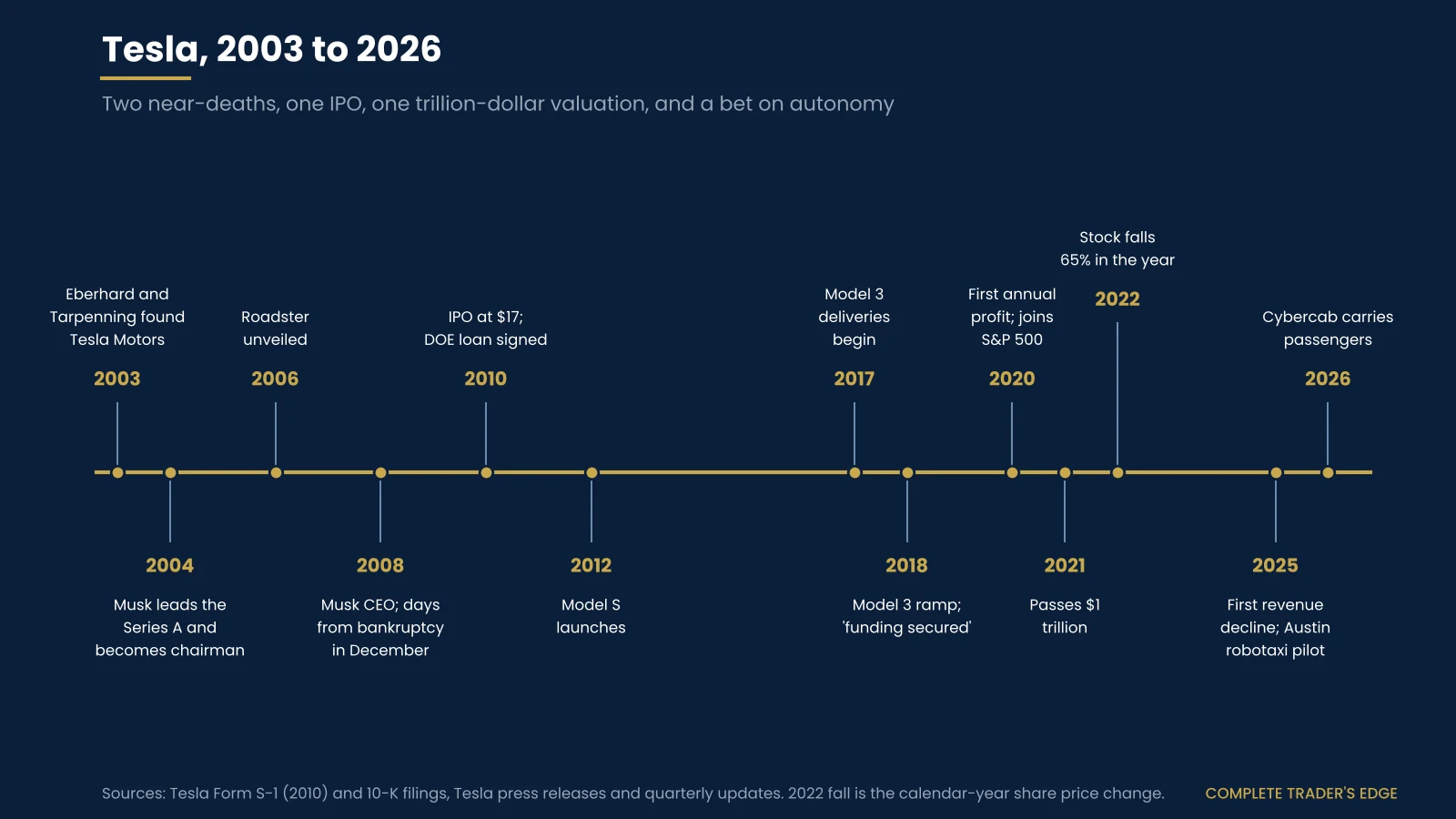
- 2003: Martin Eberhard and Marc Tarpenning found Tesla Motors to build a desirable electric car.
- 2004: Elon Musk leads the first major funding round and becomes chairman.
- 2006: The Roadster prototype is unveiled.
- 2008: The Roadster enters production; Musk becomes CEO; in December the company is days from bankruptcy before a last-minute round.
- 2009: Daimler buys ~10% for $50M; a ~$465M US Department of Energy loan follows.
- 2010: Tesla IPOs on the Nasdaq at $17, the first US carmaker to go public since Ford in 1956.
- 2012: The Model S launches.
- 2017: The mass-market Model 3 begins its brutal “production hell.”
- 2018: The “funding secured” tweet leads to an SEC fraud charge and a settlement removing Musk as chairman.
- 2020: Tesla posts its first full-year profit and joins the S&P 500.
- 2021: Tesla passes a $1 trillion valuation, the most valuable carmaker ever.
- 2022: The stock falls ~65% amid the Twitter takeover and a rate shock.
- 2024: Tesla unveils its robotaxi (Cybercab) and pivots toward autonomy.
- 2025: Musk’s political turn triggers a brand backlash and Tesla’s first annual revenue decline; BYD overtakes it in EV volume; a robotaxi pilot launches in Austin; the stock hits new highs late in the year.
- 2026: Tesla is worth around $1.5 trillion, its valuation resting heavily on an unproven autonomous future.
Key Numbers
Founded: 2003 | IPO: 2010 at $17/share, ~$2.2B market value | Near-deaths: Dec 2008 and 2017-2018 | First annual profit: 2020 | $1T valuation: 2021, most valuable carmaker ever | Worst drawdown: ~74% from the Nov 2021 record close to Jan 2023 (~65% in calendar 2022; ~54% again in early 2025) | 2025: first revenue decline; BYD overtakes in EV volume | 2026: ~$1.5T market value (Oct 2026) on more than 400 times trailing earnings. Current valuations are fast-moving and should be checked against live data.
Related Reading
Tesla is one half of a single founder’s double bet; the other half is SpaceX, the rocket company Elon Musk was funding to the brink of his own bankruptcy in the very same weeks of December 2008. Read how that improbable bet fared. For the same survive-the-drawdown lesson in other forms, see Amazon, which fell more than 90% and took most of a decade to recover, and Nvidia, whose investors had to hold through repeated brutal declines to capture the eventual returns. And for the macro backdrop to Tesla’s first near-death, our breakdown of the 2008 financial crisis explains the freeze that nearly ended the company before it began. For the underlying principle, visit our hub on surviving drawdowns and why volatility is the price of admission.
Go Deeper
The Complete Trader’s Edge book builds the full Mind, Method, and Money framework that turns stories like this into a repeatable way of reading any company. Tesla teaches you to recognize a world-changing bet while it still looks like a delusion; the book teaches you the discipline to survive the drawdowns that conviction demands.
★ Now in Kindle, Paperback & Hardcover
Greatest Companies
This story is one of fifty-one. The full book reads every legendary company through a single lens — Moat, Meltdown, Machine — from Standard Oil to SpaceX. Fifty-one companies, eight kinds of moat, one framework.
Kindle · $9.99 →
Paperback · $24.99 →
Hardcover · $34.99 →
Explore the Book →
This article is part of the Greatest Companies series, adapted from the book Greatest Companies, now available on Kindle.
Frequently Asked Questions
Who actually founded Tesla?
Tesla Motors was founded in 2003 by engineers Martin Eberhard and Marc Tarpenning. Elon Musk was not a founding employee; he led the company’s first major funding round in 2004, became its largest investor and chairman, and took over as CEO in 2008. A 2009 legal settlement recognized Eberhard, Tarpenning, Musk, JB Straubel, and Ian Wright as co-founders.
How many times did Tesla nearly go bankrupt?
At least twice. In December 2008, during the financial crisis, Tesla was days from running out of cash before a last-minute funding round closed around Christmas. Again in 2017-2018, during the Model 3 “production hell,” Musk has said the company was within single-digit weeks of running out of money.
What was the “funding secured” tweet?
In August 2018, Musk tweeted that he had “funding secured” to take Tesla private at $420 a share. No deal materialized. The SEC charged him with securities fraud, and a September 2018 settlement required Musk and Tesla each to pay $20 million and removed Musk as chairman for three years, though he remained CEO.
How volatile has Tesla stock been?
Extremely. Tesla is one of the most volatile mega-cap stocks ever. It fell about 65% in 2022 and roughly 50% again in early 2025, yet by October 2026 had delivered roughly 350 times its 2010 IPO price to long-term holders. Capturing those returns required holding through severe drawdowns that repeatedly looked like proof the thesis was broken.
Why is Tesla worth so much in 2026?
By 2026 Tesla is valued around $1.5 trillion despite modest profits relative to that price, on a very high earnings multiple. The valuation rests largely on expectations for autonomy (robotaxis) and robotics rather than current car sales, which declined in 2025. It is a bet on an unproven future, and remains highly uncertain.
 The Complete Trader's Edge
The full Mind · Method · Money framework. 70 chapters.
View on Amazon →
 Market Mayhem
400 years of bubbles, crashes, and the pattern that keeps repeating.
Buy on Amazon →
 Greatest Companies
How the world's greatest companies were built — and what traders learn from them.
View on Amazon →
 Greatest Traders
Eighty-six lives that explain the markets — Livermore to Madoff, told with the losses left in.
View on Amazon →