

Most companies in this collection are built around a product, a founder, or a single brilliant idea. 3M is built around something rarer and, in its way, more powerful: a culture of invention. For more than a century, 3M has been less a maker of any one thing than a machine for making new things, a company whose deepest competitive advantage is a system that reliably turns research, tinkering, and even happy accidents into a steady stream of products. From sandpaper to Scotch tape to the Post-it note, 3M’s genius has never been a single invention. It has been the process of inventing itself.
But 3M is also a cautionary story, and that is why it belongs here. The very inventiveness that built the company, the relentless creation of new chemicals and materials, also planted liabilities that took decades to surface, erupting in the 2010s and 2020s into some of the largest product and environmental lawsuits in corporate history. 3M is the clearest illustration in this collection of a profound truth: that a company’s greatest strength and its gravest weakness are often the very same trait, seen from different angles.
📄 Free Download · Company Research Sheet
3M Research Sheet (PDF)
The moat, the meltdown, the Legendary Scorecard, the timeline, and the Move, Money and Mind lessons from this story. Free, no email required.
A Failed Mine That Learned to Invent
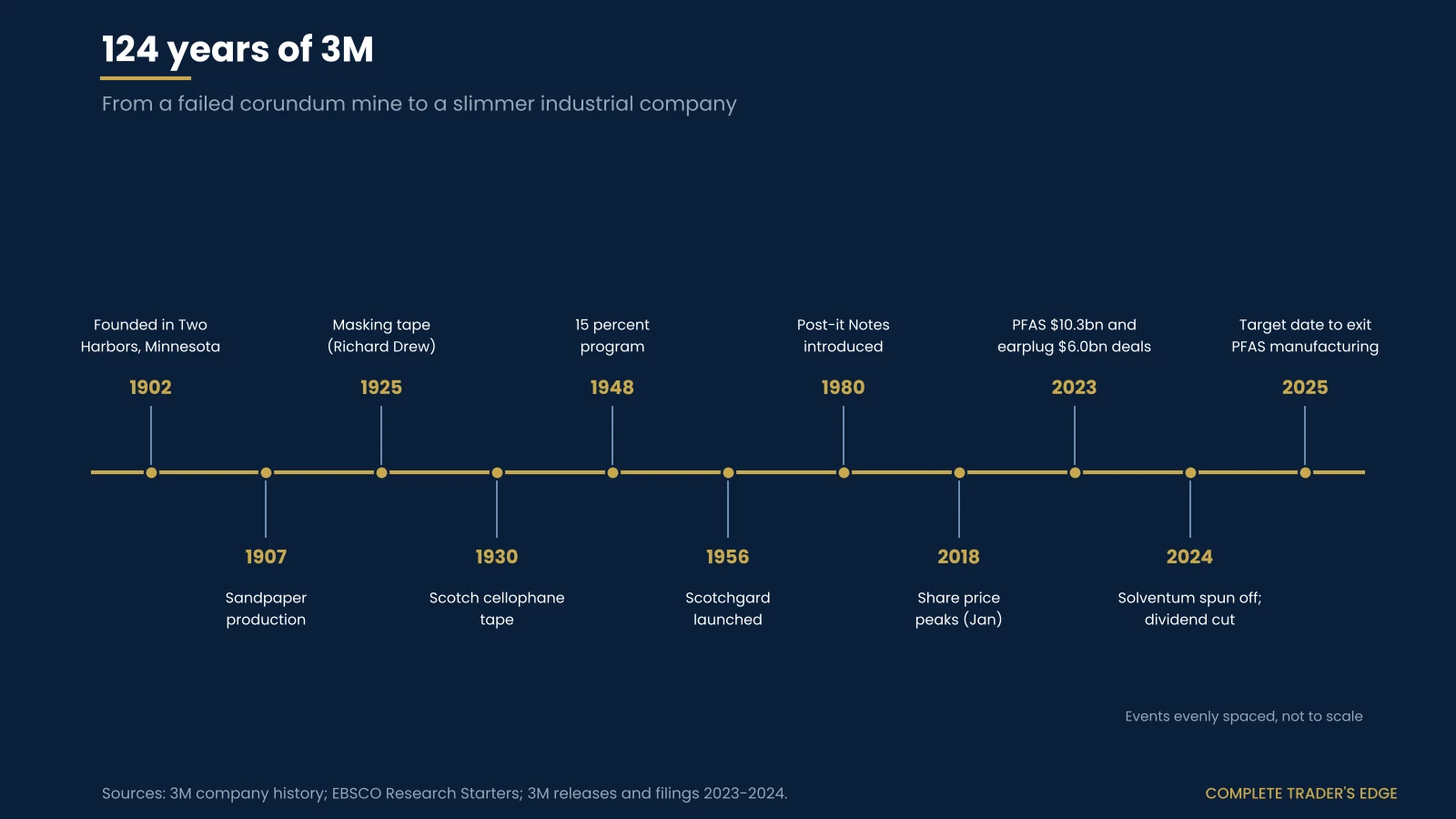
3M began, improbably, as a failure. In 1902, five businessmen in Two Harbors, Minnesota, founded the Minnesota Mining and Manufacturing Company, the three Ms that give the company its name, to mine a mineral called corundum for grinding wheels. The mineral they dug up turned out to be of poor quality, nearly worthless for its intended purpose. The venture should have died. Instead, the young company pivoted, away from mining raw materials and toward manufacturing finished products, beginning with sandpaper.
That early failure shaped the company’s character. Forced to survive on its wits rather than on a rich mineral deposit, 3M learned to define itself by what it could invent in the laboratory, not by what it could pull from the ground. Over the following decades, under leaders most notably William McKnight, it built a culture that prized experimentation, tolerated failure, and gave its researchers unusual freedom. That culture, more than any single product, became the company.
The System That Made Innovation Routine
What sets 3M apart is that it turned innovation from a matter of luck into something close to a repeatable process. The most famous expression of this is the 15 percent rule, adopted in 1948, which encouraged employees to spend a portion of their working time on projects of their own choosing, outside their formal assignments. The idea was that breakthroughs cannot be scheduled, and that giving curious people room to tinker would, across thousands of employees, produce a steady stream of valuable inventions.
It worked, sometimes in the most unexpected ways. Scotch masking tape and cellophane tape made 3M a household name. Scotchgard, the stain repellent, came from a laboratory accident when a researcher spilled a compound that beaded water. And the Post-it note, perhaps the most famous example, was born when one scientist’s failed attempt at a strong adhesive, a glue that stuck only weakly, was paired years later by another employee with the idea of a bookmark that could be repositioned. A failure became one of the most recognizable products on Earth. This was not luck alone; it was a culture designed to catch luck when it struck.
The Moat Is the Method. 3M’s deepest advantage is not Scotch tape or the Post-it note. It is the system that produced them: freedom to tinker, tolerance of failure, thousands of small bets, and a culture built to catch a happy accident and turn it into a product. The inventions change across the decades; the engine that makes them does not.
Decision Point
The Decision Point. For most of the twentieth century, 3M’s strategy seemed unambiguously brilliant: invent constantly and spread across tens of thousands of products so no single failure could sink it. But by the early twenty-first century, a shadow was forming. Some of 3M’s most successful inventions, particularly a family of durable chemicals known as PFAS, were proving persistent in the environment and the human body, and questions about their safety were mounting. The road forks.
A. Confront the emerging risks early and aggressively, disclosing, investigating, and winding down questionable products before they became crises.
B. Move cautiously, balancing the profits from valuable products against the growing doubts.
C. Continue largely as before, trusting in its products and its defenses.
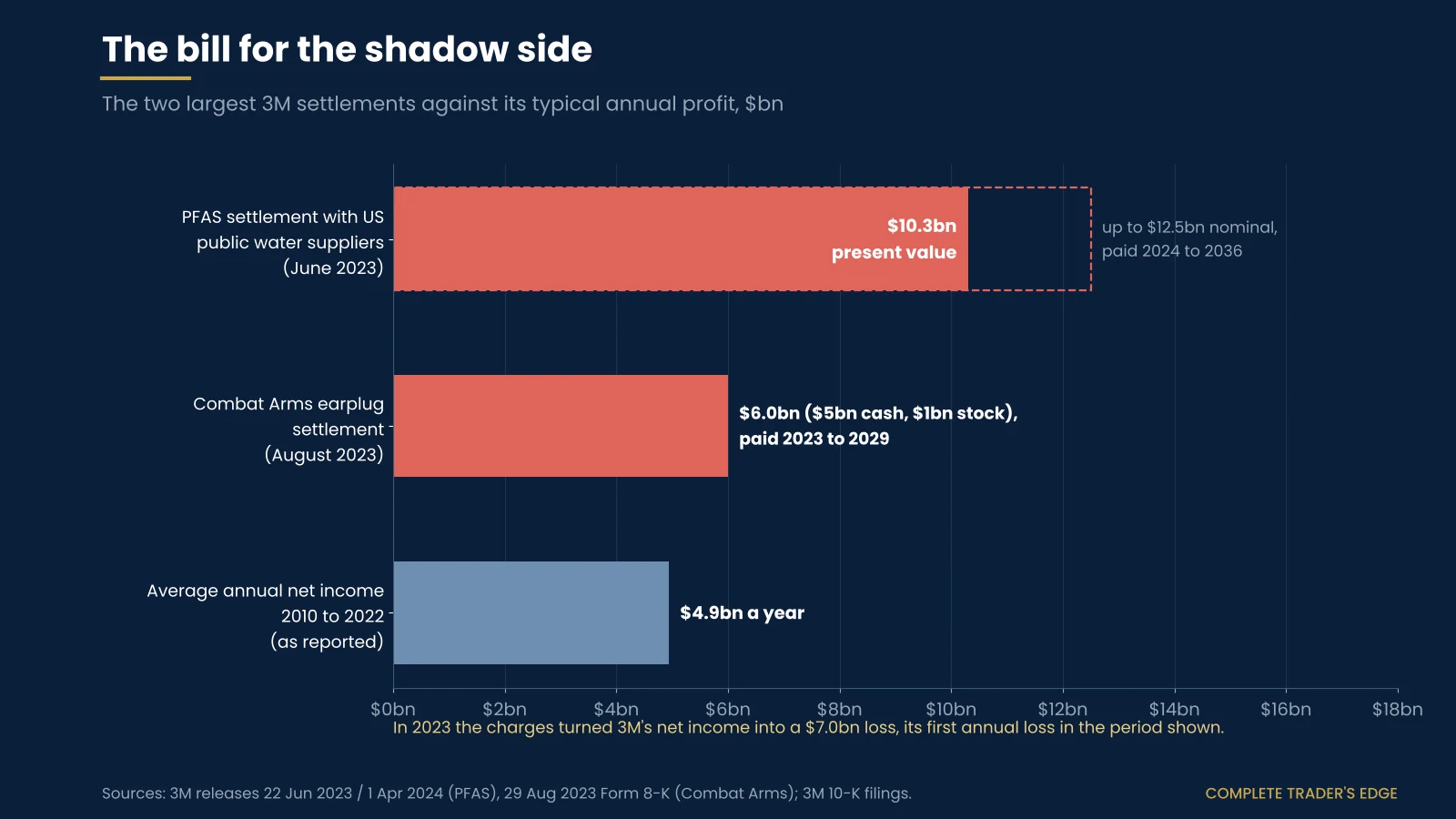
3M, in the main, did not move early or decisively enough, and the result was an avalanche of litigation, billions in settlements, and a battered reputation. The inventiveness that creates value can also create hidden, slow-burning liabilities, and a culture brilliant at making things can be slow to confront the harm some of those things cause. This is a thought experiment about the double edge of innovation, not investment advice.
What Everyone Gets Wrong
Mistake #1: Thinking 3M is defined by any one product. People know it for Post-it notes or Scotch tape. Reality: 3M’s real product is its innovation system itself, the culture and process that produce tens of thousands of products across countless fields. No single invention defines it; the machine that makes inventions does.
Mistake #2: Believing the Post-it note was a stroke of pure luck. It famously came from a failed adhesive. Reality: The luck was real, but it was caught by design. 3M’s culture, its tolerance of failure and its freedom to tinker, is precisely what allowed a useless glue to be remembered, repurposed, and turned into a hit. The system manufactures the conditions for serendipity.
Mistake #3: Assuming 3M’s litigation troubles were bad luck. The PFAS and earplug suits seemed to arrive suddenly. Reality: They were the slow-burning consequence of the company’s own inventiveness, decades of producing durable chemicals whose risks took years to surface. The liabilities were planted long before, by the very creativity that built the company.
Mistake #4: Seeing the Solventum spinoff as mere financial engineering. In 2024 3M spun off its health-care business. Reality: It was part of a deliberate, painful restructuring, simplifying the sprawling conglomerate, freeing the health-care business to grow on its own, and helping 3M manage the enormous costs of its legal settlements. It was strategy under pressure, not idle reshuffling.
The Double Edge of Creativity
The deepest theme of 3M’s story is that strength and weakness can be the same thing. The culture that made 3M one of the most inventive companies in history, free, experimental, prolific, also made it a company that produced, among its thousands of creations, chemicals that would later cost it dearly. The freedom that birthed the Post-it note is connected to the freedom that birthed PFAS.
This is not a reason to dismiss 3M. Its innovation culture is genuinely one of the great achievements in business, studied and imitated around the world. But it is a reason to see the company clearly. The same trait, viewed from one angle, is a moat: a system for endlessly creating value. Viewed from another, decades later, it is a liability: a system that also created risks no one fully understood at the time. Great companies, like great traders, must reckon with the fact that their defining strength almost always carries a shadow.
The Honest Present
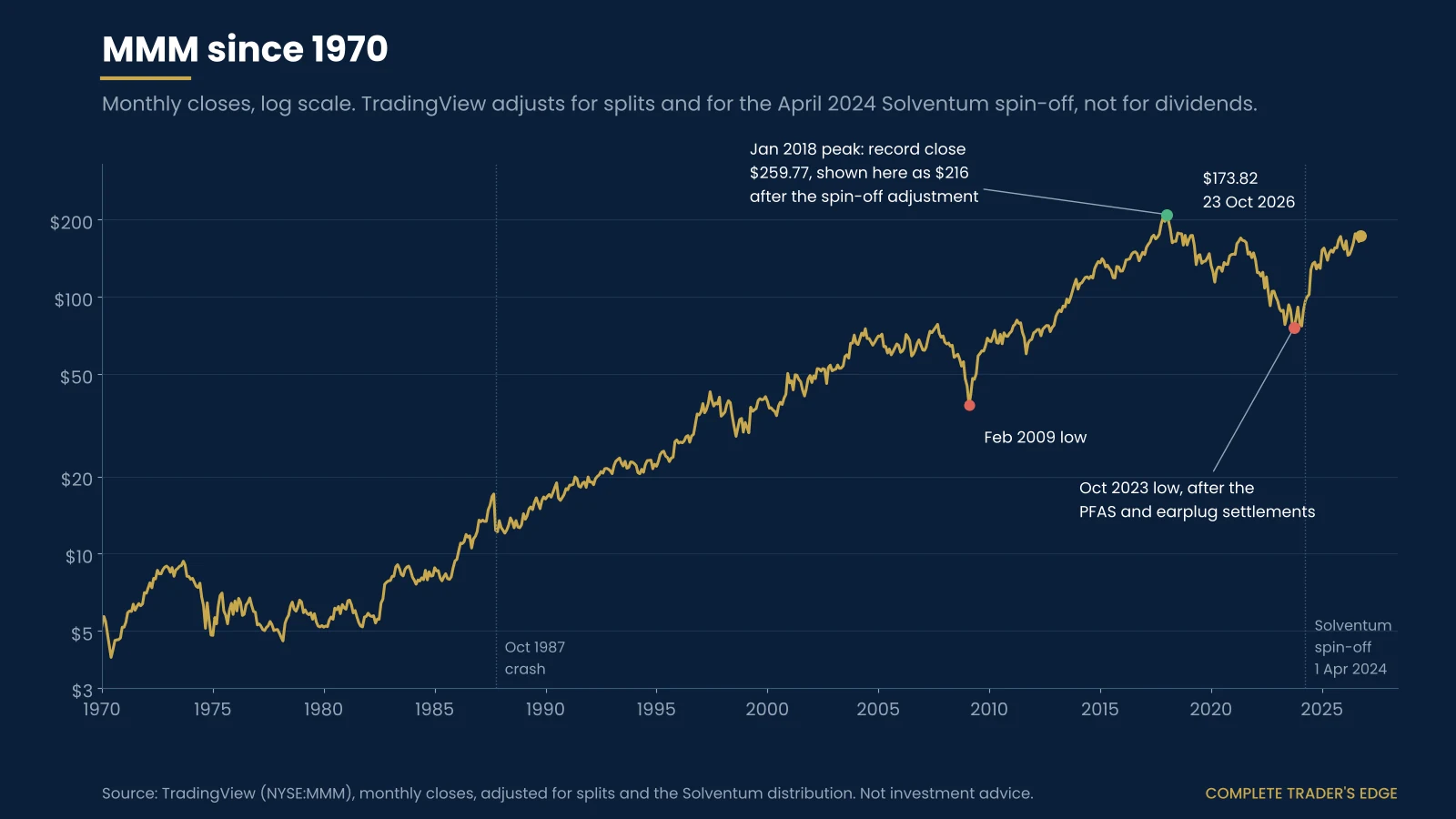
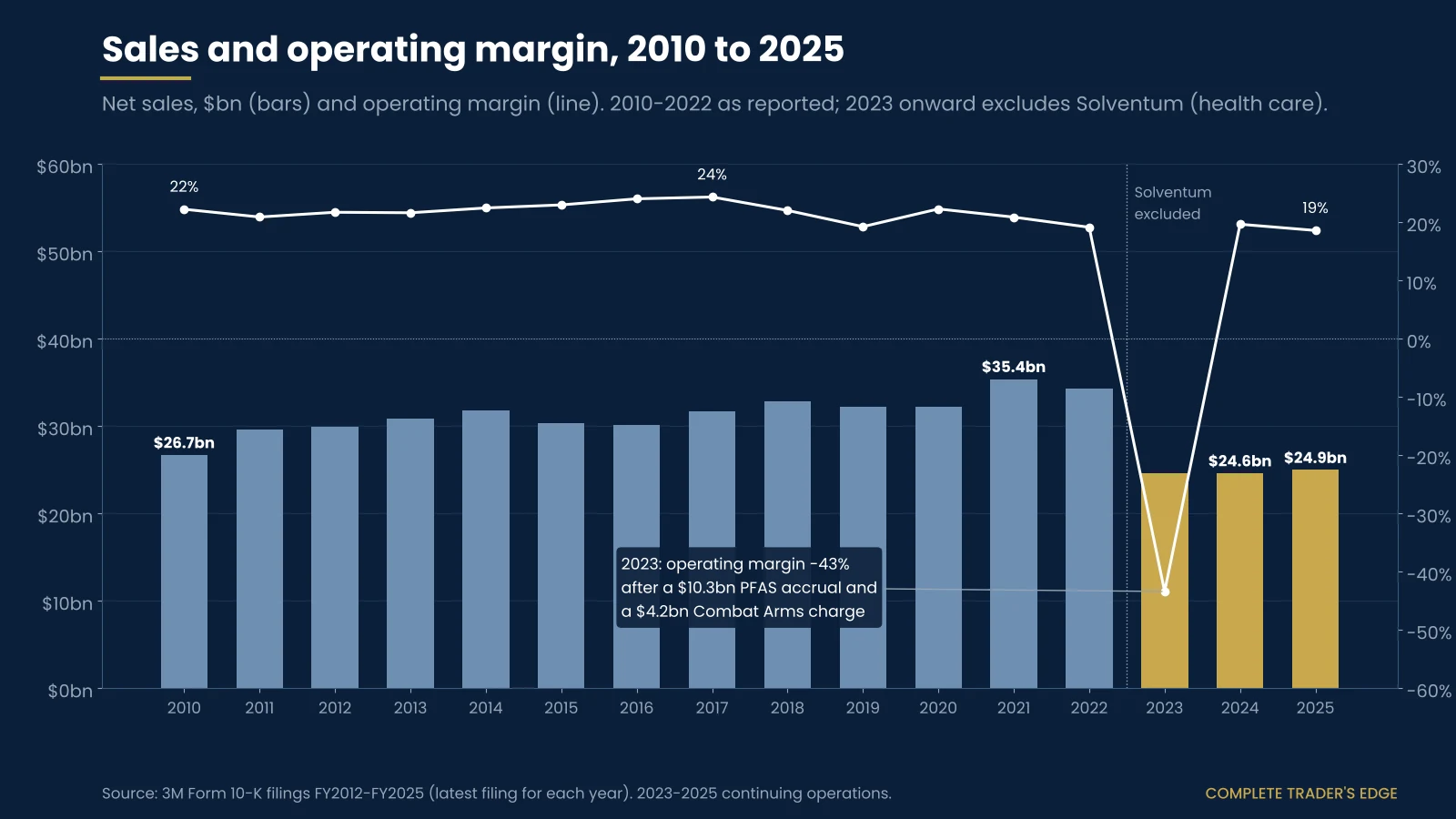
Today 3M is a company working its way out of its hardest era. The litigation over PFAS forever chemicals and over military earplugs led to settlements running into the billions of dollars, among the largest such payouts by any American company, and battered both its finances and its standing. In response, 3M has restructured: it spun off its health-care business as Solventum in 2024, brought in new leadership focused on operational discipline, pledged to exit PFAS manufacturing, and worked to streamline its sprawling operations. After the spin-off it also cut its quarterly dividend from $1.51 to $0.70 a share, ending more than six decades of annual increases, though 3M has paid a dividend without interruption for more than 100 years.
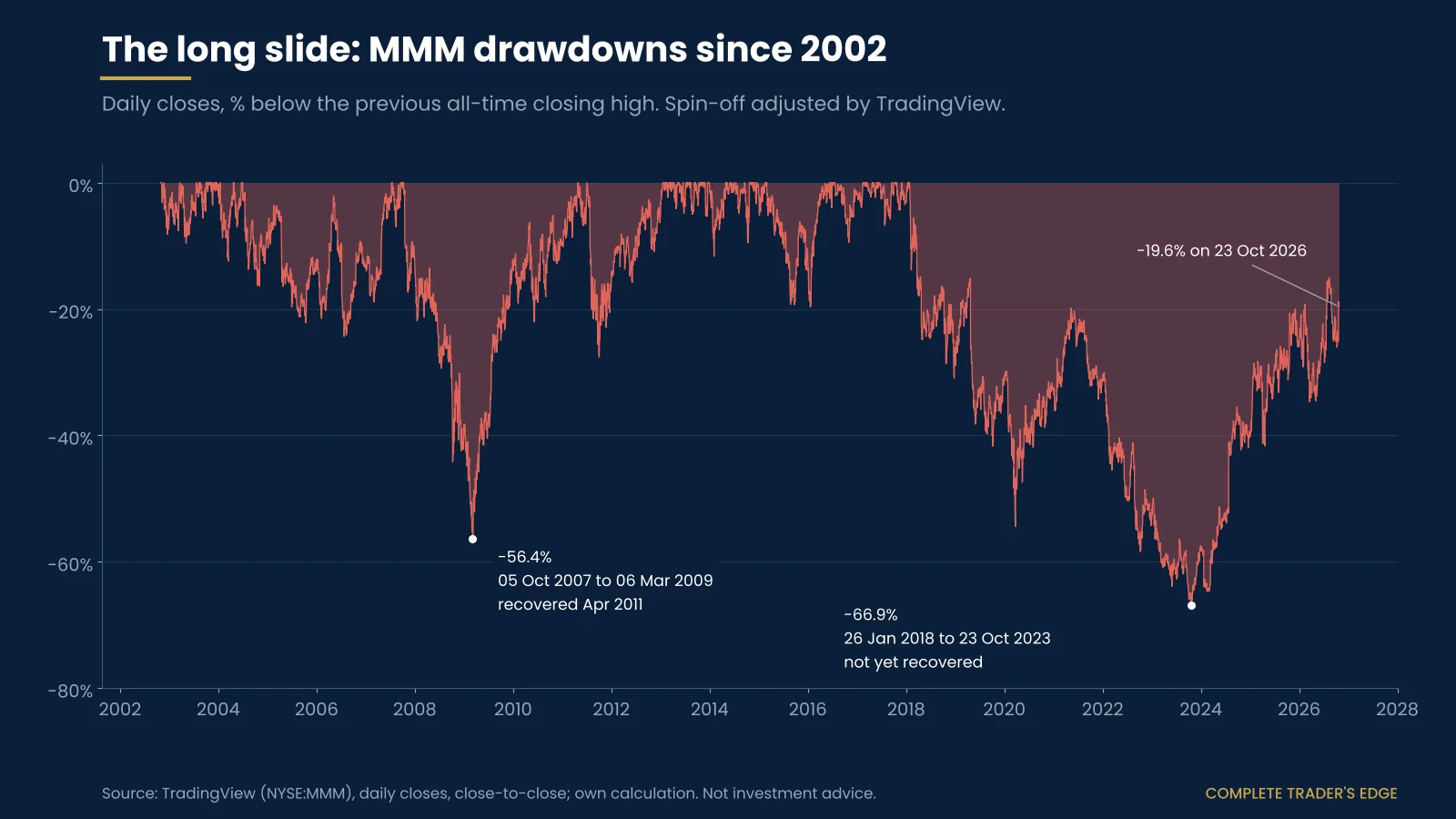
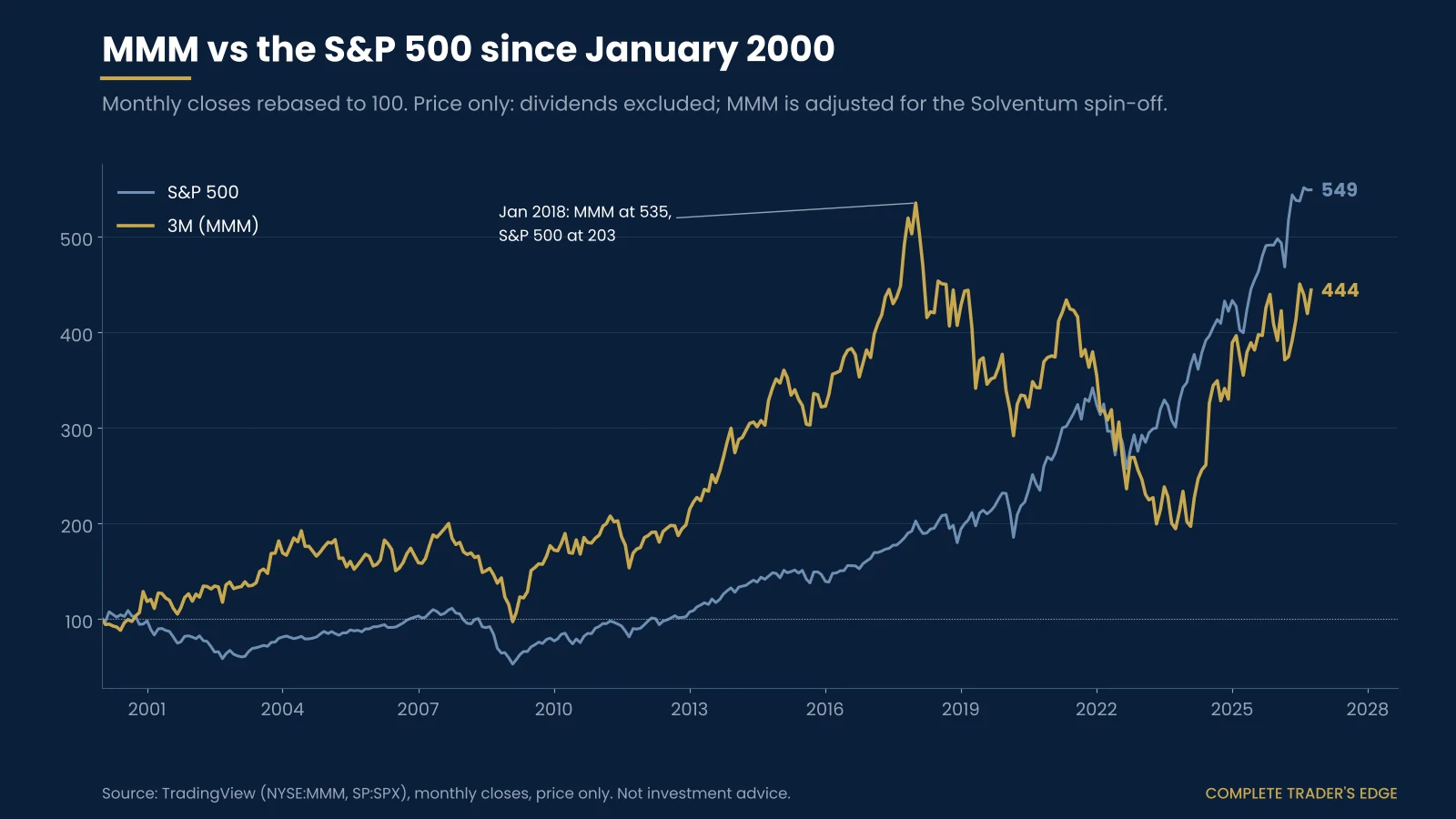
There are signs of recovery. The major settlements have given investors more clarity about the scale of the liabilities, the spinoff has simplified the company, and improved operations have begun to restore confidence, lifting a share price that had badly lagged the market. But challenges remain: the litigation is not entirely behind it, the costs will be paid out over years, and the company must prove that its legendary innovation engine can still produce the breakthroughs of the future, not just the triumphs and troubles of the past.
3M and its industrial peers at 23 October 2026
| Company | Price | Market value | Revenue (TTM) | Operating margin (TTM) | P/E (TTM) | Dividend yield | 2026 to date |
|---|---|---|---|---|---|---|---|
| 3M (MMM) | $173.72 | $89.8bn | $25.2bn | 20.7% | 25.9 | 1.7% | +8.5% |
| Emerson (EMR) | $161.21 | $89.9bn | $18.6bn | 20.6% | 35.2 | 1.4% | +21.0% |
| Illinois Tool Works (ITW) | $275.80 | $78.5bn | $16.5bn | 26.5% | 25.0 | 2.3% | +11.8% |
| GE Aerospace (GE) | $286.30 | $295.8bn | $50.6bn | 18.5% | 33.7 | 0.6% | −7.6% |
| Solventum (SOLV) | $85.48 | $14.6bn | $8.3bn | 8.5% | 10.4 | none | +7.9% |
Source: TradingView, data at 23 October 2026. S&P 500 2026 to date: +11.2%. Figures go stale; not investment advice.
Why This Matters to Investors
The Greatest Companies Thesis
Every legendary company begins with an idea that looks improbable.
Every one survives a stretch where failure looks inevitable.
Every one eventually reaches a point where success looks obvious.
The opportunity exists only in the space between the second and third.
3M is the clearest case study in this collection of innovation as a moat, and of the double edge that every great strength carries. Its lesson is that a genuine culture of invention, a repeatable system for turning research and accident into products, can be one of the most durable competitive advantages a company can have. But it is also a warning that the very same inventiveness can generate hidden liabilities that compound silently for decades before they surface. The Greatest Companies thesis is that durable competitive advantage builds lasting wealth, and 3M’s advantage, its innovation system, is real and rare. But the investor’s lesson is twofold. First, prize a true culture of innovation, because a company that can reliably invent has an edge competitors cannot easily copy. Second, look hard for the shadow side of every strength, because the trait that drives a company’s success often carries a hidden cost, and the discipline to ask what could go wrong, even at the height of success, is what separates durable wealth from the kind that is quietly undermined from within. None of this is investment advice; it is a way of reading history.
Lessons in Order of Depth
Method: build a system that makes innovation repeatable
3M’s method is to treat innovation not as a matter of chance but as a process: give curious people freedom and time, tolerate failure, spread bets across thousands of products, and build a culture that catches and develops happy accidents. The method is to see that creativity can be systematized, that the conditions for breakthroughs can be deliberately engineered even though the breakthroughs themselves cannot be scheduled. The skill to study is the building of a culture that reliably produces the new.
Money: spread your bets, but watch the tail risks
3M’s financial model is diversification through invention: thousands of products across countless fields, so that no single failure is fatal and the winners more than pay for the losers. The money lesson is the power of spreading bets so that variance cannot sink you. But 3M also teaches the harder half: that some risks are not diversified away, that a class of products can carry a shared, hidden liability that surfaces all at once. Diversification protects against ordinary failure, not against a poison running through many products at once.
Mind: your greatest strength casts your longest shadow
The deepest psychological lesson of 3M is that strength and weakness are often the same trait. The freedom and inventiveness that made 3M great are bound up with the lack of caution that let it create lasting harm. The mindset lesson is to know your defining strength so well that you can see its shadow, to ask, at the very peak of what you do best, what hidden cost it might be accumulating. The trader who wins by boldness must watch for the blowup that boldness invites; the company that wins by invention must watch for what its inventions might one day cost.
The deepest question: can a culture built to create restrain what it creates?
3M’s innovation culture is brilliant at making new things, but its crisis revealed that it was far less able to foresee and restrain the harms some of those things would cause. The deepest question 3M poses is whether a culture optimized for creation can also build in the caution, the foresight, and the willingness to stop, that responsible invention requires. Can the same company that prizes freedom and experimentation also cultivate the discipline to ask, before it is too late, whether something should be made at all? The answer will determine whether innovation cultures are an unalloyed good or a power that must be carefully governed.
The Legendary Scorecard
| Founder Vision | 8 |
| Innovation | 10 |
| Execution | 7 |
| Moat | 8 |
| Capital Allocation | 6 |
| Wealth Creation | 8 |
| Durability | 7 |
| Historical Importance | 8 |
| Overall | 8.0 |
The overall figure is an editorial verdict, not a weighted average. 3M earns a perfect score for innovation, because its culture and system for invention are among the greatest ever built and produced a century of breakthroughs. But it scores lower on execution, capital allocation, and durability, because the litigation crisis over PFAS and earplugs revealed a failure to foresee and manage the liabilities its own inventiveness created, costing it billions and years of damage. It is included as a company of genuine greatness whose story carries an essential warning about the shadow side of strength.
At a Glance
| Founded | 1902, in Two Harbors, Minnesota, as a corundum mine |
| Name | Minnesota Mining and Manufacturing, the three Ms |
| Defining trait | A culture and system for relentless innovation |
| Signature practice | The 15 percent rule, letting employees pursue their own projects |
| Famous inventions | Sandpaper, Scotch tape, Scotchgard, the Post-it note |
| Core moat | Process power, an innovation engine, plus trusted brands |
| Modern crisis | Mass litigation over PFAS chemicals and military earplugs |
| Restructuring | Spun off its health-care business as Solventum in 2024 |
| Status | Operating, listed as NYSE: MMM |
Timeline
- 1902: five businessmen found the Minnesota Mining and Manufacturing Company to mine corundum, a venture that quickly fails
- 1900s to 1910s: the company pivots from mining to making sandpaper and abrasives
- 1920s to 1930s: 3M invents masking tape and Scotch cellophane tape, establishing its inventive reputation
- 1948: 3M adopts the 15 percent rule, letting employees spend part of their time on their own projects
- 1980: the Post-it note, born from a failed adhesive, becomes a global hit
- 2023: 3M agrees to settle PFAS claims from US public water suppliers ($10.3 billion present value, up to $12.5 billion) and the Combat Arms earplug litigation ($6.0 billion)
- 2024: 3M spins off its health-care business as Solventum on 1 April, days after the PFAS settlement receives final court approval, and cuts its quarterly dividend from $1.51 to $0.70
- 2025: 3M works to move past its litigation era, exiting forever-chemical manufacturing and rebuilding
Key Numbers
1902 the year a failed mining venture became 3M
1948 the year the 15 percent rule formalized 3M’s culture of tinkering
1980 the year the Post-it note, born of a failed glue, went to market
Tens of thousands the number of products 3M has created across its history
Billions of dollars the scale of 3M’s PFAS and earplug litigation settlements
2024 the year 3M spun off Solventum and began moving past its litigation era
Related Reading
3M belongs among the great compounders and culture-builders. Read about Danaher, another industrial whose moat is a repeatable system, though one of operational improvement rather than invention. See how Nestle built a different kind of durable advantage, through brands and global distribution rather than a laboratory. And study how Berkshire Hathaway thinks about the hidden, long-tail risks that can lurk inside even a great business. For the full collection, see our Greatest Companies of All Time hub.
Go Deeper
3M is a study in innovation as a moat, in the power of spreading bets, and in the hard truth that every great strength casts a shadow. Those are the same forces that separate investors who respect both the power and the hidden risks of a great business from those who see only the upside, and the book teaches you the discipline to value a genuine culture of innovation, to spread your bets against ordinary failure, and above all to search for the shadow side of every strength, because the trait that drives success so often carries the seed of the next crisis.
★ Now in Kindle, Paperback & Hardcover
Greatest Companies
This story is one of fifty-one. The full book reads every legendary company through a single lens — Moat, Meltdown, Machine — from Standard Oil to SpaceX. Fifty-one companies, eight kinds of moat, one framework.
Kindle · $9.99 →
Paperback · $24.99 →
Hardcover · $34.99 →
Explore the Book →
This article is part of the Greatest Companies series, adapted from the book Greatest Companies, now available on Kindle.
Frequently Asked Questions
What does the name 3M stand for?
3M stands for Minnesota Mining and Manufacturing Company, the name it was given when five businessmen founded it in 1902 in Two Harbors, Minnesota. The company was originally created to mine a mineral for grinding wheels, but when that venture failed, it pivoted to making products like sandpaper, and the inventive manufacturer eventually became known simply by its three Ms.
What is 3M’s famous 15 percent rule?
The 15 percent rule, adopted in 1948, encouraged 3M employees to spend a portion of their working time on projects of their own choosing, beyond their formal assignments. The idea was that breakthroughs cannot be scheduled, so giving curious people freedom to experiment would, across the whole company, produce a steady stream of valuable new inventions. It became a model studied worldwide.
How was the Post-it note invented?
The Post-it note grew out of a failure. One 3M scientist created an adhesive that was too weak to be useful as a strong glue. Years later, another employee realized this weak, repositionable adhesive was perfect for a bookmark that could stick and unstick without damage. The result, the Post-it note, became one of the most recognizable products in the world, a triumph of 3M’s culture of catching and developing accidents.
Why did 3M face such large lawsuits?
3M faced massive litigation chiefly over two issues: PFAS, a family of durable forever chemicals it manufactured that persist in the environment and the human body, and Combat Arms earplugs sold to the military that were alleged to be defective. These led to settlements running into the billions of dollars, among the largest by any American company, and were the slow-surfacing consequence of products created decades earlier.
Why did 3M spin off Solventum?
In 2024, 3M spun off its health-care business as a separate public company called Solventum. The move was part of a broad restructuring meant to simplify the sprawling conglomerate, allow the health-care business to pursue its own growth, and help 3M focus and manage the enormous financial burden of its litigation settlements. It marked a turning point as the company worked to move past its hardest era.
 The Complete Trader's Edge
The full Mind · Method · Money framework. 70 chapters.
View on Amazon →
 Market Mayhem
400 years of bubbles, crashes, and the pattern that keeps repeating.
Buy on Amazon →
 Greatest Companies
How the world's greatest companies were built — and what traders learn from them.
View on Amazon →
 Greatest Traders
Eighty-six lives that explain the markets — Livermore to Madoff, told with the losses left in.
View on Amazon →