Explore all 80 books in the Trader’s Library →
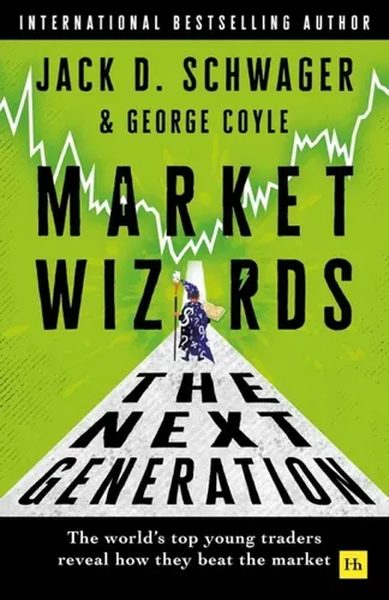
Thirty-seven years after Jack Schwager first picked up the phone and called the best traders alive, the series gets its sixth instalment. Market Wizards: The Next Generation, published in June 2026, does the same thing the original did in 1989, with one deliberate twist: the traders are young. This is the youngest-average-age cohort the series has ever assembled, and several of them already post records that sit among the best in any Market Wizards book.
Four pages covering what the authors actually bring to the book, every edition and identifier, all nine traders in chapter order from the book’s own contents page, the full six-volume series at a glance, and the criticisms worth hearing before you buy.
It is also the first time Schwager has not written a Market Wizards book alone. He is joined by George Coyle, a money manager and trading historian, and the collaboration shows in how carefully the records here are verified, which matters more than ever in an age where anyone can screenshot a fake equity curve.
This is an early verdict on a fresh release. It is grounded in the book’s verified content, the series’ three-decade track record, and the early reception from traders whose judgement we trust. This review covers what the book delivers, how this generation differs from the originals, where the format shows its familiar limits, and whether it earns a place next to the 1989 classic.
At a Glance
| Authors | Jack D. Schwager & George F. Coyle |
| First Published | June 2026 (Harriman House) |
| Format | Long-form interview collection (the series’ signature format) |
| Genre | Interview collection / trading philosophy |
| Series Position | Sixth main instalment (the series began in 1989) |
| Best For | Traders who want the Market Wizards lessons updated for the screen-era, prop-firm generation |
| Skip If | You want step-by-step systems rather than principles distilled from practitioners |
EARLY VERDICT: 8.8 / 10
Who Should Read This Book
| Reader | Verdict | Why |
|---|---|---|
| New trader (0–1 year) | Read it | These traders are closer to your starting point than the 1989 originals. The blow-up stories will hit home. |
| Intermediate (1–3 years) | Read it now | You will recognise the modern instruments and the screen-era grind these traders describe |
| Advanced / professional | Read for the update | The patterns are familiar, but seeing them in a new generation and modern markets is its own confirmation |
| SMC / ICT trader | Read it | This cohort trades the modern, fast, discretionary way. The mindset translates more directly than the original’s pit-era voices. |
| Prop-firm candidate | Read it | Several of these traders came up through exactly the screen-trading, risk-limited path you are on |
| Fan of the original | Essential | It is the modern bookend to the 1989 classic. Read them as a pair across the decades. |
The Book in Context
The Market Wizards series began in 1989 and grew into the most comprehensive interview archive in trading literature: Market Wizards, The New Market Wizards, Stock Market Wizards, Hedge Fund Market Wizards, and Unknown Market Wizards. The Next Generation is the latest, and it arrives with two things that distinguish it from the rest.
The first is the co-author. George Coyle, a money manager and the author of Principles of Great Traders, joins Schwager for the first shared by-line in the series. That partnership matters because of the second distinguishing feature: the traders are young, and their records are extraordinary, which immediately raises the question of verification. In an era of fabricated equity curves and social-media performance theatre, the care taken to confirm these track records is part of what makes the book credible. This is not a collection of influencers. It is a collection of verified outliers.
What This Generation Looks Like
The publisher highlights three of the profiles, and they capture the flavour of the whole.
| The Trader | The Record |
|---|---|
| A music-school dropout | Left education to trade and has accumulated cumulative profits of nearly half a billion dollars |
| A former security guard | Turned $5,000 into over $100 million in under twelve years |
| A volunteer firefighter | Has not posted a single losing month in more than ten years of trading |
None of these came from finance backgrounds. That is the recurring shape of the book: outsiders who out-traded the insiders.
The common thread is that none of these traders arrived through a privileged finance pipeline. They came from outside, blew up accounts on the way, and ground their way to consistency. That is the same story the original told in 1989, retold by a generation that learned on screens instead of in pits.
“Raw conviction without risk management is just gambling, and early failure is the norm rather than the exception.”
— The recurring lesson across the series
How This Generation Differs From the Originals
| The Shift | What It Means |
|---|---|
| Discretionary still dominates | In an age of quant and AI, the monster individual track records here still belong to discretionary traders, not pure systematic ones. The human read of the market is not dead. |
| Screen-era instruments | Shorting small caps, options, and leveraged products feature heavily. These are tactics the original pit-era wizards would have viewed with suspicion. |
| The psychological cost is explicit | Fourteen-hour days in front of screens, and the toll that takes, is discussed openly. The grind is part of the story in a way it was not before. |
| Verification in an AI age | The book is unusually careful about confirming records, a necessary response to a world of fabricated performance claims. |
The Pattern That Refuses to Change
The most striking thing about reading a new Market Wizards book in 2026 is how little the conclusions have shifted in thirty-seven years. A new generation, new markets, new tools, and the same handful of traits keep surfacing: a near-obsessive passion for the process, emotional resilience built through early failure, brutal honesty about mistakes, and the discipline to cut losses without flinching. As one of this book’s traders puts it, cutting losses is the single most important skill, full stop.
For a reader who already knows the original, this is the real value of the new volume. It is a fresh, independent test of the same hypothesis, run on a completely different sample, and the hypothesis holds. The principles in the 1989 book were not artefacts of their era. They are structural, and this generation proves it again from scratch.
The Eight Lessons, and How to Actually Install Them
This is an interview collection, not a system, so every reader walks away with a personal list. What is striking is how similar those lists turn out to be. A working-trader review published four days after release isolated nine lessons. A widely shared reader thread arrived at almost the same nine independently. And in a long interview about the book with Top Traders Unplugged, Schwager and Coyle compressed the entire series into three rules: respect price action, let winners run, cut losers fast.
Three of the nine that keep circulating are the same lesson wearing different clothes. “Take the first small loss”, “stop out quickly” and “do not hope, just get out” describe one discipline observed at three stages of its collapse. Counting them separately makes the list look longer than it is. Below we have collapsed them into one, mapped what remains to the Mind · Method · Money framework, and added the part almost every summary leaves out: what you change on Monday morning.
At the desk: The moment you catch yourself wanting the market to come back, the decision has already been made for you. Hope is not conviction. It is the feeling of holding a position past the point your plan allowed, dressed up as patience.
Install it: Add one field to your journal called “did I hope?” and tick it honestly on every closed trade. After twenty trades, compare the P&L of the ticked ones against the rest. The number will do the arguing for you.
At the desk: No thesis, chart pattern or fundamental obliges price to agree with you. Every trader in this book has been humiliated by a position that should have worked. The lesson they took was not to forecast better. It was to stop sizing as though forecasting works.
Install it: Before entry, write the one sentence that would prove you wrong. If you cannot write it, you do not have a trade, you have an opinion.
At the desk: This is the most human thread in the book and the one nobody expects. A recurring pattern across the interviews is that once these traders reached real success, many deliberately reduced the hours and intensity they poured into markets. The goal was never to trade forever. It was to win and then live.
Install it: Write down the number that ends the grind for you, and the life it buys. A trader with no finish line will keep raising the bar until the market takes it back.
At the desk: A correct idea with bad timing loses exactly the same money as a wrong one. Traders who last do not catch the low. They enter after the move has proved itself and accept that the first leg belongs to somebody else.
Install it: Define what confirmation looks like on your chart before the session, in writing. A break, a retest, a close beyond a level. Then refuse every entry that does not have it, including the one that is obviously going to run.
At the desk: Getting into profit fast is treated as evidence you are in the right trade, not as luck. A position that sits underwater from the moment you enter and stays there is the market telling you something about your timing or your read. The longer you sit red, the more that message should count.
Install it: Set a time stop alongside your price stop. If the trade has not moved in your favour within a defined window, close it and keep the capital and the attention. Use this with judgement: on higher timeframes the window is measured in sessions, not minutes.
At the desk: This is the lesson the circulating lists count three times, and the repetition is not accidental. The cost of waiting is not only money. A position you are nursing back to breakeven occupies the mental space the next clean setup needs. That second cost is invisible on a statement and is usually the larger one.
Install it: Place the stop as a resting order at entry, not as an intention. An intention is negotiable at the moment it matters most.
At the desk: Not every setup deserves the same risk. Your best ideas should carry the most weight and your marginal ones should barely register. Uniform sizing across setups of wildly different quality is one of the quietest ways good traders leave money behind, and oversizing a mediocre setup is one of the fastest ways to do real damage.
Install it: Grade every setup A, B or C before entry and attach a fixed risk to each grade. Then hold the line on C trades, which is where the discipline actually gets tested. Our position size calculator does the arithmetic once the grade is set.
At the desk: The umbrella under which the other seven sit, and the thesis of the whole series compressed into one line. You cannot compound an account you have blown up. Most people who read these books and still fail read them for offence, hunting the setups, when the edge on display was always the defence.
Install it: Set a daily loss limit and a weekly one, and treat hitting them as the end of the session rather than a reason to trade back. Every trader in this book survived long enough to be interviewed. That is the whole qualification.
Where the Book Falls Short
- The format’s old limits remain. Like every Market Wizards book, it is interview-driven, so the depth varies by how articulate each trader is. Some explain their edge brilliantly; others struggle to put it into words.
- Survivorship bias, again. We hear from the young traders who made it, not the equally driven ones who blew up and never came back. The series has never solved this, and this volume does not either.
- Still no women. The authors address this directly and say it was not for lack of looking, but the absence is real and worth naming.
- Eye-watering numbers can mislead. Half-a-billion-dollar and $5,000-to-$100-million stories are inspiring, but they can quietly normalise extreme risk-taking for readers who lack the same edge and temperament. Read the records as outliers, not as templates.
- It is a complement, not a replacement. If you have never read the original, start there. This builds on patterns the 1989 book establishes first.
What the Readers Who Disliked It Actually Said
Most coverage of this book has been positive, ours included, and that is worth being suspicious of on a fresh release. The dissenting reviews on Goodreads are consistent enough to be worth reporting rather than filtering out, and two criticisms come up repeatedly.
Several readers found the approaches too similar across interviews, and felt a number of the traders carried unusually low risk profiles that made them seem less remarkable than the cohorts in earlier volumes. If you are coming to this straight from Unknown Market Wizards or Hedge Fund Market Wizards, expect a narrower spread of methods.
One recurring complaint is that the interviews follow a more standardised structure than the nuanced, trader-specific questioning of the earlier books. That is a plausible side effect of a shared by-line and a larger cohort, and it is the fairest criticism in the pile.
Neither point changes our rating, and both are consistent with the trade-off the book makes: more traders, verified more carefully, at the cost of some of the idiosyncrasy that made the 1989 interviews sing. But if you are deciding between this and an earlier volume in the series, those are the two things most likely to disappoint you.
How the Book Fits the Mind · Method · Money Framework
| Pillar | Contribution | What the Book Delivers |
|---|---|---|
| MIND | PRIMARY | Obsessive passion, emotional resilience, the relationship with losing, and the psychological cost of the modern screen-trading grind |
| METHOD | SECONDARY | A spread of modern discretionary approaches across small caps, options, and leveraged products |
| MONEY | SECONDARY | Loss-cutting as the master skill, position sizing under real pressure, and surviving the early blow-ups |
Like the original, this book lands hardest on the Mind pillar of the Mind · Method · Money framework, with method and money emerging cumulatively across the interviews. It is fresh empirical evidence that the framework’s emphasis on psychology and survival is not a stylistic choice but a description of how winning traders actually operate.
Read This Instead Of / Read This After
| Relationship | Book | Why |
|---|---|---|
| Read first | Market Wizards by Jack Schwager | The 1989 original. Read it before this so you can see how little the conclusions have changed. |
| Read alongside | Best Loser Wins by Tom Hougaard | Hougaard endorsed this book, and his own work is the modern psychology that these young traders live out |
| Read after | Trading in the Zone by Mark Douglas | The operating manual for the psychological resilience these traders describe |
| Read instead of | Social-media trading influencers | These are verified records and honest accounts, not performance theatre |
Market Wizards The Next Generation Review Verdict: Should You Read It?
Yes. If you have read and loved the original, this is the most worthwhile new trading book of the year, because it runs the original’s experiment again on a completely new generation and gets the same answer. The patterns hold, which is both reassuring and instructive.
Read it for the confirmation, not for a shortcut. The eye-watering numbers are inspiration, not instruction, and the real lesson is the unglamorous one the series has taught for nearly forty years: survive the early failures, cut losses without ego, and build the emotional resilience to keep showing up. This is an early verdict on a fresh release, and we will revisit it as the dust settles, but the series pedigree and the verified content make the rating easy to stand behind.
CTE Rating Breakdown
8.8/10
Early Verdict · Series Essential
| Readability | 9 | |
| Actionability | 7 | |
| Timelessness | 9 | |
| Freshness / Relevance | 10 | |
| Beginner-Friendly | 8 |
Ready to read it?
Available in paperback, hardcover, Kindle, and audiobook.
Kindle B0GQWW8GLG · Audiobook B0H422VMHM
Frequently Asked Questions
What is Market Wizards: The Next Generation about?
It is the sixth book in Jack Schwager’s Market Wizards series, co-authored with George Coyle. It interviews a new generation of exceptionally successful traders, the youngest cohort in the series, about how they achieved their records, the failures they survived, and the mindset behind their success.
How is it different from the original Market Wizards?
The traders are much younger, the instruments are modern (small caps, options, leveraged products), and the screen-era grind is discussed openly. It is also the first in the series with a co-author. The core conclusions about psychology and risk, however, are strikingly similar to the 1989 book.
Should I read this or the original first?
Read the 1989 original first. It establishes the patterns that this volume confirms. The Next Generation is best read as the modern bookend to the classic, not as a standalone starting point.
Who co-wrote the book with Jack Schwager?
George F. Coyle, a money manager and trading historian and the author of Principles of Great Traders. It is the first time Schwager has shared the by-line on a Market Wizards book.
Are the traders’ records verified?
Verification is a stated focus of the book, which matters in an era of fabricated performance claims. The authors are careful to confirm the records, which is part of what separates this from social-media trading content.
Is it good for beginners?
Yes, with one caution. The stories are accessible and motivating, and these traders started closer to a beginner’s position than the originals did. Just read the extreme records as outliers rather than as a risk template to copy.
Is there a follow-up planned?
The authors have indicated a further volume focused more on hedge-fund and multi-strategy traders is in the works. This release is the latest in a series that shows no sign of ending.
What is the single biggest takeaway?
The same one the series has delivered since 1989: success comes from surviving early failure, cutting losses without ego, and building genuine emotional resilience. A new generation in new markets reached the same conclusion independently.
About the Authors
Jack D. Schwager & George F. Coyle
Jack Schwager spent over forty years in the futures industry as a research director and trading-advisory partner, and built the Market Wizards series into the definitive interview archive of how top traders think. He is a co-founder of FundSeeder, a platform built to find undiscovered trading talent, which is the natural extension of his life’s work.
George Coyle is a money manager and trading historian, the author of Principles of Great Traders, and the founder of Triangulated Capital Management. His research focus on what separates great traders made him a fitting partner for this volume.
The series: Market Wizards (1989), The New Market Wizards (1992), Stock Market Wizards (2001), Hedge Fund Market Wizards (2012), Unknown Market Wizards (2020), and The Next Generation (2026).
The Full Roster: Who Is Actually In This Book
Most coverage of this release names two or three traders from the publisher’s blurb and stops. Below is the complete interview list, taken from the book’s own table of contents rather than from marketing copy or podcast transcripts, in the order the chapters appear.
| # | Trader | What they are known for |
|---|---|---|
| 1 | Kristjan Kullamägi | Swedish. A security guard who saved roughly $5,000, blew up three or four accounts, and eventually peaked above $100 million. Breakout momentum in stocks. |
| 2 | Lance Breitstein | Turned down a six-figure graduate job for a $26,000 prop-shop seat, then relocated to work as assistant to the firm’s best trader. Films his own trades and replays them. |
| 3 | Simon Russo | A pseudonym, and the only anonymous chapter in the series. Music-school dropout who turned a $40,000 loan into roughly half a billion. Schwager calls it his favourite chapter in the book. |
| 4 | Lukas Fröhlich | German. 2020 returns so extreme the authors refused to accept them until a top-tier auditor would speak to them directly. The re-audit came back higher. |
| 5 | Phil Goedeker | Small-cap short seller turned options seller. Both negative-asymmetry strategies, which Schwager says he had never encountered in a Wizard before. One losing year in two decades. |
| 6 | Kelvin Chiu | Singapore-based. Among the traders who migrated from short-term trading toward longer holding periods as their capital grew. |
| 7 | Jason Berry | From a remote Northern California commune to trading floors in London and Dublin. Five losing months across a fourteen-year stretch of verified clearing statements. |
| 8 | Kenny Sharkness | Traditional prop-desk background. Built around a documented playbook and structured journalling with a coach to catch his own impatience. |
| 9 | Rick Bandazian Jr. | The volunteer firefighter of the publisher’s blurb. Merger and convertible arbitrage in a niche too small and illiquid for the algorithms. No losing month across more than a decade. |
Editions, Formats and Publication Details
All figures below are taken from the publisher’s own listing and the retail editions, not from secondary summaries.
| Format | Details | ISBN / ASIN |
|---|---|---|
| Paperback | 368 pages, Harriman House imprint | 9781804093641 |
| Hardcover | Harriman House | 9781804093634 |
| Kindle / ebook | Whispersync compatible with the audiobook | 9781804093658 / B0GQWW8GLG |
| Audiobook | Narrated by Hopper Stone, a new voice for the series. Purchase includes an accompanying PDF of the charts, which the audio alone cannot carry. | B0H422VMHM |
| Publication date | 9 June 2026 | |
| Series position | Sixth main instalment, thirty-seven years after the 1989 original | |
If you are choosing a format, the audiobook suits the interview structure well, but the charts live in the companion PDF rather than the audio. Traders who want the numbers in front of them are better served by the Kindle edition, or by pairing the two.
Who Wrote It: The Credentials Behind the Book
Twenty-two years as Director of Futures Research for major Wall Street firms, most recently Prudential Securities, followed by ten years as a partner in a hedge fund advisory firm. He is co-founder and Chief Research Officer of FundSeeder, a platform built to surface undiscovered trading talent, which is the working extension of everything the interviews have taught him. He holds a BA in Economics from Brooklyn College and an MA in Economics from Brown University. Beyond the Wizards series he wrote A Complete Guide to the Futures Markets, Market Sense and Nonsense, Getting Started in Technical Analysis, and the three-volume Schwager on Futures.
Twenty-one years inside hedge funds, research firms and family offices, in roles spanning Chief Investment Officer, portfolio manager, systematic strategy designer, macro strategist and trader. Founder of Triangulated Capital Management and Triangulated Research. He holds a BS in Finance from Ohio State and an MA in Applied Statistics from Columbia, which is the relevant qualification here: the statistics training is part of why the record verification in this volume is more rigorous than the series has previously needed. He writes the Market Meditations publication and authored Principles of Great Traders.
Why the pairing matters: Schwager brings four decades of interview craft and the access that comes with the name. Coyle brings a statistician’s discipline to verifying claims. In a market where a fabricated equity curve costs nothing to produce, the second contribution is the one that makes the first one worth reading.
Who Endorsed It
Publisher blurbs are marketing, and we read them as such. What is worth noting is the specific mix here, because it spans discretionary retail, institutional allocation and the old guard of the futures world rather than a single friendly circle.
- Tom Hougaard, author of Best Loser Wins, went in expecting to like it and came out calling it essential for anyone who takes risk daily.
- Barry Ritholtz, author of How Not to Invest, credits the series with inspiring a generation of investor interviews.
- Chris Camillo, investor and co-host of Dumb Money Live, rates this instalment as possibly the most compelling of the series.
- Dmitry Balyasny of Balyasny Asset Management, an institutional voice, says it continues the tradition rather than trading on the name.
- Peter Brandt, author of Diary of a Professional Commodity Trader, describes the series as the most comprehensive first-hand archive of successful speculators in print.
Hear the Authors Themselves
Both authors did substantial press around the launch, and two appearances are worth your time if you want their reasoning unfiltered before you buy.
- Top Traders Unplugged — Moritz Seibert sits down with both authors together. This is the substantive one. It covers how the traders were found, how records are verified in an age of AI, why the biggest individual returns still come from discretionary traders rather than systematic ones, and the psychological cost of fourteen-hour screen days.
- On Investing, Charles Schwab — Kathy Jones interviews Schwager ahead of publication. Broader and more introductory, but it contains his clearest statement of the core finding: risk and money management outweigh methodology.
Continue Learning
- Market Wizards Book Review (2026)
- Trading in the Zone Book Review (2026)
- The Three Pillars: Mind, Method, Money
- Trading Psychology: The Complete Guide
- The Complete Trader’s Edge — The Book
Who Is George Coyle, and What About His Own Book?
Schwager’s name sells the book, but the co-author is worth knowing. George F. Coyle spent twenty-one years inside hedge funds, research firms and family offices, working as chief investment officer, portfolio manager, systematic strategy designer, macro strategist and trader. He founded Triangulated Capital Management and Triangulated Research, holds a finance degree from Ohio State and a master’s in applied statistics from Columbia.
That background matters for how you read The Next Generation. Coyle has spent years researching what elite traders have in common, and this is not the first time he has put that research into print.
Principles of Great Traders distils the recurring principles of the great traders of the past hundred years, largely in their own words. It carries a foreword by Ed Seykota, one of the original Market Wizards. The Kindle edition runs 105 pages and was published in May 2026.
One thing worth knowing before you buy: the book is not new. Coyle wrote it years ago and gave it away as a free PDF at traderprinciples.com, where it circulated among traders as a roughly seventy-page document. Check whether the free version is still available before paying for the Kindle edition.
We have not yet given Principles of Great Traders a full rated review in the Trader’s Library, so treat the above as context rather than a recommendation. What it does tell you is that the research behind The Next Generation did not begin when Schwager called.
 The Complete Trader's Edge
The full Mind · Method · Money framework. 70 chapters.
View on Amazon →
The Complete Trader's Edge
The full Mind · Method · Money framework. 70 chapters.
View on Amazon →
 Market Mayhem
400 years of bubbles, crashes, and the pattern that keeps repeating.
Buy on Amazon →
Market Mayhem
400 years of bubbles, crashes, and the pattern that keeps repeating.
Buy on Amazon →
 Greatest Companies
How the world's greatest companies were built — and what traders learn from them.
View on Amazon →
Greatest Companies
How the world's greatest companies were built — and what traders learn from them.
View on Amazon →