

You risk one percent per trade. You are disciplined about it. And you have no idea what you are actually risking, because you are measuring the wrong thing.
A position size is a number of contracts. Risk is a number of dollars. The bridge between them is volatility, and if you do not build that bridge deliberately, the market builds it for you.
What one lot really costs
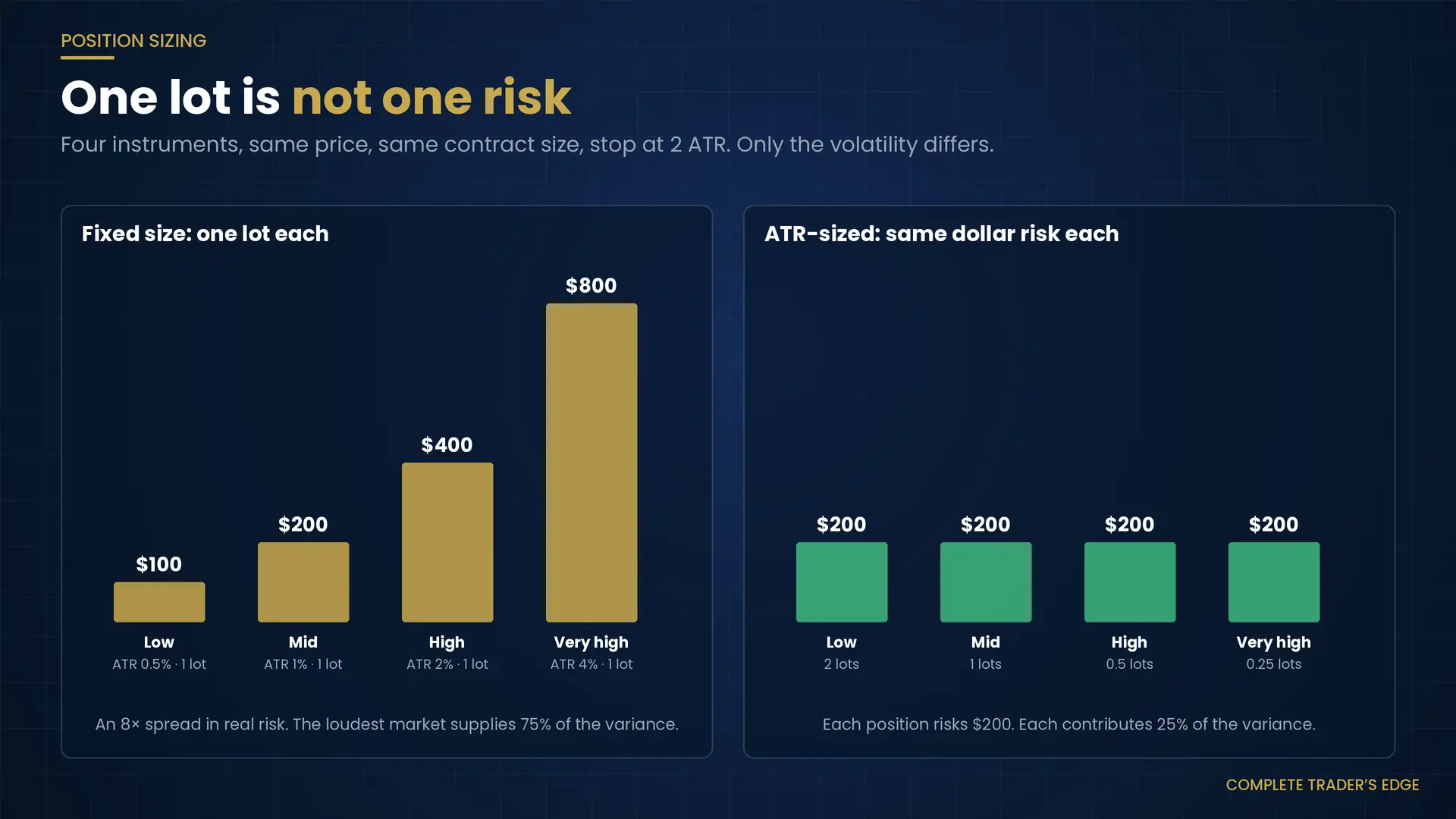
Four instruments. Same price, same contract size, same trader. Stop placed at two ATRs, which is a sensible, structure-respecting distance in every one of them.
| Instrument | Daily ATR | Stop distance | Risk on 1 lot |
|---|---|---|---|
| Low volatility | 0.5% | 1.00 | $100 |
| Mid volatility | 1.0% | 2.00 | $200 |
| High volatility | 2.0% | 4.00 | $400 |
| Very high volatility | 4.0% | 8.00 | $800 |
An eight-fold spread in real exposure, produced by a trader who believed he was trading the same size everywhere. He was. That was the problem.
He does not experience this as inconsistency. He experiences it as “gold is a difficult market” and “the low-vol name never does anything.” Both statements are about his position sizing, and neither is about the market.
The portfolio consequence, which is worse
Trade all four at once. Where does your profit and loss actually come from?
| Instrument | Share of P&L variance: one lot each | Share: N-sized |
|---|---|---|
| Low volatility | 1.2% | 25.0% |
| Mid volatility | 4.7% | 25.0% |
| High volatility | 18.8% | 25.0% |
| Very high volatility | 75.3% | 25.0% |
Read the bottom-left cell. Three quarters of everything that happens to your account comes from one of your four markets. You believe you are diversified across four instruments. You are trading one instrument and three rounding errors.
The diversification you thought you bought was never purchased. Adding a quiet, uncorrelated market to a portfolio does nothing if you allocate it one twentieth of the risk of the loud one.
The Turtles’ answer: N
Richard Dennis’s traders did not size in contracts. They sized in units of volatility, and they called the unit N. It was, essentially, a twenty-period average true range.
The rule was simple, and it is still the correct default forty years later.
Volatility-adjusted position size
Units = (Account × Risk %) ÷ (Stop distance in ATRs × ATR × Point value)
$100,000 account, 1% risk, stop at 2 ATRs.
Low vol, ATR = 0.50: stop is 1.00 wide. Size = 1,000 ÷ 100 = 10 lots.
Very high vol, ATR = 4.00: stop is 8.00 wide. Size = 1,000 ÷ 800 = 1.25 lots.
Both trades now lose exactly $1,000 if the stop is hit. Both are genuinely 1R. Your journal finally means something.
Notice what this does to R. Before N-sizing, a 1R loss on the quiet instrument and a 1R loss on the loud one were different amounts of money, which means your average loss, your expectancy, and your Kelly fraction were all computed on a unit that changed size between trades.
This is the deeper reason to do it. Volatility sizing is not primarily about risk control. It is about making your statistics valid. Without it, every number downstream of your journal is measuring a ruler that stretches.
The three parameters, and how to set them
ATR period. Twenty is the default and there is nothing sacred about it. Shorter adapts faster and whipsaws your sizing; longer is stable and slow to react when a market wakes up. If you day trade, use an intraday ATR, not a daily one, or you will size every scalp for a move that takes a week.
Stop multiple. Two ATRs is a starting point, not a rule. The correct multiple is the one that places your stop beyond the noise and before the invalidation, and structure should always win the argument. If a two-ATR stop sits inside the range, it is not a stop, it is a donation.
Risk fraction. Unchanged by any of this. One percent is one percent. What N-sizing gives you is the guarantee that one percent means one percent.
The correlated-unit cap
N-sizing solves exposure per trade. It does not solve exposure per idea, and this is where funded accounts die.
Four correctly sized positions in gold, silver, the dollar index short, and a mining name are one position with four tickets. Each is 1R. Together, on the day the dollar rips, they are approximately 4R, and your risk model reported 1R four times.
The Turtles capped units per market, per closely-correlated group, and per direction. That structure is the thing most retail traders skip, and it is the thing that turns a well-sized book into a single leveraged bet without anyone noticing.
Volatility sizing makes each trade honest. Correlation caps make the portfolio honest. You need both.
What to change tonight
Recompute your last hundred trades in true R. Take the dollar loss you would have taken at your stop, on each trade. If those numbers are not roughly equal, your journal has been reporting in a unit that changes size, and every statistic you have derived from it is approximate at best.
Put ATR in your sizing formula, not on your chart. Most traders display the indicator and size by habit. The indicator is useless as decoration.
Check the variance table against your own book. Sum the dollar risk of your open positions by instrument. If one market accounts for more than half, you do not have a portfolio. You have a position, and three opinions.
One lot is not one risk.
Size from the stop, and the stop from the volatility. Then every R in your journal is the same R.
 The Complete Trader's Edge
The full Mind · Method · Money framework. 70 chapters.
View on Amazon →
The Complete Trader's Edge
The full Mind · Method · Money framework. 70 chapters.
View on Amazon →
 Market Mayhem
400 years of bubbles, crashes, and the pattern that keeps repeating.
Buy on Amazon →
Market Mayhem
400 years of bubbles, crashes, and the pattern that keeps repeating.
Buy on Amazon →
 Greatest Companies
How the world's greatest companies were built — and what traders learn from them.
View on Amazon →
Greatest Companies
How the world's greatest companies were built — and what traders learn from them.
View on Amazon →
 Greatest Traders
Eighty-six lives that explain the markets — Livermore to Madoff, told with the losses left in.
View on Amazon →
Greatest Traders
Eighty-six lives that explain the markets — Livermore to Madoff, told with the losses left in.
View on Amazon →