
Legendary Traders · Market Wizards
Colm O’Shea
The macro trader who profits by noticing it is raining — not by forecasting the storm.
Global macro · Founder of COMAC Capital · Hedge Fund Market Wizards
Last reviewed: August 2026. Sources: Jack Schwager’s Hedge Fund Market Wizards, public interviews and fund records.
When Jack Schwager asked Colm O’Shea to describe a mistake he had learned from, O’Shea could barely produce one. It was not that he doesn’t make mistakes; by his own admission he is wrong on at least half his trades. It is that he never lets a losing trade get anywhere near the size where it would make a good story. Large losses are simply incompatible with the way he trades.
That single fact explains why a global macro trader who is wrong half the time became wealthy, ran billions at Soros and then at his own fund, and earned a chapter in the fourth Market Wizards book. O’Shea’s edge is not a superior crystal ball. It is a philosophy he sums up in one image: you do not need to forecast the weather for tomorrow, you only need to notice that it is raining today. He is the Wizard who proves that reacting to reality, with ferocious risk control, beats predicting the future.
Key Facts
| Known for | Discretionary global macro trading with elite downside control |
| Career path | Citigroup trader → Soros Quantum Fund PM → Balyasny → founded COMAC Capital |
| 2008 | COMAC returned +31% while most funds lost money |
| Peak size | ~$4.5 billion by 2012; wound down external capital in 2015 |
| Style | Currencies, rates, equities, commodities; ~1–3 month horizon; 10–15 positions |
| First inspiration | Read Reminiscences of a Stock Operator at age 17 |
| Featured in | Hedge Fund Market Wizards, “Knowing When It’s Raining” |
From Cambridge to the Quantum Fund
O’Shea’s fascination with markets started at seventeen, when he read Reminiscences of a Stock Operator and felt it pull the pieces of his interests together. He studied at Cambridge, graduated in 1992, and went straight into trading at Citigroup, where he learned the macro markets from the inside.
In 2003 he reached the top of the profession, joining George Soros’s Quantum Fund as a portfolio manager. Two successful years there gave him both a track record and a philosophy shaped by the Soros school of trading. He then moved to run a global macro strategy within the multi-manager fund at Balyasny — a portfolio that became the template for his own venture — before founding COMAC Capital, a London-based global macro hedge fund.
COMAC announced itself in the worst possible year for everyone else. In 2008, as markets collapsed and most funds lost heavily, COMAC returned roughly 31%. Assets grew to about $4.5 billion by 2012. The firm’s later years were harder, and in 2015 — after weaker returns, redemption requests, and a sharp one-day loss when the Swiss National Bank abruptly abandoned its cap on the franc — O’Shea chose to return outside investors’ money and continue managing his own capital. The public fund’s decade was over, but the trader’s principles were fully on the record.
The method: trade the present, not the prediction
O’Shea is a discretionary global macro trader. He looks for directional opportunities across currencies, interest rates, equities and commodities, typically holding for one to three months and running perhaps ten to fifteen positions at once. What sets him apart is not the markets he trades but how he thinks about being right.
He treats every trading idea as a hypothesis, not a conviction. The analysis gives him a reason to look; the market decides whether the reason is any good. Borrowing a Soros idea, he is happy to act on a clear move before he fully understands it — because if you wait until you can explain a price move, you are often too late. The unfolding reality, he insists, trumps the story you told yourself about it.
That is what “knowing when it’s raining” means. He is not trying to forecast tomorrow’s weather. He is trying to notice, accurately and early, what is actually happening now, and to position for it. The great trades, in his telling, do not require predictions at all — they require paying honest attention. And because he distrusts rigid rules, he stays flexible: a rule that fitted one regime can become a trap in the next.
The defining lesson: make losses impossible to remember
The core of O’Shea’s success is risk, not vision. He is wrong on at least half his trades and untroubled by it, because he structures every position so that a loss stays small, defined, and forgettable. He seeks asymmetry: trades where the downside is tightly limited and the upside is large. When the market rejects his hypothesis, he simply exits — there is no ego to defend, because the idea was only ever a hypothesis.
This is why he struggled to name a painful mistake. His methodology makes catastrophic losses structurally impossible; the worst he could recall was a profit he failed to capture. Being right half the time is more than enough when your winners are many times the size of your losers and your losers are never allowed to grow. Vision opens the trade; risk management is what turns it into a career.
Where the Mind · Method · Money framework meets O’Shea
Method is macro read as reaction, not prophecy: forming a hypothesis about currencies, rates, equities or commodities, then trading the reality that actually unfolds rather than the forecast. Flexibility over fixed rules is the design.
Money is where O’Shea is a master. Asymmetric risk/reward on every trade, tight and unemotional loss-cutting, and position sizes that make a large loss impossible are the whole engine of his record. He can be wrong constantly precisely because his money management never lets it matter.
Mind is the empiricist’s humility. Holding ideas as hypotheses, letting the market be the judge, refusing to marry a forecast, and feeling no need to defend a position all reflect a temperament built to change its mind the instant the evidence does.
The honest counterweight
O’Shea’s philosophy is genuinely portable, but his career is one of the harder ones to romanticise into a personal template, and honesty demands saying why.
Global macro is close to the least replicable style for an individual. It rests on deep fluency across the world’s currency, rate, equity and commodity markets, real-time access to all of them, and institutional infrastructure. O’Shea built that fluency over years at Citigroup and Soros; his “feel” for when it is raining is an institutional intuition, not something a retail trader can conjure from a data feed.
His own fund also shows how brutal macro is even for the best. COMAC’s +31% in 2008 and its rise to $4.5 billion are the highlights, but the later years brought weak or flat returns, mounting redemptions, and a punishing one-day loss on the 2015 franc shock, after which he handed external money back. The great risk manager still ran a fund whose public life ended after a decade. Being right about the big picture does not guarantee a smooth return stream, and macro regimes can turn against even a superb trader.
The elegant slogan can also mislead. “Don’t predict, react” works for O’Shea because his experience lets him tell a meaningful signal from noise. For a beginner, “react to reality” quietly becomes chasing every wiggle on the screen. And the entire approach depends on the risk-management half: wrong half the time is only survivable when losers are tiny and winners are large. Copy the reacting and skip the asymmetry, and you have simply built a losing strategy with a nice motto attached.
What to actually take from Colm O’Shea
You may never trade macro, but his thinking transfers cleanly to any market.
First, trade the present, not your prediction. Notice what is actually happening and respond to it, rather than clinging to a forecast the market is already contradicting.
Second, hold every idea as a hypothesis. Separate your analysis from your position, and let price be the judge. When the market rejects your thesis, exit without argument — there is nothing to defend.
Third, build asymmetry into every trade. Take positions where the downside is small and defined and the upside is large, so that being wrong often still leaves you well ahead. Never let a loss grow into something memorable.
Fourth, stay adaptable. Rules calcify into dogma; the market you are in today is the only one that matters. What works is the willingness to change your mind the instant the evidence does.
Frequently asked questions
Who is Colm O’Shea?
Colm O’Shea is an Irish global macro trader profiled in Jack Schwager’s Hedge Fund Market Wizards. He traded macro at Citigroup and for George Soros’s Quantum Fund before founding the London-based hedge fund COMAC Capital.
What is Colm O’Shea’s trading style?
He is a discretionary global macro trader, taking directional positions across currencies, interest rates, equities and commodities. He typically holds for one to three months and runs around ten to fifteen positions at a time, treating each idea as a hypothesis.
What does “knowing when it’s raining” mean?
It is O’Shea’s core philosophy: you do not need to forecast the future, only to notice accurately what is happening now. He believes the best trades come from recognising and reacting to reality as it unfolds, not from predicting it.
What happened to COMAC Capital?
COMAC returned about 31% in 2008 and grew to roughly $4.5 billion by 2012. After weaker returns, redemptions and a sharp one-day loss on the 2015 Swiss franc shock, O’Shea returned outside investors’ money and continued managing his own capital.
How can O’Shea be wrong half the time and still succeed?
Through asymmetry and discipline. He structures trades so losses are small and defined while winners can be large, and he cuts losing positions immediately. Being wrong often is survivable when no single loss is ever allowed to matter.
Can a retail trader use Colm O’Shea’s approach?
His macro style relies on institutional experience and access that individuals rarely have. But his principles — react to reality, hold ideas as hypotheses, and demand asymmetric risk/reward — apply to any trader in any market.
Which book features Colm O’Shea?
Hedge Fund Market Wizards (Jack Schwager, 2012), in the opening chapter “Knowing When It’s Raining.”
Continue learning
- Jamie Mai — a fellow Hedge Fund Market Wizards trader whose entire edge is seeking asymmetry.
- Ray Dalio — the macro thinker profiled alongside O’Shea in the same book.
- Stanley Druckenmiller — the top-down macro legend from the same Soros lineage.
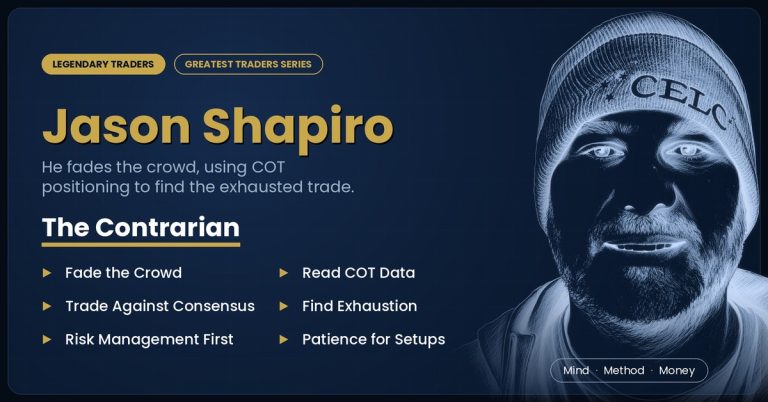
- Jason Shapiro — a trader who, like O’Shea, reacts to real positioning rather than his own forecast.
- Market Wizards (book review) — our breakdown of the Schwager series O’Shea appears in.
- The Mind · Method · Money framework — the lens we use to read every trader on this site.
 The Complete Trader's Edge
The full Mind · Method · Money framework. 70 chapters.
View on Amazon →
The Complete Trader's Edge
The full Mind · Method · Money framework. 70 chapters.
View on Amazon →
 Market Mayhem
400 years of bubbles, crashes, and the pattern that keeps repeating.
Buy on Amazon →
Market Mayhem
400 years of bubbles, crashes, and the pattern that keeps repeating.
Buy on Amazon →
 Greatest Companies
How the world's greatest companies were built — and what traders learn from them.
View on Amazon →
Greatest Companies
How the world's greatest companies were built — and what traders learn from them.
View on Amazon →
 Greatest Traders
Eighty-six lives that explain the markets — Livermore to Madoff, told with the losses left in.
View on Amazon →
Greatest Traders
Eighty-six lives that explain the markets — Livermore to Madoff, told with the losses left in.
View on Amazon →