

Legendary Traders · Market Wizards
Jaffray Woodriff
The quant who refused to follow trends or fade them — and built a third way.
Systematic futures trader · Co-founder of QIM · Hedge Fund Market Wizards
Last reviewed: August 2026. Sources: Jack Schwager’s Hedge Fund Market Wizards, public interviews and fund records.
Jaffray Woodriff wanted three things: to be a trader, to do it by computer, and to do it in a way no one else was doing. The first two are common ambitions. The third is what made him a Market Wizard.
Almost every systematic futures trader belongs to one of two camps. The larger camp follows trends, riding a move until it reverses. The smaller camp fades them, betting that an overextended move will snap back. Woodriff rejected both. He reasoned that if everyone believed trend-following worked, it would gradually stop working, and he never liked mean reversion either. So he built an entirely third class of models — ones that are, on average, indifferent to trend, simply hunting for statistical patterns that make higher or lower prices more likely over the next day. From nothing but daily price data, that idea grew into Quantitative Investment Management, a firm that at its peak ran around $5 billion. Woodriff is the Wizard of pure, disciplined pattern recognition.
Key Facts
| Known for | Trend-neutral statistical pattern recognition — “the third way” |
| Firm | Co-founded Quantitative Investment Management (QIM), 2003, Charlottesville, VA |
| Inputs | Only daily open, high, low and close prices; thousands of models |
| Obsession | Avoiding overfitting via a strict train / validate / test data split |
| Client returns | ~12.5% annualized (2003–2011) with ~10.5% volatility |
| Scale | Peaked near $5 billion; later contracted and rebuilding |
| Featured in | Hedge Fund Market Wizards, “The Third Way” |
A trader who wanted to be different
Woodriff grew up in Virginia and attended the University of Virginia. He knew early that he wanted to trade by computer, and he was drawn to the futures markets, where systematic traders — Commodity Trading Advisors — ply their models. After an early stint in the industry and a spell running a small private trading fund with a friend, he brought the operation home to Charlottesville and, in 2003, co-founded Quantitative Investment Management with Michael Geismar and Greyson Williams.
QIM grew quickly. By managing outside money on the strength of its systematic program, the firm rose to become one of the larger quant funds in the world, with assets peaking around $5 billion. Woodriff, later dubbed “the monk in managed futures,” became the firm’s investment engine and its public face — and, when Schwager profiled him in 2012, one of the most successful systematic traders of any kind.
The method: build the third category
Woodriff’s models look at almost nothing. He feeds them only the daily open, high, low and close of each market and asks a single question: given these price patterns, is the next day more likely to be up or down? From that spare input he generates thousands of candidate patterns and combines them into ensemble models that, crucially, are trend-neutral — they do not assume the current move will continue, and they do not assume it will reverse. They simply look for a statistical edge in one direction or the other over a short horizon.
This is the “third way.” Where trend-followers and mean-reverters each make a directional assumption about trends, Woodriff makes none. He treats the market as a dataset and searches it for repeatable structure, blending many weak signals into a stronger combined forecast across a wide range of markets.
Searching a dataset that hard is dangerous, and this is where Woodriff is exceptional. Test enough combinations and you will always find patterns that are pure luck — a trap system builders call “burning the data.” Woodriff’s answer is a rigorous three-way discipline: he develops models on one slice of history, validates them on a separate, untouched slice, and treats ongoing real-time results as the true, final exam. He is willing to try an enormous number of combinations precisely because his validation regime is built to expose the ones that only worked by accident.
The defining lesson: the enemy is overfitting
If Woodriff’s career teaches one thing, it is that the central danger in systematic trading is not a lack of ideas but an excess of them. A beautiful backtest is easy to manufacture and almost always a lie. The skill is not finding a pattern that fits the past — anyone can do that — but proving that a pattern will keep working on data it has never seen.
Everything about his process is engineered around that truth. The three-way data split, the insistence on out-of-sample testing, the willingness to discard models that dazzled in development but stumbled in validation — all of it exists to separate genuine edge from curve-fitted noise. He can blindly search the data only because he refuses to trust anything the data has not confirmed on ground it did not help build. That discipline, far more than any single clever pattern, is his edge.
Where the Mind · Method · Money framework meets Woodriff
Method is pure statistical pattern recognition: thousands of trend-neutral models built from nothing but daily price data, combined into short-horizon forecasts across many markets. It is one of the most rigorous methodologies in the entire series.
Money is diversification and control. By blending many weak, independent signals and trading a broad universe of markets, Woodriff spreads risk across his edge rather than concentrating it, keeping the client program’s volatility modest even as the models churn constantly.
Mind is scientific paranoia. The obsession with overfitting, the refusal to trust an unvalidated result, and the humility to let real-time data overrule a beautiful backtest are the mental disciplines that keep a data-mining approach honest. He treats his own cleverness as the thing most likely to fool him.
The honest counterweight
Woodriff is one of the most impressive traders in the Wizards canon, and also one of the least imitable. It is worth being blunt about why.
His edge sits at the frontier of quantitative sophistication. Generating and validating vast numbers of model combinations without curve-fitting requires elite statistical and programming skill, years of research infrastructure, and a validation discipline that most people simply do not possess. The very premise — “do it differently from everyone else” — means there is no formula to copy. His success is inseparable from his rare ability to avoid the trap that ruins almost everyone who tries this.
That trap is the real lesson for most readers. For every Woodriff who can data-mine safely, thousands of aspiring system builders produce gorgeous backtests that collapse the moment they trade live. His story should inspire respect for the method and fear of it in equal measure, because the same tools that built QIM destroy the undisciplined.
Even QIM shows that a brilliant statistical edge is not permanent. After peaking near $5 billion, the firm endured a multi-year stretch of underperformance that shrank it toward $1 billion, quiet enough that some allocators assumed it had become a family office. Woodriff and his partners have since revamped their research and are working to grow again — but the episode is a reminder that quant edges decay as markets adapt and competitors arrive. And the headline numbers deserve scrutiny too: his personal account’s spectacular long-run return came with volatility so extreme that almost no investor could have held it, which is exactly why the client-facing program was engineered to be far tamer. The eye-catching figure and the investable one are not the same thing.
What to actually take from Jaffray Woodriff
You will not build QIM, but its founding principles are portable to any systematic approach.
First, treat overfitting as the enemy above all. If you test many ideas, some will look brilliant by pure chance. Assume that is happening and design your process to catch it.
Second, split your data and honour the split. Develop on one period of history, validate on another you never touched, and treat live results as the real exam. A backtest you tuned until it sparkled tells you almost nothing.
Third, distrust the crowded edge. If everyone believes a method works, its advantage is already eroding. Woodriff built a third way precisely because the obvious two were crowded.
Fourth, combine many small edges rather than betting on one, and size any strategy to the volatility you can actually endure. An engine that returns spectacularly but shakes you out is worse than a steadier one you can hold.
Frequently asked questions
Who is Jaffray Woodriff?
Jaffray Woodriff is an American systematic trader and co-founder of Quantitative Investment Management (QIM), a Charlottesville-based quant hedge fund. He is profiled in Jack Schwager’s Hedge Fund Market Wizards in the chapter “The Third Way.”
What is Woodriff’s “third way”?
It is a category of systematic trading beyond the usual two. Rather than following trends or fading them, his models are trend-neutral: they search price data for statistical patterns that make higher or lower prices more likely over the near term, without assuming a trend will continue or reverse.
What data does Woodriff use?
Remarkably little — only the daily open, high, low and close prices of the markets he trades. From that spare input he builds thousands of pattern-recognition models to forecast short-term price direction.
How does Woodriff avoid overfitting?
Through a strict three-way discipline: developing models on one slice of history, validating them on a separate untouched slice, and treating ongoing real-time performance as the final test. He discards anything that works only on the data it was built from.
How has QIM performed?
From 2003 to 2011 its client program returned roughly 12.5% a year with about 10.5% volatility. Assets peaked near $5 billion, then contracted through a stretch of underperformance toward $1 billion, and the firm has been rebuilding its research and asset base since.
Can an individual copy Woodriff’s approach?
Not realistically. It demands frontier-level statistical and programming skill plus a validation discipline few possess. What individuals can adopt are his principles: guard against overfitting, split your data honestly, and distrust crowded edges.
Which book features Jaffray Woodriff?
Hedge Fund Market Wizards (Jack Schwager, 2012), in the chapter “The Third Way.”
Continue learning
- Jim Simons — the quant colossus whose firm turned pattern recognition into the greatest returns in history.
- Ed Seykota — the pioneer who first proved computerised, rules-based trading could beat the market.
- Blair Hull — a fellow Wizard who built an empire on his own models and hard data.
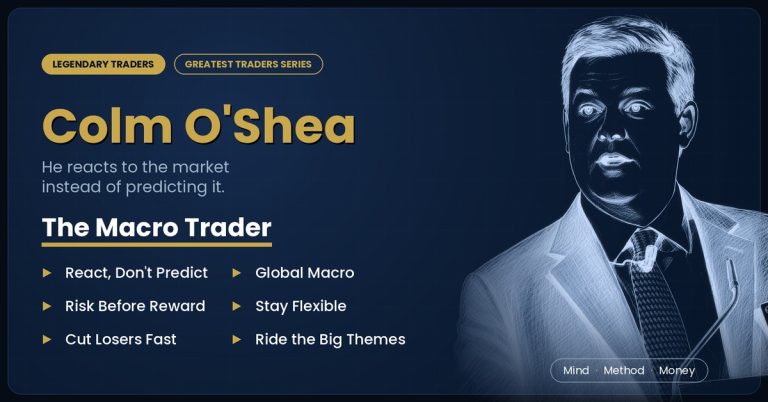
- Colm O’Shea — profiled alongside Woodriff in the same book, from the opposite, discretionary end.
- Market Wizards (book review) — our breakdown of the Schwager series Woodriff appears in.
- The Mind · Method · Money framework — the lens we use to read every trader on this site.
 The Complete Trader's Edge
The full Mind · Method · Money framework. 70 chapters.
View on Amazon →
The Complete Trader's Edge
The full Mind · Method · Money framework. 70 chapters.
View on Amazon →
 Market Mayhem
400 years of bubbles, crashes, and the pattern that keeps repeating.
Buy on Amazon →
Market Mayhem
400 years of bubbles, crashes, and the pattern that keeps repeating.
Buy on Amazon →
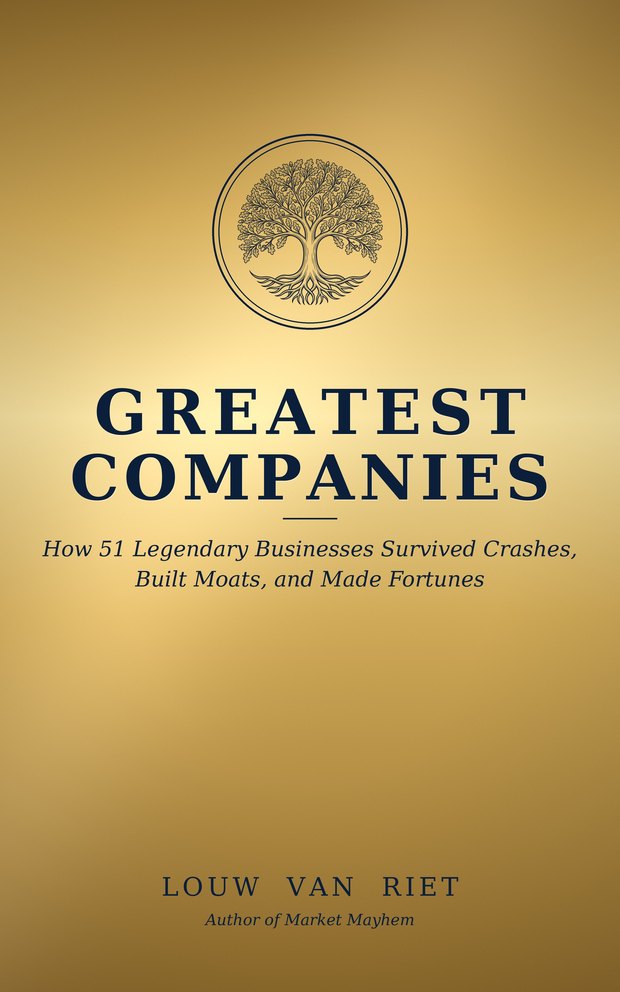 Greatest Companies
How the world's greatest companies were built — and what traders learn from them.
View on Amazon →
Greatest Companies
How the world's greatest companies were built — and what traders learn from them.
View on Amazon →
 Greatest Traders
Eighty-six lives that explain the markets — Livermore to Madoff, told with the losses left in.
View on Amazon →
Greatest Traders
Eighty-six lives that explain the markets — Livermore to Madoff, told with the losses left in.
View on Amazon →