

Most “best UK broker” pages rank firms on spreads, which is the wrong first question. In Britain the account type decides more about your outcome than the broker does. The same £10,000 and the same strategy produce three different tax bills and three different levels of protection depending on which wrapper you put them in, and no amount of tight pricing recovers a wrapper mistake.
So this page is organised the way the decision actually works: pick the wrapper, then pick the firm that is good at it. That is also why the honest answer for many readers is a boring platform they will never see advertised.
This is the broker guide the Trading in the United Kingdom hub points at.
Step one: which wrapper are you actually in?
| Wrapper | Best for | Tax | Leverage | Protection |
|---|---|---|---|---|
| Stocks and Shares ISA | Long-horizon investing | None on gains or dividends | None | FSCS to £85,000 |
| SIPP | Retirement, decades out | Relief in, sheltered growth | None | FSCS to £85,000 |
| Spread bet | Short-term speculation, profitably | None – and no loss relief | Up to 30:1 | FSCS to £85,000 |
| CFD | Short-term, with losses worth using | CGT 18% or 24% | Up to 30:1 | FSCS to £85,000 |
| General investment account | Overflow once ISA is full | CGT 18% or 24%, plus 0.5% SDRT on shares | None | FSCS to £85,000 |
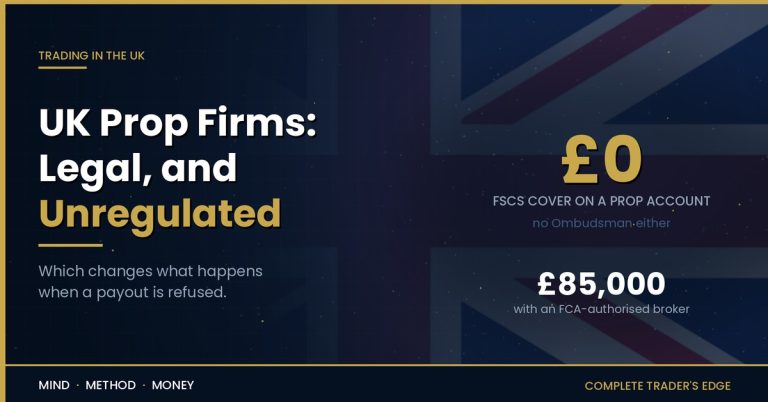
| Prop evaluation | Trading size you do not have | Income tax and Class 4 NI | Firm’s own rules | None |
Two things jump out of that table. The ISA is the only row where the tax column and the protection column are both in your favour, which is why it should be full before anything else is considered. And the last row is the only one with nothing in the protection column at all – covered in detail in the UK prop-firm guide.
The filter that comes before any comparison
Before pricing, before platform, before anything: is the firm on the Financial Services Register, with the right permissions, under the exact entity name you are about to send money to? Check the firm reference number against the website’s own footer, and use the contact details on the Register rather than the ones on the page in front of you. Clone firms copy everything except the phone number.
Authorisation is what turns “they seem reputable” into FSCS cover up to £85,000 per eligible person per firm and a free, binding route to the Financial Ombudsman Service. It is the only part of broker selection that cannot be fixed later.
One number, before the marketing.
Every UK CFD and spread-betting provider must publish the percentage of its own retail accounts that lose money. It is in small text at the bottom of the homepage, it is firm-specific rather than an industry average, and it is the most honest number on any broker’s website. Read it on every firm you shortlist. If it changes your mind about the product rather than the provider, it has done its job.
Investing: ISA and SIPP platforms
This is the category that matters most to the most people and gets the least coverage on trading sites, because the affiliate money is thinner. The broad shapes:
Percentage-fee platforms
A charge of a fraction of a percent on the value held. Cheapest on small pots, and quietly expensive once the portfolio grows into six figures. Most fund-focused platforms work this way.
Flat-fee platforms
A fixed monthly or annual charge regardless of size. Worse on small balances, materially better once the pot is large. The crossover point is the whole decision, and it is arithmetic rather than opinion.
Commission-free app brokers
Free or near-free dealing, funded by other revenue lines. Usually fine for regular investing; check FX conversion charges on overseas shares and what the withdrawal terms are.
Full-service brokers
Wider instrument access including US options and direct market access. Overkill for an index-fund investor, necessary for anyone trading overseas markets directly – see our Interactive Brokers review.
The main FCA-authorised platforms, by what they are actually built for. Charges change, so run the arithmetic on your own balance using each provider’s current fee page before opening anything.
| Platform | Shape | Suits |
|---|---|---|
| Hargreaves Lansdown | Percentage-fee, full-service, ISA and SIPP | Investors who want research, service and everything in one place, and will pay for it |
| AJ Bell | Percentage-fee with caps, ISA and SIPP | The middle ground – cheaper than full-service, wider than the app brokers |
| interactive investor | Flat monthly fee, ISA and SIPP | Larger pots, where a fixed charge beats a percentage by a widening margin |
| Vanguard UK | Own-fund only, ISA and SIPP | Index investors who want one provider and no temptation to tinker |
| InvestEngine | ETF-only, ISA | ETF portfolios built once and topped up automatically |
| Trading 212 | App broker, ISA | Regular small investing, fractional shares, low friction |
| Freetrade | App broker, ISA and SIPP | Same, with a pension option attached |
Two structural points that outlast any fee table. A flat fee beats a percentage above a certain balance, and that crossover is arithmetic you can do in a minute rather than an opinion to outsource. And a restricted range is a feature for most people – a platform that only holds index funds removes an entire category of expensive decisions.
Trading: spread bet and CFD providers
Here the shortlist is short by design, because the FCA rules mean the products are more standardised than the marketing suggests. Leverage, close-out and negative balance protection are identical across every authorised firm. What differs is execution, instrument range, platform and financing cost.
| Firm | Shape of the offer | CTE review |
|---|---|---|
| IG | The largest UK provider, spread betting and CFDs on the same platform, very wide instrument range | IG review |
| Pepperstone | Execution-focused, MetaTrader and cTrader, aimed at active FX and index traders | Pepperstone review |
| Interactive Brokers | Direct market access, futures and options, the serious multi-asset route | Interactive Brokers review |
Confirm the UK entity and its permissions on the Financial Services Register in each case. Large groups operate several entities under similar names, and the protections differ between them – the entity you contract with is the one that matters, not the brand on the homepage.
The four costs people forget
- Overnight financing. On leveraged positions this is the dominant cost of anything held beyond a few days, and it dwarfs the spread difference people shop on. A swing trader choosing on spreads alone is optimising the wrong variable.
- FX conversion. Buying US shares in a GBP account incurs a conversion charge each way. On a portfolio built from regular purchases this compounds into real money, and it is often larger than the dealing commission it sits next to.
- Platform and exit fees. Monthly charges, inactivity fees, and in some cases a per-holding charge to transfer out. Check the exit cost before you enter – it is the fee nobody reads until they want to leave.
- Stamp duty. 0.5% on most electronic purchases of UK shares, unavoidable and unrelated to your broker. It applies inside an ISA too, which surprises people.
The honest recommendation
For most readers: fill the ISA first, on the cheapest platform for your balance size, and leave it alone. No leverage, no tax, no reporting, full FSCS cover. If that sounds like a strange thing to read on a site with prop-firm links, it is the same position the rest of this site takes – the boring route beats most active retail traders over a full year, and saying otherwise would be selling.
If you are trading actively, the wrapper question is the spread bet versus CFD decision, which turns on whether you expect to need your losses. Only then does broker choice matter, and then it is execution and financing rather than headline spread.
If you are considering a funded account, read the prop-firm guide first. The protection column in that first table is empty for a reason.
Where this sits in Mind, Method, Money
Broker selection is Money, and it is mostly about what happens on your worst day rather than your average one. The FSCS limit matters when a firm fails. The Ombudsman matters when a decision goes against you. Segregated client money matters when neither of those is enough. None of it shows up in a spreads comparison, and all of it shows up exactly once, at the worst possible moment.
Match a firm to how you actually trade with the broker matchmaker, and size the position properly with the trading calculators.
Frequently asked questions
What is the best broker for UK traders?
There is no single answer, because the wrapper decides more than the firm. For long-horizon investing, the cheapest FCA-authorised ISA platform for your balance size. For active trading, an authorised spread bet or CFD provider chosen on execution and financing rather than headline spread. Check any firm on the Financial Services Register first.
Do I need an FCA-regulated broker?
You are not legally required to use one, but outside the perimeter there is no FSCS cover, no Financial Ombudsman Service and no regulator to escalate to. The protections exist precisely for the situations where you have no other recourse, which is why the check is worth two minutes.
Is my money safe with a UK broker?
With an authorised firm, client money is subject to segregation rules and eligible claims are covered by the FSCS up to £85,000 per person per firm if the firm fails. That is protection against firm failure, not against losing money in the market.
Should I use an ISA or a trading account?
If the horizon is years, the ISA, every time – no CGT, no dividend tax, and the £20,000 annual allowance does not carry forward. Leveraged trading cannot be done inside an ISA, so an active trader needs a separate spread bet or CFD account regardless.
Which is cheaper, spread betting or CFDs?
The dealing costs are broadly comparable at the same firm, since both carry a spread and overnight financing. The real cost difference is tax: no CGT on spread bets and no usable losses, against CGT on CFD gains with allowable losses. Which is cheaper depends on whether you make money.
Can I use an offshore broker for higher leverage?
It is not illegal, but you lose FSCS cover, Ombudsman access and any regulatory recourse, and higher leverage makes an account failure more likely rather than less. The FCA’s 30:1 cap exists because of what happened to retail accounts without it.
Wrapper first, firm second.
Decide what you are actually doing, then use the broker matchmaker to narrow the firms. The tax side of the same decision is on the UK hub.
Sources: FCA Financial Services Register and Warning List; FCA Policy Statement PS19/18 for retail leverage limits, margin close-out and negative balance protection; Financial Services Compensation Scheme investment cover of £85,000 per eligible person per firm; HMRC rules on ISAs, Capital Gains Tax at 18% and 24% with a £3,000 annual exempt amount for 2026/27, and stamp duty reserve tax at 0.5% on electronic purchases of UK shares. Firm offerings, fees and entity structures change; verify on the provider’s own materials and on the Register before opening an account. Last reviewed 26 September 2026.
Affiliate disclosure. CTE earns commission on some outbound links at no additional cost to you. It does not influence which firms are included or how they are assessed. Not tax, legal or financial advice.
 The Complete Trader's Edge
The full Mind · Method · Money framework. 70 chapters.
View on Amazon →
 Market Mayhem
400 years of bubbles, crashes, and the pattern that keeps repeating.
Buy on Amazon →
 Greatest Companies
How the world's greatest companies were built — and what traders learn from them.
View on Amazon →
 Greatest Traders
Eighty-six lives that explain the markets — Livermore to Madoff, told with the losses left in.
View on Amazon →