

The Reality of Day Trading · Step 1: Pre-Session Bias · Step 2: Trade Only the Kill Zones · Step 3: The Core Intraday Setup · Step 4: Risk, Stops & the Daily Stop · A Session, Trade by Trade · Why Most Day Traders Fail · Mind, Method, Money · FAQs
Most day trading content sells a fantasy: a screen full of green, a beach, a Lambo. The reality is a job that demands more discipline per hour than almost any other, where your biggest enemy is not the market but your own urge to click. A day trading strategy that survives is mostly a set of rules for protecting you from yourself.
This is that strategy. It is built on the blended method we use everywhere on the site, focused into a single session: a bias formed before the open, trades taken only inside the Kill Zones, one repeatable setup, and a hard 1% risk per trade with a daily stop on top. If you are brand new and want to understand the mechanics first, read day trading for beginners, then come back for the framework that turns mechanics into a method.
The Reality of Day Trading
Day trading means opening and closing your positions inside the same session, holding nothing overnight. Done well, it removes gap risk and gives you fast feedback. Done badly, it becomes a slot machine that pays you in dopamine and charges you in capital.
The instruments that day trade well are liquid and volatile during the main sessions: NQ and ES (Nasdaq and S&P futures), Gold (XAUUSD), and for the experienced, Bitcoin. Gold is our primary teaching instrument because it respects structure and gives clean Kill Zone moves. You do not need ten markets. One or two that you know intimately beats a watchlist you cannot follow.
Step 1: Pre-Session Bias
You never open the session and “see what happens.” That is how accounts die. Before the market opens, you do the same top-down read every day. Daily chart for the directional bias, 4H to mark the levels, and the economic calendar to flag any red-folder news.
On the Daily, read structure: are we making higher highs and higher lows, or the reverse? That sets whether you are hunting longs or shorts today. On the 4H, mark your Order Blocks, unfilled Fair Value Gaps, the daily and weekly pivots, and the prior session high and low (the obvious liquidity pools). By the time the session opens, you already know the two or three prices where a trade could happen. You are waiting, not searching.

Step 2: Trade Only the Kill Zones
Time is a filter, and most traders ignore it. The market moves with purpose during specific windows when institutional volume is active, and chops aimlessly the rest of the day. Trading outside those windows is how good setups turn into bad fills.
The two windows that matter are the London Kill Zone and the New York Kill Zone, the opening hours of each major session. That is when liquidity is deep, moves trend, and your levels actually get respected. Outside the Kill Zones, your default action is to do nothing. “Do nothing” is a position, and often the most profitable one on the screen.
| Window | Why It Matters |
|---|---|
| London Kill Zone | First clean directional move of the day; sets the early bias |
| New York Kill Zone | Highest volume window; best follow-through on NQ, ES and Gold |
| Outside Kill Zones | Low-conviction chop; default to no trade |
Confirm the exact clock hours of each Kill Zone for your timezone and instrument before trading. Session times shift with daylight saving.
Step 3: The Core Intraday Setup
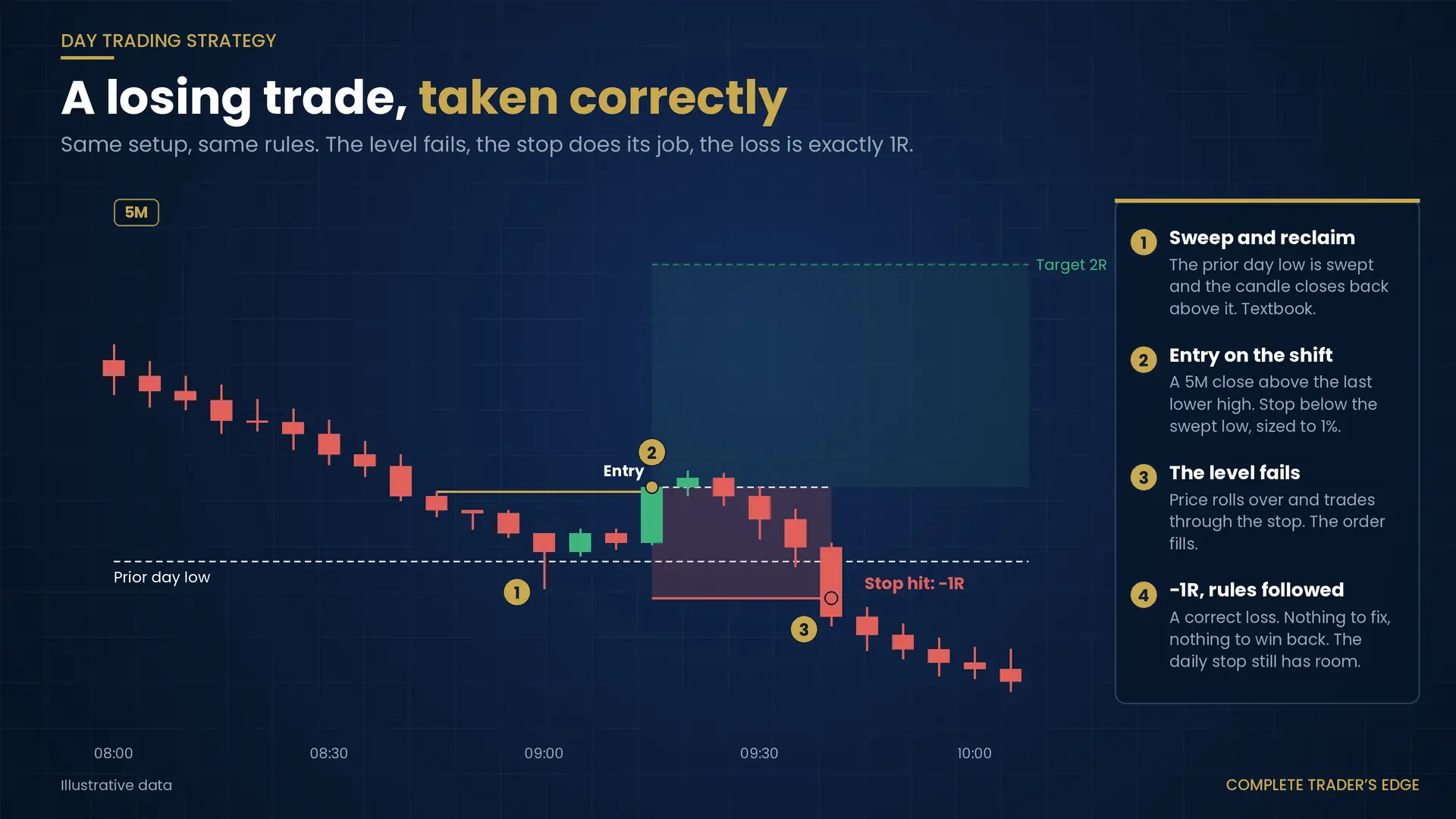
You only need one setup that you can execute in your sleep. Ours is the liquidity sweep into a key level, taken on the 15M and triggered on the 1M or 5M, in the direction of your Daily bias.
Here is the sequence. Price runs into one of your pre-marked levels, an Order Block or unfilled FVG that lines up with a pivot. It then sweeps the liquidity just beyond it, taking out the obvious stops (the prior session low on a long, for example). The moment price reverses and closes back inside the level on your trigger timeframe, you enter, with the sweep’s extreme as your stop reference. The sweep is not noise; it is smart money filling orders before the move you want to ride.


Step 4: Risk, Stops & the Daily Stop
Every trade risks a fixed 1% of your account. Your stop sits beyond the swept extreme, where the setup is proven wrong, and you size the position so that distance equals 1%. Size from the stop, never from the profit you are imagining. This is identical to every other strategy on the site because risk is the one thing that never changes.
Day trading needs a second layer that swing trading does not: a daily stop. Decide in advance the maximum you will lose in one session, for example two losing trades, or 2% of the account, whichever comes first. When you hit it, you are done for the day. No “making it back.” This single rule is what stops a normal red day from becoming the day you blow the account, and it is the difference between a professional and a gambler.
Plan your contracts and your daily stop
Pick your instrument, set your stop in points and your daily loss limit. The planner returns the contracts to trade and exactly how many full-risk losses you can take before the daily stop ends your session.
Day Trading Position & Daily-Stop Planner
Contracts to trade, plus how many losses until your daily stop closes the platform.
A Session, Trade by Trade
Picture a normal Gold session. The Daily bias is bullish. In the pre-session map, the trader marks a 4H Order Block at a price that also holds the daily pivot, and notes the prior session low just beneath it as liquidity.
The London Kill Zone opens. Price drifts down into the zone, sweeps the prior session low, and snaps back inside the Order Block. On the 1M, structure shifts up. That is the entry, stop below the swept low, target at the prior swing high a little over 2R away. The trade runs to target inside the hour. The trader is up 2R, banks it, and, crucially, does not force a second trade just because the screen is on. Flat, green, done. The discipline to stop is the strategy.
Why Most Day Traders Fail
The strategy above is not complicated. So why do most day traders lose? Not because they lack a setup, but because they break the rules around it.
They trade outside the Kill Zones. Boredom in the dead hours leads to low-quality trades that drain the account between the good windows. The fix is to literally close the platform when the Kill Zone ends.
They have no daily stop. One bad trade becomes revenge trading, which becomes a 6% day, which becomes a story they tell themselves about “almost making it back.” The daily stop ends that story before it starts.
They oversize. The 1% rule feels too slow, so they push size to feel something, and a normal losing streak that 1% would have survived becomes account death. Costs matter too: spreads and commissions quietly tax every trade, so over-trading is expensive even when your win rate is fine.
None of these are strategy problems. They are discipline problems, which is why the Mind pillar matters as much as the setup. If you cannot keep these rules, day trading may simply be the wrong style for your temperament, and there is no shame in choosing a slower one.
How This Fits Mind, Method, Money
A day trading strategy is the Mind, Method, Money framework under pressure and on a clock. The Method is the bias and the sweep-into-level setup inside the Kill Zones. The Money is the 1% risk plus the daily stop, the two rules that keep a bad session from becoming a fatal one. The Mind is the hardest part: the discipline to wait for the window, take the trade, and then stop.
Day trading rewards the trader who has built systems so their discipline does not depend on willpower. Get the three pillars aligned and you have a process you can repeat session after session. Skip the Mind work and the best setup in the world will not save you.
The full method, including the Mind work that makes the daily stop stick, is in The Complete Trader’s Edge. New to it all? Start with day trading for beginners. Find the platforms and brokers we use on the Trading Tools page.
Frequently Asked Questions
Is day trading profitable for beginners?
For most beginners, no, not at first. The mechanics are learnable quickly, but the discipline (trading only the Kill Zones, holding to 1% risk, honouring a daily stop) takes time to build. Treat the first phase as tuition, trade small, and expect a learning curve measured in months.
What is the best day trading strategy?
The best strategy is one repeatable setup you can execute without hesitation, traded only in high-volume windows with fixed risk. Ours is a liquidity sweep into a key level inside the Kill Zones, with the Daily bias as a filter. Simplicity you can follow beats complexity you cannot.
How much can you make day trading?
There is no honest fixed answer, and anyone promising one is selling something. Returns depend on your edge, your discipline, and your account size, and most new traders lose before they earn. Focus on consistent execution and protecting capital; the returns are a result, not a target.
What are Kill Zones in day trading?
Kill Zones are the high-volume opening windows of the London and New York sessions, when institutional activity drives clean directional moves. Trading inside them, and standing aside outside them, is one of the simplest ways to improve your average trade quality.
Why do most day traders lose money?
Not from bad setups, but from broken rules: trading outside the high-volume windows, skipping the daily stop, revenge trading after a loss, and oversizing. The strategy is rarely the problem; discipline around it usually is.
 The Complete Trader's Edge
The full Mind · Method · Money framework. 70 chapters.
View on Amazon →
The Complete Trader's Edge
The full Mind · Method · Money framework. 70 chapters.
View on Amazon →
 Market Mayhem
400 years of bubbles, crashes, and the pattern that keeps repeating.
Buy on Amazon →
Market Mayhem
400 years of bubbles, crashes, and the pattern that keeps repeating.
Buy on Amazon →
 Greatest Companies
How the world's greatest companies were built — and what traders learn from them.
View on Amazon →
Greatest Companies
How the world's greatest companies were built — and what traders learn from them.
View on Amazon →
 Greatest Traders
Eighty-six lives that explain the markets — Livermore to Madoff, told with the losses left in.
View on Amazon →
Greatest Traders
Eighty-six lives that explain the markets — Livermore to Madoff, told with the losses left in.
View on Amazon →