

What Swing Trading Actually Is · Why It Suits People With Jobs · Step 1: Build Your Bias (Daily & 4H) · Step 2: The Entry · Step 3: Stops, Targets & Sizing · Step 4: Managing a Trade You Cannot Watch · A Full Trade, Start to Finish · Where This Strategy Fails · Mind, Method, Money · FAQs
You do not need to stare at a screen all day to trade well. In fact, for most people with a job, a family, or a life, staring at the screen is the problem, not the edge. Swing trading is the answer that the industry quietly buries under day-trading hype: you make your decisions on the higher timeframes, place your orders, and let the market come to you over days, not minutes.
This is a complete swing trading strategy, built on the same blended method we use across the whole site: ICT structure for where to look, volume and pivots for objective levels, and strict risk for staying alive. It is written for the part-time trader who wants a repeatable process, not a dopamine hit. If you are still deciding whether swing or intraday trading fits you at all, start with our breakdown of swing trading versus day trading, then come back here for the actual system.
What Swing Trading Actually Is
Swing trading means holding a position for anywhere from two days to a few weeks, aiming to capture one clean leg of a larger move. You are not trying to scalp the noise. You are trying to catch the “swing” between one structural level and the next.
The instruments that swing well are the ones that trend and respect structure: stocks and indices for multi-week moves, plus Gold (XAUUSD) and Bitcoin (BTC) for traders comfortable holding through overnight and weekend gaps. Gold is our primary example throughout the site because it trends cleanly and respects Order Blocks and Fair Value Gaps with unusual reliability.
The trade-off versus intraday trading is simple and honest. You take fewer trades, so each one matters more, and you accept overnight risk in exchange for not having to babysit the chart. That exchange is a good deal for a person with a day job. It is a bad deal for someone who needs constant action, and you should know which one you are before you start.
Why It Suits People With Jobs
A swing strategy is built around three or four decisions a week, not three or four hundred. You do your analysis in the evening, set your orders, and check in once a day. The market does the waiting for you.
This matters for more than convenience. Most retail accounts are not destroyed by bad analysis; they are destroyed by overtrading, revenge trading, and screen fatigue. Removing yourself from the screen removes the three most expensive psychological mistakes in trading. The structure of the strategy is the risk control.
Step 1: Build Your Bias (Daily & 4H)
Every swing trade starts top-down. Before you look for an entry, you answer one question: where is this market trying to go on the higher timeframe? Bias first, entry second, always.
On the Daily chart, read the market structure. A series of higher highs and higher lows is a bullish structure; lower highs and lower lows is bearish. A Break of Structure (BOS) confirms the trend is continuing; a Change of Character (CHOCH) is your first warning that it may be turning. You only want to take longs in a bullish structure and shorts in a bearish one. Trading against Daily structure is the single most common way swing traders bleed out.
Then drop to the 4H chart to refine the level you will trade from. This is where you mark your Order Blocks and Fair Value Gaps, overlay weekly and daily pivots, and note any high-impact news (NFP, FOMC, CPI) that could land while you hold. The more of these factors that stack at one price, the higher the probability. We call that confluence, and it is the whole game.

Step 2: The Entry
You do not chase a swing trade. You wait for price to come back to your level. The cleanest swing entry is a pullback into a higher-timeframe zone: a 4H Order Block, an unfilled Fair Value Gap, or a prior support level that now sits inside the 0.618 to 0.702 Fibonacci retracement of the move.
The highest-probability version adds a trigger. Wait for price to sweep the liquidity just beyond your level (a quick stop hunt below support), then close back inside it. That liquidity sweep is smart money filling orders before the real move, and it is your signal that the level is holding. Price action is king here; the indicators only confirm what structure already told you.
For a working entry checklist, all of these should agree before you commit:
| Confluence Factor | What You Want To See |
|---|---|
| Daily structure | Trade is with the trend, not against it |
| 4H zone | Price is pulling into an Order Block or unfilled FVG |
| Fib | Level sits in the 0.618–0.702 retracement zone |
| Pivot / AVWAP | A weekly pivot or AVWAP anchored to the last swing aligns with the zone |
| Trigger | A liquidity sweep then a close back inside the level |

Step 3: Stops, Targets & Sizing
This is where swing trading is won or lost, and it has nothing to do with being clever. Your stop goes beyond the structure that invalidates the trade, not at a round number and not at an amount you “feel” comfortable losing. On a long, that is below the swing low your entry zone is built on. If price closes below it, your reason for being in the trade is gone.
Your first target is the next opposing liquidity pool or structural level: the prior swing high, an unfilled FVG above, or the value-area high on the volume profile. As a baseline we target a minimum of 1:2 risk-to-reward, and we will hold for 1:3 or more when the structure gives room. If a setup cannot offer at least 1R of reward for 1R of risk, it is not a trade.
Then size the position so the distance from entry to stop equals exactly 1% of your account. One percent, every time, no exceptions. Because swing stops are wider than intraday stops, your position size will be smaller, and that is correct. You are sizing to the risk, never to the reward you are dreaming about. This single rule outlasts every clever entry technique you will ever learn.
Size your next swing in seconds
Drop in your account size, entry, stop and target. The calculator sizes the position from your stop and tells you whether the trade clears the 1:2 minimum before you take it.
Swing Position Size & R:R Calculator
Size every swing from the stop, never the reward. 1% risk by default.
Step 4: Managing a Trade You Cannot Watch
The entire point of swing trading is that you are not at the screen. So your trade management has to survive your absence. Set your stop and your first target as live orders the moment you enter. The trade should be able to play out, win or lose, while you are at work or asleep.
Once price reaches roughly 1R in your favour, move your stop to break-even. Now the worst case is a scratch, and you can hold the rest of the position toward the larger target without anxiety. This is how you let a multi-day winner run without giving back open profit on a pullback you were not awake to see.
Manage on the close, not the wick. Swing decisions are made off the Daily and 4H candle closes, not off every intraday spike that pokes a level. Reacting to wicks is how part-time traders turn a winning swing system into an exhausting intraday one by accident.
A Full Trade, Start to Finish
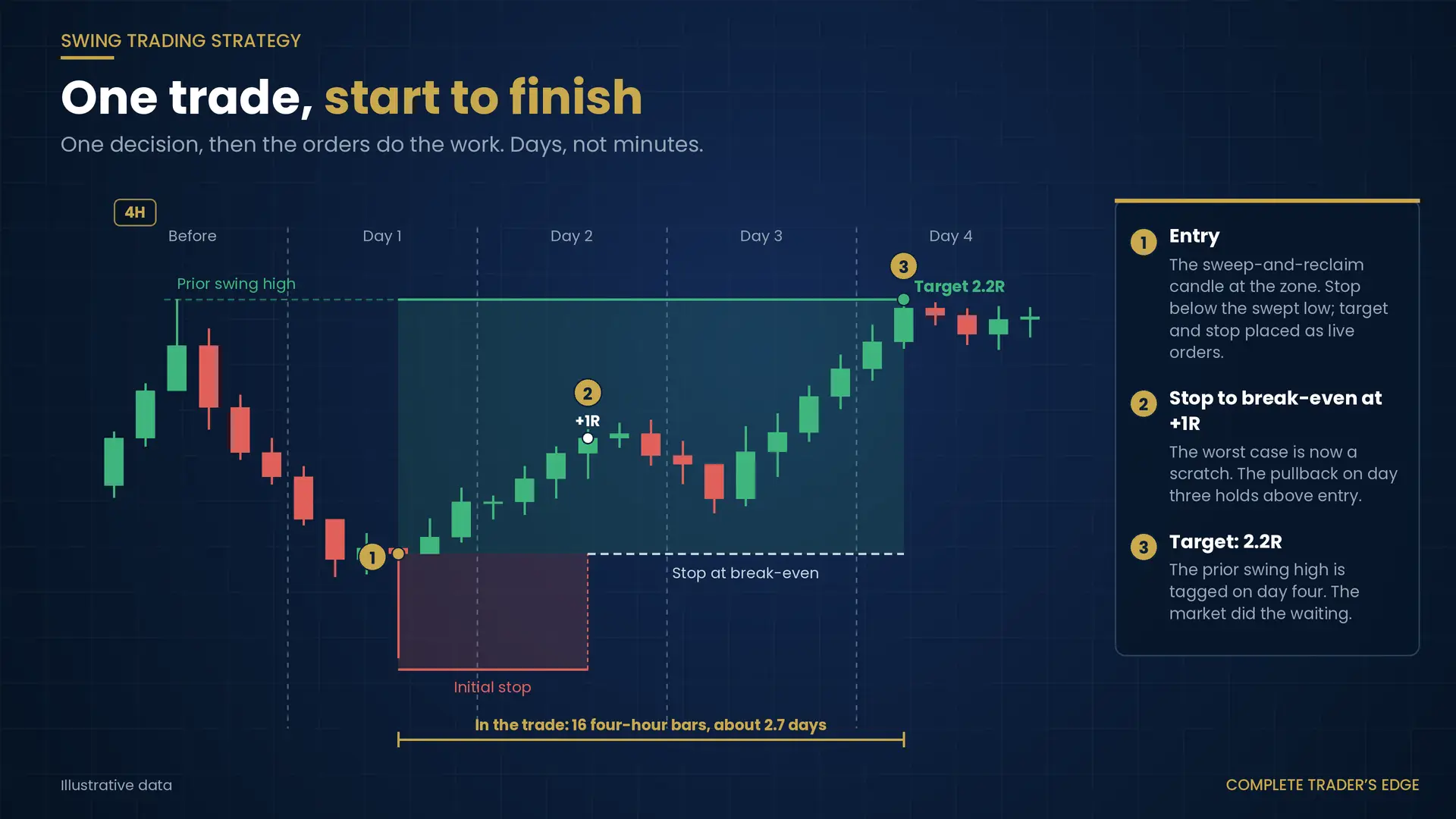
Here is how the four steps come together on a typical trade. The bias was bullish on the Daily after a clean Break of Structure. Price pulled back over two sessions into a 4H Order Block that lined up with the 0.618 retracement and the weekly pivot. Late in the London session, price swept the liquidity just below the zone and closed back inside it. That was the entry.
The stop went below the swept low. The first target was the prior swing high, a little over 1:2 away. The order sat live for three days while ordinary life continued. At +1R the stop moved to break-even; the pullback that followed held above entry, and price ran to target on the fourth day. One decision, three days of patience, just over 2R. That is the whole job.
Where This Strategy Fails (Read This Part Twice)
No honest strategy guide ends at the winning example. Here is what actually goes wrong, so you can see it coming.
Overnight and weekend gaps. A swing position is exposed while the market is closed. A gap through your stop on a Monday open or after a news shock can cost more than your planned 1%. This is the real price of not watching, and it is why we size conservatively and avoid holding full size into known event risk.
Trading against Daily structure. The most common swing failure is taking a “great-looking” 4H setup that fights the Daily trend. The higher timeframe wins. If the Daily and 4H disagree, you stand aside.
Death by patience-failure. Swing trading punishes the need for action. Traders who cannot sit on their hands start widening stops, entering early before the sweep, or adding to losers in hope. Each of those is a separate way to convert a sound system into a blown account. If you find yourself doing this, the problem is not the strategy, it is the style fit, and that is worth being honest about.
How This Fits Mind, Method, Money
Swing trading is one of the cleanest expressions of our Mind, Method, Money framework. The Method is the blended read: structure, Order Blocks, pivots, and a liquidity-sweep trigger. The Money is the fixed 1% risk and the size-from-stop discipline that keeps you in the game across hundreds of trades. And the Mind is the quiet part, the patience to wait days for the market to come to you instead of forcing a trade out of boredom.
That last pillar is the one most traders skip, and it is the one swing trading demands most. Get all three working together and you have a strategy you can run for years around a full-time life.
This strategy is the Method and Money pillars in action. Go deeper in The Complete Trader’s Edge, compare your options in Swing vs Day Trading, and find every charting and broker tool we use on the Trading Tools page.
Frequently Asked Questions
How much money do I need to start swing trading?
Enough that 1% of the account is a meaningful but survivable risk per trade, and enough to size positions properly given wider swing stops. There is no magic number, but undersized accounts force oversized risk, which is the fastest way to fail. Many traders use a funded account to swing larger size while keeping personal capital at risk to a minimum.
What is the best timeframe for swing trading?
Build your bias on the Daily and refine entries on the 4H. Some traders drop to the 1H for a more precise trigger, but the decision-making lives on the higher timeframes. Anything lower and you are drifting toward day trading.
Can I swing trade with a full-time job?
Yes, and that is exactly who this strategy is for. You analyse in the evening, set your orders, and check once a day. The strategy is designed to run without you watching the screen.
What is a good risk-to-reward ratio for swing trades?
Aim for a minimum of 1:2, and take 1:3 or more when the structure allows. If a setup cannot offer at least double your risk to the next clear target, skip it.
Is swing trading less risky than day trading?
It removes overtrading and screen-fatigue risk, but it adds overnight and weekend gap risk. Neither is safer in the abstract. The right choice depends on your schedule, temperament, and how you handle holding a position you cannot watch.
 The Complete Trader's Edge
The full Mind · Method · Money framework. 70 chapters.
View on Amazon →
The Complete Trader's Edge
The full Mind · Method · Money framework. 70 chapters.
View on Amazon →
 Market Mayhem
400 years of bubbles, crashes, and the pattern that keeps repeating.
Buy on Amazon →
Market Mayhem
400 years of bubbles, crashes, and the pattern that keeps repeating.
Buy on Amazon →
 Greatest Companies
How the world's greatest companies were built — and what traders learn from them.
View on Amazon →
Greatest Companies
How the world's greatest companies were built — and what traders learn from them.
View on Amazon →
 Greatest Traders
Eighty-six lives that explain the markets — Livermore to Madoff, told with the losses left in.
View on Amazon →
Greatest Traders
Eighty-six lives that explain the markets — Livermore to Madoff, told with the losses left in.
View on Amazon →