

On a winter night at the very end of 1900, the most important number in American business was written on a single sheet of paper.
Charles Schwab, the president of Carnegie Steel and no relation to the brokerage that would later carry the name, had given a dinner speech in New York about a vision of one great steel company that could end the ruinous price wars tearing the industry apart. In the audience sat J. P. Morgan, the most powerful banker in the country. Morgan was transfixed. He arranged a private meeting, talked through the night, and asked Schwab a blunt question: what would it take to buy Andrew Carnegie out entirely?
Schwab carried the question to Carnegie. The old Scotsman, sixty-five years old and already dreaming of giving his fortune away, thought it over and scrawled a figure on a slip of paper. The number was four hundred and eighty million dollars. Schwab walked it back to Morgan, who glanced at it and accepted without negotiation. The richest industrial empire on Earth had changed hands in a sentence. By the famous account, Morgan later shook Carnegie’s hand and told him he was now the richest man in the world.
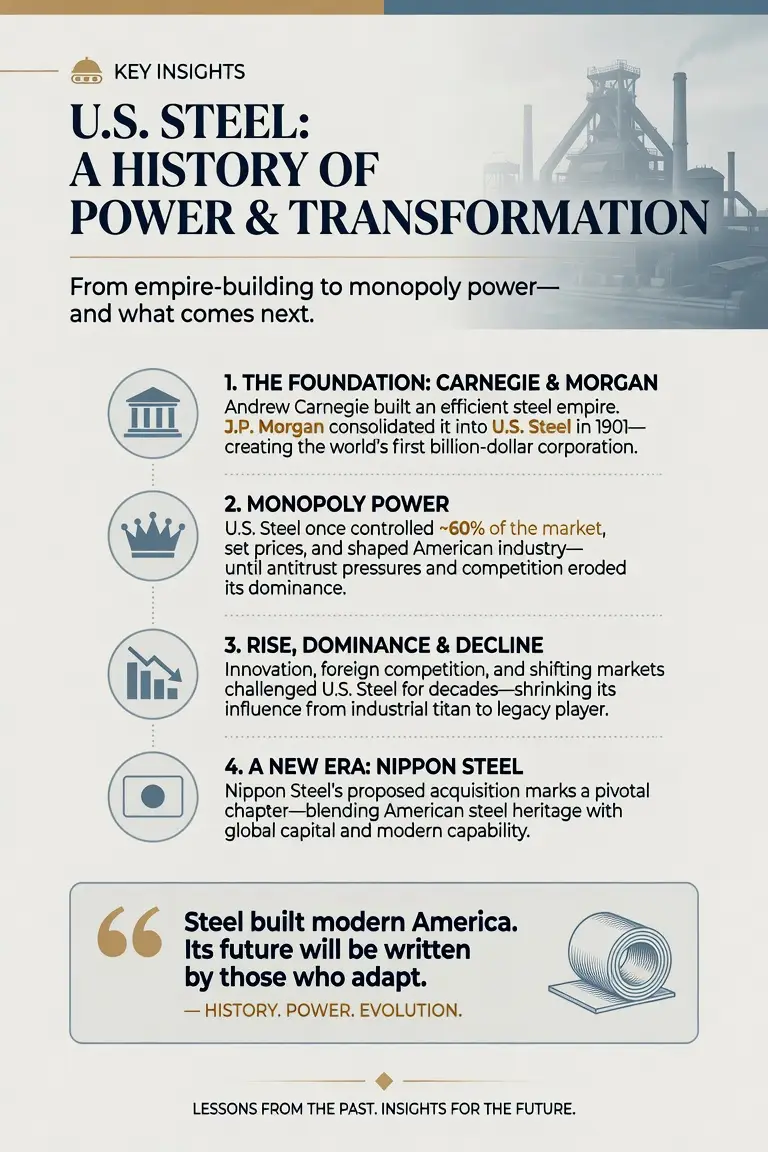
That handshake created United States Steel, the largest, most powerful, most envied corporation the world had ever seen. And the deepest lesson of its story is not how it was born. It is how something that began as the apex of an entire civilization could spend the next hundred and twenty years quietly becoming smaller, until the same federal government that once tried to break it apart had to step in to keep it from disappearing into foreign hands.
📄 Free Download · Company Research Sheet
U.S. Steel Research Sheet (PDF)
The moat, the meltdown, the Legendary Scorecard, the timeline, and the Move, Money and Mind lessons from this story. Free, no email required.
The World of Ruinous Competition
Steel in 1900 was the bloodstream of the industrial age. It built the railroads, the skyscrapers, the bridges, the warships and the machines that were turning the United States into the most productive nation on the planet. Andrew Carnegie had ridden that wave better than anyone. A penniless Scottish immigrant who started as a bobbin boy in a cotton mill, he built Carnegie Steel into a colossus through relentless cost control and vertical integration, owning the iron ore, the coke, the railroads and the mills, so that nothing he needed had to be bought at someone else’s markup. By the turn of the century his company alone made roughly a quarter of the world’s steel.
But the industry around Carnegie was a war of attrition. Dozens of producers fought for the same customers, slashing prices in good years and bleeding in bad ones. Morgan despised this kind of competition. To a banker who had spent his life imposing order on chaos, the steel industry looked like a fire that needed to be put out before it consumed the capital invested in it. He had already assembled Federal Steel in 1898. Now he wanted to fold Carnegie and the rest into one structure so large that the price wars would simply end, because there would be almost no one left to fight.
The Birth of the Billion-Dollar Corporation
In the first months of 1901, Morgan executed the largest financial transaction the world had ever seen. He merged Carnegie Steel with Federal Steel, National Steel and a string of other producers, ten companies in all, into a single corporation. He pulled in John D. Rockefeller’s iron ore holdings around Lake Superior and the largest commercial shipping fleet on the Great Lakes, incorporated the result in New Jersey, and called it the United States Steel Corporation.
The numbers were almost unreal. US Steel was capitalized at one and four-tenths billion dollars. To grasp what that meant, consider that the entire federal government of the United States spent only about five hundred and seventeen million dollars that same year. The new company was worth nearly three times the budget of the nation it was named after.
Critics charged that the capitalization was inflated, padded with what the era called watered stock, valuing the combined company at far more than its assets and earnings could justify. A government study later put the real value of the underlying properties closer to seven hundred million dollars. The gap between the two figures was, in a sense, Morgan’s fee for imposing order, and a bet that the order itself would be worth the premium.
At its founding the corporation controlled an enormous share of American steel, by most measures around two-thirds of national output, and it employed roughly one hundred and sixty-eight thousand workers. Charles Schwab became its first president, though he would leave within two years to build a rival at Bethlehem Steel. Elbert Gary, a careful Illinois judge, became chairman and ran it for a quarter century. On Wall Street they stopped calling it by its name. They simply called it the Corporation, as if there were no other.
The Corporation. It was so large that the market gave it a definite article. Not a company among companies, but the company, the one whose scale defined the scale of everything else.
The Trial Standard Oil Lost, and US Steel Won
For the first decade of its life, US Steel lived under a shadow. The same public anger that had built against Standard Oil was building against it. Here was another combination so large it seemed to threaten the very idea of a competitive economy, and in 1911 the federal government sued to break it apart under the Sherman Antitrust Act.
The timing could not have been sharper. That same year, the Supreme Court ordered Standard Oil dissolved into more than thirty separate companies. The era of the trust was supposedly ending. Surely, the reasoning went, the greatest trust of them all would be next.
It was not. In 1920, after years of argument, the Supreme Court ruled four to three that United States Steel was not an illegal monopoly and would not be broken up. The Court leaned on the same principle it had used against Standard Oil, the rule of reason, but reached the opposite conclusion. Size alone, the justices held, was no offense under the law. What mattered was conduct. And by the time the case was decided, the company’s most aggressive practices had already stopped. The infamous Gary dinners, gatherings where Gary had hosted his competitors to coordinate prices, had been discontinued before the suit was even filed. The Court found a giant, but it did not find an ongoing crime.
It was a stunning victory, and it answered the question that the Standard Oil case had raised: not every monopoly was illegal. Behavior, not bigness, was the test. For US Steel it meant survival, intact and whole. And here begins the tragedy, because survival turned out to be the worse outcome.
The Decision Point. It is 1920. You are Elbert Gary. You have just kept the largest corporation in the world intact in the face of the federal government. You control a huge share of a critical industry. The road forks.
A. Press your scale relentlessly, reinvest in the newest technology, and widen the gap before rivals catch up, accepting that aggression might invite another antitrust fight.
B. Hold steady, bank your profits, keep the peace with competitors and regulators, and protect what you have.
C. Use the company’s enormous cash to diversify beyond steel entirely, hedging against the day the industry matures.
US Steel chose B, and over time drifted toward C. This is a thought experiment about choosing growth or safety after you have already won, not investment advice.
What Everyone Gets Wrong
Mistake #1: Confusing the Charles Schwab of US Steel with the brokerage. The Charles Schwab who became the first president of US Steel and later built Bethlehem Steel was a Gilded Age steel man, born in 1862. The discount brokerage that bears the name was founded decades later by a different Charles Schwab. Reality: Two famous American businessmen, the same common name, no connection.
Mistake #2: Believing US Steel was broken up like Standard Oil. It was sued in the same era, under the same law, on the same logic. Reality: The 1920 Supreme Court ruling left it whole. It was the monopoly the antitrust era could not, or would not, dismantle.
Mistake #3: Assuming the biggest company stays the biggest. US Steel was the most valuable corporation on Earth at its birth. Reality: It spent the next century shrinking in relative terms, and ended as the subsidiary of a foreign rival, delisted from the exchange where it had traded for over a hundred years.
Mistake #4: Reading the 2025 takeover as a simple foreign buyout. The deal looked routine. Reality: It triggered an eighteen-month political war, a presidential block, a reversal, and an extraordinary arrangement in which the US government took a golden share to retain veto power over the company’s most basic decisions.
The Honest Present
In December 2023, Japan’s Nippon Steel, one of the largest steelmakers in the world, offered to buy United States Steel for fifty-five dollars a share, an all-cash deal valuing the company at roughly fourteen and nine-tenths billion dollars. What followed was less a transaction than a national argument. The United Steelworkers union opposed it. President Biden blocked it in early 2025 on national security grounds. After a change in administration, the deal was reviewed again, renegotiated, and finally approved in mid-2025, on terms no one had seen before.
To win approval, Nippon agreed to keep the headquarters in Pittsburgh, to staff the board and management largely with American citizens, to invest billions of dollars more into US Steel’s plants, and to grant the US government a so-called golden share. That golden share gave Washington veto power over a list of decisions that struck at the heart of corporate sovereignty: idling plants, cutting capacity, moving jobs overseas, changing the company’s name, relocating its headquarters, or selling parts of it off. In June 2025 the takeover closed, and United States Steel stopped trading on the New York Stock Exchange after more than a century.
Step back and the symmetry is almost too perfect. In 1920, the federal government tried to break US Steel apart and was told by the Supreme Court that it could not. In 2025, the federal government insisted on a golden share to keep the same company from being hollowed out, this time not to dismantle it but to preserve it. The state that once wanted it gone now refused to let it leave. United States Steel had traveled the entire arc of corporate power, from a giant too strong for the law to touch, to a national asset the law had to protect.
Why This Matters to Investors
The Greatest Companies Thesis
Every legendary company begins with an idea that looks improbable.
Every one survives a stretch where failure looks inevitable.
Every one eventually reaches a point where success looks obvious.
The opportunity exists only in the space between the second and third.
US Steel is the cautionary twin of every great-company story. Most of the legends in this collection are tales of moats that held, of dominance that compounded for decades. US Steel is the reminder that a moat is a snapshot, not a guarantee. It held the widest moat in the world in 1901 and still lost, because the source of that moat, sheer industrial scale, became less and less valuable as smaller, faster, cheaper producers changed what scale even meant. The investor’s job is not to admire the size of a moat today. It is to ask whether the thing that creates the moat will still matter in twenty years. None of this is investment advice; it is a way of reading history.
Lessons in Order of Depth
Method: study the source of the moat, not its size
US Steel’s advantage was scale and vertical integration, a genuine moat in 1901. But once minimills could melt scrap cheaply in small plants, the advantage of a vast integrated mill became a burden of high fixed costs. The method is to identify what specifically makes a company hard to compete with, then ask what would have to change in the world for that specific thing to stop mattering.
Money: the spread is the politics
When Nippon offered fifty-five dollars a share in late 2023, the stock traded well below that for a year and a half. That gap was not irrationality. It was the market pricing the probability that the deal would be blocked. Anyone trading the spread was, whether they admitted it or not, making a bet on Washington, not on steel. Event-driven returns are paid to whoever reads the politics most accurately.
Mind: winning can be more dangerous than losing
The most haunting fact about US Steel is that its decline began the moment it won. After 1920 it chose to protect rather than to press, and the protection slowly became decay. Comfort is the enemy that no competitor can inflict on you. Only you can do it to yourself. The hardest discipline in business and in markets is to keep attacking after you have already won the argument.
The deepest question: is survival always the goal?
Standard Oil was broken into pieces, and the pieces flourished into some of the most valuable companies in history. United States Steel was spared the breakup, kept whole, and slowly withered for a century. Set the two side by side and an unsettling question appears. Is it better to be forced apart and renewed, or to be left intact and allowed to age? Sometimes the thing that looks like a defeat is the gift, and the thing that looks like victory is the curse. Endurance and vitality are not the same thing, and a company, like a person, can outlive its own greatness by a very long time.
The Legendary Scorecard
| Founder Vision | 7 |
| Innovation | 4 |
| Execution | 5 |
| Moat | 7 |
| Capital Allocation | 4 |
| Wealth Creation | 6 |
| Durability | 4 |
| Historical Importance | 10 |
| Overall | 6.0 |
The overall figure is an editorial verdict, not a weighted average. US Steel earns a perfect ten for historical importance, because few companies shaped a nation’s industrial age more completely, and because its 1920 court victory rewrote antitrust law for decades. But it scores low on durability, innovation and capital allocation, because the rest of its story is a long lesson in how dominance decays when a company stops trying to earn it.
At a Glance
| Founded | 1901, by merger, incorporated in New Jersey |
| Assembler | J. P. Morgan, the most powerful banker of the age |
| First chairman | Elbert H. Gary, who ran it for a quarter century |
| Core seller | Andrew Carnegie, for about $480 million |
| Capitalization at birth | $1.4 billion, the world’s first billion-dollar corporation |
| Peak market share | Roughly two-thirds of US steel |
| 2024 revenue | About $15 billion |
| Acquired | 2025, by Nippon Steel, at $55 per share |
| Status | Wholly owned subsidiary, delisted from the NYSE |
Timeline
- 1892: Carnegie consolidates his mills into Carnegie Steel
- 1898: Morgan forms Federal Steel
- 1900: Schwab’s dinner speech sets the merger in motion
- 1901: Morgan buys out Carnegie and incorporates US Steel at $1.4 billion
- 1901: the company makes roughly two-thirds of America’s steel
- 1911: the federal government files its antitrust suit
- 1920: the Supreme Court rules four to three that US Steel is not an illegal monopoly
- 1982: US Steel buys Marathon Oil and diversifies
- 1986: the company is renamed USX
- 2001: it spins off Marathon and becomes United States Steel again
- 2023: Nippon Steel offers $55 per share
- 2025: President Biden blocks the deal, then a new administration approves it with a golden share
- 2025: the takeover closes and US Steel leaves the New York Stock Exchange
Key Numbers
$480 million the price Carnegie wrote on a slip of paper
$1.4 billion US Steel’s capitalization at birth, the first in history
$517 million total US federal spending in 1901, for comparison
Two-thirds the company’s share of American steel at its founding
About 12% its share of US steel by 2023
$55 the per-share price Nippon Steel paid in 2025
Related Reading
If US Steel is the giant the law could not break, these stories trace the same forces from different angles. Read how Standard Oil faced the identical antitrust logic and was shattered into pieces that went on to flourish, the exact opposite fate to US Steel’s intact decline. See how Alphabet now stands where these old giants once stood, a modern colossus facing its own antitrust reckoning in the long shadow of the 1911 and 1920 rulings. And study how General Electric shows the same pattern in living memory, a great American industrial empire whose dominance hardened into a trap. For the full collection, see our Greatest Companies of All Time hub.
Go Deeper
US Steel is a study in the difference between being big and being durable, and in the quiet danger of growing comfortable after you have won. Those are the same qualities that separate traders who last from traders who fade, and the book teaches you the discipline to keep earning your edge instead of merely defending it.
★ Now in Kindle, Paperback & Hardcover
Greatest Companies
This story is one of fifty-one. The full book reads every legendary company through a single lens — Moat, Meltdown, Machine — from Standard Oil to SpaceX. Fifty-one companies, eight kinds of moat, one framework.
Kindle · $9.99 →
Paperback · $24.99 →
Hardcover · $34.99 →
Explore the Book →
This article is part of the Greatest Companies series, adapted from the book Greatest Companies, now available on Kindle.
Frequently Asked Questions
When was US Steel founded and by whom?
United States Steel was created in 1901 when the financier J. P. Morgan merged Carnegie Steel, Federal Steel, National Steel and several other producers into a single corporation, buying Andrew Carnegie out for about $480 million. It was incorporated in New Jersey and capitalized at $1.4 billion, making it the world’s first billion-dollar corporation.
Why was US Steel called the first billion-dollar company?
Its capitalization at birth was about $1.4 billion, an unheard-of figure at the time. For comparison, the entire United States federal government spent only around $517 million that year, so the new company was valued at nearly three times the national budget.
Was US Steel ever broken up like Standard Oil?
No. The federal government sued under the Sherman Antitrust Act in 1911, the same era Standard Oil was dissolved, but in 1920 the Supreme Court ruled four to three that US Steel was not an illegal monopoly. The Court held that size alone was no offense without ongoing anti-competitive conduct, and its price-coordinating Gary dinners had already stopped.
Why did US Steel decline?
After its 1920 court victory the company chose caution over growth, avoiding expansion that might invite another lawsuit. It was slow to modernize, lost ground to nimbler rivals and to low-cost minimills, and faced rising foreign competition. Its share of American steel fell from roughly two-thirds at its founding to around 12% by 2023.
Who owns US Steel now?
Japan’s Nippon Steel acquired United States Steel in 2025 for $55 per share, roughly $14.9 billion, after an eighteen-month political fight. The deal was approved only when the US government received a golden share giving it veto power over major decisions. US Steel is now a wholly owned subsidiary of Nippon Steel and no longer trades on the New York Stock Exchange.
 The Complete Trader's Edge
The full Mind · Method · Money framework. 70 chapters.
View on Amazon →
The Complete Trader's Edge
The full Mind · Method · Money framework. 70 chapters.
View on Amazon →
 Market Mayhem
400 years of bubbles, crashes, and the pattern that keeps repeating.
Buy on Amazon →
Market Mayhem
400 years of bubbles, crashes, and the pattern that keeps repeating.
Buy on Amazon →
 Greatest Companies
How the world's greatest companies were built — and what traders learn from them.
View on Amazon →
Greatest Companies
How the world's greatest companies were built — and what traders learn from them.
View on Amazon →
 Greatest Traders
Eighty-six lives that explain the markets — Livermore to Madoff, told with the losses left in.
View on Amazon →
Greatest Traders
Eighty-six lives that explain the markets — Livermore to Madoff, told with the losses left in.
View on Amazon →