

There are thousands of trading books on Amazon. Most of them recycle the same surface-level advice. A few of them will fundamentally change the way you think about markets, risk, and yourself as a trader. This list contains only the second kind.
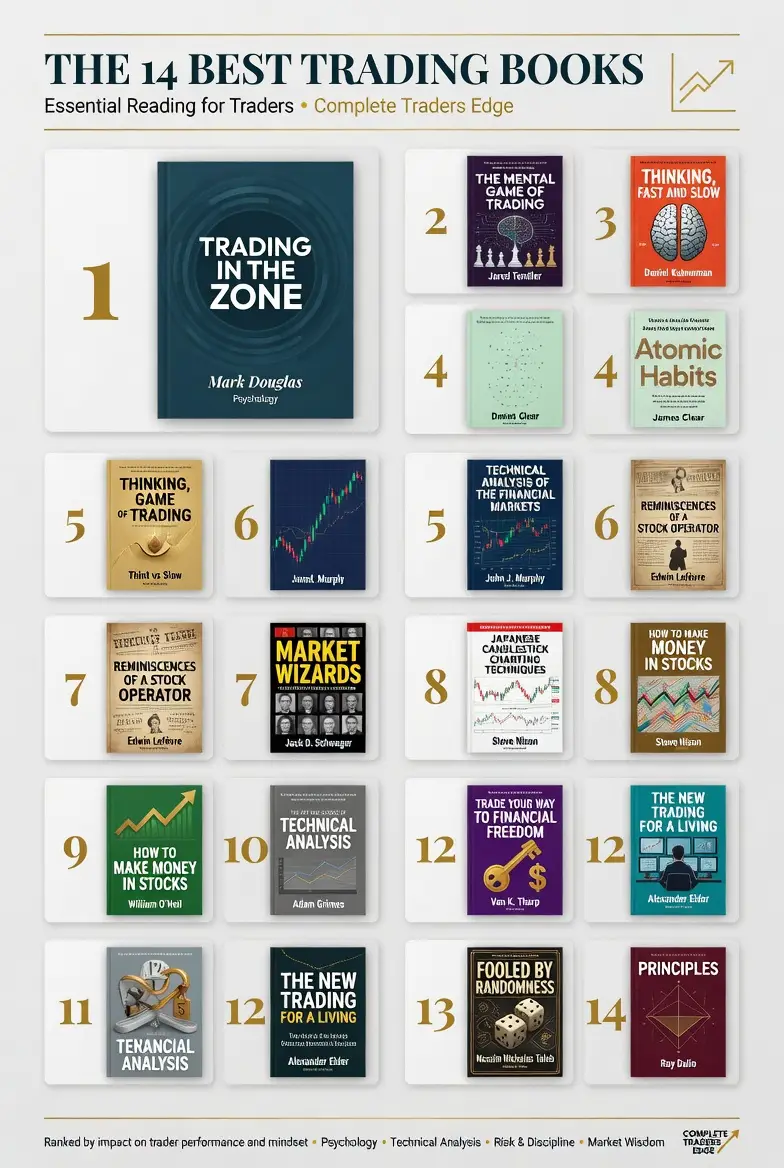
Every book here has been selected because it teaches something that cannot be easily learned any other way — a mental model, a framework, or a perspective that shifts how you approach trading at a structural level. They are organised by the three pillars of our framework: Mind, Method, and Money. Because the order you read them in matters, we have numbered them in the sequence we recommend for developing traders.
Mind: Trading Psychology and Mindset
1. Trading in the Zone — Mark Douglas
If you read only one book on trading psychology, it should be this one. Douglas’s central thesis is that trading success is not primarily a function of market knowledge or analytical skill. It is a function of mental states — specifically, the ability to think in probabilities, accept uncertainty, and execute without emotional interference.
The book systematically dismantles the belief structures that cause traders to hesitate, revenge trade, and override their systems. It is not a light read. Douglas makes you confront why your mind resists doing what you know is correct, and then provides a framework for retraining your psychological response to risk and uncertainty.
Read this before you develop any strategy. Your mindset determines whether you can execute a strategy, and Douglas teaches you how to build the right one.
2. The Mental Game of Trading — Jared Tendler
Where Douglas provides the philosophical framework, Tendler provides the practical tools. A former mental game coach for professional poker players, Tendler applies sports psychology directly to trading performance. His approach treats emotional trading problems — revenge trading, fear of pulling the trigger, tilt after losses — as skill deficiencies that can be diagnosed and fixed, not character flaws.
The book introduces the concept of an “emotional range” — the span between your best and worst mental performance — and provides exercises to narrow that range so your worst days become less damaging. Essential reading for anyone who knows what they should do but struggles to do it consistently.
3. Thinking, Fast and Slow — Daniel Kahneman
Not a trading book, but possibly the most important book any trader can read. Kahneman’s Nobel Prize-winning research on cognitive biases explains exactly why human brains are poorly designed for trading: we overweight recent events, we anchor to irrelevant numbers, we fear losses roughly twice as much as we value equivalent gains, and we are systematically overconfident in our predictions.
Every psychological trap that destroys trading accounts — overconfidence, analysis paralysis, greed loops — is catalogued and explained in this book with rigorous experimental evidence. Once you understand these biases, you can design your trading process to account for them.
4. Atomic Habits — James Clear
Trading success is the compound result of daily habits, not occasional brilliant decisions. Clear’s framework for building positive habits and breaking destructive ones applies directly to every aspect of trading: maintaining a daily routine, journaling consistently, following rules even when it feels wrong, and building the identity of a disciplined trader one small action at a time.
The most powerful insight for traders: you do not rise to the level of your goals, you fall to the level of your systems. Build the systems — the routine, the process, the habits — and the results follow.
Method: Technical Analysis, Strategy, and Market Knowledge
5. Technical Analysis of the Financial Markets — John J. Murphy
The definitive reference for classical technical analysis. Murphy covers everything from market structure and trendlines to candlestick patterns, chart formations, indicators, and intermarket relationships. It is comprehensive without being overwhelming, and it treats each tool with the appropriate balance of respect and scepticism.
This is not a book you read once and shelve. It is a reference you return to repeatedly as your understanding deepens. Beginners will learn the vocabulary and framework of TA. Experienced traders will find chapters they glossed over the first time that suddenly make sense.
6. Reminiscences of a Stock Operator — Edwin Lefèvre
A fictionalised biography of Jesse Livermore, widely considered the greatest trading book ever written. Not because it teaches specific techniques, but because it captures the emotional reality of trading better than any textbook. The cycles of overconfidence and humiliation, the temptation to overtrade after a win, the pain of being right about the direction but wrong about the timing — Livermore lived all of it, a century before you did.
Read it early in your trading journey and you will see it as entertainment. Read it again after a year of live trading and you will see it as autobiography.
7. Market Wizards — Jack D. Schwager
Schwager interviews the top traders of the 1980s and 1990s, and the result is not a strategy book but a probability mindset book disguised as interview journalism. Every trader profiled has a different approach — trend following, counter-trend, macro, quantitative, discretionary — but the common threads are striking: discipline, risk management, self-awareness, and the willingness to be wrong.
The follow-up volumes (The New Market Wizards, Hedge Fund Market Wizards, and Unknown Market Wizards) are equally valuable. Unknown Market Wizards is particularly relevant for retail traders, as it profiles successful traders without institutional advantages.
8. Japanese Candlestick Charting Techniques — Steve Nison
The original Western introduction to candlestick analysis. Nison brought Japanese candlestick methodology to global markets and remains the definitive authority. This book goes far deeper than the pattern-name lists you find online — it explains the psychology behind each formation, the market context that makes them reliable or unreliable, and how to combine candlestick analysis with Western technical tools.
Pair this with our complete candlestick patterns guide for a practical framework you can apply immediately.
9. How to Make Money in Stocks — William O’Neil
O’Neil developed the CAN SLIM methodology — a systematic approach to finding growth stocks before they make major moves. Whether or not you trade stocks, the book’s treatment of relative strength, institutional sponsorship, and chart base patterns translates to any market where trend-following is viable.
Minervini’s SEPA methodology (covered in our Mark Minervini profile) is heavily influenced by O’Neil’s work. Reading both gives you the fullest picture of momentum-based stock selection.
10. The Art and Science of Technical Analysis — Adam Grimes
A modern, statistically rigorous treatment of technical analysis that asks the question most TA books avoid: does this actually work? Grimes, a professional trader and former CMT president, applies quantitative analysis to common TA claims and separates what is statistically valid from what is tradition and wishful thinking.
If you want to move beyond “this pattern usually means X” to “here is the statistical evidence that this pattern has a measurable edge in these conditions,” this book is essential.
Money: Risk Management, Position Sizing, and Capital Preservation
11. Trade Your Way to Financial Freedom — Van K. Tharp
The most important book on position sizing and expectancy ever written for traders. Tharp’s central insight — that position sizing determines your returns more than your entry signal — is the foundation of professional money management. He introduces the concept of R-multiples (measuring every trade as a multiple of your initial risk) and demonstrates how the same trading system produces dramatically different results depending on how positions are sized.
If you still think your entry signal is the most important part of your trading, this book will change your mind permanently.
12. The New Trading for a Living — Alexander Elder
Elder covers the full spectrum — psychology, technical analysis, and risk management — in a single integrated framework. The updated edition includes modern tools and markets while retaining the practical, no-nonsense approach that made the original a classic. His Triple Screen trading system demonstrates how to combine multiple timeframes and indicators into a coherent decision-making process.
Particularly valuable for multi-timeframe analysis and for traders who want a complete system rather than isolated techniques.
13. Fooled by Randomness — Nassim Nicholas Taleb
Taleb demolishes the human tendency to find patterns in randomness and to attribute skill to what is actually luck. For traders, this book is both humbling and liberating. Humbling because it forces you to question whether your recent winning streak is skill or variance. Liberating because it redirects your focus from outcomes (which are partly random) to process (which you can control).
His follow-up, The Black Swan, extends this thinking to rare, high-impact events — the kind that wipe out traders who are unprepared for tail risk.
14. Principles — Ray Dalio
Not a trading book in the conventional sense, but a systems-thinking book written by one of the most successful macro investors in history. Dalio’s framework for decision-making — radical truth, systematic testing of beliefs, learning from mistakes — translates directly into how you should build and refine your trading process.
Read it for the chapters on decision-making and principled thinking, and apply those frameworks to your own trading plan.
15. The Complete Trader’s Edge — Louw van Riet
This is the book that integrates everything on this list into a single framework. The Mind · Method · Money structure provides the organising principle that connects trading psychology, technical methodology, and capital management into a unified approach. It draws on the insights of every trader and researcher mentioned above while providing the structured, progressive curriculum that most standalone books lack.
Available now on Amazon Kindle and in paperback.
How to Use This List
Do not try to read all fifteen books in a month. Trading education is a multi-year process, and each of these books benefits from being read at the right stage of development.
If you are just starting: Begin with Trading in the Zone, Technical Analysis of the Financial Markets, and Trade Your Way to Financial Freedom. These three cover the psychology, methodology, and money management foundations.
If you are intermediate: Add Market Wizards, Thinking, Fast and Slow, and The Art and Science of Technical Analysis. These deepen your understanding of how professionals think and what the evidence actually supports.
If you are experienced: Read Fooled by Randomness, Principles, and The Mental Game of Trading. At this stage, your greatest gains come from refining your psychology and stress-testing your assumptions about what works and why.
And at every stage: The Complete Trader’s Edge ties it all together.
Reading List Summary
Mind: Trading in the Zone · The Mental Game of Trading · Thinking, Fast and Slow · Atomic Habits
Method: Technical Analysis of the Financial Markets · Reminiscences of a Stock Operator · Market Wizards · Japanese Candlestick Charting · How to Make Money in Stocks · The Art and Science of TA
Money: Trade Your Way to Financial Freedom · The New Trading for a Living · Fooled by Randomness · Principles · The Complete Trader’s Edge
 The Complete Trader's Edge
The full Mind · Method · Money framework. 70 chapters.
View on Amazon →
The Complete Trader's Edge
The full Mind · Method · Money framework. 70 chapters.
View on Amazon →
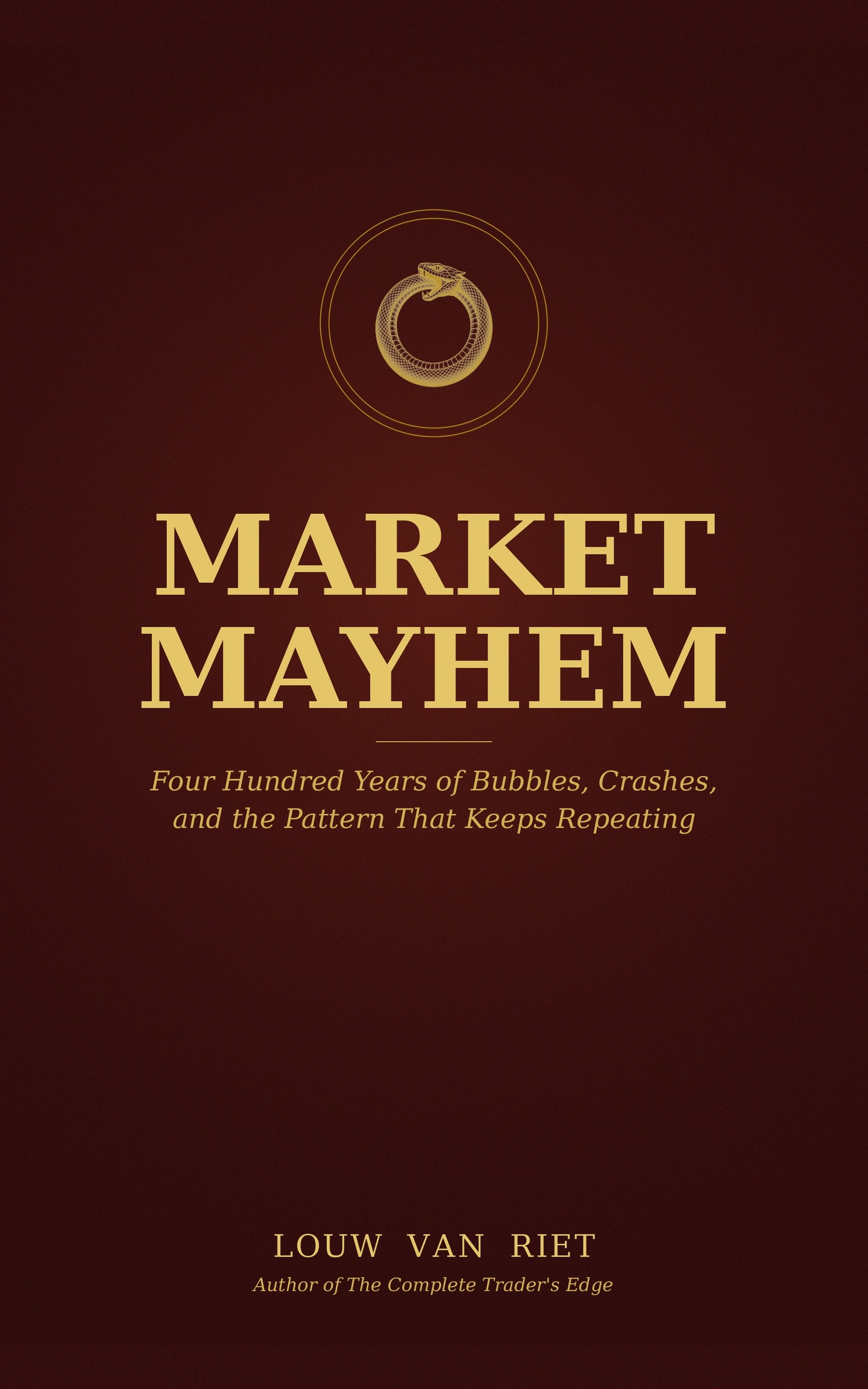 Market Mayhem
400 years of bubbles, crashes, and the pattern that keeps repeating.
Buy on Amazon →
Market Mayhem
400 years of bubbles, crashes, and the pattern that keeps repeating.
Buy on Amazon →
 Greatest Companies
How the world's greatest companies were built — and what traders learn from them.
View on Amazon →
Greatest Companies
How the world's greatest companies were built — and what traders learn from them.
View on Amazon →
 Greatest Traders
Eighty-six lives that explain the markets — Livermore to Madoff, told with the losses left in.
View on Amazon →
Greatest Traders
Eighty-six lives that explain the markets — Livermore to Madoff, told with the losses left in.
View on Amazon →