

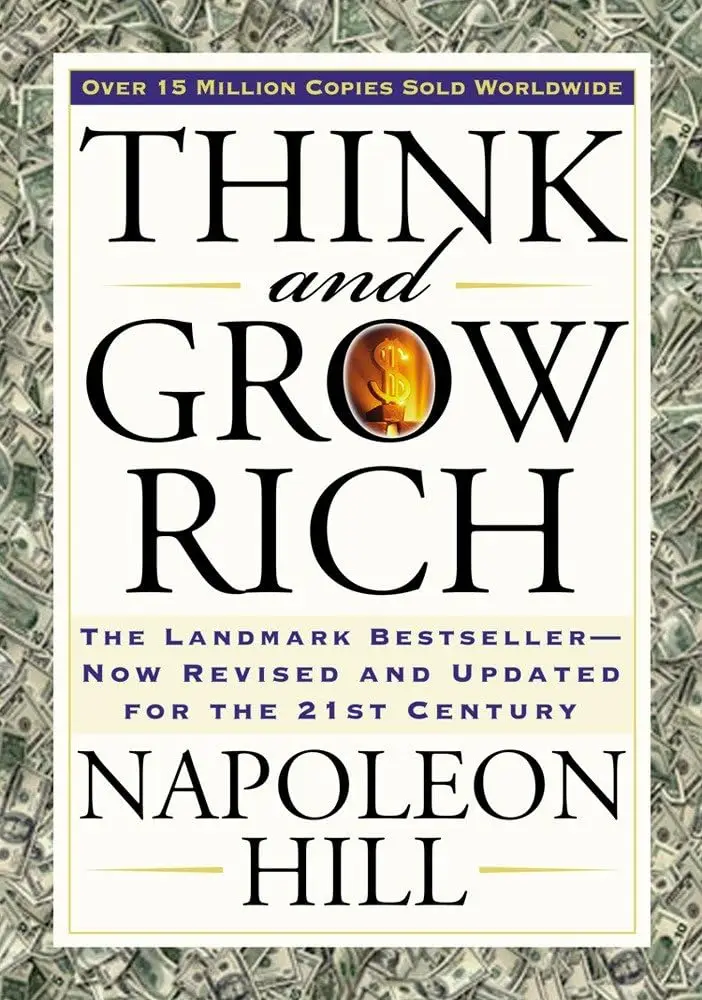
Napoleon Hill spent twenty years interviewing the wealthiest people in America, and the book he produced from that research has sold over 100 million copies. Think and Grow Rich, published in 1937, remains one of the most influential personal development books ever written. Its principles were drawn from industrialists, bankers, and entrepreneurs, but they apply to traders with a precision that Hill himself likely never anticipated.
The central thesis is deceptively simple: thoughts, when combined with definiteness of purpose, persistence, and a specific plan, produce tangible results. For traders, this is not mystical thinking. It is a description of how process-driven execution, combined with clear goals and psychological resilience, compounds into profitability over time.
Hill’s 1937 original. Read it as a study of conviction and persistence rather than as a method, and the trading parallels do the rest.
Definiteness of Purpose: The Trading Plan as a Non-Negotiable
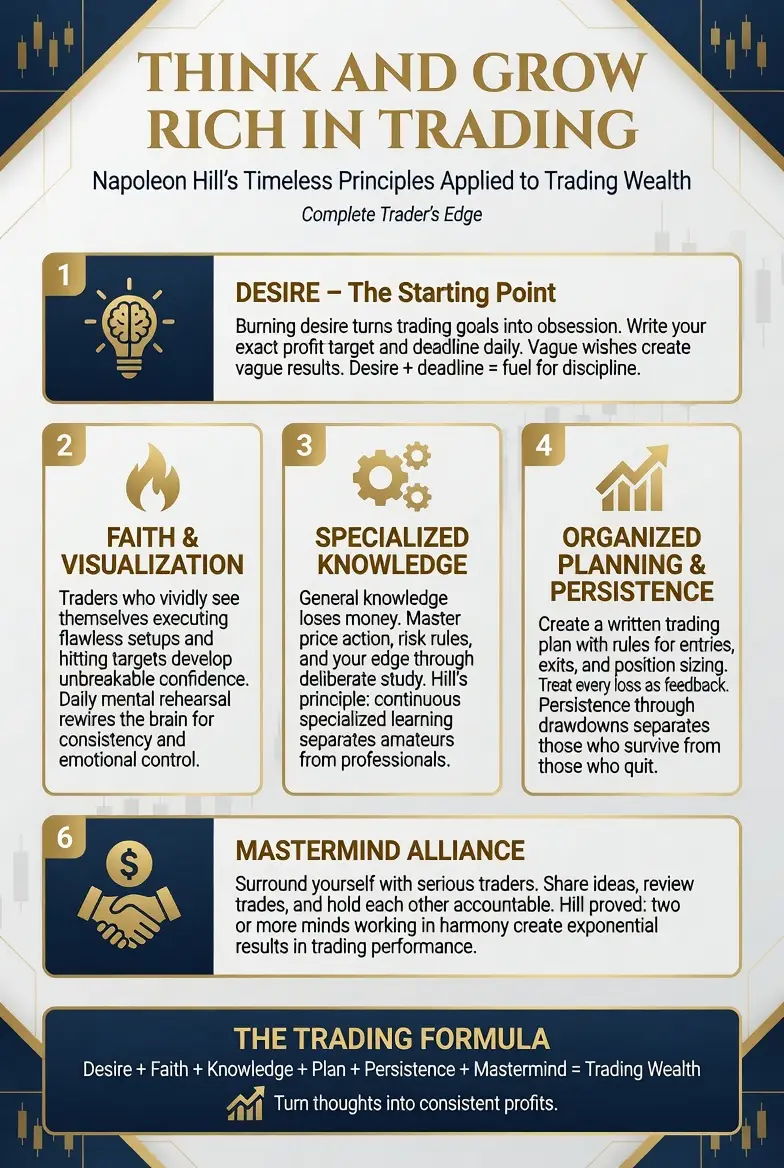
Hill’s first principle is that vague desire produces vague results. You must know exactly what you want, by when, and what you are willing to give in exchange. Most traders violate this principle fundamentally. They want to “become profitable” but have not defined what profitable means, what timeline they are committing to, or what sacrifices the journey requires.
| Key Concept | Original Context | Trading Translation |
|---|---|---|
| The 40% Rule | When your mind says quit, you are only at 40% capacity | The urge to close a winning trade early or skip the post-session review is your 40% wall. Push through. |
| Embrace discomfort | Growth happens exclusively outside your comfort zone | Trading demo forever is comfortable. Going live at minimum size is uncomfortable. Growth requires the latter. |
| Accountability mirror | Post your goals where you see them every morning | Print your trading rules and pin them next to your screen. Read them before every session. |
| Calloused mind | Build mental toughness through repeated exposure to difficulty | Each drawdown survived with discipline makes the next one easier. The mind adapts to what it practices. |
Hill’s framework applied to trading: “I will develop a consistently profitable trading system that produces a minimum 3R expectancy per month, within 18 months, by committing two hours daily to deliberate practice, journalling every trade, and following my risk management rules without exception.”
That is definiteness of purpose. It is measurable, time-bound, and specifies the price you will pay. It is also what a proper trading business plan looks like. Without this level of specificity, you are hoping rather than planning. Hill was emphatic: hope is not a strategy.
The Mastermind Principle: Why Isolated Traders Struggle
Hill’s Mastermind concept is one of his most practical contributions: surround yourself with people who are ahead of where you are, and meet regularly to exchange ideas, accountability, and support. He believed that the combined intelligence of a committed group exceeds the sum of its individual members.
Trading is a solitary profession, and this isolation is one of its greatest psychological hazards. The trader sitting alone at their desk, processing losses without external perspective, is vulnerable to every cognitive bias in the book. A mastermind group, whether a formal mentorship, a serious trading community, or even one trusted trading partner, provides the external feedback loop that keeps perception accurate and ego in check.
This connects directly to what the professional mindset requires: the willingness to seek and accept honest feedback about your trading, especially when that feedback is uncomfortable.
Persistence: The Principle That Separates the 10% from the 90%
Hill devoted an entire chapter to persistence because he found it was the single quality most common among his successful subjects and most absent among those who failed. He identified that most people quit not because their plan was wrong but because they lacked the persistence to execute it through temporary failure.
The trading application is stark. The typical retail trader tries a strategy for 30 trades, hits a drawdown, and switches to something new. They repeat this cycle for years, never giving any single approach enough trades to reveal whether it has edge. Hill would diagnose this immediately: lack of persistence, disguised as strategic adaptation.
Consistency in trading requires the commitment to execute one well-defined strategy across a statistically meaningful sample, typically 100 or more trades, before making any judgment about its effectiveness. This is persistence applied to the scientific method. Without it, you are sampling noise rather than signal.
Autosuggestion: Programming Your Trading Mind
Hill’s concept of autosuggestion, the practice of deliberately feeding your subconscious mind with specific, repeated statements of purpose, predates modern neuroscience’s understanding of neuroplasticity by decades. The mechanism is now well understood: repeated mental rehearsal strengthens neural pathways, making the rehearsed behaviour more likely under pressure.
For traders, autosuggestion is the pre-session incantation. Reading your trading rules aloud before the session. Visualising disciplined execution. Repeating your identity statement: “I am a disciplined, process-driven trader who follows rules and protects capital.” This is not affirmation for its own sake. It is deliberate neural programming that makes the right behaviour more accessible when the market tests you.
This connects to the priming ritual described in the Tony Robbins article in this series, and to Chapter 16 of The Complete Trader’s Edge on the pre-session routine.
The Subconscious Mind: Why You Sabotage Winning Trades
Hill taught that the subconscious mind accepts and acts upon whatever thoughts are most emotionally charged, regardless of whether those thoughts serve you. If your dominant emotional associations with trading are fear and inadequacy, your subconscious will produce behaviour consistent with those associations: hesitation, early exits, undersizing, avoiding valid setups.
This explains why traders who “know” the right thing to do still fail to do it. Their conscious mind understands the strategy. Their subconscious mind is running a different programme, one built from accumulated experiences of loss, fear, and self-doubt. Reprogramming requires what Hill described: persistent, emotionally charged repetition of the desired belief until it overwrites the old pattern.
Building your trader identity is the modern version of Hill’s subconscious reprogramming. Each disciplined trade is a piece of evidence that gradually overwrites the old narrative of failure with a new narrative of competence.
Organised Planning: Strategy as a Living Document
Hill distinguished between those who plan and those who merely wish. A plan, he argued, must be specific, written, reviewed regularly, and revised when evidence demands it. This is exactly what a trading routine and trade plan provide: a specific, written operating procedure that converts abstract goals into daily actions.
Hill also emphasised that the first plan almost never works perfectly. The key is to revise the plan without abandoning the purpose. Traders who switch strategies at the first sign of difficulty are not revising their plan. They are abandoning it. Traders who analyse their journal, identify specific weaknesses, and adjust one element at a time are doing exactly what Hill prescribed.
Putting It All Together: Hill’s Framework for Traders
Define your purpose with precision. Not “I want to make money trading.” But: what, how much, by when, and what will you sacrifice?
Build a mastermind. Find one mentor, one accountability partner, or one serious community. Trading alone is a psychological hazard.
Commit to persistence. Execute your strategy for a meaningful sample before judging it. Quitting after 30 trades is sampling noise, not signal.
Use autosuggestion. Read your rules aloud. Visualise disciplined execution. Programme your subconscious before each session.
Organise your plan. Write it down, review it weekly, revise the method when evidence demands it, and never abandon the purpose.
Hill’s work is nearly a century old, but the principles are timeless because human psychology has not changed. The trader who applies definiteness of purpose, persistence, and deliberate mental programming to a sound strategy is doing exactly what Hill’s most successful subjects did. The Mind, Method, and Money framework is, in many ways, Hill’s philosophy translated for the markets.
Continue Reading: The Inner Edge
▶ Tony Robbins & Trading Psychology
The Complete Trader’s Edge
This article is part of The Inner Edge series, exploring peak performance principles for traders.
Frequently Asked Questions
How does Think and Grow Rich apply to trading?
Hill’s principles of definiteness of purpose, persistence, autosuggestion, and organised planning map directly onto trading success. Defining exactly what profitability means to you, persisting through drawdowns with a statistically meaningful sample, programming your mind through pre-session rituals, and maintaining a written trading plan all come from Hill’s framework.
What is the mastermind principle for traders?
Hill’s mastermind principle means surrounding yourself with serious traders who provide honest feedback, accountability, and perspective. Trading in isolation makes you vulnerable to every cognitive bias. A mastermind group, whether formal or informal, provides the external reality check that keeps your perception accurate and your ego manageable.
How does autosuggestion help trading performance?
Autosuggestion works by repeatedly feeding your subconscious specific beliefs and intentions until they become your default operating mode. For traders, this means reading trading rules aloud, visualising disciplined execution, and repeating identity statements before each session. Modern neuroscience confirms this: repeated mental rehearsal strengthens the neural pathways that produce the rehearsed behaviour under pressure.
Why do most traders lack persistence?
Most traders quit a strategy after a short losing streak because they mistake normal statistical variance for strategy failure. Hill identified this as the most common cause of failure in any endeavour. A strategy needs a minimum of 100 trades to reveal whether it has genuine edge. Quitting after 20-30 trades is sampling noise, not signal, and guarantees you will never find consistency.
Is Think and Grow Rich still relevant for modern traders?
Yes. While the language is dated, the principles are timeless because human psychology has not changed. The need for clear purpose, persistent execution, mental programming, accountability, and written planning applies to trading as directly as it applied to the industrialists Hill interviewed nearly a century ago. The mechanism of success remains the same.
 The Complete Trader's Edge
The full Mind · Method · Money framework. 70 chapters.
View on Amazon →
The Complete Trader's Edge
The full Mind · Method · Money framework. 70 chapters.
View on Amazon →
 Market Mayhem
400 years of bubbles, crashes, and the pattern that keeps repeating.
Buy on Amazon →
Market Mayhem
400 years of bubbles, crashes, and the pattern that keeps repeating.
Buy on Amazon →
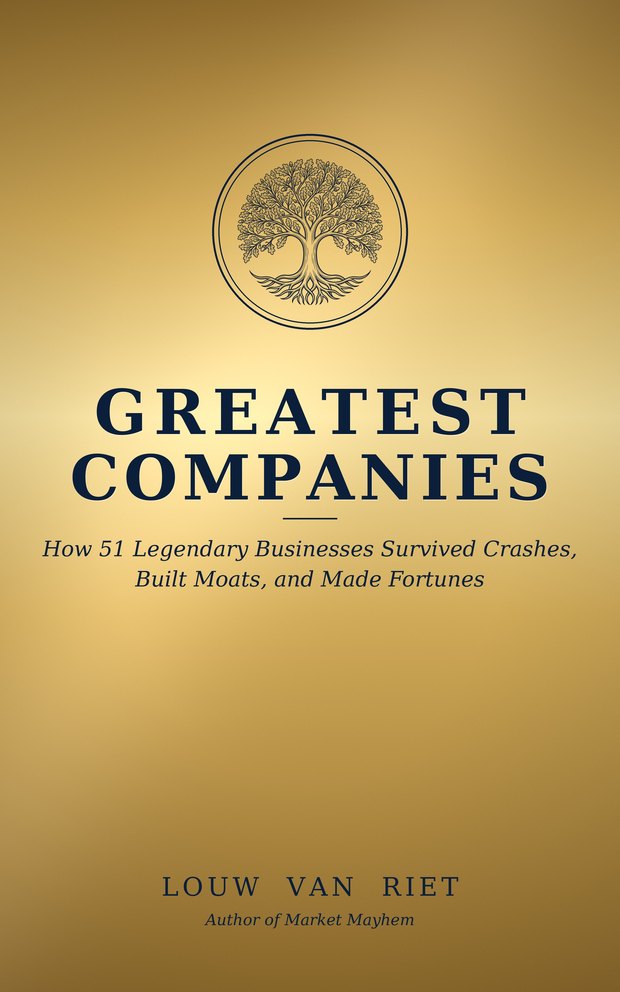 Greatest Companies
How the world's greatest companies were built — and what traders learn from them.
View on Amazon →
Greatest Companies
How the world's greatest companies were built — and what traders learn from them.
View on Amazon →
 Greatest Traders
Eighty-six lives that explain the markets — Livermore to Madoff, told with the losses left in.
View on Amazon →
Greatest Traders
Eighty-six lives that explain the markets — Livermore to Madoff, told with the losses left in.
View on Amazon →