

You cannot manage a risk you do not understand. Pips, lots and leverage are the three mechanics that decide how much you make or lose on every trade, and leverage is the one that quietly ends most beginner accounts.
Before you risk a cent, you need to understand how trades are measured and sized, because that is what risk management is built on. Three concepts do most of the work, and understanding leverage in trading is the most important of them: a pip measures how far price moves, a lot measures how big your position is, and leverage multiplies both your exposure and your risk. Get these straight and position sizing becomes simple arithmetic. Skip them and you are trading blind, which is how beginners turn a single bad trade into a blown account. This guide explains all three in plain language, then shows how they combine to determine your real risk.
What Is a Pip?
A pip is the standard unit for measuring how much a price has moved. In most currency pairs it is the fourth decimal place, so a move from 1.1000 to 1.1001 is one pip. It exists so traders can talk about price movement consistently regardless of the instrument. What matters for you is not the definition but the consequence: the number of pips between your entry and your stop, multiplied by your position size, is your risk on the trade in actual money. Pips are how you measure the distance; lots are how you turn that distance into a dollar amount.
What Is a Lot?
A lot is the unit of position size, how much of an instrument you are trading. The larger the lot, the more each pip of movement is worth, and therefore the more you make or lose per pip. Markets offer different lot sizes, from standard down to mini and micro lots, precisely so traders can scale position size to their account and risk. For a beginner, smaller lot sizes are the tool that lets you keep risk per trade sensible on a modest account. Choosing your lot size is the act of choosing how much each pip will cost you, which is the heart of position sizing.
What Is Leverage in Trading?
Leverage in trading is the ability to control a position larger than the cash in your account, using borrowed buying power from your broker. Expressed as a ratio such as 30 to 1, it means a small amount of your own capital controls a much larger position. The appeal is obvious: leverage magnifies your gains. The danger is exactly as large and almost always underestimated: leverage magnifies your losses by the same factor, and a small adverse move on a heavily leveraged position can wipe out a large chunk of your account in moments. Leverage does not change whether you are right or wrong. It only changes how violently being wrong is punished.
How Margin Fits In
Margin is the flip side of leverage: the amount of your own money the broker requires you to put up to open a leveraged position. If leverage is the multiplier, margin is the deposit that backs it. The critical thing to know is the margin call, the point at which losses erode your margin so far that the broker closes your positions automatically to stop the account going negative. Understanding margin keeps you from the nasty surprise of having positions liquidated at the worst possible moment.
How the Three Work Together
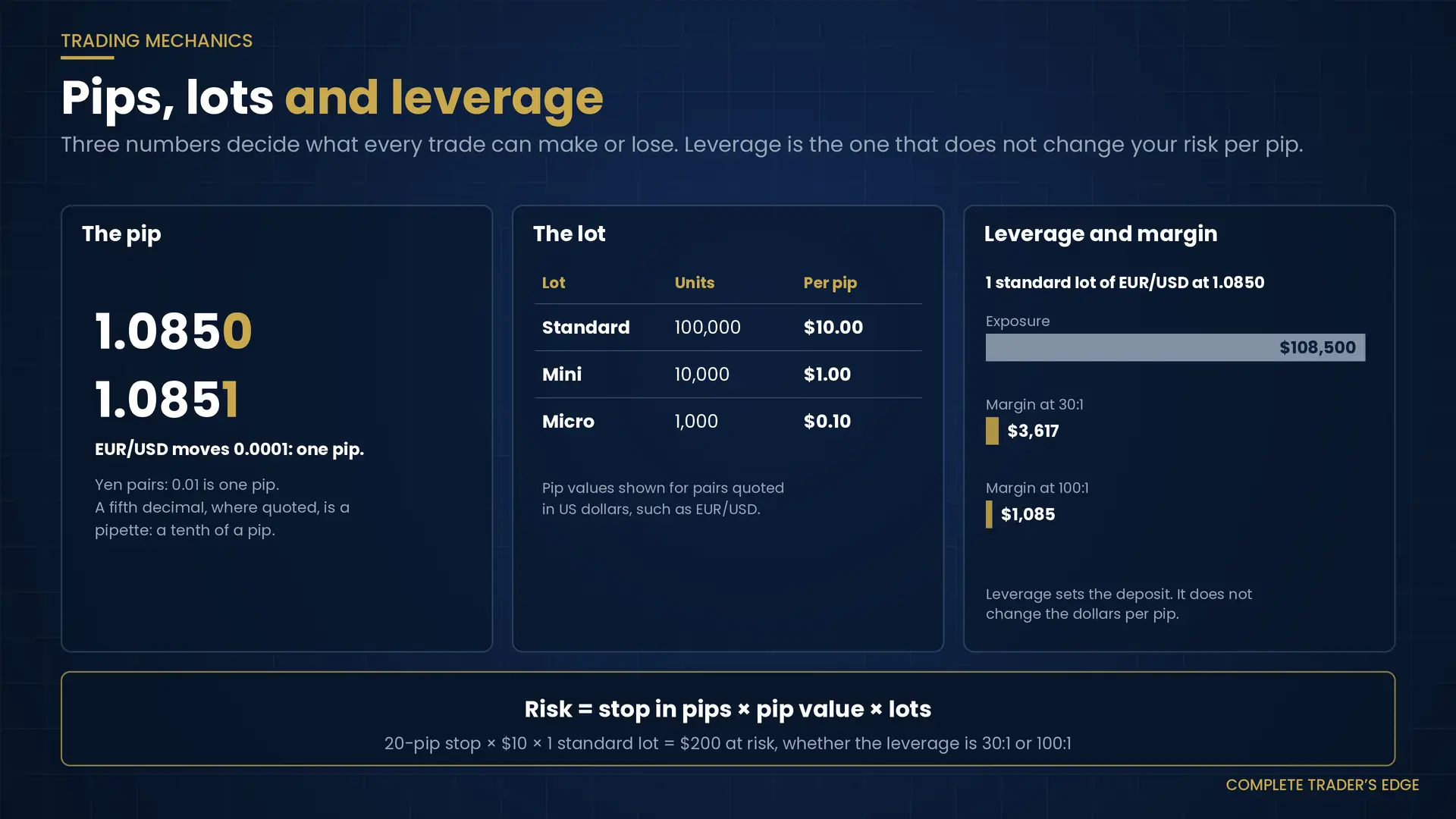
Here is where it becomes practical. Your risk on any trade is the distance to your stop in pips, multiplied by the value per pip, which is set by your lot size, with leverage determining how much margin that position ties up. To size a trade correctly, you work backwards: decide the maximum money you will risk, measure your stop distance in pips, and choose the lot size that makes those two match. Leverage then simply determines whether you have enough margin to hold the position. Done in this order, risk is a decision you make in advance, not a number you discover after the loss.
The Beginner’s Leverage Mistake
The classic error is sizing by leverage instead of by risk. A beginner sees they can open a huge position and does, because they can, then a normal market wobble hands them a catastrophic loss. The fix is to ignore how big a position you are allowed to take and instead size every trade to a small, fixed percentage of your account at risk, using lot size to control it. Leverage should be a background fact about your account, not the driver of your position size. This is the single most important habit a leveraged trader can build, and it is covered in depth in our risk management framework.
Putting It Into Practice
Learn these mechanics on a demo account before risking real money, where you can see exactly how pips, lot size and leverage translate into profit and loss without paying for the lesson. Practise sizing positions to a fixed risk until it is automatic. This sits inside the wider how to start trading roadmap, and once you understand how much each pip costs you, the question of how much money you need to start trading starts to answer itself.
Key Takeaways
- A pip measures how far price moves; it is the unit of distance for your stop and target.
- A lot measures position size and sets how much each pip is worth in money.
- Leverage in trading lets a small deposit control a large position, magnifying gains and losses equally.
- Margin is the deposit backing a leveraged position; a margin call force-closes it if losses run too far.
- Size every trade by risk, using lot size, never by how much leverage allows.
- The leverage your broker offers is not the leverage you should use.
Frequently Asked Questions
What is leverage in trading in simple terms?
It is borrowed buying power that lets you control a position larger than your own cash, expressed as a ratio like 30 to 1. A small amount of your money controls a much bigger trade. The catch is that it multiplies losses exactly as much as gains, so a leveraged position that moves against you can lose money far faster than an unleveraged one. It is a tool that amplifies whatever you do, good or bad.
Is leverage good or bad for beginners?
It is neither inherently; it is a tool that is dangerous in untrained hands. The problem is that beginners tend to use the maximum leverage available, which turns normal market noise into account-threatening losses. Used sparingly, with position size driven by a fixed risk percentage rather than by how much leverage allows, it is manageable. The mistake is treating high available leverage as a target rather than a hazard.
What is a pip and why does it matter?
A pip is the standard unit of price movement, typically the fourth decimal place in a currency pair. It matters because the number of pips between your entry and your stop, multiplied by your position size, is your actual money risk on the trade. Pips are how you measure risk distance, which is the first step in sizing a position correctly.
How do lots and leverage relate?
Lot size sets how big your position is and therefore how much each pip is worth, while leverage determines how little of your own cash is needed to hold that position. You choose lot size to control your risk per trade; leverage just affects the margin that position ties up. The mistake is letting leverage tempt you into a bigger lot size than your risk rules allow.
How much leverage should a beginner use?
As little as your strategy needs, and far less than your broker offers. The right approach is to ignore the maximum leverage entirely, decide your risk per trade as a small fixed percentage of your account, and size the position with lot size to match. Leverage then becomes a background detail rather than the thing driving your risk. Lower effective leverage is one of the clearest dividing lines between traders who last and those who blow up.
What happens in a margin call?
A margin call occurs when losses erode your account so far that you no longer meet the broker’s minimum margin requirement, at which point the broker may close your positions automatically to prevent the account going negative. It usually happens at the worst time, locking in losses. Avoiding it comes down to not over-leveraging and keeping risk per trade small, so your positions never consume the margin that keeps them open.
The Complete Trader’s Edge
Leverage rewards the disciplined and ruins the rest
The mechanics are simple; using them without blowing up is the skill. The book’s Money pillar covers position sizing, leverage discipline and risk per trade in full, inside the complete Mind, Method and Money framework.
 The Complete Trader's Edge
The full Mind · Method · Money framework. 70 chapters.
View on Amazon →
The Complete Trader's Edge
The full Mind · Method · Money framework. 70 chapters.
View on Amazon →
 Market Mayhem
400 years of bubbles, crashes, and the pattern that keeps repeating.
Buy on Amazon →
Market Mayhem
400 years of bubbles, crashes, and the pattern that keeps repeating.
Buy on Amazon →
 Greatest Companies
How the world's greatest companies were built — and what traders learn from them.
View on Amazon →
Greatest Companies
How the world's greatest companies were built — and what traders learn from them.
View on Amazon →
 Greatest Traders
Eighty-six lives that explain the markets — Livermore to Madoff, told with the losses left in.
View on Amazon →
Greatest Traders
Eighty-six lives that explain the markets — Livermore to Madoff, told with the losses left in.
View on Amazon →