
If Broadcom is the loud, aggressive face of the serial-acquirer model, Danaher is its patient, almost invisible master. For four decades, Danaher has done something that sounds simple and is fiendishly hard: it buys businesses, makes them measurably better using a repeatable operating system, and compounds the results, year after year, with so little drama that most people have never heard of it. Yet the brothers who built it, and the system they created, produced one of the great compounding machines in the history of American business.
The secret is not a product. Danaher makes scientific instruments and diagnostic tools today, but it has, over the years, made everything from industrial controls to dental equipment to water-testing systems. The secret is a method, the Danaher Business System, a culture of relentless, measured, continuous improvement that the company applies to every business it buys. Danaher’s true product is the system itself, and its genius is the patient, unglamorous discipline of getting a little better, everywhere, all the time.
📄 Free Download · Company Research Sheet
Danaher Research Sheet (PDF)
The moat, the meltdown, the Legendary Scorecard, the timeline, and the Move, Money and Mind lessons from this story. Free, no email required.
Two Brothers and a Fishing Creek
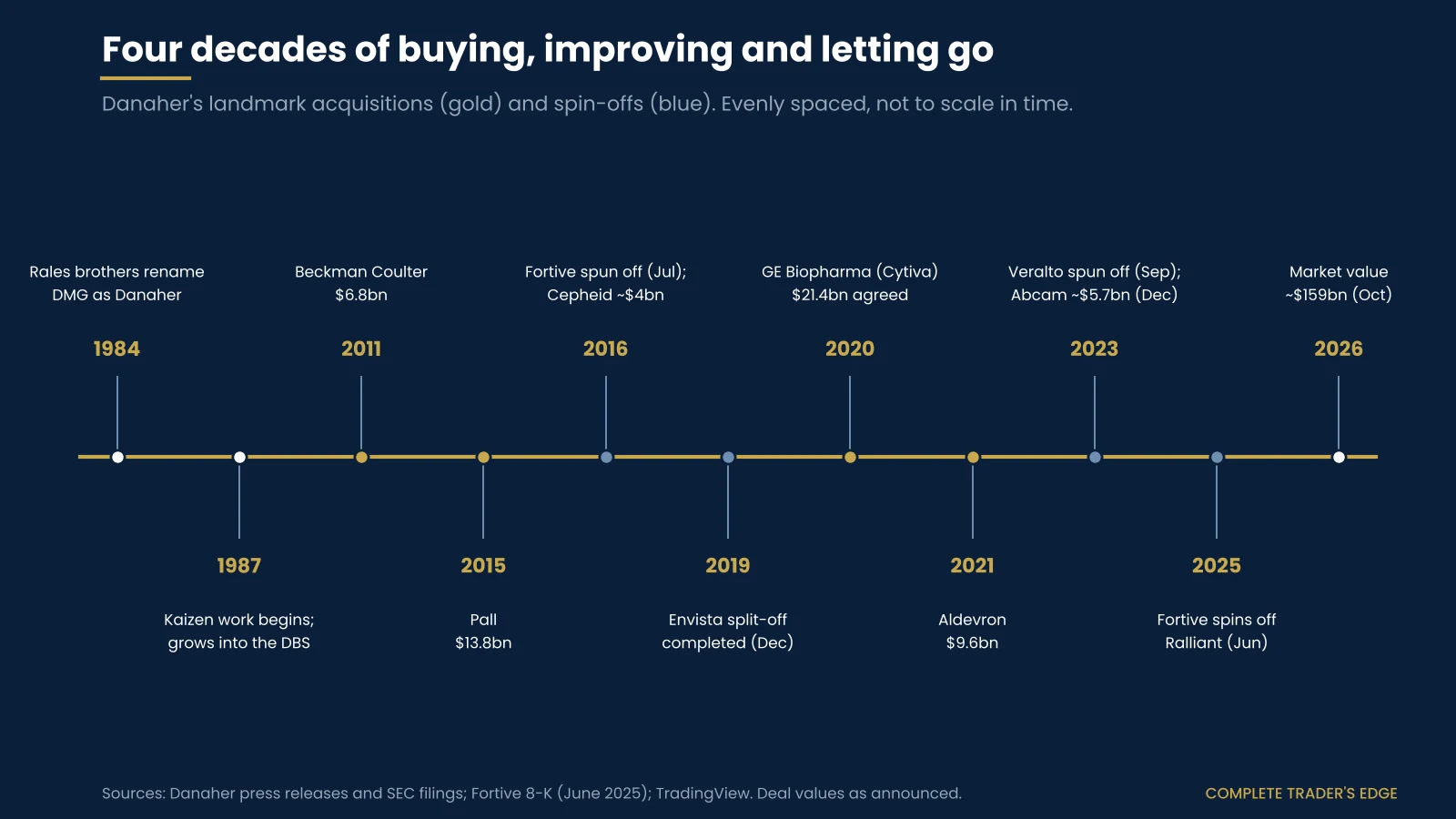
Danaher began in 1984, when brothers Steven and Mitchell Rales took control of a struggling company and reorganized it as a vehicle for acquisitions. They named it after Danaher Creek, a fishing spot where, the story goes, they had conceived the idea. In its earliest form it was closer to a financial holding company than an industrial one, buying businesses with borrowed money in the merger-hungry 1980s.
What transformed Danaher from a financial play into a legendary compounding machine was a shift in philosophy. In the late 1980s, the Rales brothers and their managers studied the Japanese manufacturing methods that had made companies like Toyota so formidable, in particular the practice of kaizen, the discipline of continuous, incremental improvement involving every employee. They adapted these ideas into what became the Danaher Business System, a rigorous set of tools and a culture for systematically improving operations, quality, and growth in any business Danaher owned.
The System Is the Strategy
The Danaher Business System is the heart of everything. When Danaher buys a company, it does not simply own it and hope; it sends in teams steeped in the system to relentlessly improve the acquired business, cutting waste, sharpening processes, accelerating product development, and embedding a culture of measurement and continuous improvement. The acquired business gets better, generates more cash, and that cash funds the next acquisition. It is a flywheel: buy, improve, generate cash, buy again.
Over decades, Danaher ran this flywheel across hundreds of acquisitions, gradually transforming itself. It started in industrial products, then moved into instruments and test equipment, and steadily climbed toward higher-margin, higher-growth markets. Crucially, the system worked not because Danaher picked perfect companies, but because it could reliably make good companies better. The repeatable process, not any single brilliant purchase, was the engine.
The System Is the Product. Danaher’s instruments change across the decades; the Danaher Business System does not. Buy a business, embed teams to improve it through continuous, measured effort, harvest the extra cash, and fund the next deal. The repeatable method, not any single product, is the true source of the company’s value.
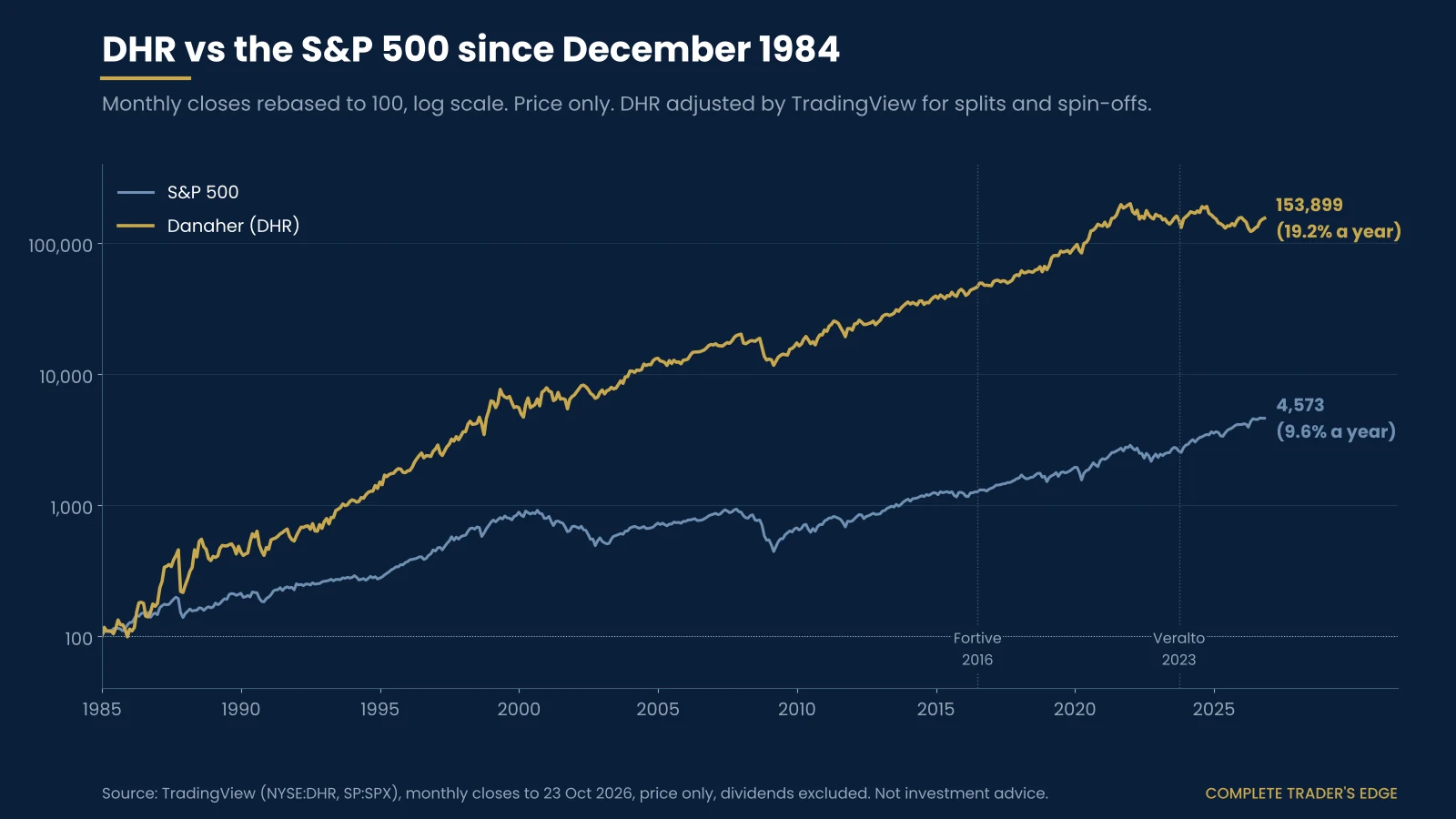
The flywheel shows up in the share price. Measured on TradingView’s adjusted monthly closes, DHR has risen about 1,500-fold since December 1984, against about 46-fold for the S&P 500: roughly 19% a year against 10%, before dividends.
Decision Point
The Decision Point. By the 2010s, Danaher had grown into a sprawling conglomerate spanning industrials, dental, environmental, and life sciences. The life-sciences and diagnostics businesses were growing faster and earning higher margins than the older industrial ones. The road forks.
A. Hold the whole empire together, valuing breadth and stability.
B. Sell the slower businesses outright for cash.
C. Spin them off to shareholders as independent companies, sharpening Danaher’s focus on its best markets while handing investors a stake in the businesses being set free.
Danaher chose to spin off: Fortive in 2016, Envista in 2019, and Veralto in 2023, emerging as a focused, pure-play life-sciences and diagnostics company. The discipline to sell or spin off good businesses, not just to buy them, is what separates a great allocator from a mere collector. This is a thought experiment about disciplined focus, not investment advice.
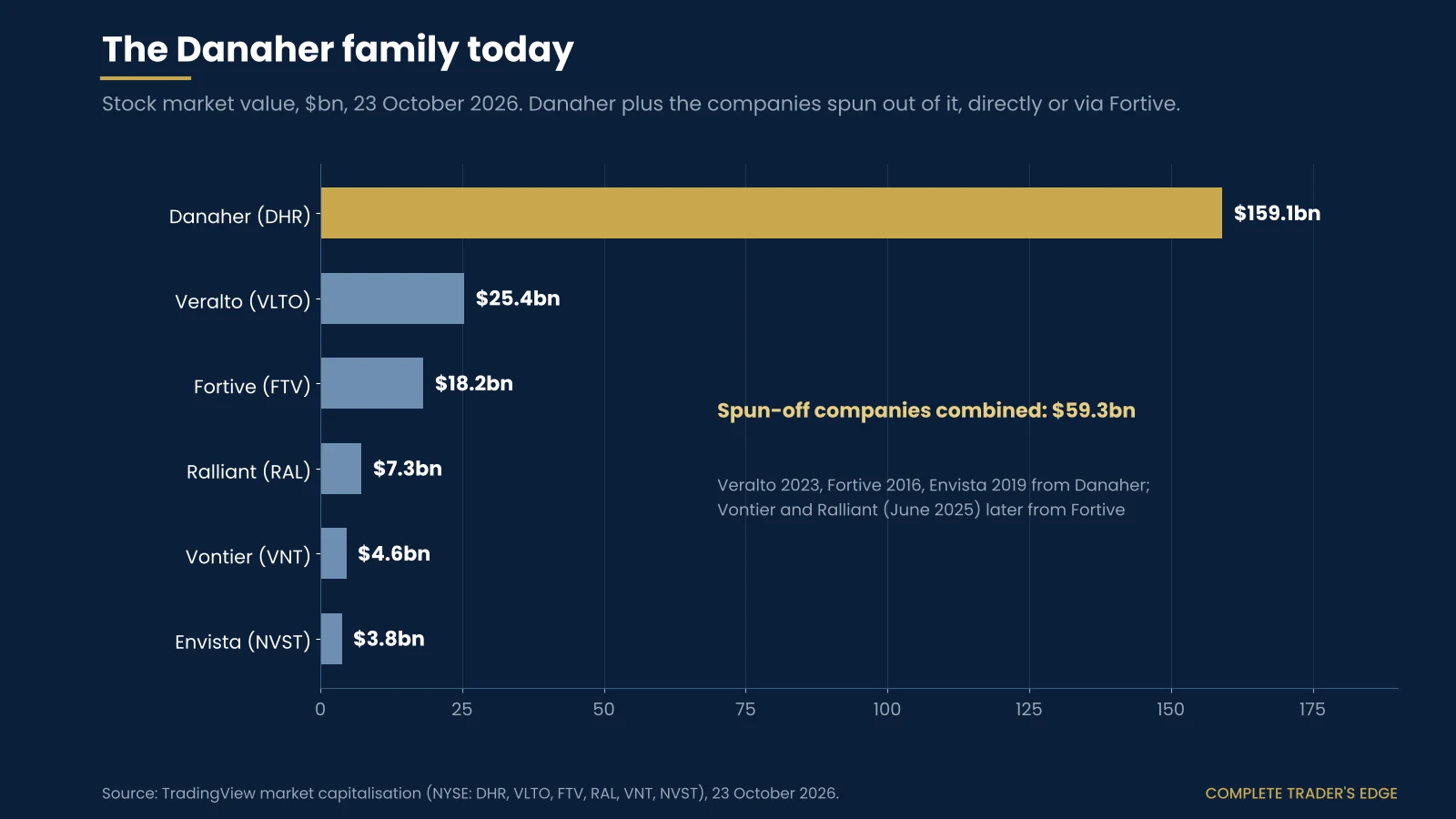
The businesses Danaher let go did not disappear. On 23 October 2026 the companies spun out of it, directly or later through Fortive, were worth about $59 billion combined on the stock market.
What Everyone Gets Wrong
Mistake #1: Thinking Danaher’s product is its instruments. It makes scientific and diagnostic tools. Reality: Danaher’s real product is the Danaher Business System, its repeatable method for improving any business it owns. The instruments change over the decades; the system is the constant, and it is the true source of the company’s value.
Mistake #2: Believing a serial acquirer is just a financial engineer. Danaher buys constantly. Reality: Unlike a pure financial buyer, Danaher operationally improves what it buys, embedding teams to make the businesses genuinely better. The value comes from real operational gains, not just clever financing, which is why the model has lasted forty years.
Mistake #3: Assuming bigger is always the goal. Most conglomerates hoard businesses. Reality: Danaher’s discipline includes shrinking on purpose. It has spun off Fortive, Envista, and Veralto, deliberately giving away large parts of itself to stay focused on its highest-return markets. Knowing what to shed is as important as knowing what to buy.
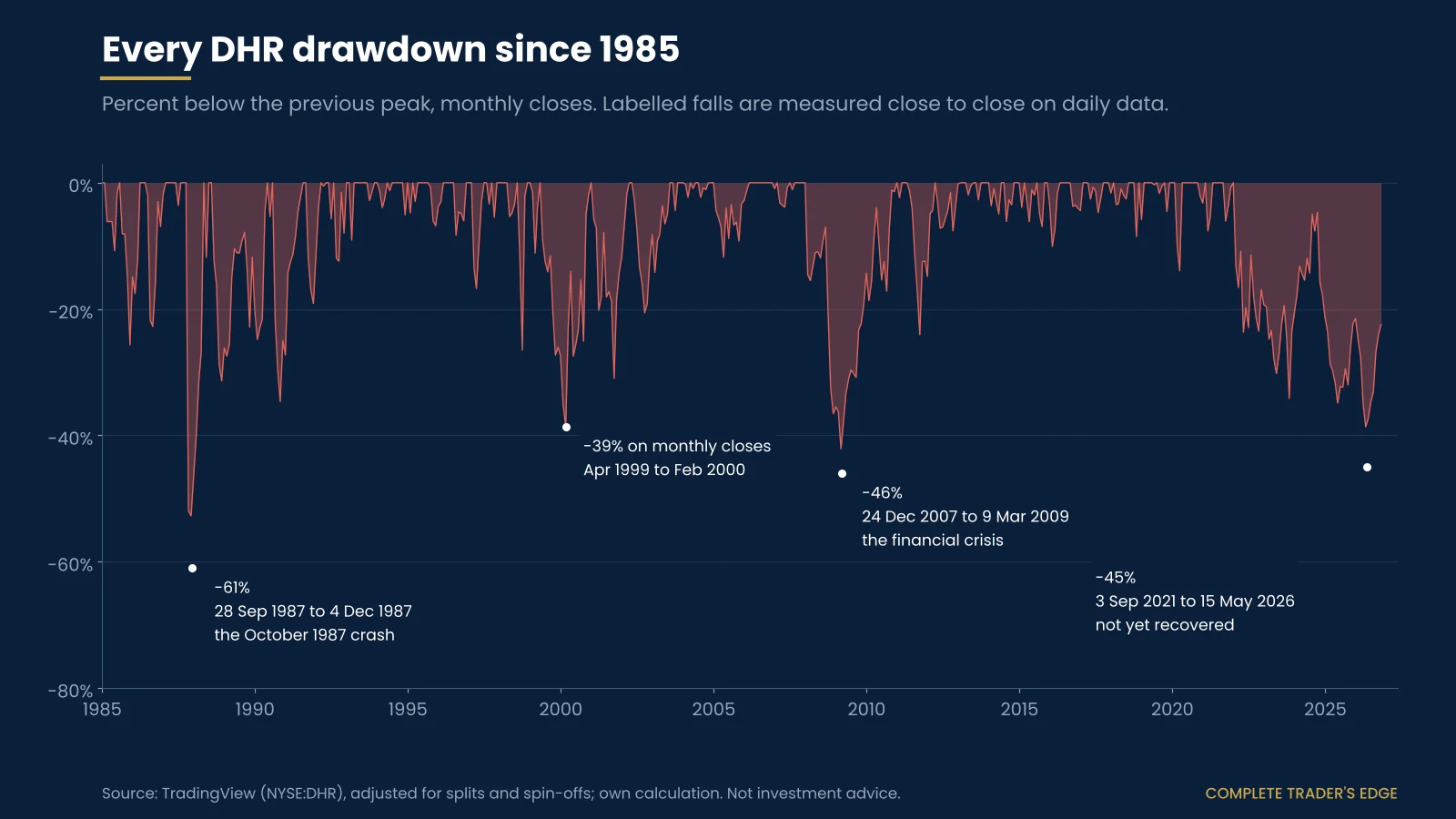
Mistake #4: Seeing the post-pandemic slump as a broken model. Its shares fell about 45% from September 2021 to May 2026 as bioprocessing demand sagged. Reality: That was an ordinary cyclical downturn, as pandemic-era customers worked off excess inventory, not a failure of the system. Across four decades the compounding engine has survived many such dips, and the operating system remains intact.
A Different Temperament, the Same Engine
Set beside Broadcom, Danaher is illuminating. Both are serial acquirers, both run repeatable systems, both compound capital brilliantly. But the temperaments could hardly be more different. Broadcom is fast, aggressive, debt-fueled, and unsentimental, raising prices and cutting hard. Danaher is patient, operational, and improvement-focused, making businesses genuinely better over years rather than squeezing them for immediate cash.
They are two dialects of the same deep truth: that a repeatable system for allocating capital and improving businesses can be a more durable engine of wealth than any single product. Where Broadcom optimizes for cash with private-equity ruthlessness, Danaher optimizes for sustained operational excellence with the patience of a craftsman. Both work. Together they show that the serial-acquirer model is not one strategy but a family of them, united by discipline and a repeatable process.
The Honest Present
Today Danaher is a focused, pure-play life-sciences and diagnostics company, one of the most valuable in its field, worth well over a hundred billion dollars. Its tools and consumables sit inside laboratories, hospitals, and the factories that manufacture biologic drugs, and a large share of its revenue is recurring, the reagents and consumables that customers buy again and again. Its 2020 acquisition of Cytiva, General Electric’s former biopharma business, made it a backbone supplier to the booming business of making biologic medicines.
The challenges are those of a focused, mature compounder. The bioprocessing market that drives much of its growth went through a sharp downturn in 2023 and 2024 as pandemic-era overstocking unwound, pressuring the shares and reminding investors that even great compounders are cyclical. And finding acquisitions large enough to move the needle gets harder as the company grows. But the Danaher Business System, the durable core of the whole enterprise, remains intact, and the company keeps applying it, patiently, as it has for forty years.
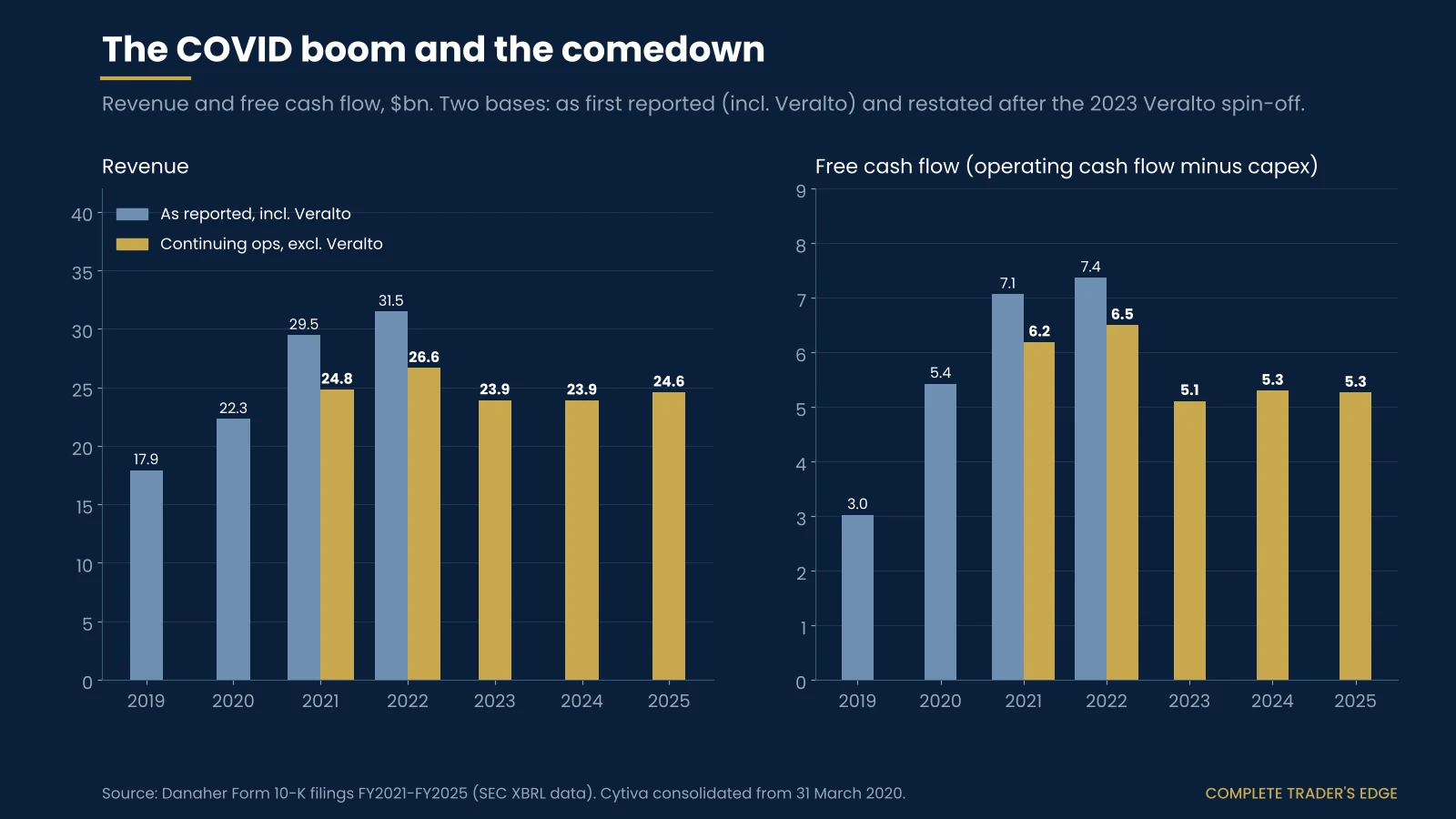
The boom and the comedown are plain in the filings. Revenue as first reported jumped from $17.9 billion in 2019 to $29.5 billion in 2021, helped by Cytiva and pandemic demand. Restated without Veralto, revenue peaked at $26.6 billion in 2022, slipped to $23.9 billion in both 2023 and 2024, and recovered to $24.6 billion in 2025.
Set against its listed peers, Danaher has been a laggard this year.
Danaher and life-science tools peers, 23 October 2026
| Company | Market value | 2026 to date | Revenue (TTM) | Trailing P/E |
|---|---|---|---|---|
| Thermo Fisher (TMO) | $246bn | +15.0% | $47.4bn | 35x |
| Danaher (DHR) | $159bn | −1.2% | $25.6bn | 37x |
| Agilent (A) | $48bn | +25.1% | $7.4bn | 34x |
| Waters (WAT) | $44bn | +18.3% | $4.6bn | 112x |
| Mettler-Toledo (MTD) | $33bn | +18.8% | $4.1bn | 37x |
| Revvity (RVTY) | $18bn | +62.3% | $2.9bn | 75x |
Source: TradingView (market capitalisation, year-to-date price change, trailing twelve-month revenue and P/E). Price only; dividends excluded. Figures change daily.
Why This Matters to Investors
The Greatest Companies Thesis
Every legendary company begins with an idea that looks improbable.
Every one survives a stretch where failure looks inevitable.
Every one eventually reaches a point where success looks obvious.
The opportunity exists only in the space between the second and third.
Danaher is the purest example in this collection of process power, the idea that a repeatable operating system can itself be the deepest competitive advantage. Its lesson is that you do not need a single revolutionary product to build extraordinary wealth; you need a disciplined, repeatable method for buying ordinary businesses and making them genuinely better, applied with patience over decades. The Greatest Companies thesis is that durable competitive advantage builds lasting wealth, and Danaher’s advantage is the rarest kind: not a product or a patent, but a culture and a system that competitors can admire but struggle to copy. The investor’s lesson is twofold. First, prize the repeatable process over the one-time stroke of genius, because a system that reliably improves what it touches compounds for decades. Second, respect the discipline of selling, the willingness to spin off even good businesses to stay focused, which is as rare and as valuable as the skill of buying. None of this is investment advice; it is a way of reading history.
Lessons in Order of Depth
Method: build a repeatable system, not a one-time win
Danaher’s method is the Danaher Business System, a rigorous, teachable culture of continuous improvement applied to every business it owns. The method is to recognize that a repeatable process, one that reliably makes things a little better everywhere, all the time, can be more powerful than any single brilliant idea. The skill to study is the building of a system that turns ordinary inputs into superior outputs, again and again, regardless of the specific business.
Money: compounding beats brilliance
Danaher’s fortune was built not on one spectacular bet but on the steady reinvestment of cash from improved businesses into the next acquisition, decade after decade. The money lesson is the quiet power of compounding: a good return, earned reliably and reinvested patiently, vastly outperforms occasional flashes of genius punctuated by mistakes. The same discipline a trader needs, consistent process over dramatic wins, is what built Danaher.
Mind: the patience to improve, and the discipline to let go
Danaher’s mindset is twofold. It has the patience to improve businesses gradually, through unglamorous, continuous effort rather than dramatic turnarounds. And it has the discipline to let go, spinning off businesses it has finished improving rather than hoarding them. The mindset lesson is that lasting success rewards both the patience to compound slowly and the discipline to release what no longer fits, resisting both the lure of quick wins and the hoarder’s instinct.
The deepest question: can a culture outlive the people who built it?
Danaher’s moat is its operating system, which is ultimately a culture, embodied in people, habits, and shared discipline. The Rales brothers and the managers who built the Danaher Business System are not young, and cultures are far harder to sustain than patents or factories. The deepest question Danaher poses is whether an advantage that lives in a culture, rather than in a physical asset or a legal monopoly, can survive the passing of its founders and generations of leadership. If it can, Danaher proves that a system is the most durable moat of all; if it cannot, it shows the fragility of advantages that live only in people.
The Legendary Scorecard
| Founder Vision | 9 |
| Innovation | 7 |
| Execution | 10 |
| Moat | 8 |
| Capital Allocation | 10 |
| Wealth Creation | 9 |
| Durability | 9 |
| Historical Importance | 8 |
| Overall | 8.5 |
The overall figure is an editorial verdict, not a weighted average. Danaher earns perfect marks for execution and capital allocation, because the Danaher Business System and the patient buy-improve-compound flywheel represent one of the most successful and durable management models ever built. It scores lower on innovation and historical importance, because its genius is operational improvement rather than invention, and because, for all its success, it remains a quiet compounder whose influence is felt mostly by other managers rather than by the wider public.
At a Glance
| Founded | 1984, by brothers Steven and Mitchell Rales |
| Name origin | Danaher Creek, a fishing spot tied to the company’s conception |
| Defining method | The Danaher Business System, rooted in Japanese kaizen |
| Core moat | Process power, a repeatable operating system, plus switching costs |
| Acquisition style | Buy, improve operationally, compound the cash, repeat |
| Divestiture style | Spin off finished businesses: Fortive, Envista, Veralto |
| Landmark deals | Pall (about $13.8 billion, 2015), Cytiva (about $21.4 billion, 2020) |
| Today | A focused pure-play life-sciences and diagnostics company |
| Status | Operating, listed as NYSE: DHR |
Timeline
- 1984: brothers Steven and Mitchell Rales found Danaher, named after a fishing-trip creek, and turn a real-estate vehicle into an industrial acquirer
- late 1980s: Danaher develops the Danaher Business System, rooted in Japanese kaizen, after studying Toyota-style methods
- 1990s to 2000s: Danaher buys and improves hundreds of businesses across industrials, instruments, and more
- 2015: Danaher acquires the filtration company Pall for about $13.8 billion
- 2016: Danaher spins off its industrial businesses as Fortive
- 2019: Danaher spins off its dental business as Envista
- 2020: Danaher buys General Electric’s biopharma business, renaming it Cytiva, for about $21.4 billion
- 2023: Danaher spins off its environmental and applied businesses as Veralto, becoming a pure-play life-sciences and diagnostics company
Key Numbers
1984 the year two brothers founded Danaher with an acquisition vehicle
Hundreds the number of businesses Danaher has acquired and improved over four decades
About $13.8 billion the price of the 2015 Pall acquisition
About $21.4 billion the price of the 2020 Cytiva acquisition
Three the major companies spun off: Fortive, Envista, and Veralto
Forty years how long the Danaher Business System has compounded value
Related Reading
Danaher is best understood among the great capital allocators. Read about Broadcom, the aggressive, debt-fueled serial acquirer whose Tan playbook is the ruthless counterpart to Danaher’s patient system. See how Berkshire Hathaway built the original compounding machine on disciplined capital allocation. And study how BlackRock grew into the world’s largest investor by quietly compounding a scalable model over decades. For the full collection, see our Greatest Companies of All Time hub.
Go Deeper
Danaher is a study in process power, in the quiet force of compounding, and in the discipline to both buy and let go. Those are the same forces that separate investors who trust a sound, repeatable process from those who chase brilliance, and the book teaches you the discipline to value a repeatable system over a single win, to compound patiently rather than gamble for spectacular returns, and to recognize that knowing when to sell is as important as knowing what to buy.
★ Now in Kindle, Paperback & Hardcover
Greatest Companies
This story is one of fifty-one. The full book reads every legendary company through a single lens — Moat, Meltdown, Machine — from Standard Oil to SpaceX. Fifty-one companies, eight kinds of moat, one framework.
Kindle · $9.99 →
Paperback · $24.99 →
Hardcover · $34.99 →
Explore the Book →
This article is part of the Greatest Companies series, adapted from the book Greatest Companies, now available on Kindle.
Frequently Asked Questions
What is the Danaher Business System?
The Danaher Business System, or DBS, is Danaher’s culture and toolkit of continuous improvement, rooted in Japanese kaizen principles. When Danaher acquires a company, it applies DBS to systematically improve operations, quality, product development, and growth. It is the heart of the company’s strategy and, arguably, its true product, a repeatable method for making businesses better.
Who founded Danaher and when?
Danaher was founded in 1984 by brothers Steven and Mitchell Rales, who reorganized a struggling company into a vehicle for acquisitions. They named it after Danaher Creek, a fishing spot connected to the idea’s conception. It began as a financially driven holding company before the Rales brothers transformed it with the Danaher Business System.
How does Danaher make money?
Danaher acquires businesses, improves them operationally using the Danaher Business System so they generate more cash, and reinvests that cash into further acquisitions, compounding over time. Today it focuses on life sciences and diagnostics, where much of its revenue is recurring, coming from consumables and reagents that laboratory and biopharma customers purchase repeatedly.
Why did Danaher spin off Fortive, Envista, and Veralto?
Danaher spun off these businesses, Fortive in 2016, Envista in 2019, and Veralto in 2023, to sharpen its focus on the higher-growth, higher-margin life-sciences and diagnostics markets. The discipline to divest good businesses it had finished improving, rather than hoarding them, is a key part of its capital-allocation strategy and a hallmark of a great allocator.
How is Danaher different from Broadcom as a serial acquirer?
Both are serial acquirers that run repeatable systems and compound capital, but their temperaments differ. Broadcom, under Hock Tan, is fast, aggressive, and debt-fueled, optimizing acquired businesses ruthlessly for cash. Danaher is patient and operational, improving businesses genuinely over years through continuous improvement. They are two contrasting expressions of the same powerful serial-acquirer model.
 The Complete Trader's Edge
The full Mind · Method · Money framework. 70 chapters.
View on Amazon →
 Market Mayhem
400 years of bubbles, crashes, and the pattern that keeps repeating.
Buy on Amazon →
 Greatest Companies
How the world's greatest companies were built — and what traders learn from them.
View on Amazon →
 Greatest Traders
Eighty-six lives that explain the markets — Livermore to Madoff, told with the losses left in.
View on Amazon →