Explore all 80 books in the Trader’s Library →
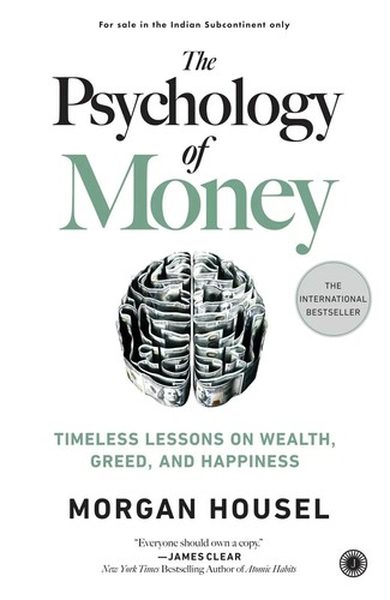
Most money books try to make you smarter. Morgan Housel wrote one that tries to make you behave. The Psychology of Money argues that doing well with money has almost nothing to do with intelligence and almost everything to do with how you act when fear, greed, and ego are in the room.
It is nineteen short stories rather than a system, and that is the point. Housel is not teaching you to value a company or time a trade. He is teaching you the behavioural traits that separate people who build and keep wealth from people who are smart and still blow up. For traders, that second category is uncomfortably familiar.
This review covers what the book delivers, the chapters that matter most for traders specifically, where it is thin, and why it belongs on a trading shelf even though it never mentions a chart.
At a Glance
| Author | Morgan Housel |
| First Published | 2020 (Harriman House) |
| Pages | ~250 |
| Genre | Behavioural finance / money psychology |
| Difficulty | Beginner — short, plain, story-driven |
| Best For | Any trader whose real problem is behaviour, not knowledge |
| Skip If | You want tactical setups or a valuation method. This is mindset, not mechanics. |
OVERALL RATING: 8.5 / 10
Who Should Read This Book
| Reader | Verdict | Why |
|---|---|---|
| New trader (0–1 year) | Read it early | It inoculates you against the get-rich-quick wiring before the market exploits it |
| Intermediate (1–3 years) | Read it now | You have made the behavioural mistakes it describes. Reading it is recognising yourself. |
| Advanced / professional | Read for the reframes | The chapters on survival, tails, and playing your own game reward a re-read at any level |
| SMC / ICT trader | Read it | The psychology is method-agnostic. Your edge means nothing if your behaviour gives it back. |
| Prop-firm candidate | Read the survival chapters | “Getting wealthy versus staying wealthy” is the entire psychology of passing and keeping a funded account |
| Long-term investor | Essential | This is arguably the best modern book on investor behaviour, full stop |
The Book in Context
Morgan Housel is a partner at the Collaborative Fund and a former columnist at The Motley Fool and The Wall Street Journal. He built his reputation writing short, clear essays about how people actually behave with money, and The Psychology of Money is the distillation of that work into nineteen self-contained chapters.
The book became one of the best-selling finance titles of recent years, and it earned that reach honestly. It is short, it never condescends, and it makes its points through stories rather than formulas. You can read any chapter in ten minutes and carry it for a decade.
The Core Argument: Behaviour Beats Brains
Housel’s thesis is stated plainly and repeated through every story. Financial success is not a hard science you master with intelligence. It is a soft skill, where how you behave matters more than what you know. A person with no finance education who controls their greed and stays in the game can outperform a finance PhD who cannot stop himself from blowing up.
For traders this is the whole ballgame. Edge is a knowledge problem. Keeping the proceeds of that edge is a behaviour problem. Most traders who fail do not fail because they could not find a setup. They fail because they could not sit still, could not size sensibly, could not survive the drawdown, or could not stop comparing themselves to someone playing an entirely different game.
“Doing well with money has a little to do with how smart you are and a lot to do with how you behave.”
— Morgan Housel
The Chapters That Matter Most for Traders
| The Idea | Why It Matters at the Screen |
|---|---|
| Getting wealthy vs staying wealthy | Making money and keeping it are different skills. Survival is the one that compounds. This is risk management stated as philosophy. |
| Tails drive everything | A small number of trades produce most of your results. Your job is to be present for the big winners and survive everything else. |
| Room for error | Margin of safety is not pessimism. It is what lets you stay in the game long enough for the odds to work. Plan for the world to be harsher than your backtest. |
| Nothing is free | Volatility and drawdown are the fee for returns, not a fine for doing something wrong. Traders who treat the fee as a penalty quit at the worst moment. |
| Beware playing someone else’s game | Most blow-ups come from taking cues from people on a different timeframe and risk tolerance. Know which game you are playing and ignore the rest. |
These five chapters alone are a complete trading-psychology curriculum disguised as personal finance.
The Compounding Lesson Traders Underrate
Housel’s most-quoted illustration is that the overwhelming majority of Warren Buffett’s net worth was built after his sixties. The point is not about Buffett. It is that compounding rewards time and survival far more than it rewards any single brilliant decision.
Translate that to trading and it becomes brutal clarity: the trader who makes 15% a year for twenty years without a catastrophic loss destroys the trader who makes 60% for three years and then gives it all back. Consistency and survival are not the boring alternative to big returns. Over a long enough horizon they are the big returns. Most traders chase the steep curve and never live to see the compounding.
Where the Book Falls Short
- It is not a trading book. Housel writes for savers and long-term investors. Traders have to do the translation work themselves, which most of this review is.
- It repeats its core point. Behaviour beats brains, survival compounds, tails matter. The repetition reinforces, but a sharp reader gets the thesis in the first few chapters.
- Light on mechanics. It tells you to leave room for error but does not tell you how much. You will not find a position-sizing formula here. Pair it with Tharp or Elder for that.
- Anecdote-driven. The stories are persuasive but selective. Treat them as illustrations of principles, not as data.
How the Book Fits the Mind · Method · Money Framework
| Pillar | Contribution | What the Book Delivers |
|---|---|---|
| MIND | PRIMARY | Greed, ego, patience, the urge to compare, and the behaviours that quietly hand your edge back to the market |
| METHOD | NONE | No setups, no analysis. Deliberately so. |
| MONEY | SECONDARY | Room for error, survival, and the case for sizing to stay in the game rather than to maximise a single bet |
The book lives on the Mind pillar of the Mind · Method · Money framework, with a strong secondary pull toward Money through its survival theme. It pairs perfectly with a method book, since it answers the question of why traders with good methods still lose.
Read This Instead Of / Read This After
| Relationship | Book | Why |
|---|---|---|
| Read alongside | Trading in the Zone by Mark Douglas | Housel gives the behaviour, Douglas gives the mechanism behind it. Two angles on the same pillar. |
| Read after | Fooled by Randomness by Nassim Taleb | Taleb sharpens Housel’s “luck and risk” chapter into a full theory of randomness |
| Read for mechanics | Trade Your Way to Financial Freedom by Van Tharp | Turns “room for error” into actual position-sizing math |
| Read instead of | Hustle-culture “get rich” finance content | This is the calm, durable opposite of that genre |
Final Verdict: Should You Read This Book in 2026?
Yes, and it is the rare trading-adjacent book you could hand to a complete beginner or a twenty-year veteran and both would underline something. It will not give you a method, and it does not pretend to. What it gives you is a clear-eyed account of the behaviours that decide whether your method ever pays off.
Read it for the survival chapters. Internalise “getting wealthy versus staying wealthy” and “tails drive everything,” and you will already think about risk like a professional, whatever you trade.
CTE Rating Breakdown
8.5/10
Behavioural Essential
| Readability | 10 | |
| Actionability | 7 | |
| Timelessness | 9 | |
| Beginner-Friendly | 10 | |
| Modern Relevance | 9 |
Frequently Asked Questions
What is The Psychology of Money about?
It is a collection of nineteen short stories arguing that doing well with money depends far more on behaviour, patience, greed control, and survival than on intelligence or technical knowledge.
Is it a trading book?
No. It is written for savers and long-term investors. But its lessons on survival, tail outcomes, and room for error map directly onto trading risk management, which is why it earns a place on a trader’s shelf.
Is it good for beginners?
Extremely. It is short, plainly written, and story-driven, with no jargon. It is one of the best first finance books a new trader can read.
What is the most important chapter for traders?
“Getting wealthy versus staying wealthy.” It frames survival as a distinct skill from making money, which is the core of trading risk management told as philosophy.
Does it teach how to invest or trade?
Not in any mechanical sense. There are no formulas or strategies. It changes how you think about risk and patience, then leaves the mechanics to other books.
How long does it take to read?
A few hours. The chapters are short and self-contained, so it also works well dipped into rather than read straight through.
What is the single biggest takeaway?
Survival compounds and brilliance does not. The trader who avoids catastrophic loss and stays in the game for decades beats the one who posts spectacular short-term returns and then gives them back.
About the Author
Morgan Housel
Morgan Housel is a partner at the Collaborative Fund and a former columnist for The Motley Fool and The Wall Street Journal. He is known for short, lucid essays on human behaviour around money, and that essayist’s instinct for the memorable example is what makes The Psychology of Money so widely read.
Other notable works: Same as Ever, a follow-up exploring the patterns of human behaviour that never change.
Housel’s gift is making durable financial truths feel obvious in hindsight. Few writers turn risk and patience into stories you actually remember at the moment you need them.
Continue Learning
- Trading Psychology: The Complete Guide
- The Three Pillars: Mind, Method, Money
- Fooled by Randomness Book Review (2026)
- Trading in the Zone Book Review (2026)
- The Complete Trader’s Edge — The Book
 The Complete Trader's Edge
The full Mind · Method · Money framework. 70 chapters.
View on Amazon →
The Complete Trader's Edge
The full Mind · Method · Money framework. 70 chapters.
View on Amazon →
 Market Mayhem
400 years of bubbles, crashes, and the pattern that keeps repeating.
Buy on Amazon →
Market Mayhem
400 years of bubbles, crashes, and the pattern that keeps repeating.
Buy on Amazon →
 Greatest Companies
How the world's greatest companies were built — and what traders learn from them.
View on Amazon →
Greatest Companies
How the world's greatest companies were built — and what traders learn from them.
View on Amazon →