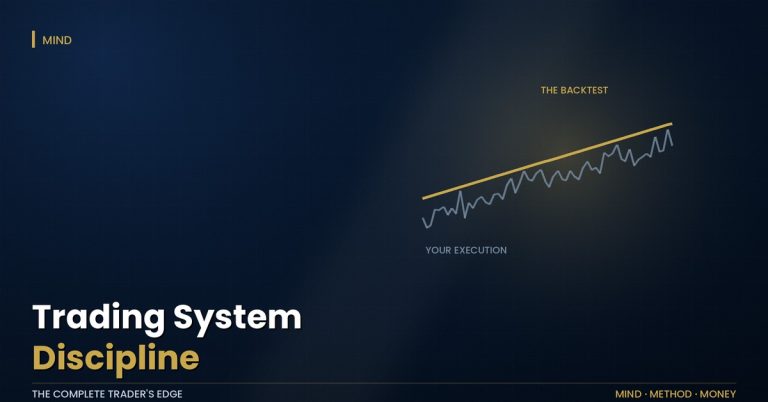


A trader breaks his rules, doubles his size, holds through the stop, and closes the position for a 4R gain. What did he learn? Something, certainly. The question is whether what he learned will help him or eventually end him. Outcome bias is the habit of judging the quality of a decision by the quality of its result, and in an environment as noisy as markets it is the mechanism by which a profitable week can teach a trader to be worse.
Outcome Bias in Trading: Good Decisions Can Lose
Trading is a domain of probabilistic feedback. A high-quality decision, taken with a real edge, correct sizing and a pre-committed stop, will still lose four times in ten or worse. A low-quality decision, taken on impulse with no stop, will still win sometimes, because price has to go somewhere. Over a single trade, outcome carries almost no information about decision quality. Over hundreds, it carries a great deal.
The problem is that reinforcement does not wait for hundreds. It arrives with the outcome, immediately, and it teaches. When the reckless trade pays 4R, the nervous system files “hold through the stop” alongside “profit”. The trader may intellectually know it was a bad process. He will still find that particular rule slightly easier to break next time, because something in him has been paid for breaking it.
Reverse the case. A trader follows every rule, takes a clean setup with positive expectancy, and loses. The nervous system files the discipline alongside the pain. Repeat this three times in a row, which a 40% win-rate system produces routinely, and correct behaviour starts to feel like the thing that is not working. This is how good traders talk themselves out of good systems.
The Four-Box Grid
Every trade lands in one of four boxes. Good decision, good outcome: deserved, and safe to celebrate. Good decision, bad outcome: a cost of doing business, the ordinary tax on a real edge. Bad decision, bad outcome: painful and useful; the lesson and the punishment agree. Bad decision, good outcome: the dangerous box, because the market has just paid you to do the wrong thing.
Most traders review only the outcome column. They dissect losses and skim wins. That habit leaves the dangerous box entirely unexamined, which is unfortunate, since that is the box where blowups are incubated. The 4R gain on a violated stop is not a win. It is a deferred loss with interest, and the account statement will not tell you so for months.
DO THIS
Journal two grades per trade, kept in separate columns. Process: did I follow the plan, yes or no, judged only on what I knew at entry. Outcome: the result in R. Review the process column first, every week, before you look at the R column at all. A week of 100% process compliance and negative R is a good week. A week of profitable rule-breaking is a warning.
Why the Process Column Has to Come First
Order matters because knowing the outcome contaminates the assessment. Read that a trade made 4R and your mind will construct reasons the decision was sound. Read that it lost and the same mind will find flaws in a decision that was flawless. This is not weakness; it is how memory reconstructs. The only defence is to grade the process against what you knew at entry, before the result colours the evidence, and to keep that grade in a column the outcome cannot edit.
Doing so reveals something liberating. Process compliance is fully within your control and can be achieved on every single trading day, losing ones included. It gives discipline a scoreboard that variance cannot touch, which is exactly what a trader needs during the stretches when the equity curve is telling an unhelpful story. Every real edge has a painful period; the process column is how you keep behaving well inside one.
The Node and Its Neighbours
On the Trader’s Roadmap, outcome bias sits in tier three of the Mind pillar alongside base rate neglect, survivorship bias and regression to the mean, all locked behind probabilistic thinking. They form a cluster for a reason: each one is a different way of drawing the wrong conclusion from a small, noisy, flattering sample.
Grade the decision, not the result. The results will take care of themselves, in the only timeframe where they were ever going to make sense.
Keep process and outcome in separate columns with the free Edge Companion journal, and see the full bias cluster on the Trader’s Roadmap.
 The Complete Trader's Edge
The full Mind · Method · Money framework. 70 chapters.
View on Amazon →
The Complete Trader's Edge
The full Mind · Method · Money framework. 70 chapters.
View on Amazon →
 Market Mayhem
400 years of bubbles, crashes, and the pattern that keeps repeating.
Buy on Amazon →
Market Mayhem
400 years of bubbles, crashes, and the pattern that keeps repeating.
Buy on Amazon →
 Greatest Companies
How the world's greatest companies were built — and what traders learn from them.
View on Amazon →
Greatest Companies
How the world's greatest companies were built — and what traders learn from them.
View on Amazon →