

Explore all 80 books in the Trader’s Library →
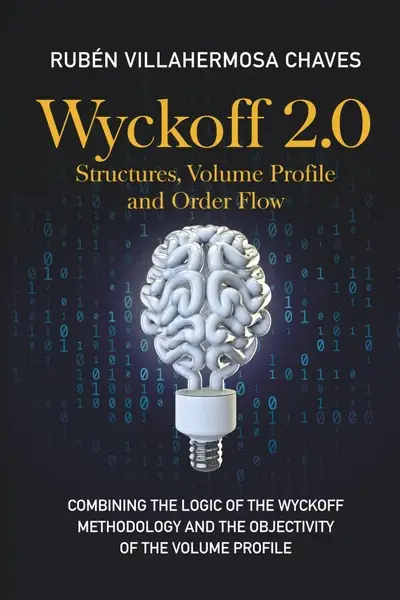
Most books that promise to modernise a classic method just paint a new coat over the old one. This one actually tries to bolt new engines onto the chassis. It takes Wyckoff’s century-old logic of accumulation and distribution and fuses it with two genuinely modern tools, Volume Profile and Order Flow, to build a single, layered way of reading a market.
That ambition is the best and the riskiest thing about it. Done well, the synthesis is elegant: Wyckoff tells you why a range should resolve, Volume Profile tells you where value actually sits, and Order Flow tells you who is transacting at the moment of truth. Done carelessly, it is three interpretive layers stacked on top of each other, each adding a fresh way to see what you already wanted to see.
Villahermosa is a serious, systematic writer and the book is the most complete modern statement of this particular fusion in print. It is also an advanced text with real tooling and data requirements that decide whether you can use it at all. The review holds both, and the rating sits above the axis mean for reasons the final section spells out.
At a Glance
| Author | Rubén Villahermosa |
| Full Title | Wyckoff 2.0: Structures, Volume Profile and Order Flow |
| Published | First published 2021 (independently published). Book 2 of the author’s advanced series. |
| Difficulty | Advanced. Assumes a solid Wyckoff foundation and a willingness to learn order-flow tooling. |
| Best For | Grounded Wyckoff traders on futures or centralised markets who want to add Volume Profile and Order Flow |
| Skip If | You are new to Wyckoff, trade only spot forex, or do not have access to real order-flow data |
OVERALL RATING: 7.8 / 10
Who Should Read This Book
| Reader | Verdict | Why |
|---|---|---|
| Grounded Wyckoff trader | Strong yes | This is the modern upgrade you have been missing. Volume Profile and Order Flow give the schematics real-time confirmation. |
| Futures / centralised-market trader | Yes | This is the market the tools were built for, with genuine volume and order-flow data behind every read. |
| Spot forex trader | Careful | Volume Profile and Order Flow assume real centralised volume. Off a decentralised feed you are working with proxies and gaps. |
| Wyckoff beginner | Not yet | This is the advanced volume. Get the foundation first, or the fusion will read as three unfamiliar things at once. |
| ICT / SMC trader | Yes, for rigour | Much of modern liquidity language lives here in a more structured, data-backed form. It disciplines the intuition. |
| Systematic trader | For the concepts only | It is a discretionary reading framework. There is no backtest or expectancy here to code against. |
The Book in Context
Wyckoff’s original method reads price and volume to infer what large operators are doing across phases of accumulation and distribution. It has survived a century because the core claim keeps being partly true, and it has always had one obvious limitation: it was built in an era before you could see the order book, the delta, or a volume distribution by price. Villahermosa’s project is to close that gap by grafting the modern tools onto the classic structure.
This is the second book in his series, following a deeper treatment of the Wyckoff methodology itself, and it assumes you have that grounding. On credentials, the honest position is straightforward: Villahermosa is a recognised author and educator on Wyckoff and order flow, with a body of published work and a public teaching presence. That is checkable. What this site will not do is attach specific returns, a documented track record, or performance claims the book does not contain. Weigh the work on the coherence and usefulness of the synthesis, which is the honest basis available, and on that basis it is a serious book.
One practical note for readers: the book was written in Spanish and reaches most of this audience in translation. The prose is occasionally stiff as a result, and the value is carried heavily by diagrams and schematics. That is worth knowing before you buy, but it is a matter of texture, not substance.
The Core Argument: Three Lenses on One Question
The book’s organising idea is that Wyckoff, Volume Profile, and Order Flow answer three different questions about the same moment, and that reading them together is stronger than reading any one alone.
Wyckoff answers why: the range is an accumulation or a distribution, and the phases tell you where in the process you are. Volume Profile answers where: it maps how much volume traded at each price, so you can see the levels where value was accepted and the point of control the market keeps returning to. Order Flow answers who and now: the footprint, the delta, and the tape show whether buyers or sellers are actually being absorbed at the level that Wyckoff says matters. Stack the three and a classic Wyckoff spring stops being a hopeful pattern and becomes a level where you can watch, in real time, whether the absorption the theory predicts is genuinely happening.
Wyckoff gives you the thesis, Volume Profile gives you the level, and Order Flow gives you the confirmation or the denial in real time. The power is in the agreement of all three.
— The synthesis the book is built to teach
When it works, this is genuinely powerful, and it is the most current-feeling framework in this whole cluster of books. It also gives Wyckoff something it has always lacked: a way to be told no. A schematic that would once have been traded on faith can now be checked against what volume actually did and what order flow is actually showing, and abandoned when the confirmation does not come.
The same stacking, though, is where the danger lives.
The Problem: More Lenses, More Ways to Fool Yourself
Every interpretive layer you add is a layer that can be bent to fit the conclusion you already reached, and this book adds two of them at once.
Wyckoff schematics are already flexible enough that a determined trader can label almost any range as accumulation or distribution after the fact. Add Volume Profile and Order Flow and you now have three vocabularies to narrate the same bias, each lending it the appearance of independent confirmation when in fact you are reading the same wish three times. The book’s elegance is real, and elegance is exactly what makes an over-fitted read feel rigorous. A disciplined user treats the three lenses as a way to disagree with themselves. An undisciplined one treats them as three witnesses who all happen to be the same person.
What the Fusion Delivers and What It Demands
| It delivers | It demands |
|---|---|
| Real-time confirmation for a Wyckoff thesis | A prior Wyckoff foundation the book does not teach from scratch |
| A structured, data-backed view of levels and absorption | Real centralised volume and an order-flow platform, which cost money |
| A modern, current framework that ages well | The discipline to use three lenses as disagreement, not triple confirmation |
| A more honest, falsifiable version of Wyckoff | Acceptance that idealised schematics rarely match live markets cleanly |
The left column is a real advance on classic Wyckoff. The right column is the entry fee, and it is higher than most readers expect.
The second problem is the hard gate: tooling and data. Volume Profile and Order Flow are only as good as the volume feeding them, and that means a centralised market with real reported volume, plus a platform that renders footprint and delta, which is generally a paid product. On futures this is native and the book is on solid ground. On spot forex, where there is no central exchange, you are working with tick-volume proxies and a fractured picture, and a good deal of the book’s machinery simply does not land the way it does on an index future. A reader on the wrong market or the wrong data can do everything the book says and still be reading noise.
Five Ideas Worth Carrying With You
Why, where, and who are three different questions, and the best reads answer all three at the same level.
This is the book’s organising insight. Wyckoff supplies the thesis, Volume Profile the level, Order Flow the live confirmation. Their agreement is worth far more than any one of them shouting alone.
The point of control is where the market keeps agreeing to do business, and it pulls price like gravity.
Volume Profile’s most useful export. Knowing where the heaviest volume traded tells you which levels are magnets and which are voids, and that reframes both your targets and your invalidation.
A Wyckoff spring is only real if something is being absorbed at the low. Order Flow lets you check instead of hope.
The upgrade the book delivers. Where classic Wyckoff traded the pattern on faith, the footprint and delta let you watch whether the predicted absorption is actually happening, and walk away when it is not.
Three lenses that always agree are not three witnesses. They are one bias wearing three costumes.
The warning to carry. Added interpretive layers multiply the ways to confirm what you already wanted. The value of the fusion is in using it to disagree with yourself, which takes deliberate effort against your own instinct.
A tool is only as good as the data behind it, and not every market gives you the data these tools assume.
Order Flow and Volume Profile need real centralised volume. On a decentralised market you are reading proxies. Knowing what your feed actually measures is the difference between analysis and expensive superstition.
Common Misreadings of the Book
Misreading #1: “Three tools that agree means the trade is confirmed”
Only if the three were genuinely independent, and often they are not. It is easy to read the same bias into Wyckoff, Volume Profile, and Order Flow and call the result confirmation. Real confirmation comes from actively trying to make the lenses disagree and failing.
Misreading #2: “I can apply this to spot forex like any other market”
Not cleanly. Volume Profile and Order Flow assume real centralised volume, which spot forex does not have. You can use the Wyckoff structure, but the two modern lenses lose much of their force on a decentralised, proxy-volume feed.
Misreading #3: “This replaces classic Wyckoff”
It extends it and assumes it. The book is the second in a series and takes the Wyckoff foundation as read. Coming to it without that grounding means learning three things at once and understanding none of them properly.
Misreading #4: “The schematics will look like the textbook”
They rarely do. Idealised accumulation and distribution diagrams are teaching aids, and live markets are messier. This is an inherited Wyckoff critique the modern tools reduce but do not remove, and expecting clean textbook shapes is a fast way to force trades that are not there.
Misreading #5: “Order Flow is an edge on its own”
It is a lens, not a system, and it has a steep learning curve and a strong pull toward narrative. The book is right to embed it inside a structure rather than sell it as a standalone signal. Used alone it becomes tape-reading superstition faster than most tools.
Where the Book Falls Short
- High prerequisite bar. It assumes a solid Wyckoff foundation from the ground up. Without it, the fusion is three unfamiliar things stacked at once.
- Real tooling and data cost. Volume Profile and Order Flow need centralised volume and a paid platform. On the wrong market or feed, much of the book cannot be applied as intended.
- More layers, more confirmation bias. Three interpretive lenses multiply the ways to justify a bias you already hold. The elegance can make an over-fitted read feel rigorous.
- Idealised schematics. The classic Wyckoff diagrams rarely match live price cleanly. The modern tools help, but the gap between textbook and tape remains.
- No statistical validation. No sample, expectancy, or out-of-sample test. It is a discretionary framework taught through worked examples, not a measured strategy.
- Thin on money management, and translated prose. Little on sizing or risk of ruin, and the English text is occasionally stiff and diagram-dependent, being translated from Spanish.
How the Book Fits the Mind · Method · Money Framework
| Pillar | Contribution | What the Book Delivers |
|---|---|---|
| MIND | LIGHT TOUCH | Implicit discipline in waiting for confirmation across lenses, but psychology is not the book’s subject. |
| METHOD | PRIMARY | The whole book. A layered reading method fusing Wyckoff structure with Volume Profile and Order Flow. |
| MONEY | WEAK | Little on sizing, risk of ruin, or expectancy. The framework locates trades; it does not manage the account. |
This is a Method book at the deep end of the pool. Read against the Mind · Method · Money framework and The Complete Trader’s Edge, the Wyckoff-plus-order-flow read becomes a high-resolution entry engine inside a system that supplies its own risk arithmetic and psychology. The book gives you a sharper way to locate the trade. What that precision is worth still depends on sizing it does not cover.
Read This Instead Of / Read This After
| Relationship | Book | Why |
|---|---|---|
| Read before | Trades About to Happen | Weis builds the Wyckoff reading discipline this book assumes. Come to Wyckoff 2.0 with it already in hand. |
| Read before | A Complete Guide to Volume Price Analysis | Coulling makes the volume vocabulary accessible first, so the advanced fusion has somewhere to land. |
| Read alongside | Markets in Profile | Dalton gives the auction-theory frame that sits behind Volume Profile. The two illuminate each other. |
| Read after | Alpha Trader | The Money pillar this book omits. Donnelly supplies the sizing and expectancy that make a precise read survivable. |
| Do not read as | A beginner’s first Wyckoff book | It is the advanced second volume and assumes the foundation. Starting here is the fast way to be overwhelmed. |
Final Verdict: Should You Read This Book in 2026?
For the reader it is aimed at, yes, and the 7.8 sits above the axis mean for the same reason the rest of this specialist cluster does.
The dimensions this site scores penalise the prerequisites and the tooling gate. Beginner-friendliness is low because the book demands a Wyckoff foundation and a paid order-flow setup. Readability is dragged by translation and diagram-dependence. Averaged, those numbers land near 6.4.
The 7.8 reflects a judgement the axes cannot carry: this is the most complete and most current synthesis of Wyckoff, Volume Profile, and Order Flow in print, and it gives a century-old method something it never had, a way to be confirmed or denied in real time. For a grounded trader on the right market with the right data, that is a real upgrade and it ages well because order flow is where a lot of serious discretionary trading is heading. That reader gets close to an 8.5. A beginner, a spot-forex trader without real volume, or anyone unwilling to police their own confirmation bias gets considerably less. The 7.8 is the weighted answer. Meet the prerequisites, budget for the tools, use the three lenses to argue with yourself rather than agree with yourself, and bring the risk arithmetic the book leaves out.
CTE Rating Breakdown
7.8/10
The Modern Wyckoff Synthesis
| Readability | 6 | |
| Actionability | 7 | |
| Timelessness | 7 | |
| Beginner-Friendly | 4 | |
| Modern Relevance | 8 |
The axes penalise the prerequisites and tooling this book requires. The overall reflects the strength and currency of the synthesis, not the mean.
Frequently Asked Questions
What is Wyckoff 2.0 about?
It fuses the classic Wyckoff method with two modern tools, Volume Profile and Order Flow, so that a Wyckoff thesis about accumulation or distribution can be located at specific levels and confirmed or denied in real time by what volume and order flow are actually doing.
Do I need to read the author’s first book first?
In practice, yes, or another solid Wyckoff foundation. This is the advanced second volume in the series and assumes you already understand the Wyckoff structures, phases, and events it builds on.
Can I use Wyckoff 2.0 on forex?
Only partly. Volume Profile and Order Flow assume real centralised volume, which spot forex does not have. The Wyckoff structure still applies, but the two modern lenses lose much of their power on a decentralised, proxy-volume feed. Futures and centralised markets are the natural home.
What tools or data do I need?
Real reported volume from a centralised market and a platform that renders Volume Profile and order-flow footprint and delta. That is generally a paid setup, and the book’s methods depend on having it.
Is it good for beginners?
No. It is an advanced text that assumes a Wyckoff foundation and a willingness to learn order-flow tooling. Beginners should build the basics first and come to this later.
How is it different from classic Wyckoff?
Classic Wyckoff infers large-operator activity from price and volume alone. Wyckoff 2.0 adds Volume Profile to map where value traded and Order Flow to show who is transacting at the key level, turning a pattern traded on faith into one you can check in real time.
Does the book include backtests or statistics?
No. It is a discretionary reading framework taught through worked examples and schematics. There is no sample, expectancy figure, or out-of-sample test.
Who is Rubén Villahermosa?
He is a recognised author and educator on the Wyckoff methodology and order flow, with a series of published books and a public teaching presence. His specific trading record is not documented in the book, so it should be weighed on the quality of the framework rather than on unverified performance claims.
Is the prose difficult?
Occasionally. The book was written in Spanish and reaches most readers in translation, so the English text can be stiff and leans heavily on diagrams. It is a matter of texture rather than substance.
What is the single most important takeaway?
That why, where, and who are separate questions, and the strongest reads answer all three at the same level. Used with discipline, the fusion lets you confirm or reject a Wyckoff thesis with real data instead of faith.
About the Author
Rubén Villahermosa
Rubén Villahermosa is a Spanish trader, author, and educator known for a series of books on the Wyckoff methodology and order flow. Wyckoff 2.0 is the second volume in that series, following a deeper treatment of the Wyckoff method itself, and it has become one of the better-known modern texts on combining structure with Volume Profile and Order Flow.
An honest boundary: his standing as an author and educator on this material is established and checkable. His specific trading returns and track record are not documented in the book. This site states the verifiable claim and does not manufacture the rest, in either direction.
What can be assessed is the framework, and the framework is coherent, current, and unusually willing to make Wyckoff falsifiable rather than faith-based. That is the reason a demanding, prerequisite-heavy book still earns its place on a serious shelf.
Continue Learning
- Trades About to Happen Book Review (2026)
- A Complete Guide to Volume Price Analysis Book Review (2026)
- Markets in Profile Book Review (2026)
- Alpha Trader Book Review (2026)
- The Top Trading Books Explorer
- Recommended Reading for Traders
- The Mind · Method · Money Framework
- The Complete Trader’s Edge — The Book
 The Complete Trader's Edge
The full Mind · Method · Money framework. 70 chapters.
View on Amazon →
 Market Mayhem
400 years of bubbles, crashes, and the pattern that keeps repeating.
Buy on Amazon →
 Greatest Companies
How the world's greatest companies were built — and what traders learn from them.
View on Amazon →
 Greatest Traders
Eighty-six lives that explain the markets — Livermore to Madoff, told with the losses left in.
View on Amazon →