

Legendary Traders · Market Wizards
Amrit Sall
The Unicorn Sniper — who does almost nothing, then strikes with everything.
Event-driven futures trader · 337% average annual return · Unknown Market Wizards
Last reviewed: August 2026. Sources: Jack Schwager’s Unknown Market Wizards, public interviews and performance records.
Amrit Sall’s nickname is the Unicorn Sniper, and both halves matter. The sniper waits, sometimes for a very long time, for a single perfect shot — then takes it without hesitation. The unicorn is the trade itself: the rare, high-conviction opportunity that appears only occasionally and, when it does, is worth an enormous bet. Most of Sall’s professional life is spent waiting. The rest is spent striking.
That temperament produced one of the most extraordinary records in any Market Wizards book: a 337% average annual compounded return over a 13-year career, with return-to-risk ratios so high they look like typos. He built it by trading market-moving events — economic releases, central-bank decisions, the moments when the world reprices in seconds — holding very large positions for very short periods, often only intraday. He is the Wizard who proves that in trading, patience is not the absence of action. It is the whole strategy.
Key Facts
| Known for | Event-driven trading around market-moving news, “The Unicorn Sniper” |
| Track record | ~337% average annual compounded return over 13 years |
| Style | Very large, short-term (often intraday) positions on high-conviction events |
| The two conditions | High probability of the move and asymmetric payoff |
| Nationality | British; one of the UK traders in the book |
| Featured in | Unknown Market Wizards, “The Unicorn Sniper” |
The record and the reputation
When Jack Schwager profiled Sall for Unknown Market Wizards in 2020, the numbers stood out even in a book full of exceptional individual traders. Over a 13-year career, Sall compounded at an average of about 337% a year. His return-to-risk statistics — an adjusted Sortino ratio around 17.6, a monthly gain-to-pain ratio above 21 — run roughly ten times what would normally be called excellent. The conventional Sharpe ratio actually understates him, because it penalises his enormous winning months as if they were risk.
He is British, one of a cluster of UK traders Schwager featured, and he trades largely from a screen rather than a trading floor. The persona — the Unicorn Sniper — captures the method precisely. He is not in the market every day looking for something to do. He is watching, preparing, and waiting for the specific configuration of events that justifies a very large bet.
The method: price in the surprise
Sall makes his money around market-moving events. When a central bank decides, an economic figure prints, or a scheduled announcement lands, markets can reprice violently in the space of seconds or minutes. Sall’s edge is anticipating how the market will react to a surprise and positioning for that reaction, then capturing the move with a large short-term position — frequently entering and exiting within the same day.
What separates him from a gambler is the discipline around the bet. He will only take a trade that satisfies two conditions at once. First, it must have a high probability of moving in the direction he anticipates. Second, it must be asymmetric: the potential gain has to dwarf the risk he is taking. If a setup has one without the other, it is not a unicorn, and he does nothing. Because these conditions rarely align, he does nothing for long stretches — and that willingness to sit out is the foundation of the whole approach.
When a genuine opportunity does appear, the sizing is anything but timid. Sall varies his position size dramatically, and it is precisely that variation — small or nothing on ordinary days, very large on the rare high-conviction event — that generates his outsized returns. The gains do not come from trading often. They come from trading big when, and only when, the odds and the payoff both justify it.
The defining lesson: manage the stop, don’t just place it
Trading large size into volatile events creates an obvious problem: a normal stop-loss sitting right at the entry would be triggered constantly by the noise of the release itself. Sall’s solution is a subtle piece of risk management. Rather than place a stop at entry and get shaken out by ordinary volatility, he waits for the market to move enough in his favour that his stop can sit at a level which will only be hit if the trade idea has genuinely failed. The stop protects the thesis, not the entry price. And if the market moves against him before he has been able to place that stop at all, he does not hope — he liquidates the position quickly.
Underneath the mechanics is a deeper principle: Sall evaluates his trading by process, not outcome. A winning trade that broke his rules is still a bad trade. A losing trade that followed a sound process with logical risk is still a good one. That reframing is what lets him take large, concentrated bets without becoming reckless — he is not chasing a result, he is executing a repeatable decision, and he judges himself on the quality of the decision.
Where the Mind · Method · Money framework meets Sall
Method is event-driven precision: anticipating how markets will react to surprises, then expressing that view through large, short-horizon positions built on two strict conditions — high probability and asymmetric payoff.
Money is dramatic, selective sizing paired with intelligent stops. Sall risks little on ordinary days and a great deal on the rare unicorn, and he defines his risk only once the market has confirmed the move, cutting instantly when it hasn’t. The wide variation in size is the engine; the stop discipline is the brake.
Mind is the sniper’s patience and the process mindset. The ability to do nothing for long periods, to strike decisively when the moment comes, and to judge every trade by the quality of the decision rather than the outcome are the mental disciplines that make the whole method possible.
The honest counterweight
Sall’s record is real and independently examined by Schwager, but it should be read with clear eyes about what it is and is not.
It is a record built on very large, concentrated positions taken into some of the most volatile moments in markets. That style carries a fat tail of catastrophic risk if the stop discipline ever fails. His entire edge depends on the market moving in his favour before he defines his risk; in a violent adverse move with no time to react, large size on a news event can produce an outsized loss. The 337% figure reflects a trader who has executed the risk control almost flawlessly — it does not mean the style itself is safe. In the wrong hands, the same approach is a route to ruin.
The dramatic sizing cuts both ways. Betting big on conviction is what produces the spectacular gains, but it also means a single misjudged “high-conviction” trade can do serious damage. The skill lives entirely in the judgement of when conviction is real — which is exactly the judgement a less experienced trader has not yet developed.
Sall is also refreshingly honest that his edge has decayed. He has said that increased automation and high-frequency algorithms have made execution harder and eroded his advantage on the very shortest timeframes, and that markets now price central banks so efficiently that there are far fewer surprises to exploit than there were a decade ago. He made much of his record in a more forgiving era. A retail trader trying to out-execute algorithms on a live economic release today is at a structural disadvantage he did not fully face.
Finally, patience is easy to admire and brutally hard to live. His moat is doing nothing through long dry spells and then acting without hesitation. Most traders cannot sit through the “nothing periods” without manufacturing trades out of boredom — which, as Sall warns, is precisely when they damage their accounts. And Unknown Market Wizards is a book of survivors: it shows Sall’s extraordinary numbers, not the many event traders who blew up taking large positions on releases.
What to actually take from Amrit Sall
Few traders should replicate his style. Almost everyone can adopt his principles.
First, judge your trades by process, not outcome. A win that broke your rules is a bad trade; a loss that followed a sound process is a good one. Score the decision, not the result.
Second, wait for both conditions. A trade needs a high probability of the move and a payoff that dwarfs the risk. If either is missing, there is no trade — and sitting out is itself a position.
Third, understand that success is largely about what you don’t do. The real damage happens in the quiet periods when you invent trades to stay busy. Learn to be comfortable doing nothing.
Fourth, trade on conviction, not hope, and manage your stop with intelligence. On volatile, large trades, a stop at the entry gets shaken out by noise — let the market prove you right before you define your risk, and if it goes against you first, cut fast. Keep a journal so you can tell genuine conviction from wishful thinking.
Frequently asked questions
Who is Amrit Sall?
Amrit Sall is a British event-driven futures trader profiled in Jack Schwager’s Unknown Market Wizards under the title “The Unicorn Sniper.” He compounded roughly 337% a year on average over a 13-year career, one of the strongest records in the series.
What is Amrit Sall’s trading style?
He trades market-moving events — economic releases, central-bank decisions and similar surprises — taking very large positions for very short periods, often only intraday. He makes money by anticipating how markets will react to a surprise and positioning for that reaction.
Why is he called the Unicorn Sniper?
The name captures his method: like a sniper, he waits patiently for a single perfect shot and takes it decisively; the “unicorn” is the rare, high-conviction trade worth a very large bet. Most of his time is spent waiting, not trading.
What two conditions does Sall require for a trade?
He acts only when a setup has both a high probability of moving in his anticipated direction and an asymmetric payoff, where the potential gain far exceeds the risk. If either is missing, he does nothing.
How does Sall manage risk on such volatile trades?
Because a stop at the entry would be triggered by news-release noise, he waits for the market to move in his favour before placing a stop at a level that will only be hit if the trade idea has failed. If the market moves against him first, he liquidates quickly. His position size also varies dramatically with conviction.
Can a retail trader copy Amrit Sall?
The style is difficult and its edge has decayed — Sall himself notes that automation and fewer central-bank surprises have eroded short-timeframe opportunities. But his principles transfer: judge trades by process, demand asymmetry, and master the patience to do nothing until the odds are right.
Which book features Amrit Sall?
Unknown Market Wizards (Jack Schwager, 2020), in the chapter “The Unicorn Sniper.”
Continue learning
- Daljit Dhaliwal — a fellow UK event-driven trader from the same book, with the same large-size, high-conviction DNA.
- Jason Shapiro — profiled alongside Sall in Unknown Market Wizards, trading the crowd rather than the news.
- Chris Camillo — another of the book’s unknown traders, finding an edge in a place no one was looking.
- Randy McKay — a veteran who, like Sall, varied his position size dramatically to press his best trades.
- Market Wizards (book review) — our breakdown of the Schwager series Sall appears in.
- The Mind · Method · Money framework — the lens we use to read every trader on this site.
 The Complete Trader's Edge
The full Mind · Method · Money framework. 70 chapters.
View on Amazon →
The Complete Trader's Edge
The full Mind · Method · Money framework. 70 chapters.
View on Amazon →
 Market Mayhem
400 years of bubbles, crashes, and the pattern that keeps repeating.
Buy on Amazon →
Market Mayhem
400 years of bubbles, crashes, and the pattern that keeps repeating.
Buy on Amazon →
 Greatest Companies
How the world's greatest companies were built — and what traders learn from them.
View on Amazon →
Greatest Companies
How the world's greatest companies were built — and what traders learn from them.
View on Amazon →
 Greatest Traders
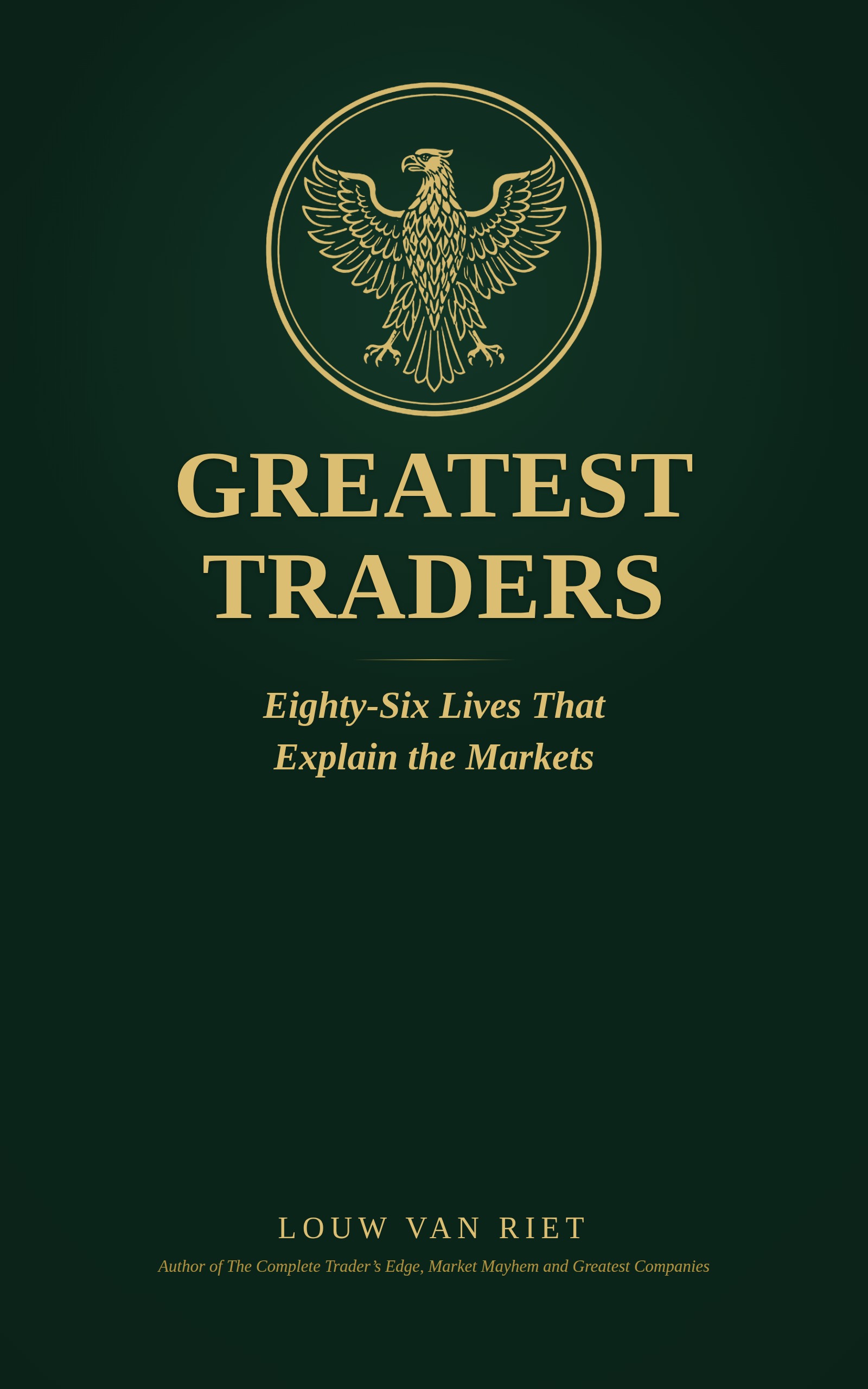
Eighty-six lives that explain the markets — Livermore to Madoff, told with the losses left in.
View on Amazon →
Greatest Traders
Eighty-six lives that explain the markets — Livermore to Madoff, told with the losses left in.
View on Amazon →