
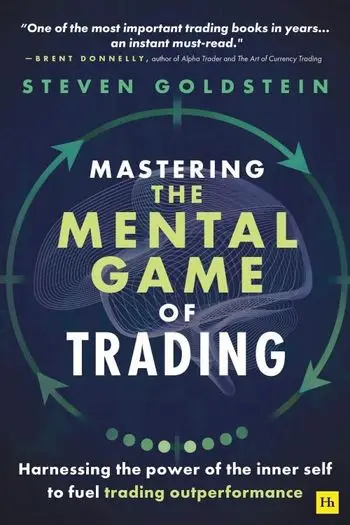
Most people who teach trading psychology have never carried risk. Most people who have carried risk cannot explain what it did to them. Steven Goldstein is one of the few who can do both, and it is the reason his work has ended up in the corner of the market where it matters most: on the desks of traders who are already good and want to stop getting in their own way.
He traded rates and foreign exchange for almost twenty-five years at institutions including Credit Suisse, Commerzbank and American Express Bank. He left the desk in 2010 and became a performance coach. He now runs coaching work through Alpha R Cubed, co-founded The AlphaMind Project with Mark Randall, co-hosts the AlphaMind podcast, and wrote Mastering the Mental Game of Trading, published by Harriman House in 2024.
This piece is about what he teaches, and why it belongs in the Mind pillar of any serious trader’s development.

Steven Goldstein: almost twenty-five years trading rates and FX, then a second career coaching the people who do it.
From the Desk to the Chair
The origin story is a small one, which is why it works.
Summer 2007. Goldstein is at a London bank, the market is moving against him, and he throws his pen down and starts cursing himself. His colleague Ashley says, without much ceremony, that he is doing it again. That thing where he beats himself up. Then Ashley adds the observation that eventually redirects a career: you sit here every year with no clients, no flow and no obvious edge, and you produce a profit anyway. If I had that ability, the last thing I would do is treat myself like this.
Goldstein describes standing on a hot, crowded commuter train hours later, turning that over. The realisation was not that he needed a better method. It was that he had been running two contests at once, and losing the private one badly enough to damage the public one.
He had already had his own experience of being coached, by Peter Burditt, who later told him he had the temperament to do the job himself. Three years after the pen incident he stopped trading professionally and took the chair on the other side of the desk. He trained formally, taking coaching and organisational development accreditations including from the European Association of Gestalt Therapists, which is where the distinctive vocabulary in his work comes from.
The client list speaks for itself in the way these things usually do, sideways. Jack Schwager has noted that several of the traders he interviewed for the Market Wizards series had used Goldstein as their coach. Goldstein himself has said that three of his former clients appear in Unknown Market Wizards, and that some of his clients have been U.S. Investing Champions. He is coaching at the thin end of the distribution.
The Inner Game and the Outer Game
The foundation of everything Goldstein teaches is a split.
The outer game is what everyone photographs: the market, the analysis, the setup, the execution, the risk model. The visible craft, and the part the entire education industry sells.
The inner game is the relationship you have with yourself while you play the outer one. Whether you back yourself at the point of decision. Whether you can hold a position without needing it to reassure you every few minutes. Whether a loss stays a loss, or becomes evidence about who you are.
His claim is stronger than the usual “psychology matters” line. He argues the inner game is the ground the outer game stands on, and that a fractured inner game cannot support an outer game no matter how good that outer game looks on paper. That single idea explains the most common story in this business: a profitable method in the hands of an unprofitable trader.
The other half of the claim is the interesting one. Goldstein also warns about the trader whose self-belief has no give in it at all, who has removed the possibility of being wrong. That inner game is not strong, it is rigid, and rigid things snap rather than bend. A degree of fragility, he says, is a good thing.
The Performance Process Cycle
Goldstein’s main model, and the spine of his book, is the Performance Process Cycle. It divides the trader’s process into four phases, each with completely different psychological demands.
| Phase | What it is | Where traders lose it |
|---|---|---|
| Being | Who you are before the session starts. Purpose, presence, the bargain you have made with yourself | Arriving as the version of yourself your last three trades created, rather than as yourself |
| Production | Preparation and analysis. Building a view, knowing the limits of your map, working with intuition | Mistaking the map for the terrain, then defending the map when price disagrees with it |
| Performance | The live position. Radical uncertainty, and the pull between process and results | Trading the P&L instead of the plan, because the P&L updates every second and the plan does not |
| Letting go | The close and the reset. Putting the trade down, in full, before the next cycle begins | Carrying the last trade into the next one, which is how one bad session becomes a bad month |
The practical value of the model is that it turns a vague complaint into a located one. “I lack discipline” is not a problem anyone can work on. “I execute well and I cannot complete the cycle afterwards” is a problem with an address.
Goldstein gives that fourth phase more space than any other trading writer has. Letting go, in his framing, is a skill rather than a mood, and an unfinished trade behaves exactly like an open position. It is still costing you something. The Gestalt term he uses for the uncomfortable pause between one cycle ending and the next forming is the fertile void, and his observation is that traders are extremely bad at sitting in it. They fill it with an entry.
Work With the Ego, Do Not Banish It
The standard advice is to leave your ego at the door of the trading room. Goldstein’s response is that this is about as realistic as leaving your shadow at the door. It travels with you.
So instead of telling you to remove it, he explains what it is for. His framing is evolutionary: the ego is a relational guardian, inherited equipment whose job is to protect your standing in your group. For our primate ancestors, ejection from the group was close to a death sentence, so a system evolved to keep its host accepted and respected. It does that job through a reward and punishment loop, delivering pleasant chemistry when your status looks safe and unpleasant chemistry the moment it looks threatened, fast, and well before you have consciously decided anything.
Now sit that system in front of a profit and loss figure that updates every second. Your trade goes green and you feel like a king. It goes red thirty seconds later and you feel like a clown. Neither feeling is information about the quality of your decision.
The self-sabotage follows directly. When the ego’s agenda and the task diverge, the ego takes the wheel. You close a good position early because the ego wants the win banked and the credit secured. You refuse to take a small loss because taking it makes the mistake real. That is not a character defect. It is a guardian doing its job in an environment where its instincts are expensive.
And then Goldstein does the thing that separates him from most of the field: he refuses to cast the ego as the villain. Great performers in every domain are driven by it. The people who changed things did so partly because their egos pushed them to project themselves. The objective is balance and taming, not elimination. He points at Marty Schwartz, who said the most important change in his career was learning to divorce his ego from the trade, and notes that Schwartz tamed the thing. He did not kill it.
The Two Approaches: Know Which Game You Are Playing
Goldstein’s second major model is the Two Approaches theory. His argument is that what we lump together under the single word “trading” is really two distinct practices, the Player approach and the House approach, with different philosophical foundations, different risk processes and different psychological demands.
The model is diagnostic rather than prescriptive. It does not tell you which one is better. It asks you to work out which one you are actually running, and then to check whether your risk process and your temperament match it.
This lands hard for anyone trading a funded challenge. The rules of a challenge impose one approach on you. Most retail instincts were formed in the other. Nobody names the mismatch, so the trader concludes he has a discipline problem when what he actually has is an alignment problem. Our prop firm challenge simulator is, in effect, a live demonstration of what happens when the game and the temperament disagree.
Mental Capital Is a Finite Account
Goldstein treats a trader’s mental capital as a real, depleting resource. Attention, decision quality and emotional tolerance all draw down through a session, affected by time of day, by cognitive load and by whatever the market has already put you through that morning.
Traders track one account obsessively and the other not at all. Then they take the worst decision of the day at hour seven, on an empty tank, and file it under discipline.
The practical consequence is that a trading plan which ignores the state of the operator is incomplete. This is exactly where his work overlaps with The Trader’s Physical Edge: sleep, load and recovery are not wellness topics, they are inputs to the size of the account you are drawing decisions from.
The Runway: Goldstein on the Odds
The most useful thing Goldstein has written recently is not about psychology at all. It is about arithmetic, and about what an honest reading of the arithmetic should make you do.
He points to the Taiwanese day trading research: Barber, Lee, Liu and Odean examined the complete records of the Taiwan Stock Exchange from 1992 to 2006, a period in which roughly 450,000 individuals engaged in day trading in the average year. Their finding is the one that gets quoted everywhere and understood almost nowhere: fewer than 1% of that population were able to predictably and reliably earn positive returns net of fees.
Goldstein’s reading of it goes a step further. Most of that 1%, in his view, were scraping by rather than thriving. The genuinely thriving group, he estimates, is closer to a quarter of one per cent. Two or three people in a thousand. He is explicit that this refinement is his own inference, not a number the study prints.
Then he does something almost nobody does with that statistic. He treats it as good news.
The question was never whether it can be done. It is what you are going to do to increase your odds of being one of the few who does it.
— Steven Goldstein, on the survival numbers
His comparison is with any other highly skilled pursuit. Ask how many children who want to play professional sport get there. Or make a living acting, or playing music, or at poker. Nobody treats those odds as proof that the thing is a scam. They treat them as proof that it is hard, and that the people who get there did something specific to get there.
What they did, in his account, is not mystical. He has watched it up close. None of it came naturally to them. They worked harder than most people ever will, through years that asked more than seemed reasonable, and they kept going when doubt arrived. And there is a detail buried in the fact that he coaches them at all: they went looking for people who could make them better.
Build the runway first
The operational half of his argument is the part worth printing out.
Trading is a highly skilled activity. You cannot be good at a highly skilled activity without the years of practice that skill requires. Which means the first year, and probably the second, is not going to pay you. If it does pay you, Goldstein’s warning is that it was probably a wave rather than a skill, and the real test arrives later.
So you build a runway: the years of income, from somewhere else, that let you be bad at this while you learn it. Some people keep another job. Some trade at night. Some have a partner carrying them through the learning years. Some sell a business to fund the leap. It is the same runway the actor builds pulling coffees between auditions, and nobody calls that failure.
Give yourself five or six years. You may make money sooner, in year two or three. You will still need a reserve, because success is never a straight line, and you still have to eat while it fails to be one.
The last move is the one that separates his advice from motivational content. Invert the process. Do not start trading and hope. Work out what success actually requires first, write the plan, and be honest with yourself about the timeline before you have money on the line. Goldstein’s own guess is that surviving year one lifts your odds significantly, and two years lifts them again. He flags plainly that this part is a guess. The point is not the numbers. The point is that survival is the variable you control, and almost nobody optimises for it.
If you want to run those numbers against your own situation rather than treat them as a slogan, the path to financial freedom calculator does exactly the runway arithmetic Goldstein is describing.
Goldstein and the Mind · Method · Money Framework
| Pillar | Where his work lands |
|---|---|
| MIND | Nearly all of it. The inner game, the ego as relational guardian, the four-phase cycle, detached curiosity, self-compassion as a performance tool rather than a comfort, letting go as a trainable skill |
| METHOD | No setups, but the Two Approaches model asks the question most method work skips: does the way you take risk match the temperament of the person taking it |
| MONEY | The runway argument is capital planning, and the ego material is the strongest case anyone has made for limits set in advance by a version of you who was not yet winning |
Everything above, set out in full: the Performance Process Cycle, the Two Approaches, and the ego chapter that is worth the price on its own.
Where to Find His Work
- The book: Mastering the Mental Game of Trading (Harriman House, 2024). Our full review of the book covers the models in depth.
- The AlphaMind podcast: co-hosted with Mark Randall, well past its hundredth episode, built around long conversations on the psychological and behavioural side of taking risk.
- The AlphaMind newsletter and his coaching work through Alpha R Cubed.
- On X: @AlphaMind101, where the runway argument above first appeared.
What to Take From It
Three things, in the order they are likely to matter to you.
First, locate your failure. Stop calling it discipline and work out which phase of the cycle you are losing. Preparation, execution and completion are three different problems with three different fixes.
Second, stop fighting your ego and start understanding it. It is not going anywhere. What you can do is know its patterns well enough to notice when it has taken the wheel, and build a process it cannot quietly override.
Third, build the runway. The odds are long, and Goldstein’s honesty about how long is the most respectful thing in his work. He is not telling you to give up. He is telling you that the people who make it gave themselves enough time to be bad at it first, and that the single highest-leverage decision you make is the one that keeps you in the game long enough to get good.
Frequently Asked Questions
Who is Steven Goldstein?
A performance coach for traders and financial market risk-takers, based in London. He traded rates and foreign exchange for almost twenty-five years at institutions including Credit Suisse, Commerzbank and American Express Bank before moving into coaching around 2009. He is managing director at Alpha R Cubed, co-hosts the AlphaMind podcast with Mark Randall, and is the author of Mastering the Mental Game of Trading.
What is the Performance Process Cycle?
Goldstein’s central model. It splits the trader’s process into four phases: being, production, performance and letting go. Each phase makes different psychological demands, and the point of the model is to let you identify which phase you are failing in rather than blaming a general lack of discipline.
What does Goldstein say about the ego?
That you cannot leave it at the door, and should stop trying. He describes the ego as a relational guardian, an inherited system for protecting your standing in a group, which sabotages traders when its agenda and the trade’s requirements pull apart. The objective is to tame and work with it, not to eliminate it, because the drive to succeed comes from the same place.
What is the runway, in trading terms?
The period of income from another source that lets you learn to trade without needing trading to pay you. Goldstein’s argument is that trading is a highly skilled activity, that skill takes years, and that anyone serious should plan for five or six years of learning with a reserve, rather than expecting the account to support them in year one.
What percentage of traders actually succeed?
The most rigorous figure comes from research on the Taiwan Stock Exchange covering 1992 to 2006, which found that fewer than 1% of day traders could predictably and reliably earn positive returns net of fees. Goldstein’s own reading is that the genuinely thriving group is smaller still, closer to a quarter of one per cent, though he is clear that this refinement is his inference rather than a published figure.
Is his work relevant to retail traders?
Yes, and arguably more so. His stories come from bank desks because that is where he worked, but the mechanisms do not scale with account size. The retail trader has no risk manager, no mandate and no colleague to tell him he is beating himself up again, which means the inner game is running with nothing external holding it in check.
Continue Learning
 The Complete Trader's Edge
The full Mind · Method · Money framework. 70 chapters.
View on Amazon →
The Complete Trader's Edge
The full Mind · Method · Money framework. 70 chapters.
View on Amazon →
 Market Mayhem
400 years of bubbles, crashes, and the pattern that keeps repeating.
Buy on Amazon →
Market Mayhem
400 years of bubbles, crashes, and the pattern that keeps repeating.
Buy on Amazon →
 Greatest Companies
How the world's greatest companies were built — and what traders learn from them.
View on Amazon →
Greatest Companies
How the world's greatest companies were built — and what traders learn from them.
View on Amazon →
 Greatest Traders
Eighty-six lives that explain the markets — Livermore to Madoff, told with the losses left in.
View on Amazon →
Greatest Traders
Eighty-six lives that explain the markets — Livermore to Madoff, told with the losses left in.
View on Amazon →