

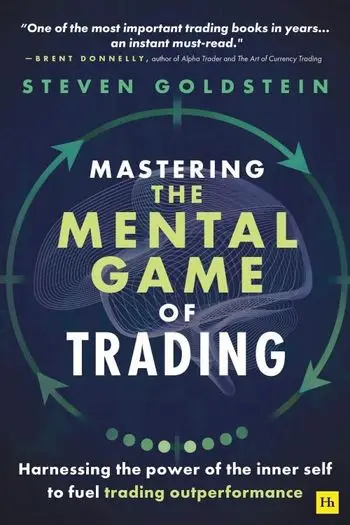
A trading coach who sat in the seat for twenty-five years first. If your method works and your execution does not, this is the book aimed straight at that gap.
Or browse all 81 books in the Trader’s Library →Most trading psychology books are written by psychologists who have watched traders. This one was written by a man who sat in the seat for almost twenty-five years, at Credit Suisse, at Commerzbank, at American Express Bank, and who spent a good part of that career quietly beating himself up at his own desk.
Steven Goldstein opens the book with that scene. Summer 2007, London, a bad afternoon. He throws a pen down. His colleague Ashley looks over and says the thing that eventually changes his career: you sit here every year with no customers, no flow, no obvious edge, and every year you make money, so why are you the one person on this desk who treats yourself like an idiot?
That question is the book. Not how to find an edge. Not how to read a chart. Why a competent trader with a working process spends his career fighting the one opponent who never leaves the room.
Goldstein hung up his trading gloves in 2010 and became a performance coach. He now runs coaching work through Alpha R Cubed, co-hosts the AlphaMind podcast with Mark Randall, and coaches at the level where a small change in behaviour is worth a great deal of money. This book is the distillation of that second career, and it is one of the most useful things written on the inner side of trading in the last decade.
One clarification before we go further. This is not Jared Tendler’s The Mental Game of Trading. Two different books, two different authors, two different projects, and the titles collide badly in search. Tendler’s is a diagnostic system for finding and dismantling specific emotional leaks. Goldstein’s is a map of the whole psychological cycle a trader moves through, and what each phase of it demands. They are complementary, not competing.
At a Glance
| Author | Steven Goldstein |
| Publisher | Harriman House, 2024 |
| Pages | 344, in 36 chapters across five parts |
| Genre | Trading psychology and performance coaching, Gestalt-informed |
| Difficulty | Intermediate. The prose is plain; the ideas ask something of you |
| Best For | Traders whose method works and whose execution does not |
| Skip If | You want setups, indicators or a rulebook. There are none here |
OVERALL RATING: 9.1 / 10
Who Should Read This Book
| Reader | Verdict | Why |
|---|---|---|
| New trader (0–1 year) | Read it second | You need a method before you need a mirror. But read it inside year one, because the habits it describes are being formed right now |
| Intermediate (1–3 years) | This is your book | You have a process that works on paper and a person who keeps overriding it. Goldstein is writing directly at that gap |
| Professional / institutional | Read it, then re-read Part Five | Written by someone who understands mandates, seat politics and the psychological contract between a trader and the firm paying him |
| Prop-firm / funded-challenge trader | Read the Two Approaches chapters first | Most challenge failures are a mismatch between the game the trader thinks he is playing and the one the rules actually impose |
| Systematic / algo trader | Read for the override problem | The code does not turn itself off in month four of a drawdown. A person does, and that person has an ego |
| Anyone who has read every psychology book | Still read it | The Performance Process Cycle is a genuinely new organising structure, not a restatement of Douglas with different nouns |
The Book in Context: Why Goldstein Could Write It
The trading psychology shelf has a structural problem. The clinicians can describe the mechanism but have never held a losing position overnight. The traders have held the position but have no vocabulary for what happened to them while they held it. Very few people sit on both sides of that line.
Goldstein does. He traded rates and FX at major banks for almost a quarter of a century, then trained formally as a coach, taking accreditations in coaching and organisational development including from the European Association of Gestalt Therapists. He has now been coaching traders since around 2009. The foreword is written by Peter Burditt, the coach who worked with Goldstein when Goldstein was still trading, and who later told him he should do this for a living.
That combination shows on almost every page. The Gestalt training gives him language for things traders usually describe as “I don’t know, I just tilted”. The trading career stops him from using that language carelessly, because he knows what a real bad month feels like and he is not willing to be precious about it.
The endorsement list is worth noting, not because blurbs prove anything, but because of who is on it: Jack Schwager, Brett Steenbarger, Linda Raschke, Mike Bellafiore, Brent Donnelly and Denise Shull. Schwager’s note is the one that carries weight, because he mentions that several of the traders he has interviewed for the Market Wizards series have used Goldstein as their coach. That is a specific claim from someone with no reason to make it loosely.
The Core Argument: The Inner Game Is the Foundation, Not the Supplement
Goldstein splits trading into two games that run at the same time.
The outer game is the one everybody talks about. Markets, setups, analysis, execution, risk. The visible craft.
The inner game is the relationship you have with yourself while you play the outer one. Whether you back yourself at the moment of decision. Whether you can hold a position without needing it to reassure you. Whether, after a loss, you can look at what happened without turning it into a verdict on who you are.
His claim, and it is the load-bearing wall of the entire book, is that the inner game is not a nice-to-have that sits alongside the outer game. It is the surface the outer game is built on. A fractured inner game cannot support an outer game, no matter how good the outer game looks on a spreadsheet. This is why traders with genuinely profitable systems still lose money: the system is fine, the platform under it is moving.
The reverse also gets stated, and it is the more unusual half. Goldstein warns against the trader whose self-belief has no give in it at all, who has removed failure from his vocabulary. That inner game is rigid rather than strong, and rigid structures do not bend under load, they snap. A degree of fragility, he argues, is a feature.
Taking on the market is hard enough on its own. It becomes a great deal harder when you are also losing a second contest, inside your own head, at the same time.
— The book’s premise, compressed
The Performance Process Cycle: The Book’s Central Model
The main framework, and the structure of the whole book, is the Performance Process Cycle. Part One introduces it. Parts Two to Five take one quadrant each and spend seven or eight chapters inside it.
The insight behind it is simple and, once you see it, hard to unsee. A trader is not in one psychological state. He cycles through four of them, continuously, and each phase has completely different demands. The state that makes you good at preparation is the wrong state for execution. The state that gets you through a live position is useless for review. Most traders run one setting all day and wonder why parts of their process keep collapsing.
The Four Quadrants
| Quadrant | What it covers | What it asks of you |
|---|---|---|
| 1. Being | Who you are before the session starts. Purpose, presence, the bargain you have made with yourself | Show up as yourself rather than as the version of you the last three trades created |
| 2. Production | Preparation, analysis, forming a view, the limits of your map, intuition and when to trust it | Accept that you are making an educated guess and prepare like it matters anyway |
| 3. Performance | The live position. Radical uncertainty, the performance effect, process versus results orientation | Stay in your process while the market actively works to pull you out of it |
| 4. Letting go | The close, the reset, self-compassion, becoming your own ally, returning to the start clean | Put the trade down completely, including the good ones, before the cycle starts again |
Four phases, four different psychological requirements. Most traders optimise one and let the other three run on default.
Quadrant four is where the book earns its rating. Goldstein gives seven chapters to letting go, and calls it a superpower without a hint of embarrassment. In most trading books, the review phase is a page about journalling. Here it is a quarter of the volume, because his argument is that the failure to complete a cycle is what contaminates the next one.
The trade you did not finish emotionally is still open. You take the next entry carrying it. That is how a single bad Tuesday becomes a bad quarter, and it is not a discipline failure, it is an unclosed loop. His term for the space you have to be willing to sit in while you close it, borrowed from Gestalt, is the fertile void: the uncomfortable gap after something ends and before the next thing has formed. Traders hate that gap. They fill it with a trade.
The Two Approaches: Which Game Are You Actually Playing?
The second major model in the book is the Two Approaches theory, framed as the Player approach versus the House approach. Goldstein’s argument is that what we lump together as “trading” is really two distinct practices with different philosophical foundations, different risk processes and different psychological demands.
The point of the model is not to rank them. It is diagnostic. He asks the reader to work out which approach he is actually running, then to check whether his risk process and his mindset match it. A great many trading problems, on his account, are not psychology problems at all in the first instance. They are alignment problems. You are running the risk process of one approach with the temperament and expectations of the other, and then blaming your discipline when the two grind against each other.
This chapter cluster travels further than trading. Anyone who has ever taken a funded challenge will recognise the problem immediately: the rules of a challenge impose one approach, the trader’s instincts were formed in the other, and nobody ever named the mismatch out loud. If you want to see how badly that plays out in practice, our prop firm challenge simulator is essentially a demonstration of what happens when the game and the temperament disagree.
The Behavioural Gap
Chapter three names the thing every trader has felt and few have labelled: the distance between what you know you should do and what you actually do. Not a knowledge deficit. A behavioural one.
This matters because of what it rules out. If the gap were knowledge, more education would close it, and the entire retail trading industry is built on the assumption that it would. Another course, another indicator, another session on market structure. Goldstein’s position is that the trader who cuts winners at half his target already knows he should not, has known for years, and will still do it tomorrow. Nothing you can teach him touches it, because teaching is aimed at the wrong system.
What closes the gap, in his framing, is awareness in the moment. Not resolve. Not rules. The capacity to notice what you are doing while you are doing it, which is a skill, and which can be trained, and which almost nobody trains.
The Ego Chapter: The Best Thing in the Book
If you read one chapter standing up in a bookshop, read the ego material in Part One.
The standard advice is to leave your ego at the door of the trading room. Goldstein points out that this is roughly as achievable as leaving your shadow at the door. It goes where you go. So instead of instructing you to remove it, he does something more useful: he explains what it is for.
His framing is evolutionary. The ego is a relational guardian, a piece of inherited equipment whose job is to protect your standing in the group. For a primate, ejection from the group was a death sentence, so a system evolved to keep its host accepted, respected and safely inside. It does that job with a reward-and-punishment loop: favourable outcome, pleasant neurochemistry; threat to status, unpleasant neurochemistry, delivered fast enough to change behaviour before you have consciously decided anything.
Now put that system in front of a P&L that updates every second. Your trade goes green and you feel like a king. It goes red thirty seconds later and you feel like a clown. Neither feeling has anything to do with the quality of the decision you made, and both are being generated by an organ optimised for a social environment that no longer exists.
The self-sabotage mechanism follows directly. When the ego’s agenda and the task diverge, the ego takes the wheel. The trader closes a good position early because the ego wants the win banked and the praise secured. He refuses to take the loss because taking it makes the mistake public, first to himself. That is not weakness. That is a guardian doing exactly what it was built to do, in a context where its instincts are lethal.
Then Goldstein does the thing that separates him from the crowd. He refuses to make the ego the villain. Great performers in every field, he notes, are driven by ego, and the people who changed the world did it partly because their egos pushed them to project themselves. The ego has a bright side. The objective is balance and taming, not banishment. He anchors it with Marty Schwartz’s line about the most important change in his career being learning to divorce his ego from the trade, and points out that Schwartz tamed the thing rather than killing it.
Five Ideas Worth Carrying With You
Your inner game is the ground your outer game stands on.
Not the finishing touch, the foundation. It explains the most common story in trading: a profitable method in the hands of an unprofitable trader. Nobody needs to change the method. Somebody needs to repair the ground it is standing on.
The ego is not your enemy. It is an organ with a job, and its job is not making you money.
It is trying to protect your standing, using chemistry that predates markets by millions of years. You cannot fire it. You can learn its patterns, notice when it has taken the wheel, and build a process it cannot quietly override.
Mental capital is a finite account, and most traders have no idea what their balance is.
Goldstein treats attention and decision quality as a depleting resource, affected by time of day, by load and by the emotional cost of the session so far. Traders track the money account obsessively and the other one not at all, then take their worst decision of the day at hour seven and call it a discipline problem.
Detached curiosity is the working state. Not confidence, not calm. Curiosity.
A position you are curious about is a position you can be wrong about. Confidence has to be defended, and defending it is how traders end up arguing with price. Curiosity is the only stance that lets new information in while your money is on the table.
Letting go is a skill, and an unfinished trade is an open position.
Winners contaminate the next decision as reliably as losers do. The cycle has to be closed properly, which means sitting in the empty space after it ends rather than filling that space with another entry.
What the Book Actually Asks You to Do
Goldstein is explicit that this is not a book of answers, and readers who want a checklist will find that frustrating. What it does have is a set of practices that follow from the models.
The journalling chapter is the most immediately usable thing in it, and it is a better chapter than the topic usually gets. His journal is not a trade log. Trade logs record what the market did. His version records what you did and, more importantly, what state you were in when you did it. The purpose is not record-keeping. It is building the capacity to see yourself, which is the only thing that closes the behavioural gap.
Then there is the purpose material in Part Two, which is more practical than it sounds. Goldstein’s position is that a trader without a clearly articulated purpose has no stable reference point, so his sense of himself gets set by his last few trades. Purpose is not motivational decoration here. It is the thing that stops the P&L from being the only judge in the room.
And there is the self-compassion chapter, which some traders will bounce off hard, and which is aimed precisely at them. His argument is that self-criticism is not the engine of improvement it pretends to be. It depletes mental capital, and it makes you avoid looking at your own mistakes clearly, because looking hurts. The trader who is his own worst critic is usually also the trader with the least accurate picture of his own game. Ashley worked this out about Goldstein on a trading desk in 2007 in about fifteen seconds.
Common Misreadings of the Book
Misreading #1: “It’s just mindset fluff”
The vocabulary invites this, and readers who stop at chapter titles will make the mistake. But the content underneath is structural: a four-phase model of the trading process, a two-approaches diagnostic for matching risk process to temperament, and an evolutionary account of why the ego behaves as it does. That is architecture, not affirmation.
Misreading #2: “So the ego is the problem”
He argues the opposite as carefully as he argues anything. An ego suppressed to nothing takes the drive with it. The target is a working relationship, where the ego motivates and the self decides. Readers who come away resolved to eliminate their ego have read the chapter backwards.
Misreading #3: “This is for institutional traders”
The stories come from bank desks and hedge funds because that is where Goldstein worked and coaches. The mechanisms do not care about your account size. If anything the retail trader is more exposed, because he has no risk manager, no mandate and no colleague named Ashley to tell him he is doing it again.
Misreading #4: “I’ll read it once and I’m done”
The book is built to be re-entered by quadrant. Read Part Three during a live drawdown and it says something different to what it said in a calm week. Linda Raschke’s blurb says she could read it once a month, and that is a comment about structure rather than enthusiasm.
Misreading #5: “It will fix my discipline”
Goldstein’s own framing rules this out. The book raises awareness. Awareness gives you the option to respond differently. It does not take the trade for you, and the work of actually changing behaviour happens after the book is closed, over months, usually with something external holding you to it.
Where the Book Falls Short
An honest review names the weaknesses, and there are real ones.
- The client stories are unverifiable by design. Goldstein anonymises his clients and their contexts, as any coach bound by confidentiality must. The stories are the most persuasive material in the book, and they are also the material a sceptical reader cannot check. That is an honest constraint honestly handled, but it is still a constraint.
- The Gestalt vocabulary will lose some readers. Fertile void, presence, the self as distinct from the ego. Every term is doing real work and none of it is decorative, but a quant-minded reader may need to push through a hundred pages of unfamiliar register before the payoff arrives.
- 344 pages for a smaller number of distinct ideas. The Performance Process Cycle, the Two Approaches, the ego, the behavioural gap, mental capital, letting go. Six or seven load-bearing concepts, thoroughly illustrated. Some readers will feel the middle chapters circling rather than advancing.
- Thin on the modern retail environment. Nothing meaningful about phone trading, funded-challenge economics, prop-firm rule structures or social media as a psychological input. The mechanisms transfer, but the reader has to do the transferring.
- Diagnosis outweighs protocol. The book tells you what is happening and why with unusual clarity. It gives you less to do about it on Monday morning than a reader in pain will want. That is a deliberate choice and it is defensible, but pair it with something operational.
- No measurement. There is no way, inside the book, to know whether your inner game is improving. For a book aimed partly at professionals who live by numbers, that gap is noticeable.
How the Book Fits the Mind · Method · Money Framework
A Mind-pillar book that also quietly explains why the Method pillar keeps failing in practice.
| Pillar | Contribution | What the Book Delivers |
|---|---|---|
| MIND | PRIMARY | The Performance Process Cycle, the inner and outer games, the ego as relational guardian, the behavioural gap, mental capital, detached curiosity, letting go and the reset |
| METHOD | SECONDARY | No setups, but the Two Approaches model forces a hard question about whether your method and your temperament are even playing the same game |
| MONEY | SECONDARY | Positive expectancy is treated as a foundational chapter rather than an afterthought, and the ego material is the clearest case anyone has made for pre-committed risk limits |
Read alongside the Mind · Method · Money framework, the complete guide to trading psychology, and The Complete Trader’s Edge. If you want to know which of the three pillars is currently costing you the most, the M·M·M assessment will tell you in about five minutes.
Read This Instead Of / Read This After
| Relationship | Book | Why |
|---|---|---|
| Read after | Trading in the Zone | Douglas tells you what beliefs a trader needs. Goldstein explains the machinery that keeps overriding them, and gives you a cycle to work inside rather than a state to reach |
| Read alongside | The Hour Between Dog and Wolf | Coates supplies the physiology underneath Goldstein’s psychology. One explains the chemistry of the state, the other explains what to do while you are in it |
| Read alongside | The Mental Game of Trading by Jared Tendler | Confusingly similar title, genuinely complementary content. Tendler gives you a diagnostic protocol for specific leaks. Goldstein gives you the map of the whole cycle those leaks appear in |
| Read after | Best Loser Wins | Hougaard shows you the behaviour of someone who has done this work. Goldstein shows you the work |
| Read instead of | The next course on market structure | If you already have a method and cannot execute it, more method is the most expensive form of procrastination available to a trader |
Final Verdict: Should You Read This Book in 2026?
Yes. For the intermediate trader who has a method and cannot run it, this is close to the most useful book on the shelf.
The reason is the combination, and the combination is genuinely rare. Goldstein has the coaching training to describe internal mechanics precisely, and he has twenty-five years in the seat that stops the description from floating. He is not guessing what a drawdown does to a person. He is also not writing a memoir. He is doing the harder thing, which is turning what he learned in both careers into a structure another trader can use.
The Performance Process Cycle is the most valuable thing in it. Not because it is complicated, but because it reorganises how you think about your own day. Once you have seen that you are moving through four psychological phases with four different requirements, the question stops being “why am I not disciplined” and becomes “which phase am I failing in, and what does that phase actually need”. That is a much better question, and better questions are what good coaches give you.
It loses points for what it does not do. It will not hand you a protocol, it will not measure your progress, and it does not speak to the specific modern retail environment most readers of this site are trading in. Pair it with something operational and the gap closes.
But read it for the reframe. Goldstein’s central move is to take the trader’s relationship with himself out of the moral register, where it lives as guilt and resolutions, and put it into the engineering register, where things get fixed. That move is worth the price of the book on its own.
CTE Rating Breakdown
9.1/10
Essential Reading
| Readability | 9 | |
| Actionability | 7 | |
| Timelessness | 9 | |
| Beginner-Friendly | 7 | |
| Modern Relevance | 9 |
Ready to read it?
Available in paperback, Kindle and audiobook, narrated by Ian Pringle.
Frequently Asked Questions
Is this the same as Jared Tendler’s The Mental Game of Trading?
No. Two different books by two different authors with near-identical titles. Tendler’s is a diagnostic system for solving specific emotional problems such as greed, fear, anger and confidence. Goldstein’s is a map of the trader’s whole performance cycle and the relationship between the trader and himself. Owning both is not redundant.
Who is Steven Goldstein?
A performance coach for traders and one of the better known coaches working in the financial markets industry. He traded rates and FX for almost twenty-five years at institutions including Credit Suisse, Commerzbank and American Express Bank before moving into coaching around 2009. He co-hosts the AlphaMind podcast with Mark Randall and holds coaching and organisational development accreditations, including from the European Association of Gestalt Therapists.
What is the Performance Process Cycle?
The book’s central model. It divides the trader’s process into four quadrants: being, production, performance and letting go. Each phase has its own psychological demands, and Parts Two to Five of the book take one quadrant each. The practical value is that it lets you locate a problem in a specific phase rather than treating every failure as a general discipline issue.
What are the Two Approaches?
Goldstein’s Two Approaches theory splits trading into two distinct practices, the Player approach and the House approach, each with its own philosophy, risk process and psychological requirements. The model is diagnostic rather than prescriptive. It asks you to identify which one you are actually running and whether your mindset and risk process match it.
Is it suitable for beginners?
Reasonably, though the value scales with experience. A trader with no live losses has nothing to attach the material to. Get a method and one real drawdown behind you and the book stops being interesting and starts being uncomfortable, which is when it works.
Does it cover trading strategy?
No. There are no setups, no indicators and no entry rules. The one chapter that touches the mechanics of edge covers positive expectancy as a foundational concept. If you need a method, get one elsewhere first and come back.
How long does it take to read?
344 pages of plain prose, so roughly eight to ten hours at a normal pace. Reading it properly takes longer, because the book is built around reflection prompts and skipping them removes most of the point.
What is the single biggest takeaway?
That the trader and the trader’s self are two parties in a relationship, and the quality of that relationship sets the ceiling on everything else. When the two are aligned, the method gets executed. When they are at war, no method survives contact with the market.
About the Author

Steven Goldstein
Steven Goldstein traded rates and foreign exchange for almost twenty-five years at institutions including Credit Suisse, Commerzbank and American Express Bank, where he spent seven years as a proprietary trader. He left the desk in 2010 to work full time as a performance coach.
Now: managing director at Alpha R Cubed, co-founder of The AlphaMind Project with Mark Randall, and co-host of the AlphaMind podcast, which has run well past its hundredth episode of conversations on the psychological and behavioural side of market risk-taking. He holds coaching and organisational development accreditations including from the European Association of Gestalt Therapists.
The crossing is the point. Coaches who have never traded get dismissed by traders. Traders who write about themselves have no framework. Goldstein has done both jobs seriously, which is why this book reads the way it does.
Continue Learning
- Trading Psychology: The Complete Guide
- Trading in the Zone Book Review
- The Hour Between Dog and Wolf Book Review
- Best Loser Wins Book Review
- The Top Trading Books Explorer
- The M·M·M Trading Assessment
- The Complete Trader’s Edge — The Book
 The Complete Trader's Edge
The full Mind · Method · Money framework. 70 chapters.
View on Amazon →
The Complete Trader's Edge
The full Mind · Method · Money framework. 70 chapters.
View on Amazon →
 Market Mayhem
400 years of bubbles, crashes, and the pattern that keeps repeating.
Buy on Amazon →
Market Mayhem
400 years of bubbles, crashes, and the pattern that keeps repeating.
Buy on Amazon →
 Greatest Companies
How the world's greatest companies were built — and what traders learn from them.
View on Amazon →
Greatest Companies
How the world's greatest companies were built — and what traders learn from them.
View on Amazon →
 Greatest Traders
Eighty-six lives that explain the markets — Livermore to Madoff, told with the losses left in.
View on Amazon →
Greatest Traders
Eighty-six lives that explain the markets — Livermore to Madoff, told with the losses left in.
View on Amazon →