

GREATEST TRADERS · EPISODE 3
Paul Tudor Jones
The Greatest Risk Manager in Trading History
▶ Watch on YouTube🎵 Listen on Spotify
Also available on Apple Podcasts · Amazon Music
Last updated: 15 August 2026
Paul Tudor Jones II founded Tudor Investment Corp in 1980 and has produced one of the longest and most impressive track records in hedge fund history. He is perhaps best known among traders for calling the 1987 stock market crash, and his approach to that trade reveals the principles that have driven his success across four decades.
What makes Jones particularly instructive for retail traders is that his edge is not intellectual complexity. It is psychological discipline applied to simple, time-tested principles. His rules, which he has shared openly in interviews and the rare 1987 documentary Trader, are remarkably straightforward. The difficulty is in following them, which is why they remain an edge even after being publicly known.
Memphis, Eli Tullis, and the Firing That Made Him
Paul Tudor Jones II was born in Memphis, Tennessee, in 1954. The family was comfortable rather than wealthy. He went to the University of Virginia and graduated in economics, and by his mid-twenties had found his way to the New York Cotton Exchange, one of the last open-outcry pits where orders were shouted across a physical floor.
Before that came the part of the story that actually matters. Eli Tullis was one of the largest cotton traders in the world and a legendary figure in the Memphis commodities scene. Jones worked for him, learned from him, watched him operate. And then Tullis fired him, for falling asleep at his desk during a punishing trading session.
Jones has since described that firing as one of the most important events of his career. Not because it taught him to stay awake. Because it taught him that the market does not forgive lapses in attention, and that complacency for even a moment can cost everything. Tullis ran his operation at a level of intensity Jones had initially thought excessive. After being fired, he understood it was not excessive at all. It was simply the seriousness the job demands.
He founded Tudor Investment Corporation in 1980, built around a single idea he has articulated more clearly than almost any trader in history: do not lose money.
“The most important rule of trading is to play great defence, not great offence.”
— Paul Tudor Jones
The 1987 Trade That Made His Reputation
In the months before Black Monday, October 19, 1987, when the Dow fell 22% in a single day, Jones studied historical parallels with the 1929 crash and became convinced a significant market correction was imminent. He built a large short position progressively as the evidence accumulated. When the crash came, Tudor’s fund reportedly made over 200% that year.
What is most instructive is not the trade itself but how it was constructed. Jones did not go all-in on a prediction. He built the position gradually, adding as the market confirmed his thesis (exactly the pyramiding approach Jesse Livermore used decades earlier). His risk on the initial position was small. Had he been wrong, the loss would have been manageable. Being right, the profit was enormous. This is the textbook asymmetric risk-reward setup that defines the best macro trades.
The 1929 Overlay
The specific thing Jones did was both simple and deeply contrarian. He overlaid the Dow’s 1928 to 1929 price action on its 1986 to 1987 price action. The resemblance was striking: the same euphoric rally, the same higher highs on declining internal strength, the same signatures of exhaustion masked by headline optimism.
This was not quantitative analysis in the modern sense. It was pattern recognition, historical awareness, and the psychological independence to take the result seriously while the rest of the market dismissed any possibility of a crash. The summer of 1987 was euphoric. Portfolio insurance, a new product that was supposed to protect investors from downside, had given the market a false sense of security. Everyone believed they were hedged. Jones believed the hedging itself had created the structural vulnerability.
He built a large short position in S&P 500 futures, sized to his rules: large enough to matter if he was right, small enough to survive if he was wrong. Then he waited.
On 19 October 1987 the Dow fell 508 points, 22.6 per cent, still the largest single-day percentage decline in the history of the American stock market. Screens went blank. Margin calls went unmet. Jones made roughly $100 million in the day, roughly tripled the fund’s money that month, and finished the year up over 200 per cent.
A documentary crew happened to be filming him through this period. Jones later tried to suppress the resulting film, reportedly buying up copies to keep it out of circulation. It has become one of the most sought-after pieces of trading footage in existence.
“Don’t Lose Money”: The Three Words Underneath Everything
Not “don’t take losses”. Not “don’t have losing trades”. Do not lose money. The distinction is the whole method.
Jones assumes every single trade he enters is wrong. He does not hope it will work. He does not believe it will work. He assumes it will fail and builds his position management around that assumption. If the market proves him wrong by moving in his favour, he lets it run. If it confirms his assumption by moving against him, the stop is already sitting there and the damage is contained.
That psychological inversion is the most powerful risk tool in his arsenal, and it is the exact opposite of how most traders operate. Most enter a position and then hunt for reasons to stay in it. They anchor to the entry price. They widen the stop. They add to the loser. They rationalise. Jones enters assuming he is wrong and makes the market prove otherwise before he adjusts anything.
The Three Rules He Has Not Changed in Forty Years
- Never risk more on one trade than you can afford to lose. This sounds obvious and is not. Almost every trader who blows up violates this single rule: position too large for the account, market moves against them, and a manageable loss becomes a terminal one.
- A minimum risk-to-reward of 1:5. For every dollar risked he wants at least five in potential. At that ratio he can be wrong four times out of five and still break even. His actual hit rate is far above twenty per cent, which is where the asymmetry compounds. Note the gap between his floor and the practical floor most traders can find setups at: the 1:2 or 1:3 minimum used elsewhere on this site is a realistic working standard, not a contradiction of his.
- The 200-day moving average. Jones has said repeatedly that nothing is worth owning below its 200-day moving average. It is the simplest trend filter that exists, and he applies it without exception or override.
The simplicity is itself the lesson. No complex algorithms, no team of quants running models. A small number of clear rules applied with total consistency. The edge is not in the sophistication of the system. It is in the discipline to follow it.
“Don’t focus on making money. Focus on protecting what you have.”
— Paul Tudor Jones
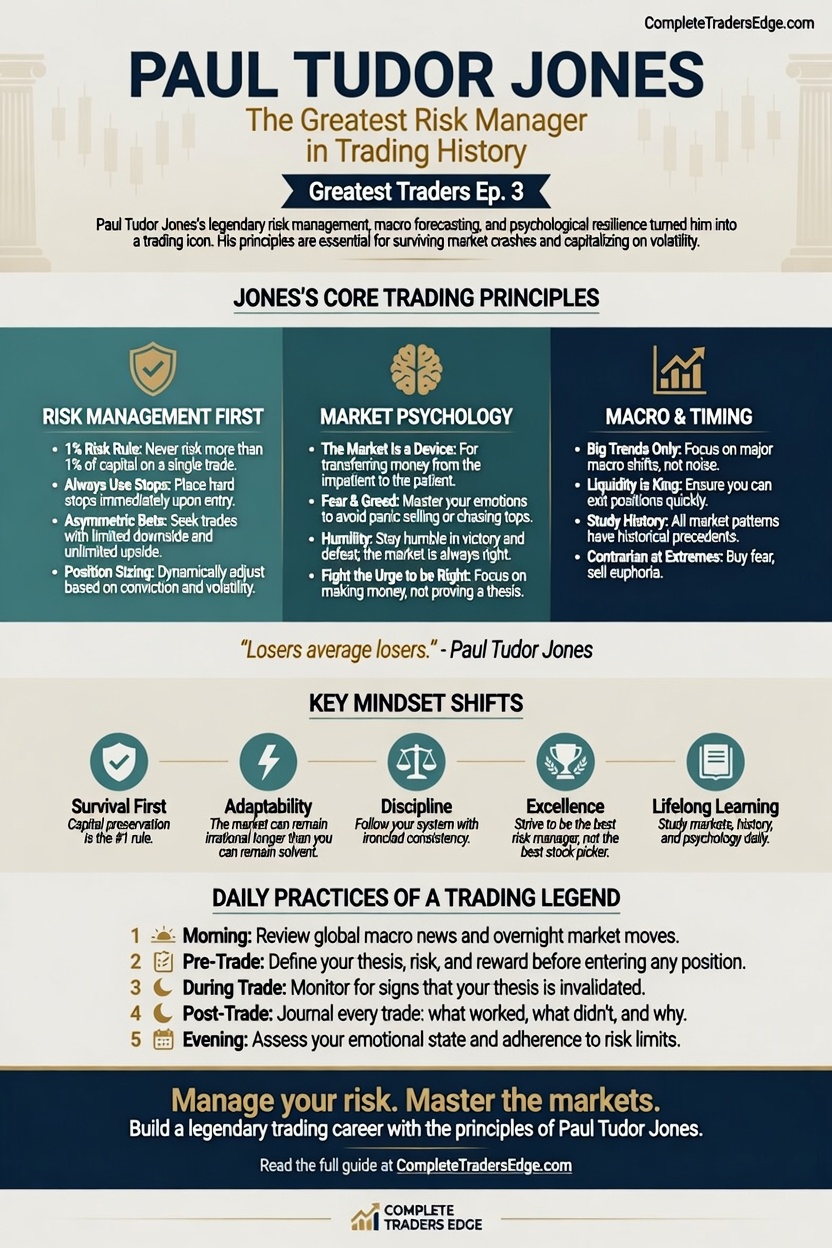
Paul Tudor Jones’s Core Principles
| Principle | What It Means | How to Apply It |
|---|---|---|
| Losers average losers | Never add to a losing position. The market is telling you that you are wrong. | Hard rule: no averaging down. If stopped out, re-evaluate. Never throw good money after bad. |
| Defence over offence | Focus on not losing money rather than on making it. | 1% risk per trade. Daily loss limit. Drawdown protocol. Capital preservation first. |
| Every day is a new day | Reset emotionally between sessions. Yesterday’s results do not affect today. | Post-session shutdown ritual. Close platform. Journal. Start fresh tomorrow. |
| Asymmetric risk-reward | Only take trades where the potential reward significantly outweighs the risk. | Minimum 1:2 R:R. Ideally 1:3 or better. No trade where you risk more than you can gain. |
| Watch for inflection points | The biggest moves happen at market turning points where the consensus is wrong. | Study liquidity, sentiment extremes, and structural turning points where the crowd is positioned on one side. |
“Losers Average Losers”: The Rule That Saves Accounts
This is arguably the single most important piece of advice in the Jones canon. Adding to a losing position is one of the most dangerous habits in trading. Jones has described it as a trading sin, because it means the market is telling you that you are wrong and you are responding by increasing exposure to being wrong.
The psychology is understandable: averaging down lowers your average entry price, which means you need a smaller move to break even. But the mathematics are devastating. If your original thesis was wrong, adding size means you now have a larger position in the wrong direction. When the market continues against you, the larger position amplifies the loss. What would have been a 1R loss becomes a 3R or 5R catastrophe.
The professional alternative: if you are stopped out and still believe in the thesis, wait for the market to confirm a new setup at a new level before re-entering. This forces the market to show you evidence before you commit more capital. It is what Order Block entries and liquidity sweep reversals are designed to identify: the next valid entry point after an initial thesis has been tested.
Defence Over Offence: The Professional Orientation
Jones repeatedly emphasises that his primary focus is on not losing money rather than on making it. This defensive orientation is counterintuitive for most retail traders who enter markets thinking about profits. But it is the professional standard because the mathematics of drawdowns are asymmetric: a 50% loss requires a 100% gain just to break even.
In practice, defence-first thinking means: calculate your maximum risk before you calculate your potential profit. Set your daily loss limit before the session starts. During drawdowns, reduce size rather than increase it. Treat capital preservation as the foundation on which profit potential is built.
This aligns perfectly with the Mind, Method, Money framework. The Money pillar is not about maximising returns. It is about ensuring survival while the edge compounds. Jones has lived this principle for over 40 years, and his consistency is the result.
Technical Analysis as a Risk Tool, Not a Crystal Ball
One distinction in the Jones approach gets lost in most retellings, and it is the one worth stealing. He does not use technical analysis primarily to predict where price is going. He uses it to define where he is wrong.
That sounds like a small reframing. It changes everything about how you read a chart. A trader using technicals predictively looks at a level and asks what happens next. A trader using them defensively looks at the same level and asks: if price closes through this, is my thesis dead? The first question produces conviction. The second produces an exit.
It also explains how a macro trader with a strong fundamental view still respects a chart. The macro thesis says what should happen. The chart says whether it is happening yet, and at what point the market has disagreed with you decisively enough that you should stop paying to be right. Support and resistance become invalidation markers rather than targets.
Position Size Is the Variable, Not the Conviction
Jones has been open that his worst losses came less from bad ideas than from good ideas held in the wrong size. He was right about direction and too large for the volatility, which meant a normal adverse swing became an abnormal loss.
Most retail traders have this backwards. They treat conviction and size as the same dial: the more certain they feel, the bigger they go. That is precisely how a high-conviction trade becomes an account-ending one, because certainty is a feeling and volatility is a measurement, and only one of them decides how far price can move against you before you are stopped.
The professional version separates them. Conviction determines whether you take the trade. Volatility and structure determine how large it is. A trade you are certain about, in an instrument with wide daily ranges and a distant invalidation level, is a smaller position, not a bigger one. Getting this backwards is one of the most common ways a genuinely good trader still blows up.
What Retail Traders Can Learn
Jones is a macro trader operating at a scale most retail traders will never approach, but his principles are universally applicable. Never add to losers. Focus on capital preservation first. Reset emotionally between sessions. Only take asymmetric risk-reward opportunities. These are not complicated ideas. They are, however, consistently difficult to apply, which is why they define professional traders and remain an edge even after being publicly shared for decades.
The most powerful takeaway from Jones’s career is the concept of the professional trader mindset: the trader who has survived 40+ years in the markets is not primarily a genius forecaster. He is primarily a risk manager who happens to have good market instincts. The risk management came first. The instincts developed over time. This sequence matters.
Key Lessons
- “Losers average losers”: never add to a losing position. The market is telling you that you are wrong.
- Defence over offence: focus on not losing money first, making money second.
- Emotional reset between sessions. Yesterday’s results do not affect today’s execution.
- Asymmetric risk-reward: only take trades where potential profit significantly outweighs potential loss.
- Use technical analysis to define where you are wrong, not to predict where price is going.
- Conviction decides whether you take a trade. Volatility and structure decide how large it is. Never confuse the two.
- The most successful traders are primarily risk managers, not return maximisers.
Listen to the Full Episode
Jones is Episode 3 of the Greatest Traders podcast, running from the Memphis cotton pits to Black Monday and the four decades since. Players are at the top of this page.
What You’ll Hear in the Episode
▶ How getting fired by Eli Tullis was the best thing that ever happened to him
▶ The 1929 and 1987 chart overlay that flagged Black Monday in advance
▶ Why he assumes every trade he enters is wrong until proven right
▶ The 200-day moving average rule he never breaks
▶ His minimum 1:5 risk-reward ratio, and why most traders have this backwards
▶ The documentary he tried to suppress, and why
| Time | Section | Theme |
|---|---|---|
| 0:00 | Black Monday | Cold open, 19 October 1987 |
| 2:00 | Memphis to Wall Street | The cotton pits and Eli Tullis |
| 7:00 | The Principles | Defence wins, the three core rules |
| 12:00 | The 1929 Overlay | Spotting Black Monday before it arrived |
| 17:00 | The Legacy | Four decades without a losing year |
| 20:00 | The Lesson | Mind, Method, Money and what PTJ teaches every trader |
Frequently Asked Questions
Who was Eli Tullis?
Eli Tullis was one of the world’s largest cotton traders and a legendary figure in the Memphis commodities scene. He mentored Jones early in his career and then fired him for falling asleep at his desk during a gruelling session. Jones has repeatedly called that firing one of the most valuable things that ever happened to him, because it taught him that markets do not forgive lapses in attention.
What is the 200-day moving average rule?
Jones has said many times that nothing is worth owning while it trades below its 200-day moving average. Above the line he works from the long side, below it from the short side or not at all. It is deliberately the simplest trend filter available, and the point is not the indicator. The point is that he applies it without exception, which is what almost nobody else does.
Has Paul Tudor Jones really never had a losing year?
Tudor Investment Corporation has delivered positive returns in every year since its founding in 1980, which is the claim usually made on his behalf. To see how unusual that is, note that Soros had losing years, Druckenmiller had losing years, and Buffett has had long stretches of underperformance. A record like that points less to superior forecasting than to a risk framework robust enough to function as structural protection against catastrophic loss.
What is Paul Tudor Jones’s net worth?
As of 2026, Jones’s net worth is estimated at approximately $8 billion, built entirely through trading and investment management over four decades. Tudor Investment Corp manages approximately $12 billion in assets. His sustained wealth (unlike Livermore, who lost his fortunes) is a direct testament to his defence-first approach to risk management.
Can retail traders apply macro trading principles?
The specific principles (defence first, no averaging down, asymmetric R:R, emotional resets) apply directly to any trading style. You do not need to trade macro events to benefit from Jones’s approach. A day trader using ICT concepts on the 15-minute chart can apply every one of these principles. The scale is different. The discipline is identical.
What is the “Trader” documentary?
Filmed in 1987, Trader is a rare documentary showing Jones preparing for and trading the 1987 crash. It was pulled from public distribution at Jones’s request and has been difficult to find since. It shows his analytical process, his emotional intensity during live trading, and his reliance on historical pattern analysis. Clips have circulated online and provide valuable insight into how a professional macro trader operates in real time.
How does Jones’s approach compare to George Soros?
Both are macro traders who bet on large market dislocations, but their philosophical frameworks differ. Soros operates through reflexivity theory (markets create self-reinforcing cycles that eventually reverse). Jones relies more on historical pattern analysis and technical timing combined with macro fundamentals. Both share the asymmetric risk-reward orientation and the willingness to be wrong quickly. Stanley Druckenmiller, who managed money for Soros, bridges both approaches.
What is the most important lesson from Jones for a beginner?
Defence over offence. Before you think about how to make money, build the infrastructure that prevents you from losing it: 1% risk per trade, hard stop losses, daily loss limits, and a drawdown protocol. If Paul Tudor Jones, one of the most talented traders alive, puts defence first, a beginner should build their entire approach around it.
Continue Reading
▶ Jesse Livermore: The Greatest Speculator Who Ever Lived
▶ George Soros: Reflexivity and the Macro Trade
From The Book
Paul Tudor Jones is featured in Chapter 68 of The Complete Trader’s Edge.
Jones was interviewed for the original Market Wizards, and it remains the best single source on how he actually thought about risk rather than how the Black Monday story gets retold.

Read our full Market Wizards review.
 The Complete Trader's Edge
The full Mind · Method · Money framework. 70 chapters.
View on Amazon →
The Complete Trader's Edge
The full Mind · Method · Money framework. 70 chapters.
View on Amazon →
 Market Mayhem
400 years of bubbles, crashes, and the pattern that keeps repeating.
Buy on Amazon →
Market Mayhem
400 years of bubbles, crashes, and the pattern that keeps repeating.
Buy on Amazon →
 Greatest Companies
How the world's greatest companies were built — and what traders learn from them.
View on Amazon →
Greatest Companies
How the world's greatest companies were built — and what traders learn from them.
View on Amazon →