You have reached the end of the framework — but in truth, you are standing at the beginning. Every chapter in this book has addressed one component of a complete trading approach. This final chapter is about integration: how Mind, Method, and Money combine into a unified, self-reinforcing system, and what the path forward looks like for a trader who commits to building all three.
The Integrated Framework
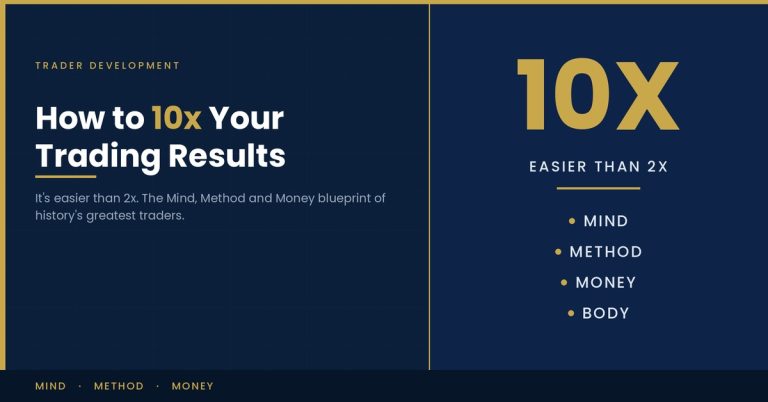
Mind, Method, and Money are not three separate subjects that happen to coexist in the same book. They are three aspects of a single unified approach, each dependent on and reinforcing the others.
A clear, well-defined Method gives your Mind something concrete to execute — removing ambiguity and reducing the decision burden that emotional states exploit. Consistent Money management removes the existential financial pressure that corrupts psychological discipline. Psychological strength (Mind) allows you to follow your Method precisely and maintain your Money management rules even during difficult periods. Remove any one pillar, and the other two are undermined.
The Development Timeline
A realistic development timeline for a committed trader: Year one focuses primarily on education, system building, and backtesting. Year two transitions to live trading at small size, focusing on consistency of process over profitability of outcome. Year three is where genuine confidence develops — you have seen your edge work across different market conditions and you have the psychological data from your journal to trust it. Scaling becomes appropriate.
This timeline is uncomfortable for people who want to trade full-size immediately. It is, however, an honest reflection of how consistently profitable traders develop.
The Ongoing Practice
Trading mastery is not a destination. The market evolves. Your life circumstances change. Your psychological relationship with risk and money deepens over time. The traders who achieve and maintain genuine consistency treat it as an ongoing practice — not a problem to be solved once and then forgotten.
The journal never stops. The weekly review never stops. The study of markets never stops. The attention to psychological state never stops. The routine never stops. These are not chores to be endured — they are the craft itself.
What You Now Have
You have a complete framework. You have the psychological understanding to build a trader identity capable of consistent execution. You have the technical knowledge to identify and validate a genuine edge. You have the risk management principles to protect your capital and let your edge express itself over time. What you do with it is entirely up to you.
The market will be here tomorrow, and the day after, and the year after. The traders who succeed are not the most talented or the most intelligent. They are the most persistent, the most self-aware, and the most committed to the process. Build the process. Trust the process. Let the process deliver the results.
The Three Pillars: How They Reinforce Each Other
| Pillar | What It Provides | What Happens Without It |
|---|---|---|
| Mind | Psychological discipline, emotional regulation, patience, consistency | Good strategy, poor execution. Revenge trading, overtrading, fear-based exits. |
| Method | A tested strategy with defined edge: structure, OBs, FVGs, Fibonacci | No repeatable edge. Random entries. Gambling, not trading. |
| Money | Position sizing, stops, drawdown management, R:R discipline | Good strategy, good discipline, but blown accounts from oversizing. One loss undoes months of work. |
Key Lessons
- Mind, Method, and Money are three aspects of one unified system. Remove any one and the others collapse.
- Realistic development timeline: Year 1 (education/building), Year 2 (small live), Year 3 (confidence and scaling).
- Trading mastery is an ongoing practice, not a problem solved once. The craft never stops deepening.
- Success belongs to the persistent, the self-aware, and the process-committed, not the most talented.
Frequently Asked Questions
Where should I start if I am a complete beginner?
Start with the Mind pillar: Why Most Traders Fail, The Three Pillars, Building Your Trader Identity. Then move to Method: Market Structure, Candlestick Patterns, Order Blocks. Then Money: Position Sizing, Stop Losses, Risk-to-Reward. This sequence mirrors the book’s structure and builds each concept on the previous one.
How long until I am profitable?
The honest answer: 1 to 3 years of deliberate, structured practice. Some traders reach consistency faster; many take longer. The variable is not intelligence or talent. It is the quality and consistency of the practice. A trader who journals every trade, reviews weekly, backtests systematically, and follows a routine will reach consistency faster than one with 10x the screen time but no structure.
Which pillar is the most important?
They are equally important because they are interdependent. However, most traders underinvest in Mind relative to Method and Money. They spend 90% of their time learning setups and 10% on psychology. The professionals who sustain long-term success, from Livermore to Druckenmiller, consistently identify the mental game as the ultimate differentiator. If forced to prioritise, invest more time in Mind.
Can I learn trading from this website alone?
This website provides the complete educational framework. The book, The Complete Trader’s Edge, provides the same material in a structured, sequential format designed for deep study. What no resource can provide is the screen time, the journalling practice, and the live trading experience that converts knowledge into skill. The articles teach you what to do. Your daily practice teaches you how to do it under pressure. Both are necessary.
What is the single most important thing I can do today to improve my trading?
Start a trading journal. If you already have one, review it. The journal is the single highest-leverage tool because it converts every trade into a learning opportunity, reveals patterns invisible to the naked eye, and provides the data that drives all improvement. A trader with a journal improves. A trader without one repeats mistakes indefinitely. Start today. 3 minutes per trade. The return on that time investment is the highest in trading.
 The Complete Trader's Edge
The full Mind · Method · Money framework. 70 chapters.
View on Amazon →
The Complete Trader's Edge
The full Mind · Method · Money framework. 70 chapters.
View on Amazon →
 Market Mayhem
400 years of bubbles, crashes, and the pattern that keeps repeating.
Buy on Amazon →
Market Mayhem
400 years of bubbles, crashes, and the pattern that keeps repeating.
Buy on Amazon →
 Greatest Companies
How the world's greatest companies were built — and what traders learn from them.
View on Amazon →
Greatest Companies
How the world's greatest companies were built — and what traders learn from them.
View on Amazon →