

Overnight risk is the category of loss that catches traders off guard the most consistently, because it arrives while you’re not watching. A gap open on Monday morning, a CPI release at 8:30am before the regular session, an geopolitical headline at 2am — these events move markets 1-3% in minutes, and if you’re holding an unprotected position through them, your carefully placed stop loses all relevance.
This guide gives you the complete framework for managing overnight exposure: how to size down into the close, which events to avoid entirely, and how to structure positions that can survive gaps without catastrophic damage.
The Three Types of Overnight Risk
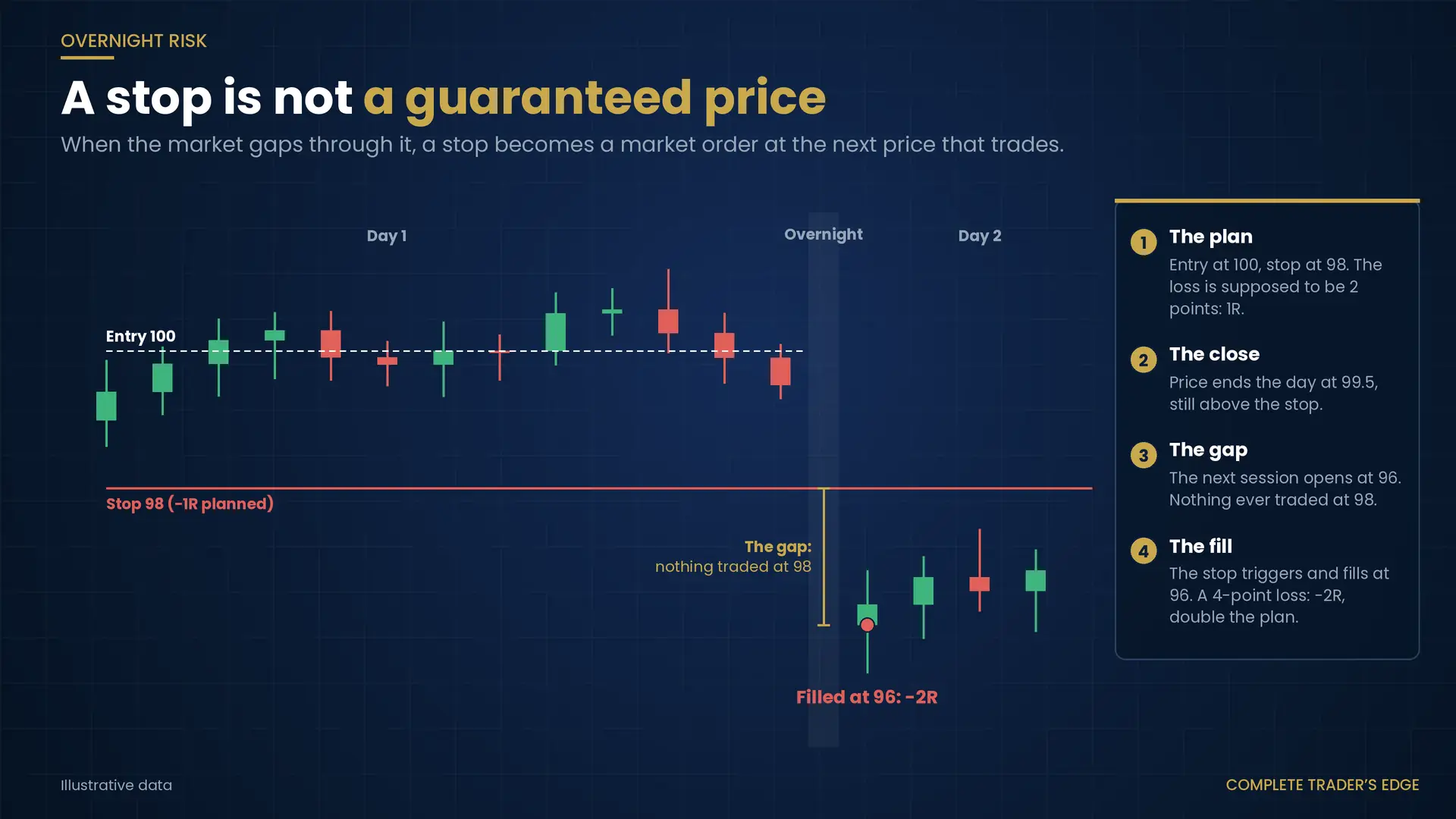
1. Gap risk: Price opens significantly above or below where it closed, skipping past your stop entirely. Your broker fills you at the open price, not your stop price. On a Gold long with a stop 20 pips below Friday’s close, a Monday gap open of 50 pips below that level produces a 70-pip loss instead of a 20-pip loss. Gap risk is not theoretical — Gold averages a gap of 8-12 pips on normal Mondays and 30-80 pips after significant weekend developments.
2. News event risk: Scheduled data releases and central bank decisions produce 30-200 pip moves in seconds. Stops are frequently jumped entirely during the initial spike. The events with the highest gap risk for Gold and index traders: FOMC decisions, NFP, CPI, PPI, major central bank speeches, and geopolitical developments.
3. Liquidity risk: During Asian hours and particularly the hours before the European open, spreads widen and depth thins. A stop placed at a level that would trigger a 20-pip loss during London hours might produce a 35-40 pip loss during thin Asian liquidity. This is not a gap — it is slippage on a legitimate stop execution in low-liquidity conditions.
The Overnight Position Sizing Framework
The core rule: overnight positions should carry a fraction of your intraday position size, scaled by the quality of the setup and the proximity of high-risk events.
| Scenario | Max Overnight Size | Rationale |
|---|---|---|
| Clean HTF setup, no news nearby | 50% of normal size | Normal gap risk, no event risk |
| FOMC/NFP/CPI tomorrow | 25% or flat | High event risk, gap likely |
| Friday into weekend | 25% or flat | Weekend headline risk (48hrs) |
| Prop firm account | 25% max, check firm rules | Gap can breach daily loss limit |
| High geopolitical tension | Flat — no overnight position | Unquantifiable tail risk |
Instrument-Specific Overnight Rules
Gold (XAU/USD)
Gold is one of the most gap-prone instruments for retail traders because it trades nearly 24 hours but has clearly defined thin liquidity windows (late Friday NY, early Sunday Sydney) where headline-driven gaps occur. Average Monday gap: 8-15 pips in normal conditions, 40-100 pips after a significant weekend development.
Friday rule for Gold: scale out 50% of any open position before 20:00 UTC on Friday. Close entirely if within 30 pips of a key level where a gap could trigger the stop and then reverse — your worst outcome is a gap stop-out with no chance to manage the trade.
Oil (WTI/BRENT)
Oil carries the highest geopolitical overnight risk of any liquid instrument. OPEC decisions, Middle East developments, pipeline incidents, and US inventory data all produce gap moves of 1-3% with minimal warning. For Oil swing positions, never hold through OPEC meetings with more than 25% of normal position size, and always scale to flat before inventory data (Wednesday 15:30 UTC).
NQ/ES (Index Futures)
US equity index futures re-open on Sunday at 18:00 ET and trade overnight. The Sunday open gap reflects the market’s re-pricing of any weekend developments. Typically modest in stable markets (5-15 NQ points) but can be 50-200 points after significant events. For swing positions held over the weekend, a stop placed at a structurally justified level should survive a normal Sunday gap. The risk is an abnormal Sunday gap — reduce position to 33% on Friday if any meaningful weekend risk is present.
BTC
BTC trades 24/7 and has no gap risk from session opens. However, it has the highest intra-session volatility of any instrument in your typical watchlist. A BTC overnight “stop” must account for 3-5% moves during low-liquidity Asian hours. Size overnight BTC positions at 25-33% of your intraday size, with stops placed beyond the daily ATR range rather than at a fixed pip distance.
The Pre-Close Checklist
Run this checklist every day before the NY session closes (21:00-22:00 UTC):
- Open economic calendar. Identify all red-folder events in the next 24 hours. FOMC, NFP, CPI, major central bank speeches, and country-specific PMI data are all on the close-or-reduce list.
- Check current position size. Is it appropriate for overnight hold at the current risk level? If you’re at full intraday size, halve it before close.
- Assess gap exposure. Where is your stop relative to the current price? Would a 50-pip gap take you beyond your stop? If yes, either tighten the stop or reduce size.
- Review prop firm daily limit. If you’re already down on the day, an overnight gap could push you into the daily loss limit. Close partially or entirely if the gap risk combined with current drawdown could trigger a breach.
- Set gap alarm. Set a price alert 10 pips below your stop (for a long) so that if a gap fires your stop, you are notified immediately when trading resumes.
The Gap Insurance Trade
For swing positions you want to hold but are concerned about gap risk, a low-cost options hedge (where available) provides “gap insurance.” For Gold specifically, buying an out-of-the-money put option with a strike at your stop level costs a small premium and caps your downside if a gap takes price far beyond the stop. This is a more advanced technique suited to traders who already use options; it is not essential for most retail traders who can simply reduce size.
For futures and forex traders without options access, the alternative is scaling the position to a size where even a 3x stop-out (gap 3× your stop distance) doesn’t breach your daily or weekly loss limit. At 0.25% risk per trade, a 3x gap produces a 0.75% loss — painful but not catastrophic.
Frequently Asked Questions
Should I always close positions before the weekend?
For intraday traders, yes — close by Friday 20:00 UTC. For swing traders, the decision depends on the quality of the setup and current market conditions. A clean Daily uptrend in Gold with no scheduled weekend events and a stop well below the swing structure can be held. A position near a key level with geopolitical tensions elevated should be reduced or closed. The question is not “is it okay to hold overnight” but “what is the specific risk of holding this specific position through this specific period?”
What is the biggest overnight gap I should plan for on Gold?
Plan for a 100-pip gap on Gold in your worst-case sizing scenario. This covers the majority of weekend and event-driven gaps historically. Position your overnight size so that a 100-pip gap (regardless of your technical stop level) produces no more than 2% drawdown on your account. If your normal stop is 20 pips, that means sizing down to 20% of your intraday size for overnight holds. Uncomfortable, but it means you survive the worst-case and can continue trading.
How do prop firm daily loss limits interact with gap risk?
This is the most important overnight risk consideration for funded account traders. If your firm has a 5% daily loss limit and you’re holding a position overnight, a gap that takes you through your stop at 3× the stop size could immediately put you close to the daily limit before the session has even started. The solution is to calculate: what gap size would push my account to 80% of the daily loss limit? Size the overnight position so that answer is “a gap larger than I’ve ever seen on this instrument.”
Are there instruments where overnight holds are safer?
Major currency pairs (EUR/USD, GBP/USD) tend to have smaller gaps than commodities or indices because the forex market is genuinely near-continuous with no defined session gaps. Equity indices have defined gap windows (Sunday open) but typically have moderate gaps in stable conditions. Commodities (Gold, Oil) and crypto carry the highest gap risk. If you trade primarily for overnight or multi-day swings, major forex pairs with tight structural stops are the most manageable.
What should I do if I wake up to find a gap has triggered my stop overnight?
Accept the result and review the process, not the outcome. If your overnight sizing was appropriate for the risk (25-50% of intraday size on a sensible setup), the gap stop-out is a cost of doing business on a swing strategy — it will happen occasionally and is accounted for in your expectancy calculation. If the stop-out resulted in a loss larger than your pre-defined overnight risk budget, that is a sizing error to correct. Do not revenge trade after a gap stop-out. The market does not owe you a recovery.
▶ CONTINUE READING
Complete your risk management framework:
▶ Prop Firm Risk Calculator: How to Size Every Trade on a Funded Account
▶ Correlation Risk: Why Trading Gold and NQ at the Same Time Can Double Your Exposure
The Complete Trader’s Edge
Chapter 63 covers the complete overnight and weekend risk framework including instrument-specific rules, pre-close checklists, and how to structure swing positions that survive gap events.
 The Complete Trader's Edge
The full Mind · Method · Money framework. 70 chapters.
View on Amazon →
The Complete Trader's Edge
The full Mind · Method · Money framework. 70 chapters.
View on Amazon →
 Market Mayhem
400 years of bubbles, crashes, and the pattern that keeps repeating.
Buy on Amazon →
Market Mayhem
400 years of bubbles, crashes, and the pattern that keeps repeating.
Buy on Amazon →
 Greatest Companies
How the world's greatest companies were built — and what traders learn from them.
View on Amazon →
Greatest Companies
How the world's greatest companies were built — and what traders learn from them.
View on Amazon →
 Greatest Traders
Eighty-six lives that explain the markets — Livermore to Madoff, told with the losses left in.
View on Amazon →
Greatest Traders
Eighty-six lives that explain the markets — Livermore to Madoff, told with the losses left in.
View on Amazon →