

Scaling out is the most contentious topic in trade management. Close too early and you consistently underperform your own setups. Hold too long and you watch profits evaporate. Most traders bounce between the two extremes depending on their emotional state that day, which means their actual average R is significantly lower than their theoretical R.
The solution is a pre-defined scaling framework that removes the decision from the live trade. You decide the rules before the session opens. The market moves. You execute the rules mechanically. This guide gives you that framework.
Why Scaling Out Beats Full Close or Full Hold
There are three approaches to trade exit:
Full close at target: Simple, consistent, easy to backtest. But you leave all of the extended move on the table when price continues past your target. You also close winning trades at exactly the level where buy-side liquidity exists, meaning you’re selling into institutional buying.
Full hold (trail the stop): Maximum upside on the best trades, but psychologically very difficult. A trailing stop on a volatile instrument like Gold or NQ will frequently get hit on a retracement before the move continues, converting a potential 5R trade into a 1.5R trade. Most traders cannot hold through a 150-pip retracement on a trade that was showing 200 pips of profit.
Scaled exit: Locks in guaranteed profit at a pre-defined level while preserving exposure to the extended move with reduced position size. Creates the “free trade” — a position where the locked-in profit exceeds the remaining risk — which dramatically reduces psychological pressure and allows better decision-making on the held portion.
The scaled exit approach consistently produces higher average R than full-close strategies for most discretionary traders because it eliminates the emotional tendency to close early while also protecting against complete profit reversal.
The Two-Scale Framework
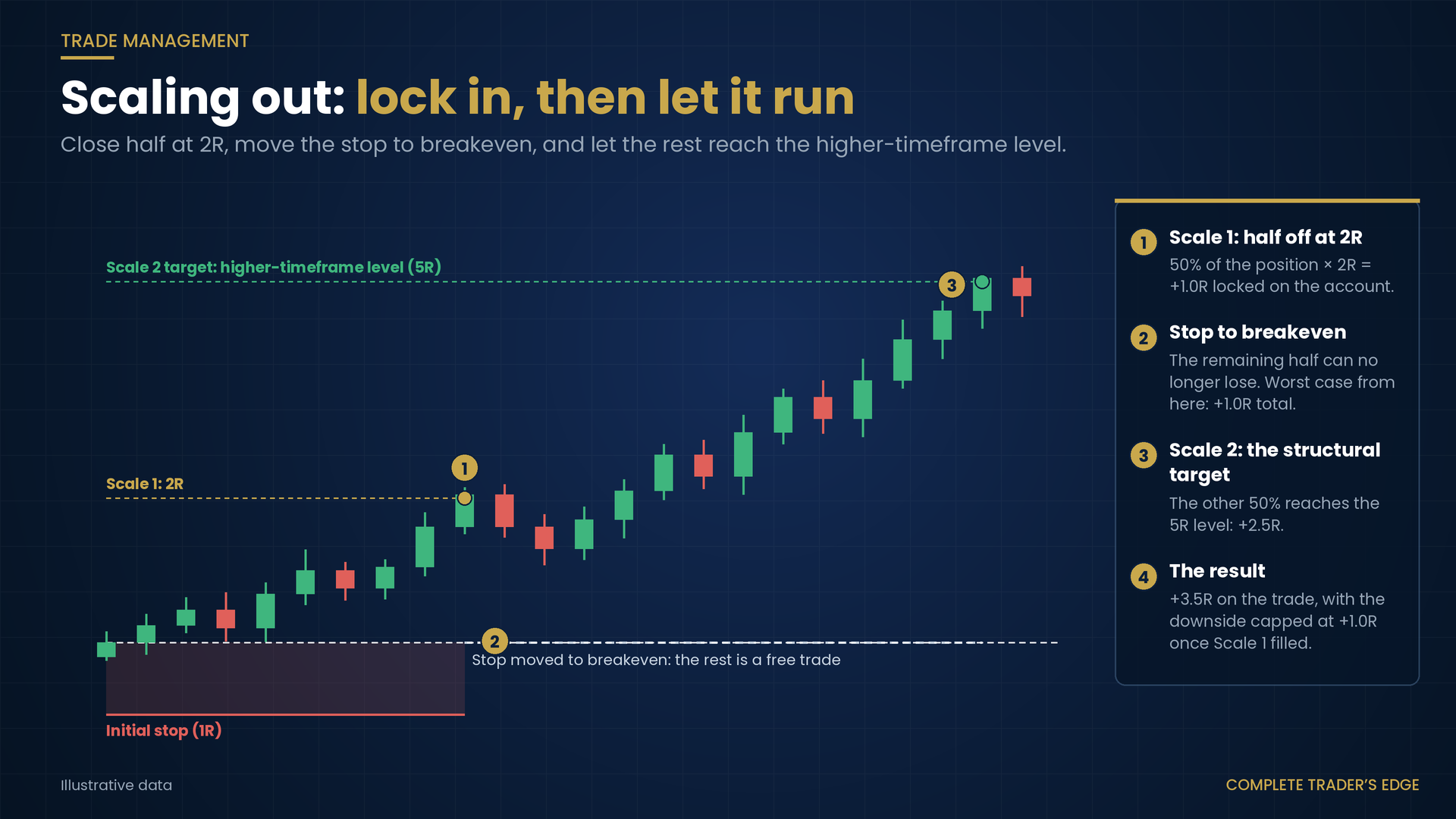
The simplest effective scaling framework uses two exit points:
Scale 1: The Lock-In (50% of position at 2R)
Close 50% of the position when price reaches 2R from entry. Simultaneously, move the stop on the remaining 50% to breakeven.
After Scale 1, you have:
- Locked in: 2R × 50% = 1R guaranteed profit on the closed portion
- Remaining: 50% position with a breakeven stop — a free trade
- Worst case outcome: +1R (if the remainder stops at breakeven)
- Best case outcome: +1R (locked) + extended move on the 50% remainder
The breakeven stop is the critical element. Once the stop is at breakeven on the remainder, you cannot lose money on the trade. This psychological shift — from “I need to manage this trade” to “I have a free trade running” — is what allows you to hold the remainder long enough to capture extended moves.
Scale 2: The Structural Target (remaining 50% to HTF level)
Hold the remaining 50% to the next significant structural target: the prior session high, a major liquidity pool, an HTF FVG, or a weekly level. Close at this target unless price shows a clear CHoCH (Change of Character) on the lower timeframe before reaching it.
What constitutes a valid early exit before the structural target:
- A bearish engulfing candle at a known resistance level on the 1H chart (for a long)
- A CHoCH on the 15M confirming momentum shift
- Price entering a known supply zone with strong rejection
What does not constitute a valid early exit:
- Price stalling for more than expected
- Feeling “nervous” about the trade
- “The market looks different now”
The rule: exit Scale 2 only at the structural target or on structural invalidation. Not on emotion.
Extended Framework: Three-Scale Approach
For trades with identified targets at multiple structural levels, a three-scale approach captures more of the extended move:
| Scale | Close | Target | Stop Action |
|---|---|---|---|
| Scale 1 | 33% of position | 2R (first liquidity) | Move stop to breakeven |
| Scale 2 | 33% of position | 3-4R (prior session high) | Move stop to Scale 1 level |
| Scale 3 | 33% of position | HTF target / trail | Trail below structure |
After Scale 2 closes, move the stop on Scale 3 to the Scale 1 exit level. Your worst-case outcome on Scale 3 is now above breakeven. The remaining third of the original position is protected and running with no risk of loss.
Instrument-Specific Scaling Rules
Different instruments have different volatility profiles that affect optimal scaling points.
Gold (XAU/USD): Gold frequently extends beyond initial targets during strong directional moves. A 2R scale-out with the remainder held to the prior session high typically captures 60-70% of the available move. Use the 1H chart to trail the stop below each swing low after Scale 1 closes.
NQ/ES: Index futures during trending sessions can produce 5-10R moves from a single OB entry. Scaling at 2R and 4R with a final trail on the remainder allows participation in the full session directional move. Be alert to the FOMC/macro risk that can reverse 5R gains in minutes — ensure Scale 1 and 2 are closed before any major news event if you’re holding Scale 3.
BTC: Cryptocurrency produces larger percentage moves and longer extensions than traditional futures during risk-on phases. Scale 1 at 2R, Scale 2 at 5R, and trail the remainder with a wide stop — BTC retracements of 3-5% intraday are normal within a strong directional move.
The Stop-Trailing Protocol for Scale 3
Once Scale 1 and 2 are closed, trailing the remaining position requires a mechanical rule. Options:
Structure-based trail: Move stop to below each new swing low (for a long) as price makes higher highs. Exit only if price makes a lower low below the prior swing. This keeps you in the trade as long as uptrend structure is intact.
ATR-based trail: Trail the stop 1.5× ATR(14) below the close of each new high candle. This gives the trade room to breathe without requiring visual chart monitoring every few minutes.
Time-based exit: For intraday trades, close the remainder at the end of the Kill Zone (10:00 London, 16:00 New York) regardless of where price is. Intraday setups that run past the Kill Zone frequently reverse during the low-liquidity session that follows.
Frequently Asked Questions
Should I always scale out or is a full close sometimes better?
Full close is better when your target is a very specific, hard resistance level where continuation is unlikely — for example, a major round number on Gold, the prior week’s high, or a key HTF supply zone. In these cases, scale out 75-80% near the target and close the remainder on the first sign of rejection. The two-scale framework is optimal when your target is a structural level with potential for continuation beyond it. Identify which type of target you have before entry, and choose the exit approach accordingly.
What if price reaches my Scale 1 target then reverses before I can execute?
Set limit orders at your scale-out levels before the trade moves. This is standard practice for professional traders and solves the execution problem entirely. Place your Scale 1 limit at the 2R level when you enter the trade. If price gaps through it (unusual on Gold or NQ intraday), you get a better fill. If price touches and reverses, the limit has already closed 50% of the position automatically. Manual execution of scale-outs during a fast-moving trade is unreliable — automate the levels.
How do I calculate the exact Scale 1 price level?
Scale 1 price = Entry + (2 × Stop Distance) for a long. Example: Entry at $2,320, stop at $2,308 (12-pip stop distance). Scale 1 = $2,320 + (2 × 12) = $2,344. Set your limit sell at $2,344 when you enter. Scale 2 and 3 targets are at structurally identified levels (prior session high, HTF supply zone), not calculated from fixed R multiples.
Should scaling rules be the same for prop firm accounts?
The mechanics are the same but the priority is different. On a prop firm account, the primary goal is protecting the account from drawdown. This means Scale 1 should be taken more aggressively — even at 1.5R if approaching your daily loss limit — to lock in profit and convert the remaining position to a free trade. Never hold a full position through a major news event on a prop firm account. Scale 1 before the event, then manage the remainder after the volatility settles.
How do I avoid the habit of closing Scale 2 early “while profit is there”?
Write the Scale 2 exit condition explicitly in your trading plan before the session opens and read it before managing any live trade. The condition should be: “Close Scale 2 at [specific level] or on a confirmed CHoCH on the 15M chart — not before.” When you feel the urge to close Scale 2 early, ask yourself: “Has the condition I defined been met?” If the answer is no, your hands stay off the trade. The written plan is the authority, not your in-session feeling.
▶ CONTINUE READING
Complete your trade management system:
▶ Asymmetric Risk: How to Structure Trades Where You Can Be Wrong 60% of the Time
▶ Maximum Adverse Excursion (MAE): How to Use It to Optimise Your Stops
▶ Prop Firm Risk Calculator: How to Size Every Trade on a Funded Account
The Complete Trader’s Edge
Chapter 62 covers the complete trade management framework including scaling protocols, trailing stops, and the decision rules that protect your R multiples on both intraday and swing positions.
 The Complete Trader's Edge
The full Mind · Method · Money framework. 70 chapters.
View on Amazon →
The Complete Trader's Edge
The full Mind · Method · Money framework. 70 chapters.
View on Amazon →
 Market Mayhem
400 years of bubbles, crashes, and the pattern that keeps repeating.
Buy on Amazon →
Market Mayhem
400 years of bubbles, crashes, and the pattern that keeps repeating.
Buy on Amazon →
 Greatest Companies
How the world's greatest companies were built — and what traders learn from them.
View on Amazon →
Greatest Companies
How the world's greatest companies were built — and what traders learn from them.
View on Amazon →
 Greatest Traders
Eighty-six lives that explain the markets — Livermore to Madoff, told with the losses left in.
View on Amazon →
Greatest Traders
Eighty-six lives that explain the markets — Livermore to Madoff, told with the losses left in.
View on Amazon →