

Legendary Traders · Market Wizards
Tony Saliba
Mocked as “One-Lot” — then he strung together month after month without a loss.
CBOE options market maker · The only options trader in the original Market Wizards
Last reviewed: August 2026. Sources: Jack Schwager’s Market Wizards, Saliba’s own books, and public records.
On the floor of the Chicago Board Options Exchange, traders gave Tony Saliba a nickname that was meant as an insult. After some early stumbles, he rebuilt his trading by dealing in the smallest possible size — one contract at a time — and the pit called him “One-Lot” for it. The name was a taunt. It became a legend.
Because the trader they mocked for trading one lot went on to string together 70 consecutive profitable months and to become, in 1989, the only options specialist Jack Schwager chose for the original Market Wizards. Saliba is the Wizard who proves that discipline, defined risk, and obsessive mastery of a single instrument can turn a near-washout into one of the most consistent records in trading. His chapter is titled, fittingly, “One-Lot Triumphs.”
Key Facts
| Known for | Defined-risk options spreads; the only options trader in the original Market Wizards |
| The nickname | “One-Lot” — from rebuilding with a single contract at a time |
| Record | 70 consecutive profitable months |
| Career | CBOE clerk 1979 → floor market maker → CBOE board director by 1987 |
| Specialty | Butterflies, iron butterflies, condors, ratio and calendar spreads |
| After the floor | Founded the International Trading Institute; authored several options books |
| Featured in | Market Wizards, “Tony Saliba: One-Lot Triumphs” |
From caddie to the CBOE floor
Saliba was born in Chicago in 1955 and began his career as a stockbroker in Indianapolis in 1977. Two years later, drawn by the opportunities he saw in the young options market, he took a job as a clerk on the floor of the Chicago Board Options Exchange. A chance encounter changed everything: a trader he had once caddied for offered to back him, putting up $50,000 in capital while Saliba supplied the fast-growing trading knowledge. Saliba soon bought his partner out and began building his own network of traders. By 1987 he sat on the CBOE’s board of directors with 27 traders working under him.
The ascent was not smooth. Like many of the most talented traders, Saliba’s mastery was forged in early failure. He nearly washed out, and the experience left him obsessive about learning everything there was to know about options. That is the context for the “One-Lot” nickname: rebuilding from a low point, he traded the smallest unit possible while he rebuilt both his account and his process, absorbing the taunt and turning it into a discipline.
The method: defined risk, mastered mechanics
Saliba was an options market maker, and his edge came from a depth of understanding in his instrument that few could match. He specialised in the butterfly family of option spreads — butterflies, iron butterflies and condors — along with ratio spreads, calendar spreads, straddles and strangles. What unites these strategies is that they are defined-risk: the worst-case loss is known and capped before the trade is placed. Many of them are built to profit in directionless markets, where the underlying goes nowhere and the position earns as time passes and volatility behaves.
Underneath the strategies sat a mastery of options mechanics that Saliba treated almost as a science. He worked constantly with the Greeks — delta, gamma and the higher-order sensitivities — and with implied volatility and option synthetics, the relationships that let a trader construct the same payoff in different ways. He did not guess at direction and hope. He built precise, limited-risk structures, understood exactly how each would behave as prices and volatility moved, and managed them actively. It was engineering, not gambling.
The defining lesson: consistency is built, not found
The number that defines Saliba is 70 consecutive profitable months. Nearly six unbroken years without a losing month is not the product of a hot streak or a single brilliant call. It is the product of a process designed so that no single trade can do catastrophic damage, repeated with discipline month after month.
That is the real lesson of “One-Lot.” The nickname was about size, but the philosophy behind it was about control: prove the process at the smallest scale, define the risk on every position, and let consistency compound. Saliba did not chase spectacular directional wins. He assembled a business out of small, defined-risk edges and executed it with a rigor that made losing months rare. His consistency was manufactured by design, not discovered by luck — and that is precisely why it lasted.
Where the Mind · Method · Money framework meets Saliba
Method is options as precision engineering: defined-risk spread structures from the butterfly family, built on deep fluency in the Greeks, implied volatility and synthetics, and designed to profit even when the market goes nowhere.
Money is defined risk taken literally. Every position has a known, capped worst case set before entry, and Saliba’s “One-Lot” ethic — prove it small, then scale — means size is earned by demonstrated skill rather than assumed at the start.
Mind is the discipline of the rebuild. The willingness to trade one contract at a time after a setback, the obsessive study that turned early failure into expertise, and the patience to grind out consistency rather than swing for glory are the mental traits that produced 70 unbroken months.
The honest counterweight
Saliba’s story is genuinely inspiring, and it also belongs to a world that no longer exists in the form he thrived in. Honesty requires saying so.
His edge was earned as a floor market maker on the CBOE in the 1980s — a role that has essentially vanished for individuals. Floor market makers captured the bid-ask spread and enjoyed structural advantages in order flow and execution that electronic markets and high-frequency firms have since absorbed. The “one-lot to empire” arc happened inside a market structure that is gone. A screen-based retail options trader is not stepping into the same game.
The defined-risk spreads he made famous are real and valuable, but they are not low-skill, and they are frequently misunderstood. Butterflies and condors win small and cap their gains while a mismanaged position or a sudden volatility shock can still hurt, and after commissions and slippage the edge is thin. Retail traders drawn to “defined-risk income” often string together many small wins, grow overconfident, size up — and then a gap or a volatility spike delivers a loss that erases months. Saliba’s mastery of the Greeks and his discipline are exactly what prevent that outcome. Copy the strategy without the mastery and the smooth equity curve becomes a trap.
The 70-month record itself, extraordinary as it is, reflects a full-time floor professional with an information and execution edge, not a template a part-time trader can expect to reproduce. And the honest heart of his story — the near-failure that came first — is the part most often skipped. Most traders who almost blow up early do not come back to trade a single contract at a time; Saliba’s return is the survivor’s exception, not the rule.
What to actually take from Tony Saliba
You will not make markets on a 1980s options floor, but his principles are as useful now as they were then.
First, define your risk before you enter. Saliba’s entire craft is built on limited-risk structures where the worst case is known in advance. Whatever you trade, know your maximum loss before you are in the position.
Second, start small and earn your size. The “One-Lot” ethic — trade the smallest unit until the process is proven, then scale — is how he rebuilt from near-failure. Size is a reward for demonstrated skill, not a starting condition.
Third, treat trading as a business built on knowledge. Saliba’s durable edge came from obsessive study of how options actually behave. Deep understanding of your instrument is a real and lasting advantage that no shortcut replaces.
Fourth, build consistency from process, not prediction. His strategies profit without needing a big directional call, and his record came from repeating a controlled edge with discipline. And respect the rebuild: early failure is not disqualifying, but refusing to learn from it is.
Frequently asked questions
Who is Tony Saliba?
Anthony “Tony” Saliba is an American options trader, author and entrepreneur, born in 1955. He was the only options specialist profiled in Jack Schwager’s original Market Wizards, in the chapter “One-Lot Triumphs,” and later founded the International Trading Institute.
Why is Tony Saliba called “One-Lot”?
After early setbacks, Saliba rebuilt his trading by dealing in the smallest possible size — a single contract at a time. Floor traders mocked him with the nickname “One-Lot,” which became a badge of honour once his consistency became legendary.
What was Saliba’s trading style?
He was a CBOE options market maker who specialised in defined-risk option spreads — butterflies, iron butterflies, condors, ratio spreads and calendar spreads — grounded in a deep command of the Greeks, implied volatility and option synthetics. Many of his strategies profit in directionless markets.
What is Tony Saliba’s famous record?
He strung together 70 consecutive profitable months of options trading. The streak came from a process engineered so that no single trade could do catastrophic damage, repeated with discipline.
What are butterfly spreads?
A butterfly is a defined-risk option strategy built from several options at different strikes. Its maximum loss is known and capped in advance, and it typically profits when the underlying stays within a range — which is why Saliba favoured such structures in sideways markets.
Can a retail trader copy Tony Saliba?
Not directly — his floor market-making edge no longer exists for individuals, and his defined-risk spreads demand real fluency in the Greeks and volatility. But his principles transfer: define your risk before entering, start small and earn size, and master your instrument deeply.
Which book features Tony Saliba?
Market Wizards (Jack Schwager, 1989), in the chapter “Tony Saliba: One-Lot Triumphs.”
Continue learning
- Blair Hull — a fellow options market maker who turned mathematical edge into a trading empire.
- Jeff Yass — who built one of the world’s largest options firms on probability and defined-risk thinking.
- Edward Thorp — the pioneer who first showed how to price and hedge options mathematically.
- Victor Sperandeo — a contemporary whose edge, like Saliba’s, was relentless risk discipline.
- Market Wizards (book review) — our breakdown of the Schwager book Saliba appears in.
- The Mind · Method · Money framework — the lens we use to read every trader on this site.
 The Complete Trader's Edge
The full Mind · Method · Money framework. 70 chapters.
View on Amazon →
The Complete Trader's Edge
The full Mind · Method · Money framework. 70 chapters.
View on Amazon →
 Market Mayhem
400 years of bubbles, crashes, and the pattern that keeps repeating.
Buy on Amazon →
Market Mayhem
400 years of bubbles, crashes, and the pattern that keeps repeating.
Buy on Amazon →
 Greatest Companies
How the world's greatest companies were built — and what traders learn from them.
View on Amazon →
Greatest Companies
How the world's greatest companies were built — and what traders learn from them.
View on Amazon →
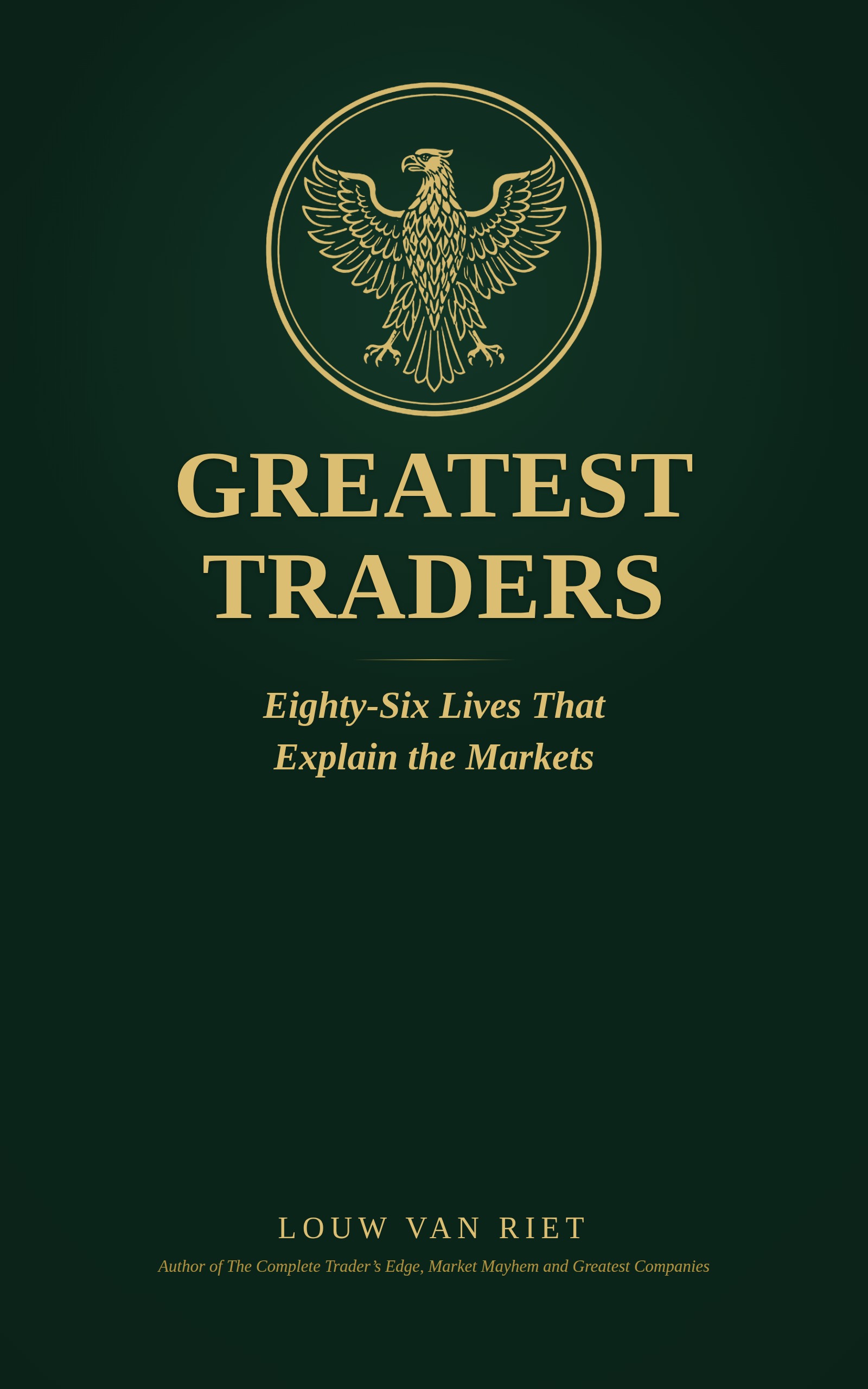 Greatest Traders
Eighty-six lives that explain the markets — Livermore to Madoff, told with the losses left in.
View on Amazon →
Greatest Traders
Eighty-six lives that explain the markets — Livermore to Madoff, told with the losses left in.
View on Amazon →