

The biggest mistakes in trading usually start as “good advice.” These are the myths most traders have to unlearn to grow.
Trading is one of the few professions where the most popular advice is often the most destructive. Beginners absorb these ideas from social media, courses, and well-meaning mentors, then spend years unlearning them. The damage is not just financial. Bad mental models create bad habits that compound over hundreds of trades.
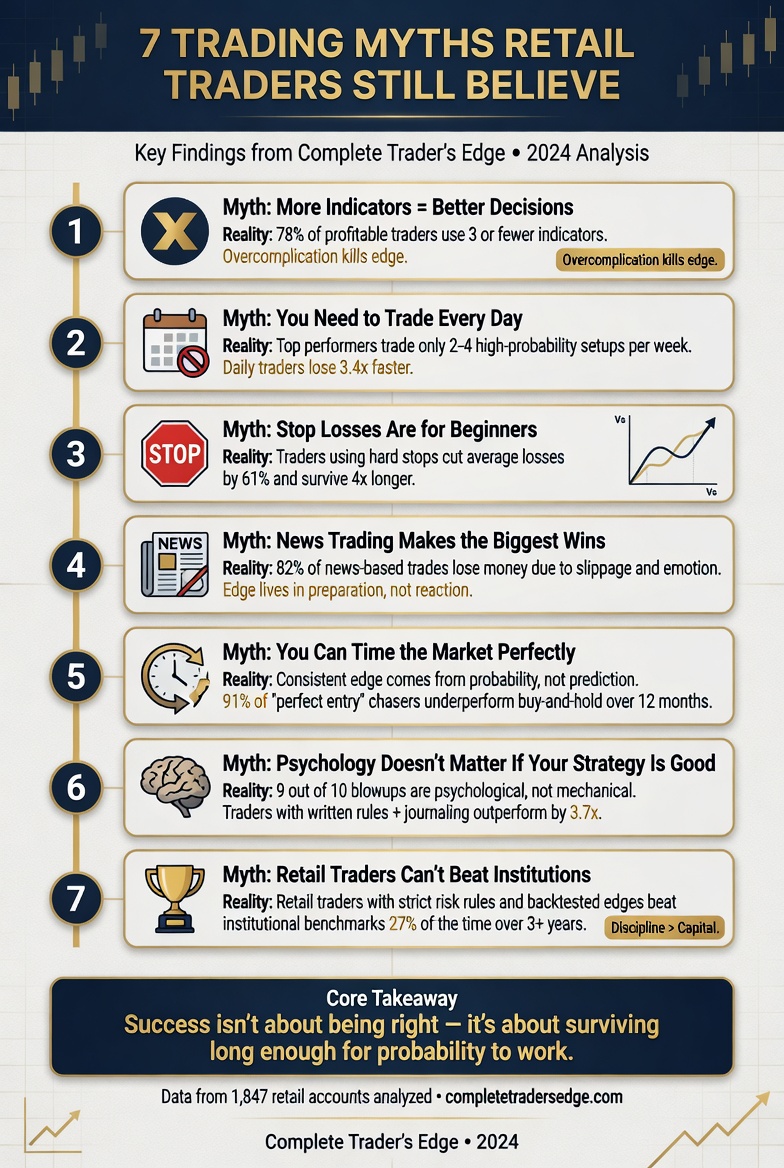
| Myth | Reality |
|---|---|
| “You need a high win rate to be profitable” | At 1:2 R:R, you only need to win 34% of trades to be profitable. R:R matters more than win rate. |
| “More indicators = better analysis” | Indicators lag price. Stacking them creates conflicting signals and analysis paralysis, not clarity. |
| “You need to trade every day to make money” | Overtrading is one of the top account killers. The best traders wait for A-grade setups, which may not appear daily. |
| “Professionals never lose” | Every professional loses regularly. Druckenmiller, Soros, and Tudor Jones all have losing trades. The difference is size management. |
| “You need a large account to start” | Micro lots on $500 accounts and prop firms with $100K+ funded capital make this myth obsolete. |
| “Trading is gambling” | Trading with a tested edge, position sizing, and risk management is a business. Trading without them is gambling. |
| “The market is rigged against retail” | The market has structural dynamics (liquidity hunts, institutional flow) that you can learn to read and trade with, not against. |
Here are seven myths that are actively keeping retail traders from becoming profitable, along with what actually works in their place.
Myth 1: You Need a High Win Rate to Be Profitable
This is the myth that causes more damage than any other. Retail traders obsess over win rate because it feels intuitive. Winning feels good. Losing feels bad. A 70% win rate sounds impressive. A 40% win rate sounds like failure.
The reality is that win rate tells you almost nothing about profitability without knowing the average payoff ratio. A trader who wins 40% of the time but averages 3R on winners and 1R on losers has an expectancy of 0.6R per trade. That is an excellent edge. A trader who wins 80% of the time but averages 0.5R on winners while losing 3R on losers has a negative expectancy and will go broke.
The fix is simple: stop evaluating individual trades and start tracking expectancy. Expectancy equals (win rate multiplied by average win) minus (loss rate multiplied by average loss). That single number tells you everything about your system’s profitability.
Myth 2: More Screen Time Equals More Profit
Many traders believe that spending more time watching charts leads to better results. The opposite is usually true. Excessive screen time leads to overtrading, impulse entries, and decision fatigue. Studies on professional performance in other fields consistently show that quality of focused attention matters far more than total hours spent.
The most efficient traders have specific session windows where they trade, typically two to four hours maximum, and they spend the rest of their time on preparation, review, and education. A trader who trades the London killzone for two focused hours with a clear plan will outperform a trader who watches charts for twelve hours and takes every setup that vaguely resembles their strategy.
Myth 3: You Need to Catch the Bottom or Top
Trying to pick exact tops and bottoms is not trading. It is gambling with a narrative attached. Professional traders do not need to catch the turn. They need to catch the middle of the move, where the probability is highest and the evidence is strongest.
Waiting for a break of structure, a displacement candle, or a confirmed change of character means you miss the first portion of the move. That is the cost of entry. The benefit is dramatically higher probability. The best traders are comfortable “missing” the first 20% of a move if it means they catch the next 60% with conviction.
Myth 4: Indicators Will Give You an Edge
No indicator provides an edge by itself. Every indicator you will ever use is a derivative of price. RSI measures rate of price change. MACD measures the relationship between moving averages of price. Bollinger Bands measure standard deviations of price. They are all looking at the same information, just processed differently.
Indicators can confirm what price action is already telling you. They can quantify conditions that are visible on the chart. But adding more indicators does not create more information. It creates more noise. The traders who improve fastest are those who reduce their indicators to one or two, or eliminate them entirely, and learn to read price action directly.
Myth 5: You Should Never Move Your Stop Loss
The blanket advice to “never move your stop” sounds disciplined but ignores market reality. There is a crucial difference between moving your stop further away to avoid a loss, which is destructive, and moving your stop to breakeven or in the direction of profit as the trade moves in your favour, which is professional trade management.
The nuance matters. Widening a stop because you cannot accept the loss is emotional decision-making and will destroy your account. Trailing your stop to lock in profit as the market confirms your thesis is active risk management. One is fear-driven. The other is system-driven. Learn the difference and you eliminate one of the most common sources of confusion.
Myth 6: Professional Traders Do Not Have Losing Streaks
This myth is perpetuated by social media, where traders post only winners and create the illusion of near-perfect records. In reality, every professional trader experiences losing streaks. A trader with a genuine 55% win rate will experience runs of five or more consecutive losses regularly.
The difference between professionals and amateurs is not that professionals avoid losing streaks. It is that professionals have position sizing, drawdown protocols, and psychological preparation that allows them to survive losing streaks without changing their strategy or increasing their risk. They know the streak is coming and they are prepared for it.
Myth 7: You Need a Lot of Capital to Start
This myth keeps many capable traders from ever beginning. The belief that you need $50,000 or $100,000 to trade professionally was true decades ago. It is not true today. Prop firms offer funded accounts from $10,000 to $200,000 for challenge fees of $50 to $200. Micro-lot forex accounts allow you to trade with as little as $500 while maintaining proper risk management.
What you actually need is not more capital. You need a tested strategy with positive expectancy, proper risk management per your account size, emotional discipline to execute consistently, and a minimum of three to six months of demo or small-account experience. Capital without these foundations is just money waiting to be lost.
The Common Thread
Every one of these myths shares a common feature: they simplify trading into rules that sound wise but collapse under the weight of market reality. Real trading is nuanced. It requires understanding why something works, not just what to do. The traders who break through are those willing to question everything they have been told, test it against their own data, and keep only what survives contact with the market.
📚 Related Articles:
This article is adapted from The Complete Trader’s Edge
70 chapters covering Mind · Method · Money — the most comprehensive trading education framework available.
Frequently Asked Questions
What is the most dangerous trading myth?
That you need a high win rate to be profitable. This myth causes traders to hold losers (trying to avoid being “wrong”) and cut winners short (locking in being “right”). In reality, a 40% win rate with a 1:3 risk-to-reward ratio is highly profitable. Understanding probability eliminates this myth entirely.
Is it true that 95% of traders lose money?
The exact percentage varies by study (some show 70-80%, others 90%+), but the majority of retail traders do lose. However, this statistic includes people who trade without a plan, without risk management, and without education. Among traders who follow a tested strategy with disciplined execution, the failure rate is dramatically lower. The statistic is real but misleading without context.
Do I need to trade every day to be successful?
No. Many successful traders trade 2-3 times per week or less. Patience and selectivity produce better results than frequency. A swing trader who takes 3 high-quality trades per week can outperform a day trader who takes 15 mediocre ones.
Is technical analysis just astrology for traders?
No. Technical analysis works because it reads the footprints of actual buying and selling behaviour. Support and resistance levels work because orders cluster at those prices. Order Blocks work because they mark institutional entry zones. These are not mystical; they describe real market mechanics.
Do you need a lot of money to start trading?
No. You can start with as little as $500 on forex with micro lots. The key is proper position sizing (1% risk per trade). Prop firms also provide funded capital of $10K-$200K for traders who pass evaluation challenges, removing the capital barrier entirely for skilled traders.
Frequently Asked Questions
What is the biggest myth in trading?
That you need a high win rate to be profitable. A trader with a 40% win rate and 1:3 risk-to-reward makes more money than a trader with a 70% win rate and 1:0.5 R:R. Expectancy, the combination of win rate and R:R, determines profitability. This myth keeps traders chasing accuracy when they should be chasing asymmetry.
Is trading just gambling?
No. Gambling has a fixed negative edge (the house always wins long term). Trading can have a positive edge if you have a tested strategy with positive expectancy, apply consistent risk management, and execute with discipline. However, trading without a tested edge and without risk management is functionally identical to gambling.
Do most traders really lose money?
Yes. Studies consistently show that 70-90% of retail traders lose money over any 12-month period. But this statistic reflects the behaviour of the majority (no plan, no risk management, no journal), not the inherent impossibility of profitable trading. The minority who treat trading as a business with tested systems and professional discipline can and do produce consistent returns.
Do I need expensive tools and indicators to be profitable?
No. Price action and market structure require only a candlestick chart, which is free on TradingView. The most consistently profitable retail traders use fewer tools, not more. Adding indicators beyond the basics creates analysis paralysis without improving decisions.
Can you really make a living from trading?
Yes, but with realistic expectations. It requires sufficient capital (or prop firm funding), a verified track record of 12+ months, and the psychological preparation to handle income volatility. See our full guide: How to Become a Full-Time Trader.
Continue Reading
From The Book
This article covers concepts from Chapter 1 of The Complete Trader’s Edge.
 The Complete Trader's Edge
The full Mind · Method · Money framework. 70 chapters.
View on Amazon →
The Complete Trader's Edge
The full Mind · Method · Money framework. 70 chapters.
View on Amazon →
 Market Mayhem
400 years of bubbles, crashes, and the pattern that keeps repeating.
Buy on Amazon →
Market Mayhem
400 years of bubbles, crashes, and the pattern that keeps repeating.
Buy on Amazon →