

Why Every Trader Is Trading Their Body, Not Just the Chart
The body is the foundation of every great trade.
A trader’s worst week is rarely about strategy. The setup didn’t change. The market didn’t change. What changed was the trader. Specifically, the body and the brain that runs the trader. Slept four hours. Skipped breakfast. Spent the morning scrolling X. By the time the trader sat down at the desk, the result of the day was already half-written before a single chart loaded.
Most traders track their P&L to the dollar. Many track their trades to the tick. Almost none track sleep, glucose, hydration, screen time, or what they consumed on social media before market open. Yet those inputs determine the quality of every decision the trader will make that day. The body is not a vehicle that transports a trading mind to the chart. The body is the trading mind. And whether the trader knows it or not, they are trading that body every single session.
This article is the foundation of a new series: The Trader’s Physical Edge. Over the next 16 episodes, we are going to take a serious, research-backed look at the biological and environmental factors that shape every trade. Not biohacking. Not wellness platitudes. Real protocols a real trader can implement starting tomorrow.
The Hidden Variable in Every Trading Plan
If you opened your last 20 losing trades and ranked them by cause, you would probably list things like: bad entry, ignored stop, chased the move, broke the rules. All of these are real. All of them are downstream of something else.
Behind every “I broke my rules” trade is a state. Tired. Hungry. Wired on caffeine. Emotionally rattled from a news cycle that wasn’t even about you. Distracted by a Discord conversation that pulled you out of the chart you were watching. State precedes decision. Biology precedes psychology. And the body that holds both is something almost no trader ever audits.
This is the gap. Trading psychology has become a saturated topic. Books, podcasts, courses on discipline, patience, emotional regulation. All of it useful. None of it addresses the underlying truth: you cannot have discipline if you slept four hours. You cannot have patience if your blood sugar has crashed. You cannot have clarity if you spent the morning consuming algorithmic outrage on a feed designed to extract your attention[1].
The Inner Edge series, which we have been running for months, covers the philosophical frameworks: Stoicism, Atomic Habits, Goggins, Frankl, Deep Work. Those frameworks work. But they sit on top of something. They sit on top of a body and a brain that, if neglected, will sabotage every framework you try to apply. The Trader’s Physical Edge is the substrate underneath the Inner Edge. The biology that makes the philosophy possible.
The Cost: What Your Body Is Doing to Your P&L Right Now
Let us be specific. Here is what the research shows about how your physical state translates directly into trading performance.
Sleep deprivation
A landmark study from the University of Pennsylvania found that subjects restricted to six hours of sleep per night for two weeks performed cognitively as poorly as subjects who had been kept awake for 48 hours straight. The catch: the six-hours-a-night group did not feel impaired. They felt fine. They were, in measurable performance terms, drunk[2].
For a trader, the implications are direct. Working memory, risk assessment, impulse control, and pattern recognition all degrade with sleep loss. Worse, the trader’s self-assessment of their own state becomes unreliable. The trader who is sleep-deprived believes they are sharp. They are not. They are taking trades with degraded cognition while believing themselves to be in normal form.
Glucose and decision quality
A widely-cited 2011 study of Israeli judges found that decisions on parole became dramatically more favourable immediately after meal breaks and progressively less favourable as the judges’ glucose levels dropped through the morning and afternoon. By late session, before lunch, parole was being denied in nearly all cases. After lunch, the favourable rate jumped sharply[3].
The lesson for traders is not that you should never trade hungry. The lesson is that your decisions are not independent of your physical state, even when you believe they are. You are not making a clean judgement about the market. You are making a judgement filtered through whatever your body and brain are experiencing at that moment.
Information environment
Recent research on attention and screen-based work has consistently found that interruptions cost more than the time of the interruption itself. One often-cited estimate puts the cost of a single context switch at over 20 minutes of refocus time[4]. Multiply that by 30 notifications during a trading session and the trader has not actually been trading. The trader has been refocusing all day.
Beyond interruptions, the content of the information environment matters. Trading communities on X, Discord, Telegram, and YouTube run on engagement algorithms designed to amplify emotional reaction. A trader who spends 30 minutes on those feeds before market open is not arriving at their desk neutral. They are arriving primed for action, with elevated arousal, and with a distorted view of what the consensus is.
The compounded effect
None of these factors operates in isolation. The trader who slept six hours is more likely to skip breakfast. The trader who skipped breakfast is more likely to over-caffeinate. The trader who over-caffeinated is more likely to feel anxious, which makes them more likely to seek the social comfort of a Discord chat. The Discord chat is where they pick up a bias that they will then trade on. Each link in the chain looks small. The chain itself decides the day.
The Five Pillars of the Trader’s Physical Edge
The series is organised around five pillars. Each episode lives inside one of these pillars. Each pillar represents a layer of the body’s contribution to the trader’s edge. The pillars are sequenced deliberately: each builds on the ones below it, and the order matters. Recover is the foundation; without it, every other pillar degrades. Environment is the scaffolding around the whole stack; without it, the other four pillars sit on shifting ground.
PILLAR ONE · RECOVER
The trader who does not recover does not improve. They just deteriorate at varying rates.
Sleep is the foundation. This pillar also covers the architecture of recovery: rest days, the trading week, the body’s restoration cycle. Without recovery, the work does not compound. Episodes in this pillar cover sleep architecture, diet on the recovery side of fuel, cold exposure, and the structured recovery day that prevents the accumulation of fatigue across months.
PILLAR TWO · FUEL
What you put into your body is the second-most important input to your trading day, after sleep.
Diet, fasting, hydration, caffeine, supplementation. The fuel that the cognitive engine actually runs on across a session. We look honestly at what the research supports (creatine, omega-3, magnesium, vitamin D, the cortisol-caffeine relationship) and what is mostly marketing (most “nootropic” stacks). The goal is a fuel system that keeps cognition stable across an entire session, not just for the first hour after coffee.
PILLAR THREE · MOVE
What your body does between trades determines what your brain can do during them.
Exercise, posture, the minimum effective dose of physical activity. The pillar that fights the sedentary default of trading work. Six to ten hours seated, mostly still, eyes locked to screens is the trader’s default state. The cost is not just physical decline. It is metabolic, hormonal, and cognitive. This pillar covers the minimum effective exercise dose, the protocols that keep posture and circulation intact across long sessions, and the movement work that compounds across decades of desk-bound trading.
PILLAR FOUR · REGULATE
Your nervous system shapes every decision. Train it deliberately or it trains you by default.
Breath work, visualisation, screen fatigue management, the trader’s information diet. The pillar covering inputs the trader chooses to put into their nervous system, and protocols that regulate state actively. This is the active work of the trading day: the conscious protocols that prevent the autopilot decisions that cost most retail traders most of their performance.
PILLAR FIVE · ENVIRONMENT
Your environment makes the trader. Build the environment, and the trader builds the edge.
The workspace, the social environment, week architecture, external systems, travel and disruption. The pillar covering the contextual surround that either supports or sabotages everything else. The workspace audited and built. The mentor and peer group that calibrate your baseline. The architecture of the trading week. The journal and checklist and risk automation that do the work willpower cannot. The travel and disruption protocols that protect the stack against the inevitable interruptions.
These five pillars form the spine of the next 16 episodes. Every episode lives inside one of them. By the end of the series, you will have a complete framework, a stack of protocols, and a course-ready system that fits underneath the Mind · Method · Money architecture you already know.
The order matters. Recover is foundational because without sleep, every other pillar degrades. Fuel sits above Recover because sleep is upstream of food and caffeine. Move sits above the first two because exercise benefits multiply when the body has the recovery and the fuel to support adaptation. Regulate sits above the first three because state regulation requires a working brain. And Environment sits at the top because it is the scaffolding around everything else. Build in this order. The compounding does the rest.
The Physical Edge Self-Audit
Before you can change anything, you need a baseline. Tick the boxes below for every statement that is true of your typical trading week — not your best week, not your worst. The score updates as you go. There are no wrong answers. The point is to know where you actually are.
THE 10-QUESTION BASELINE
If you scored lower than you wanted, do not treat it as a problem. Treat it as a map. You now know exactly which areas of this series are going to matter most for you. The trader who scored a 3 has more potential edge in the next twelve weeks than the trader who scored a 9. The work is just more concentrated.
How to Use This Series
Sixteen episodes is a lot. Here is how to get the most out of them.
Read each episode the week it is published. Each one is built to stand on its own. You do not need to wait until the series is complete to start applying anything.
Pick one protocol per episode and run it for two weeks before adding another. The temptation will be to overhaul everything at once. Resist it. The trader who changes one variable at a time can attribute results to that variable. The trader who changes everything at once cannot.
Track in writing. The same way you keep a trading journal, keep a one-page physical edge journal. Sleep hours, key meal, exercise yes/no, notable energy. Two weeks of data is enough to start seeing patterns that connect physical state to trading outcomes.
Download the Self-Audit worksheet. The PDF version of the audit above is yours to print, mark up, and re-take in 12 weeks. As the series rolls out, additional protocol pages will stack into a full Trader’s Physical Edge Protocol Pack. You can grab the audit worksheet free at the link at the bottom of this article.
If you are a coaching client or a future course participant, this material becomes the foundation module. Everything in this series is designed to compress into a structured course later. For now, use the free version. Use it well.
Frequently Asked Questions
Is this going to be another wellness blog?
No. The Trader’s Physical Edge applies physiology research specifically to trading outcomes. Every claim is referenced. Every protocol is tied to a trading-day application. We are not interested in cold plunges for the sake of cold plunges. We are interested in whether the cold plunge changes how you respond to a drawdown the next day.
Do I need to buy supplements, equipment, or subscriptions?
No. The series prioritises free or near-free protocols. Sleep, hydration, walking, breath, screen discipline, and information hygiene cost nothing. Where supplements or equipment are discussed, we present the evidence honestly and let you decide. Most of the highest-leverage interventions cost nothing.
How is this different from the Inner Edge series?
The Inner Edge covers philosophical frameworks: Stoicism, deep work, atomic habits, mastery. Those frameworks sit on top of a body. This series is about the body and environment that the frameworks run on. Both sit under the Mind pillar of the Mind · Method · Money framework. Together they form a complete approach to the trader’s mental and physical operating system.
What if I am already in good shape physically?
This series is not a fitness course. It is a performance optimisation series for traders specifically. The audit will tell you where you have headroom. Even traders who train hard and eat well often have major gaps in their information environment, recovery architecture, or session-day fueling. Those gaps cost money.
Should I see a doctor before changing anything?
Yes, especially if you have any existing health conditions, are on medication, or plan to make major changes to diet, fasting, exercise, or supplements. This series provides education, not medical advice. It is meant to inform your decisions and your conversation with your doctor, not replace them.
References
- Hari, Johann (2022). Stolen Focus: Why You Can’t Pay Attention. Crown Publishing. (Framing source for the research aggregation on attention and modern information environments. Direct studies cited below.)
- Van Dongen, H. P., Maislin, G., Mullington, J. M., & Dinges, D. F. (2003). The cumulative cost of additional wakefulness: Dose-response effects on neurobehavioral functions and sleep physiology from chronic sleep restriction and total sleep deprivation. Sleep, 26(2), 117-126. doi.org/10.1093/sleep/26.2.117
- Danziger, S., Levav, J., & Avnaim-Pesso, L. (2011). Extraneous factors in judicial decisions. Proceedings of the National Academy of Sciences, 108(17), 6889-6892. doi.org/10.1073/pnas.1018033108 (Note: subsequent research has debated the magnitude of this effect; the broader principle that physical state affects judgement remains robustly supported.)
- Mark, G., Gudith, D., & Klocke, U. (2008). The cost of interrupted work: More speed and stress. Proceedings of the SIGCHI Conference on Human Factors in Computing Systems, 107-110. doi.org/10.1145/1357054.1357072
Get the Self-Audit Worksheet (free)
Download the printable PDF of the audit above. Drop your email, get the worksheet and weekly episode notifications.
The Trader’s Physical Edge publishes every Sunday at 11:00 SAST.
Next week: EP02 — Sleep and Trading: Why Less Than 6 Hours Is Worse Than Drunk Trading
Take it further
The Complete Trader’s Edge book covers the full Mind · Method · Money framework that sits above this series.
 The Complete Trader's Edge
The full Mind · Method · Money framework. 70 chapters.
View on Amazon →
The Complete Trader's Edge
The full Mind · Method · Money framework. 70 chapters.
View on Amazon →
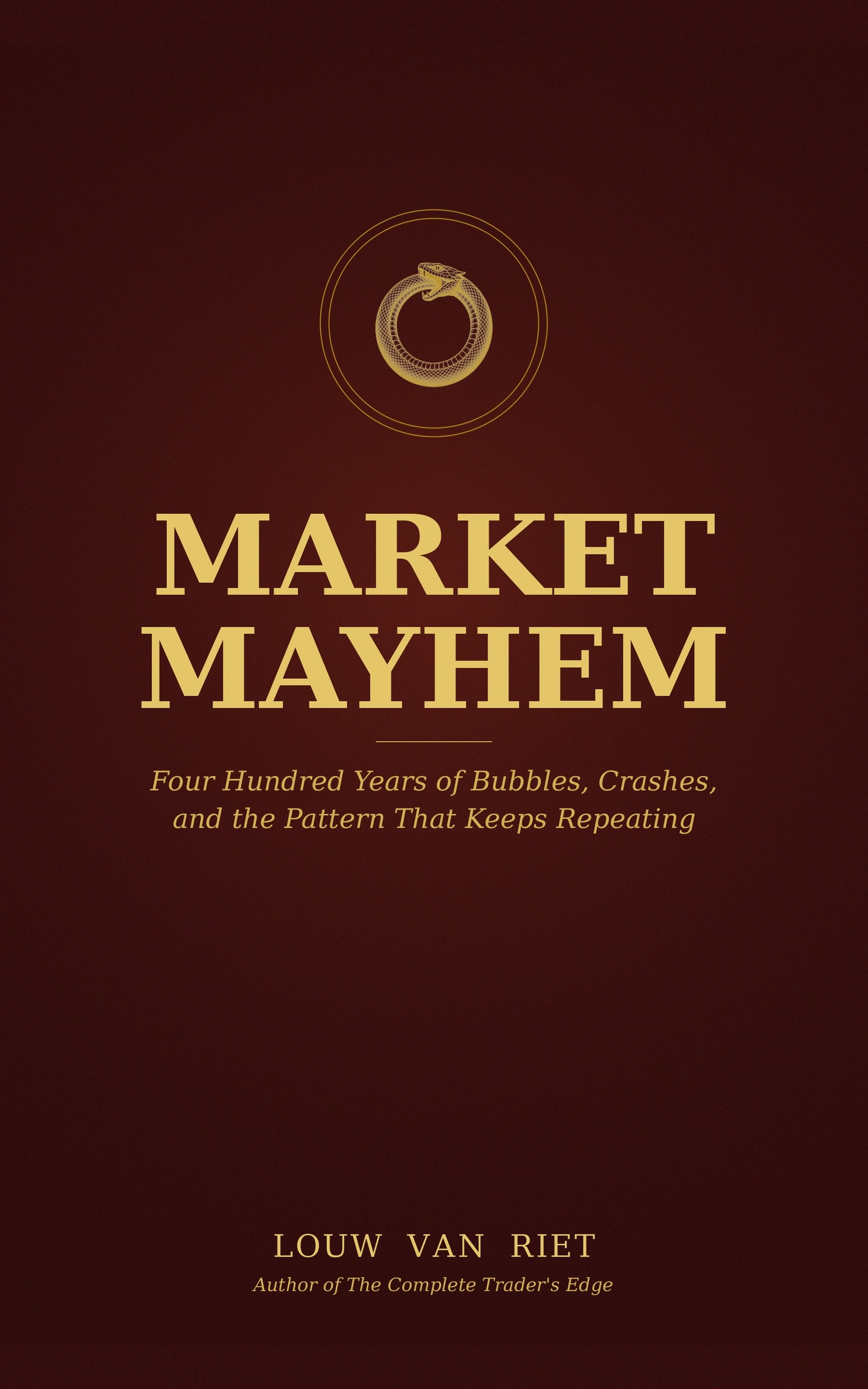 Market Mayhem
400 years of bubbles, crashes, and the pattern that keeps repeating.
Buy on Amazon →
Market Mayhem
400 years of bubbles, crashes, and the pattern that keeps repeating.
Buy on Amazon →
 Greatest Companies
How the world's greatest companies were built — and what traders learn from them.
View on Amazon →
Greatest Companies
How the world's greatest companies were built — and what traders learn from them.
View on Amazon →
 Greatest Traders
Eighty-six lives that explain the markets — Livermore to Madoff, told with the losses left in.
View on Amazon →
Greatest Traders
Eighty-six lives that explain the markets — Livermore to Madoff, told with the losses left in.
View on Amazon →