

Explore all 80 books in the Trader’s Library →
Most trading books try to give you a method. This one tries to give you a work ethic, a review habit, and a way of measuring yourself that has nothing to do with whether the last trade won. It is a book about how traders are actually made, written from inside a room where people either develop or wash out.
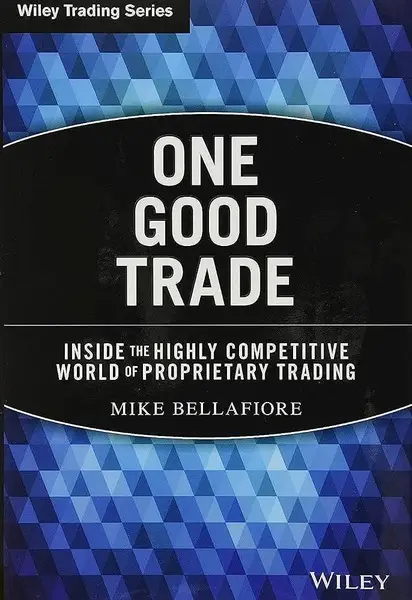
One Good Trade comes from Mike Bellafiore, co-founder of a New York proprietary trading firm, and it is really a book about process. Its title is its thesis: your job is not to predict the market but to string together individual trades where you did everything right, regardless of the outcome, and to build yourself into the kind of trader who can do that repeatedly. That idea is durable and genuinely valuable.
What has aged less well is the specific tape-reading world the book is set in. Some of its concrete tactics belong to the equity-desk microstructure of its era, and a retail trader reading it in 2026 has to separate the timeless development philosophy from the dated mechanics. The rating reflects a book whose culture and process lessons are excellent and whose specific edges are a period piece.
At a Glance
| Author | Mike Bellafiore |
| Full Title | One Good Trade: Inside the Highly Competitive World of Proprietary Trading |
| Published | 2010 (Wiley) |
| Difficulty | Easy to read, hard to live. Accessible prose, demanding standard of work. |
| Best For | Developing traders who need a process, a review habit, and a professional standard to aim at |
| Skip If | You want a mechanical system, or you cannot separate the timeless process from the dated tape-reading tactics |
OVERALL RATING: 8.5 / 10
Who Should Read This Book
| Reader | Verdict | Why |
|---|---|---|
| Developing trader | Strong yes | The process, review, and PlayBook habits are exactly the professional infrastructure most self-taught traders never build. |
| Aspiring intraday equities trader | Yes | This is its native world. Take the mindset and the workflow, and update the specific tactics for the current market. |
| Retail solo trader | Yes, with translation | You lack the desk, the mentors, and the firm capital. The process still transfers; the environment does not. |
| Swing / position trader | Read for the mindset | The specific tactics are intraday, but the process philosophy and self-review discipline apply at any horizon. |
| Prop-firm challenger | Yes | The professional standard and the process focus are a good fit for the mindset an evaluation demands. |
| System / quant trader | Optional | It is about human development, not a codable edge. Read it for the review discipline, not for a strategy. |
The Book in Context
By 2010 the retail world had plenty of books promising setups and almost none showing what it actually looks like to develop as a professional trader inside a firm. Bellafiore wrote from that vantage point, as the co-founder of a proprietary trading firm that trains and funds traders, and the book’s authority comes from that seat: this is what a trading desk does with new people, day after day, to turn most of them into something and let the rest go.
On credentials, this is one of the cleaner cases on the shelf. Bellafiore’s role as co-founder of an established proprietary trading firm is public and checkable, and the book is explicitly about the training environment he runs rather than a pitch for a secret personal edge. This site still avoids attaching specific profit figures the book does not verify, but the professional context here is real and documented, which is more than many trading authors offer.
Its place in the literature is as one of the best books on trader development rather than trading method. It sits closer to the deliberate-practice and performance literature than to the pattern books, and it is most useful read as a manual for how to build yourself, not what to buy.
The Core Argument: You Cannot Control Outcomes, So Control the Trade
The whole book turns on the phrase in its title: one good trade. A good trade is defined by process, not result. You had a reason, you sized it correctly, you managed it by your rules, and you exited as planned. Whether it made money is partly luck. Whether it was a good trade is entirely up to you.
From that definition everything follows. If you cannot control outcomes, you stop measuring yourself by them and start measuring yourself by the quality of your decisions. You review every trade to see whether it was good in this process sense, regardless of profit. You build a PlayBook of the specific setups that work for you, studied and refined until they are second nature. And you treat trading as a craft developed through deliberate, effortful practice rather than a talent you either have or lack. The desk culture the book describes is essentially an engine for producing that kind of practice at scale.
A good trade and a winning trade are not the same thing, and the day you stop confusing them is the day you can finally start improving.
— The idea the whole book is built on
This is excellent, and it is the part of the book that does not date. Separating decision quality from outcome, reviewing relentlessly, and building a personal PlayBook are among the most reliable habits in all of trading, and Bellafiore teaches them with energy and concrete detail. For a developing trader, absorbing this mindset is worth more than another dozen setups.
The weaker part is the specific world those habits are demonstrated in.
The Problem: The Desk Is Not Your Bedroom, and 2010 Is Not 2026
The book teaches a professional process inside a professional environment, and most readers have neither the environment nor the specific market it describes.
Two gaps matter. The first is context. The traders in the book have firm capital, live mentorship, a competitive peer group, and a risk manager watching them. A retail trader alone at home has none of that, and some of what makes the desk work, the accountability, the instant feedback, the culture, cannot simply be read into existence. The second is time. Many of the concrete tape-reading and order-flow tactics reflect the equity-market microstructure of around 2010, and markets have changed since in ways that blunt some of those specific edges. The book is also, by design, heavy on inspiring stories of traders who made it, which is motivating but tilts toward the survivors and light on rigorous, general evidence of what works.
The Timeless Part vs the Period Piece
| Take this with you | Update or discount this |
|---|---|
| Judge trades by process, not by outcome | Specific tape-reading tactics from the 2010 market |
| Review every trade and build a personal PlayBook | Assumptions of firm capital, mentors, and a live desk |
| Deliberate practice as the engine of development | Survivor stories read as evidence of what works |
| A professional standard for effort and self-review | The idea that the retail environment matches the desk |
The left column is why the book endures. The right column is why you cannot just copy it into a retail account and expect the desk’s results.
Five Ideas Worth Carrying With You
A good trade is one you executed correctly. Whether it won is the market’s business, not your scorecard.
The definition that reorganises everything. Once you grade yourself on decision quality rather than profit, you can finally improve the thing you actually control instead of chasing the thing you do not.
Build a PlayBook of the setups that work for you, and study them until they are reflex.
The most practical habit in the book. A written, growing library of your own best setups, reviewed and refined, is how a scattered trader becomes a specialist in a handful of things they do genuinely well.
The review after the close is where the money is actually made. The session is just where it shows up.
Bellafiore treats post-session review as non-negotiable, not optional. The traders who improve are the ones who study their own tape as seriously as the market’s, and that habit is the desk’s real product.
Trading is a skill built through effortful practice, not a gift you are born holding.
The book’s deliberate-practice framing is its most durable claim. It reframes struggle as development rather than proof of unsuitability, which is both truer and more useful than the talent myth most beginners quietly believe.
The desk gives its traders accountability for free. Alone, you have to build it, or you will not develop.
The lesson to extract for a retail reader. What actually drives the book’s results is structure and accountability, and if you trade alone you must manufacture your own, through journaling, peers, or rules, because it will not arrive by itself.
Common Misreadings of the Book
Misreading #1: “The tape-reading tactics are a ready-made edge”
Many of the specific tactics reflect the equity microstructure of around 2010 and have been blunted by changes since. Take the process and the mindset as durable; treat the concrete plays as illustration to verify against the current market, not a plug-in edge.
Misreading #2: “I can replicate the desk from my bedroom”
You can replicate the process, not the environment. The firm capital, live mentorship, and peer accountability are a large part of what makes the desk work, and a solo trader has to build a substitute for that structure deliberately.
Misreading #3: “The success stories prove the method”
They inspire more than they prove. The book leans on stories of traders who made it, which tilts toward survivors and is light on general evidence. Enjoy the motivation, but do not mistake a good story for an established edge.
Misreading #4: “It’s just motivational fluff”
The opposite mistake. Underneath the energy is a concrete, demanding process, the good-trade definition, the review discipline, the PlayBook, that is among the most practical development frameworks in the literature. The motivation is the wrapper, not the substance.
Misreading #5: “It’s only for intraday equity traders”
The tactics are, but the process is universal. Judging trades by execution, reviewing relentlessly, and building a PlayBook apply to any market and any timeframe. Read for the transferable framework, not the instrument.
Where the Book Falls Short
- Dated tactics. Specific tape-reading and order-flow plays reflect the 2010 equity market and have been partly overtaken by changes in microstructure since.
- Environment gap. The desk’s capital, mentorship, and accountability are central to its results and cannot be read into a solo retail setup.
- Survivor-heavy. The inspiring stories tilt toward traders who made it and are light on rigorous, general evidence of what reliably works.
- Not a system. It is a development and process book, not a codified method. Readers wanting setups to trade tomorrow will feel the absence.
- Motivational register. The energy that carries the book can, for some readers, tip into hustle-culture tone that overstates how much effort alone guarantees.
- Light on the maths. Strong on process and psychology, comparatively thin on expectancy and the quantitative side of an edge.
How the Book Fits the Mind · Method · Money Framework
| Pillar | Contribution | What the Book Delivers |
|---|---|---|
| MIND | PRIMARY | Process over outcome, deliberate practice, relentless self-review, and a professional standard of effort. |
| METHOD | SECONDARY | The PlayBook idea and intraday tactics, the latter now dated but the framework durable. |
| MONEY | LIGHT TOUCH | Sound on disciplined risk per trade, but not a full expectancy or sizing treatment. |
This is primarily a Mind book wearing a Method jacket. Read against the Mind · Method · Money framework and The Complete Trader’s Edge, it supplies the development engine, the review habit and the process definition of a good trade, that turns a method into a career. Bring your own tested edge and risk arithmetic; the book will supply the professional standard to hold yourself to.
Read This Instead Of / Read This After
| Relationship | Book | Why |
|---|---|---|
| Read alongside | Enhancing Trader Performance | Steenbarger gives the science of deliberate practice that this book demonstrates on the desk. They reinforce each other. |
| Read after | High Probability Trading | Link supplies the all-round developing-trader fundamentals that the process here assumes you are building on. |
| Read after | Alpha Trader | Donnelly supplies the expectancy and sizing maths this book is light on, completing the picture. |
| Read instead of | Generic trading-motivation books | It has the same energy but a real, concrete process underneath, which most motivation books lack. |
| Do not read as | A ready-to-trade tape-reading system | The specific tactics are dated. It is a development book, and the process is the deliverable. |
Final Verdict: Should You Read This Book in 2026?
Yes, for almost any developing trader. The 8.5 sits a little above the axis mean, and the gap is small and easy to explain.
The dimensions this site scores treat the book kindly on readability and accessibility and mark it down for dated tactics and a light quantitative side. Averaged, the axes land near 8.0, which is already a good score.
The 8.5 leans slightly higher for one reason the axes do not fully capture: the book’s process philosophy, judging trades by execution, reviewing everything, and building a PlayBook, is among the most durable and transferable frameworks a developing trader can adopt, and it survives completely intact even as the specific tactics age. That core is worth more than the axis mean suggests. The divergence is modest and honest: a small premium for a development framework that does not expire, on top of a book that is already strong on its own terms. Read it for who it can help you become, not for the plays, and update the tactics for the market you actually trade.
CTE Rating Breakdown
8.5/10
How Traders Are Actually Made
| Readability | 9 | |
| Actionability | 7 | |
| Timelessness | 8 | |
| Beginner-Friendly | 8 | |
| Modern Relevance | 8 |
Axes average near 8.0. The 8.5 adds a small premium for a process philosophy that transfers to any market and does not date, which the axes do not directly reward.
Frequently Asked Questions
What is One Good Trade about?
It is a book about how professional traders are developed, told from inside a proprietary trading firm. Its central idea is that a good trade is defined by process, not outcome, and that traders improve through relentless review, a personal PlayBook of setups, and deliberate practice.
Is it a trading system?
No. It is a development and process book rather than a codified method. It teaches how to build yourself into a trader and how to work, not a fixed set of setups to trade mechanically.
Are the tape-reading tactics still useful?
Partly. Many reflect the equity-market microstructure of around 2010 and have been blunted by changes since. Take the process and mindset as durable, and treat the specific tactics as illustration to verify against today’s market.
Is it useful for retail traders who trade alone?
Yes, with translation. The process transfers, but the firm capital, mentorship, and accountability do not. A solo trader has to build their own version of that structure through journaling, rules, and peers.
What is a PlayBook?
It is a personal, growing library of the specific setups that work for you, each studied and refined until it is second nature. Building and reviewing a PlayBook is one of the book’s most practical and transferable habits.
What does “one good trade” actually mean?
A trade you executed correctly, with a valid reason, correct size, and disciplined management, regardless of whether it made money. It shifts your scorecard from outcome to decision quality, which is the only part you control.
Is it good for beginners?
Yes, in spirit. It is readable and its process lessons are exactly what beginners tend to skip. The specific tactics are advanced and dated, so read it primarily for the development framework rather than the plays.
Who is Mike Bellafiore?
He is the co-founder of a New York proprietary trading firm and a well-known trading educator. His role running a firm that trains and funds traders is public and checkable, which gives the book’s account of trader development real, documented grounding.
Does it cover risk management?
It is sound on disciplined risk per trade but is not a full expectancy or position-sizing treatment. You should pair it with a dedicated risk framework for the quantitative side.
What is the single most important takeaway?
That you should judge yourself by the quality of your trades, not their outcomes, and build the review and practice habits that improve that quality over time. Process is the thing you control, and it is where lasting development comes from.
About the Author
Mike Bellafiore
Mike Bellafiore is the co-founder of a New York proprietary trading firm that trains and funds traders, and a well-known writer and educator on trader development. One Good Trade was his first book, drawn directly from the training environment he runs, and he later followed it with a second book focused on the PlayBook concept.
On credentials: his role co-founding and running an established proprietary trading firm is public and checkable, which gives this account of how traders are developed unusually solid grounding. This site still avoids attaching specific profit figures the book does not verify.
What can be assessed is the development philosophy, and it is concrete, demanding, and honest about how much work becoming a trader actually takes. That is the durable core, and it is why the book still earns its place.
Continue Learning
- Enhancing Trader Performance Book Review (2026)
- High Probability Trading Book Review (2026)
- Alpha Trader Book Review (2026)
- The Top Trading Books Explorer
- Recommended Reading for Traders
- The Mind · Method · Money Framework
- The Complete Trader’s Edge — The Book
 The Complete Trader's Edge
The full Mind · Method · Money framework. 70 chapters.
View on Amazon →
 Market Mayhem
400 years of bubbles, crashes, and the pattern that keeps repeating.
Buy on Amazon →
 Greatest Companies
How the world's greatest companies were built — and what traders learn from them.
View on Amazon →
 Greatest Traders
Eighty-six lives that explain the markets — Livermore to Madoff, told with the losses left in.
View on Amazon →