

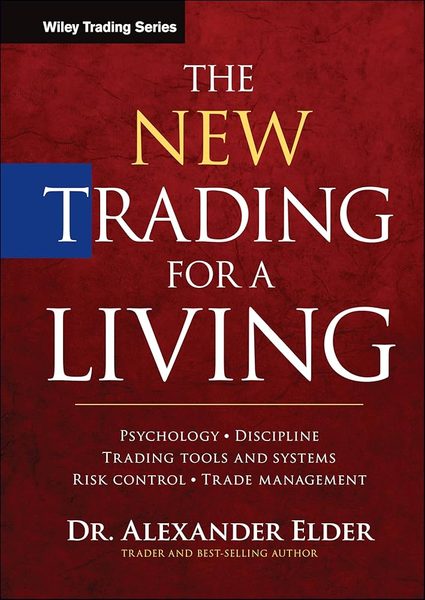
Almost every trader who blows an account had a workable strategy and an unworkable size. Two books address this directly and they answer it in opposite ways. One gives you a system. The other gives you a ceiling.
Which you need depends less on your strategy than on how much maths you will actually do.
The short answer
If you want the simplest rule that will keep you alive, read Alexander Elder. The 2% and 6% rules take ten minutes to understand and can be applied this afternoon. We rate The New Trading for a Living 8.5/10.
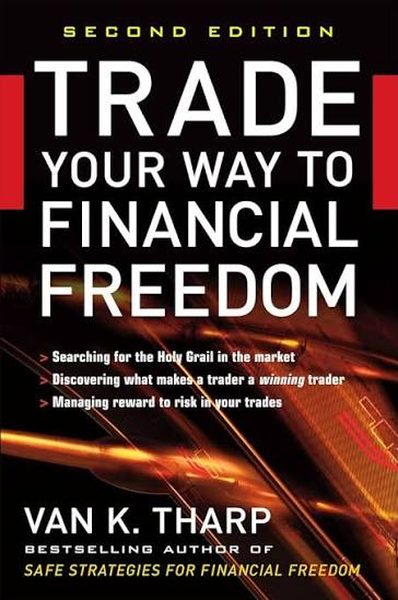
If you want to understand why sizing works and to build something specific to your own edge, read Van Tharp. We rate Trade Your Way to Financial Freedom 9.0/10. It is the deeper book and the harder one.
Most traders should read Elder first and Tharp second. Reversing that order is the single most common way people bounce off Tharp and conclude that position sizing is complicated. It is not complicated. It is just presented thoroughly.
Elder’s answer: a ceiling
Elder’s contribution is a pair of limits that require no modelling.
The 2% rule caps the loss on any single trade at 2% of account equity. The 6% rule caps total losses in a month at 6%, after which you stop trading until the month turns over. The first prevents one trade from mattering too much. The second prevents one bad run from mattering too much.
The strength here is that it is enforceable. You can calculate it in your head, you can check it before every entry, and you can tell immediately whether you followed it. Rules that survive contact with a live market tend to be rules this simple.
The weakness is that it is arbitrary. Two percent is a reasonable number, not a derived one. It takes no account of your win rate, your average reward-to-risk, or the correlation between your open positions. It is a speed limit, not a route.
Tharp’s answer: a system
Tharp builds from a different starting point. He argues that traders think in win rates when they should think in R-multiples, where R is the amount risked on a trade and every outcome is expressed as a multiple of it. A trade that makes three times what you risked is a 3R win regardless of the instrument or the account size.
From there you get expectancy, which is the average R you can expect per trade across a series. Once you have expectancy and a distribution of outcomes, position sizing stops being a rule of thumb and becomes an optimisation problem with an answer.
This is genuinely more powerful. It is also considerably more work, and it requires something most traders do not have when they first read the book, which is a sample of their own trades large enough to compute anything from.
Side by side
| Elder | Tharp | |
|---|---|---|
| Book | The New Trading for a Living | Trade Your Way to Financial Freedom |
| Our rating | 8.5/10 | 9.0/10 |
| Core tool | 2% and 6% rules | R-multiples and expectancy |
| Time to apply | Same day | Weeks, and you need trade data |
| Adapts to your edge | No | Yes |
| Also covers | Psychology and method too | System design and objectives |
| Best for | Beginners and prop challenges | Traders with a track record |
If you trade a prop account
Elder wins on practicality here, with one adjustment.
A funded account has a fixed drawdown ceiling set by someone else, which is a harder constraint than anything in either book. The 2% rule is usually too loose in that context, because five consecutive losses at 2% puts you close to most daily limits. Traders working within a challenge generally need something nearer 0.5% to 1% per trade, and Elder’s 6% monthly stop maps reasonably onto a maximum loss limit.
Tharp’s framework is better suited once you are funded and have real data, because at that point you can size against your measured expectancy rather than a generic number.
The honest counterweight
Tharp’s book is longer than it needs to be and the SQN material at the back is more useful to system developers than to discretionary traders. Plenty of readers get the value in the first half and never apply the rest, which is a reasonable outcome rather than a failure.
Elder’s book tries to cover psychology, method and money in one volume, and the money section is the strongest of the three. Read for sizing it is excellent. Read as a complete education it is necessarily shallower than a dedicated book on each.
And neither of them will help if the real problem is that you move your stop. That is a Mind pillar issue, and the honest fix is Douglas rather than either of these.
Full reviews
- Trade Your Way to Financial Freedom Book Review (2026) — R-multiples, expectancy and the SQN system.
- The New Trading for a Living Book Review (2026) — the three M’s and the 2% and 6% rules.
- Position Sizing: The Most Important Decision in Every Trade
- Explore all 80 books in the Trader’s Library
 The Complete Trader's Edge
The full Mind · Method · Money framework. 70 chapters.
View on Amazon →
The Complete Trader's Edge
The full Mind · Method · Money framework. 70 chapters.
View on Amazon →
 Market Mayhem
400 years of bubbles, crashes, and the pattern that keeps repeating.
Buy on Amazon →
Market Mayhem
400 years of bubbles, crashes, and the pattern that keeps repeating.
Buy on Amazon →
 Greatest Companies
How the world's greatest companies were built — and what traders learn from them.
View on Amazon →
Greatest Companies
How the world's greatest companies were built — and what traders learn from them.
View on Amazon →