Ray Dalio is quoted in more trading journals than almost any writer who has never published a trading book. Principles is not about entries, stops or setups. It is a 592-page operating manual for making decisions when you do not have enough information and the cost of being wrong is real. That description happens to fit trading exactly, which is why the book keeps turning up on desks that have nothing to do with macro hedge funds.
It also gets misused. Traders lift the slogans, print “Pain + Reflection = Progress” above the monitor, and change nothing about how they actually review a losing week. The slogans are the least valuable part of the book. The machinery underneath them is the part that transfers.
This article separates the two. What in Dalio’s system genuinely improves a retail trading account, what does not survive the translation from a $150-billion macro fund to a $10,000 prop account, and which of his six books is actually worth your time.
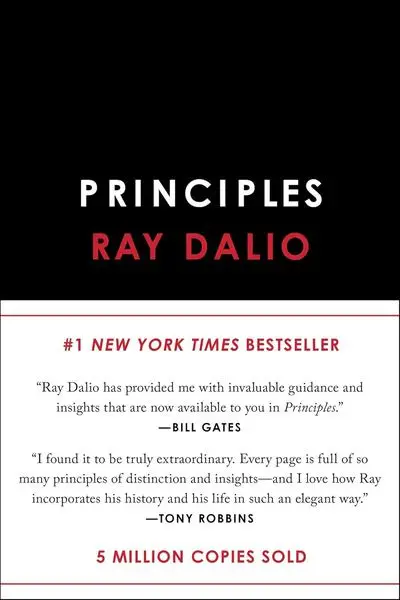
The book this article works from. 592 pages, three parts, and only the first two matter to a solo trader.
All six Dalio titles are ranked further down, with a verdict on each.
What Principles Actually Is
Dalio founded Bridgewater Associates in 1975 out of a two-bedroom apartment in New York and ran it for most of the next fifty years, building it into the largest hedge fund in the world before stepping back from running the firm. He graduated with a finance degree from C.W. Post College in 1971 and took an MBA from Harvard Business School in 1973. Those two facts matter, because they frame the book’s central claim: that his results came from a system, not from personal brilliance.
The book comes in three parts. The first is autobiography, covering the founding of Bridgewater and the 1982 episode where Dalio publicly called for a debt-driven depression, was spectacularly wrong, and lost almost everything he had built. The second part, Life Principles, is the general decision-making system. The third, Work Principles, is the Bridgewater management manual: radical truth, radical transparency, the idea meritocracy, and the tools the firm built to run it.
For a trader, the value is concentrated in parts one and two. Part three is a book about running an organisation of a thousand people. If you trade alone, roughly a third of the book does not apply to you and you should skim it without guilt.
There is also a practical point almost no review mentions. Dalio has given a very large amount of this material away. The core principles are published free on his own sites, the ideas are compressed into the Principles for Success animated series on YouTube, and his 30-minute How the Economic Machine Works animation covers the macro framework better than any chapter does. If you are unsure whether the book is for you, watch the animations first. They cost nothing and take under an hour.
Pain + Reflection = Progress: The Only Formula That Matters
This is the single most useful idea Dalio has given traders, and it is almost universally applied badly.
The formula is not “losses make you stronger.” That is a motivational poster. Dalio’s actual claim is narrower and far more demanding: pain by itself teaches nothing, reflection by itself changes nothing, and progress only occurs when the two are deliberately connected inside a defined window. The pain is the signal that a lesson is available. The reflection is the work of extracting it. Skip either half and you get nothing.
Most traders skip the reflection. They feel the loss intensely, they experience it as pain, and they conclude they have learned something because it hurt. Then they take the same trade eleven days later. The pain was real. The reflection never happened.
A smaller group skips the pain, which sounds impossible but is not. These are the traders who journal diligently and dispassionately, logging entries and exits and R-multiples without ever sitting with the fact that the account is down. Their reviews are clean, accurate and completely inert, because nothing about them creates the discomfort that forces a rule change.
The Working Version
The version that actually functions in a trading account has three parts and a deadline.
First, you log the pain while it is still live. Not the trade data, the state. What you felt, what you told yourself, what you were avoiding. Dalio calls this a pain button, and the point is to capture it before your brain sands the edges off, which it starts doing within hours.
Second, you reflect on a fixed schedule, not when you feel like it. Weekly is the practical unit for most retail traders. Reflection performed in the emotional aftermath of a loss produces revenge decisions dressed as insight. Reflection performed six weeks later produces nothing, because the pain has decayed.
Third, and this is the part that separates it from ordinary journalling, every reflection must terminate in either a written rule or an explicit decision that no rule is needed. A reflection that ends in an observation is a diary entry. A reflection that ends in a rule is a system change. Dalio’s entire body of work is the accumulated output of that one habit performed for fifty years.
Believability Weighting: Whose Opinion Should Count
Bridgewater’s most distinctive idea is that not all opinions are equal, and that the inequality should be measured rather than felt. The firm built systems that assigned people credibility scores by domain, based on their track record in that specific domain, and used those weights when the firm disagreed with itself. Dalio calls the outcome believability-weighted decision making.
Translated to a solo trader, this is the antidote to the single most expensive habit in retail trading: taking input from people whose results you have never seen.
Run the audit honestly. List every source that influenced a trade decision in the last month. The X account with the clean charts. The Discord with 4,000 members. The YouTube analyst. The friend who has been trading eight months. Then, for each, write down what you actually know about their verified performance over a full market cycle. For most traders the honest answer for most sources is: nothing at all.
Believability has two requirements in Dalio’s formulation, and both must hold. The person must have a record of success in that specific thing, repeated, not once. And they must be able to explain the causal reasoning behind their conclusion, not just state it. A trader who has been profitable for six years but cannot articulate why a setup works fails the second test. A brilliant explainer with no verified record fails the first.
The uncomfortable application is turning it on yourself. Your own opinion about a discretionary trade is entitled to exactly as much weight as your documented record in that setup justifies. If you have taken a particular pattern nine times for a negative expectancy, your conviction on the tenth is not evidence. It is noise wearing the costume of experience. This is why thinking in probabilities and keeping setup-level statistics are the same discipline, not two.
Radical Open-Mindedness and the Two Barriers
Dalio argues that two specific barriers stop people from seeing reality clearly, and that both are structural rather than moral. You do not get past them by trying harder to be honest.
The ego barrier is the part of you that experiences being wrong as being attacked. In an office it produces defensiveness in meetings. In a trading account it produces the widened stop, the averaged-down position, the “it will come back” that is really “I cannot be wrong about this.” The ego barrier is why traders hold losers: exiting converts a floating loss into a verdict on their judgement.
The blind spot barrier is different and less discussed. It is the simple fact that you cannot see what you cannot see. Some traders are structurally unable to perceive risk; others are structurally unable to perceive opportunity. Neither can fix the gap through introspection, because introspection uses the same faulty instrument that created it.
The ego barrier is addressed by process. The blind spot barrier can only be addressed by other people, which is a genuine problem for the solo retail trader. Dalio’s solution at Bridgewater was a thousand colleagues instructed to disagree with him. You do not have that. The closest available substitutes are a trading partner with a materially different style, a mentor who is paid to disagree with you, or a mechanical checklist that forces you to state the bear case in writing before every long. The checklist is weaker than a person, but it is not nothing, and it is available today.
The Test Dalio Would Apply to Your Last Loss
Did you write down what you felt, or only what you did?
Did the review end in a rule, or in an observation?
Whose opinion moved you into that trade, and what is their verified record?
Would you have taken the trade if you had been required to write the opposing case first?
The Five-Step Process, Rebuilt as a Trading Plan
Dalio’s Life Principles reduce to a five-step loop: set clear goals, identify the problems standing in the way, diagnose those problems to their root causes, design a plan that routes around them, and then push the plan through to results. He insists the steps be done one at a time, because the most common failure is collapsing diagnosis into design, jumping to a fix before understanding the cause.
Traders do this constantly. The account draws down, and within an hour the trader has a new indicator, a new timeframe or a new strategy. That is design without diagnosis. It is why so many traders have a graveyard of abandoned systems and no idea which of them actually had an edge.
| Dalio’s Step | Trading Equivalent | Where Traders Fail |
|---|---|---|
| 1. Clear goals | A written definition of what success is, in process terms | Goal is a number (“$5k a month”) rather than a behaviour, so it cannot be executed. |
| 2. Identify problems | Statistics that show where the money actually leaks | No setup-level data, so the “problem” is a feeling rather than a measurement. |
| 3. Diagnose root causes | Was it the strategy, the sizing, or the execution? | Skipped entirely. A discipline problem gets misdiagnosed as a strategy problem. |
| 4. Design a plan | One specific rule change, isolated so it can be measured | Six changes at once, making it impossible to attribute the result to any of them. |
| 5. Push through | Run the change for a fixed sample before judging it | Abandoned after three losers, which is far too small a sample to mean anything. |
The discipline is in the sequencing. Diagnose before you design, and change one thing at a time so the result is attributable. That is the whole method.
Think Like a Machine Operator
Dalio’s framing device is that you should picture yourself operating a machine that produces outcomes, and that your job is to compare the outcomes to your goals and improve the machine. The subtle part is that you are also a component inside the machine, which means you have to be able to assess yourself as coldly as you assess any other part.
For traders this reframes what a losing month is. A losing month is not a verdict on you. It is output data from a machine whose design you control. The question stops being “am I any good at this” and becomes “which component produced this output, and is it the strategy, the sizing model, or the operator.” That last option is the one traders resist, and it is the one discipline work exists to address.
It also explains why Dalio pushed relentlessly toward writing things down and then converting the writing into algorithms. Principles become rules, rules become checklists, checklists become code. Every step in that chain removes discretion, and every removal of discretion removes a place for the ego barrier to operate. A trader does not need to reach the code stage to benefit. Reaching the written-checklist stage captures most of the value.
The Honest Counterweight
A trading site that recommends Principles without qualification is not being useful. There are four real objections, and they are worth understanding before you buy.
The attribution problem is unresolved. Bridgewater’s returns are real. So is the culture Dalio describes. What has never been established is that the second caused the first. Macro funds succeed for many reasons, including scale, access, fee structure, timing and luck. A book that presents a management philosophy alongside an investment record invites you to connect them, but the connection is asserted rather than demonstrated. That is exactly the survivorship reasoning Taleb warns about, and Dalio’s book is not immune to it.
The culture is contested. Radical transparency has been described by former employees as brutal rather than clarifying, and journalist Rob Copeland’s 2023 book The Fund presents a reported account of Bridgewater that differs sharply from the one in Principles. You do not have to accept Copeland’s version to accept the narrower point: the firm’s own founder is the primary source for the claim that his system works, and that is a weak evidentiary position. Read the book knowing it is also a work of self-presentation.
Dalio is not a trader in the sense you probably are. He is a macro allocator running systematised, diversified, long-horizon positions with institutional risk infrastructure. If you are managing a prop-firm account with a daily loss limit and a two-week evaluation window, the portfolio construction material is intellectually interesting and operationally irrelevant. Take the decision-making, leave the allocation.
The length is a genuine cost. 592 pages, and a meaningful share of it is organisational management you will never use. The book is repetitive by design, because Dalio wants the principles to stick, but repetition reads as padding when the material does not apply to you. Skimming is not disrespect here. It is correct usage.
Which Dalio Book Should a Trader Actually Read?
Dalio has six titles in print. They serve genuinely different purposes, and buying the wrong one is the most common mistake readers make. Only two of them belong on a trader’s shelf.
| Book | Year | What It Is | Verdict for Traders |
|---|---|---|---|
| Principles: Life and Work | 2017 | The decision-making system, plus memoir and management manual. 592 pages. | Start here. Read parts one and two, skim part three. |
| Principles for Success | 2019 | Short illustrated distillation of the Life Principles. | A gift book. The free animated series covers the same ground. |
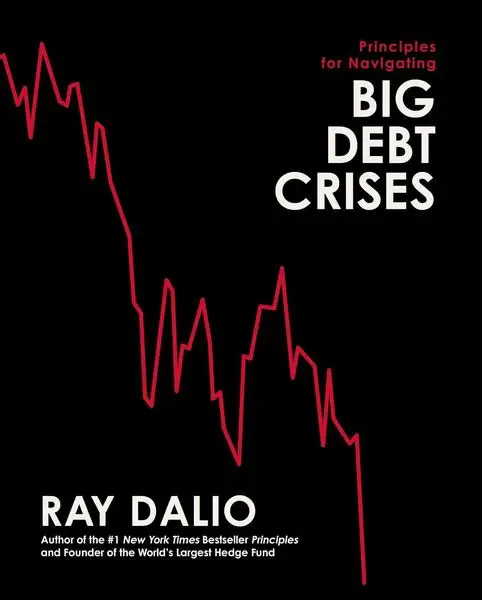
| Principles for Navigating Big Debt Crises | 2018, rev. 2022 | A debt-cycle template, three deep case studies, and a compendium of 48 further cases. | The one macro traders should own. Dense, chart-heavy, genuinely useful. |
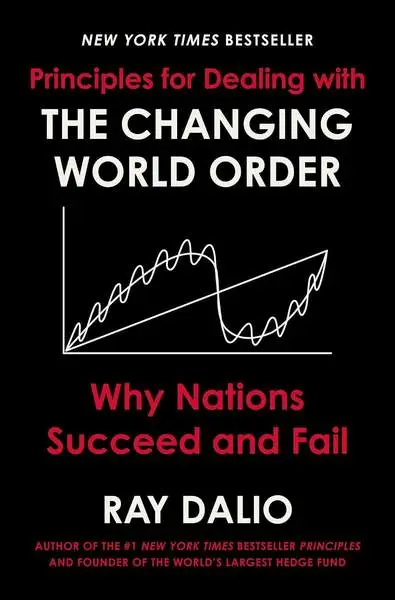
| Principles for Dealing with the Changing World Order | 2021 | 500 years of empire rise and decline, and the Big Cycle framework. 576 pages. | Fascinating, but geopolitical context rather than a trading tool. |
| Principles: Your Guided Journal | 2022 | Prompted workbook for writing your own principles. | Skip. A blank notebook and the pain-reflection loop do the same job. |
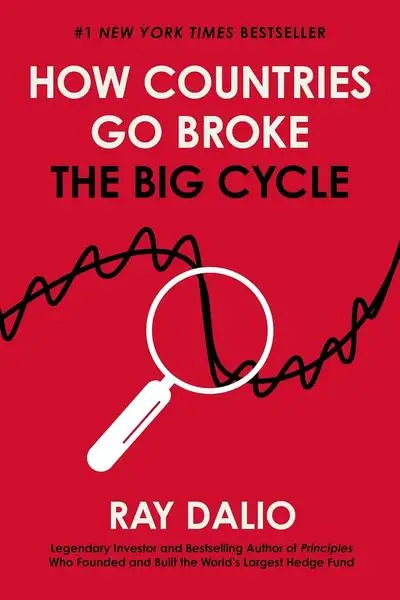
| How Countries Go Broke: The Big Cycle | 2025 | Sovereign debt mechanics, built on 35 historical cases of governments going broke. | Read it after the debt-crises book, not instead of it. |
The short answer: read Principles: Life and Work for the decision-making system, and add Principles for Navigating Big Debt Crises only if you trade macro. The rest are optional, and two of them are free in another format.
Six titles, ranked for a trader. The first two are the only ones most readers need.
More rated trading books in the Trader’s Library.
Dalio Through the Mind · Method · Money Framework
Mind: This is where Dalio’s contribution sits almost entirely. The pain-reflection loop is a mechanism for converting emotional events into rule changes, and the two barriers explain precisely why traders fail to do that on their own. Radical open-mindedness, applied to a single trader, means writing the opposing case before you take the position.
Method: The five-step process is a strategy-development framework, not a strategy. It tells you how to improve a system, in what order, and how to avoid the changing-six-things-at-once failure. Combine it with a properly specified plan and you have a way to evolve that plan without destroying it.
Money: The weakest transfer. Dalio’s capital ideas are portfolio construction across uncorrelated return streams at institutional scale. The principle that diversification is the only free lunch survives the translation. The implementation does not, unless you are allocating rather than trading. For actual sizing, position sizing and Van Tharp are far more directly useful.
Frequently Asked Questions
Is Ray Dalio’s Principles worth reading for traders?
Yes, with the caveat that roughly a third of it is organisational management that will not apply to a solo trader. The decision-making system in the Life Principles section and the account of the 1982 failure in part one are the sections that transfer. Read those closely and skim the Work Principles.
What does “Pain + Reflection = Progress” actually mean in trading?
That a loss only produces improvement if it is deliberately connected to a structured review inside a defined window, and if that review terminates in a written rule change. Pain without reflection is just damage. Reflection without pain is bookkeeping. Progress requires both, on a schedule.
Which Ray Dalio book should I read first?
Principles: Life and Work (2017). It contains the decision-making system all his later books assume you already know. Add Principles for Navigating Big Debt Crises only if you trade macro or want to understand credit cycles properly.
Can I get Ray Dalio’s principles for free?
Much of the core material is published free by Dalio himself, and the ideas are also covered in his Principles for Success animated series and the How the Economic Machine Works animation on YouTube. Watching those first is a reasonable way to decide whether the full book is worth 592 pages of your time.
Is Bridgewater’s culture really as described in the book?
That is contested. Former employees have described radical transparency as considerably harsher in practice, and Rob Copeland’s 2023 book The Fund presents a reported account that conflicts with Dalio’s. Treat Principles as a valuable method combined with a favourable self-portrait, and take the method.
Does Principles teach you how to trade?
No. There are no setups, entries or risk rules in it. It is a decision-making manual that happens to be unusually well suited to a discipline where you must act repeatedly on incomplete information and be measured on the results.
Explore the Full Legendary Traders Series
Learn from history’s greatest market minds.
Ray Dalio ·
George Soros ·
Paul Tudor Jones ·
Druckenmiller ·
Ed Seykota
 The Complete Trader's Edge
The full Mind · Method · Money framework. 70 chapters.
View on Amazon →
The Complete Trader's Edge
The full Mind · Method · Money framework. 70 chapters.
View on Amazon →
 Market Mayhem
400 years of bubbles, crashes, and the pattern that keeps repeating.
Buy on Amazon →
Market Mayhem
400 years of bubbles, crashes, and the pattern that keeps repeating.
Buy on Amazon →
 Greatest Companies
How the world's greatest companies were built — and what traders learn from them.
View on Amazon →
Greatest Companies
How the world's greatest companies were built — and what traders learn from them.
View on Amazon →
 Greatest Traders
Eighty-six lives that explain the markets — Livermore to Madoff, told with the losses left in.
View on Amazon →
Greatest Traders
Eighty-six lives that explain the markets — Livermore to Madoff, told with the losses left in.
View on Amazon →