

SNAPSHOT · 21 OCTOBER 2026
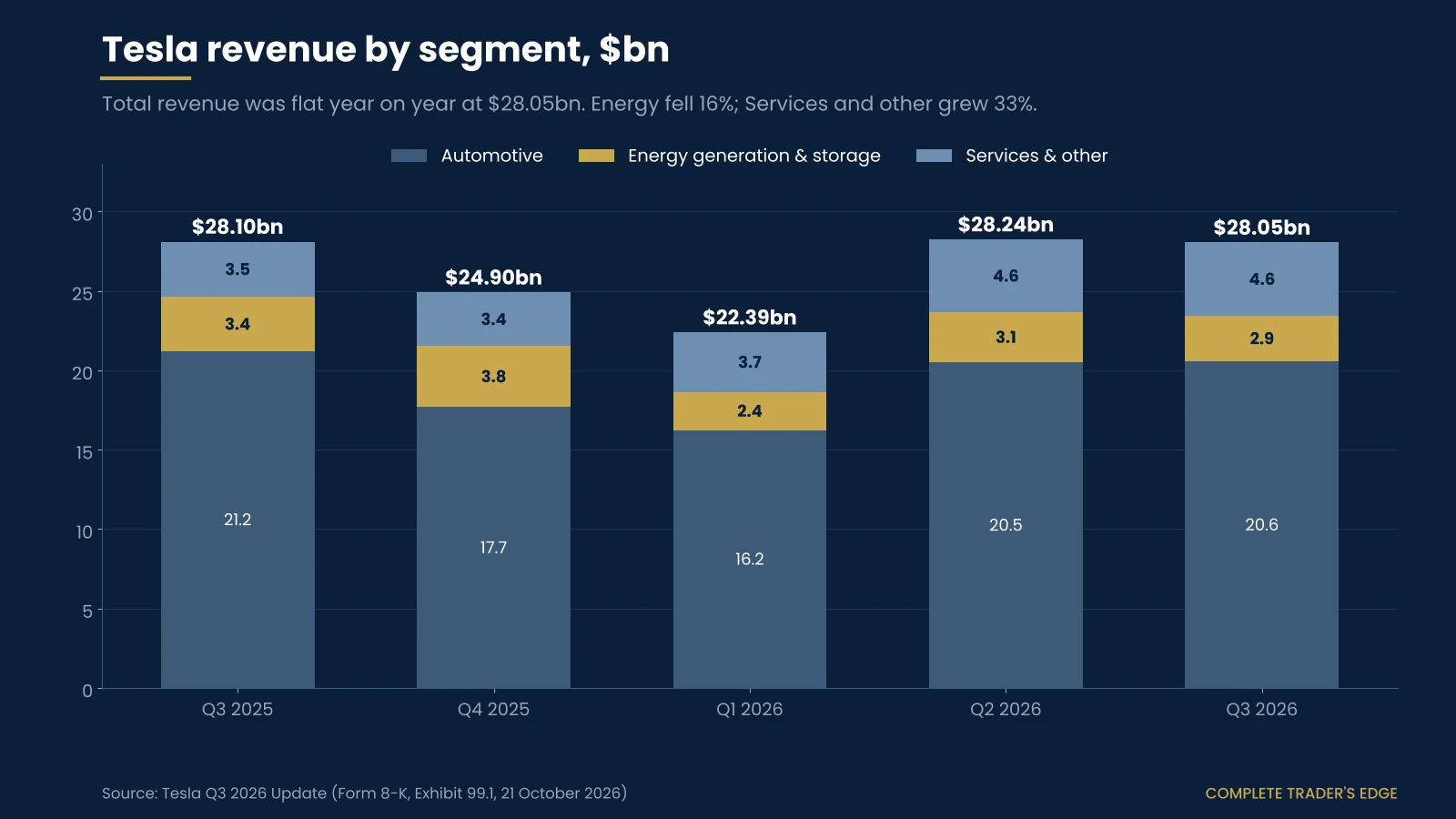
Tesla reported third-quarter revenue of $28.05 billion, flat on a year ago, and adjusted earnings of 48 cents a share against roughly 43 to 45 cents expected. GAAP net income fell 43% to $787 million and the operating margin halved to 2.6%.
Free cash flow was $1.53 billion against a consensus that expected cash to go out, not in. Management cut 2026 capex guidance to about $20 billion. TSLA closed at $386.47, up 3.4%, then gave back about 3% after hours as the call went on.
Tesla beat on earnings per share and, depending on whose consensus you use, beat, matched or slightly missed on revenue. The headline that matters more is cash. Analysts had pencilled in negative free cash flow of around $4.5 billion for the quarter. Tesla reported positive $1.53 billion.
That is a $6 billion gap, and it did not come from selling more cars. It came from spending about $3 billion less on capex than the Street expected and from a $2.6 billion swing in working capital, mostly bills that have not yet been paid and customer money received in advance.
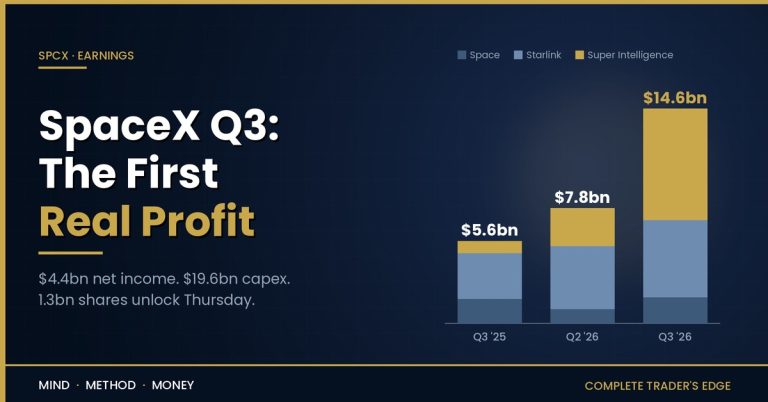
Yesterday we looked at SpaceX’s first real profit and the bill underneath it. Tesla’s quarter is the mirror image: a profit line that is shrinking, and a cash line that looks better than the business underneath it. This piece separates the two, then covers the capex reversal, the merger question and what the last four reports did to the share price.
What Tesla Reported in Q3
The figures below come from the Q3 2026 Update, filed with the SEC as Exhibit 99.1 to a Form 8-K on 21 October.
REVENUE
$28.05 billion, against $28.10 billion a year ago and $28.24 billion in Q2. Automotive revenue fell 3% to $20.56 billion, Energy fell 16% to $2.88 billion, and Services and other rose 33% to $4.61 billion.
EARNINGS
Non-GAAP diluted EPS of $0.48, against $0.50 a year ago. GAAP diluted EPS of $0.22, against $0.39. The 26-cent gap between the two is mostly stock-based compensation, which ran at $1.17 billion before tax.
MARGINS
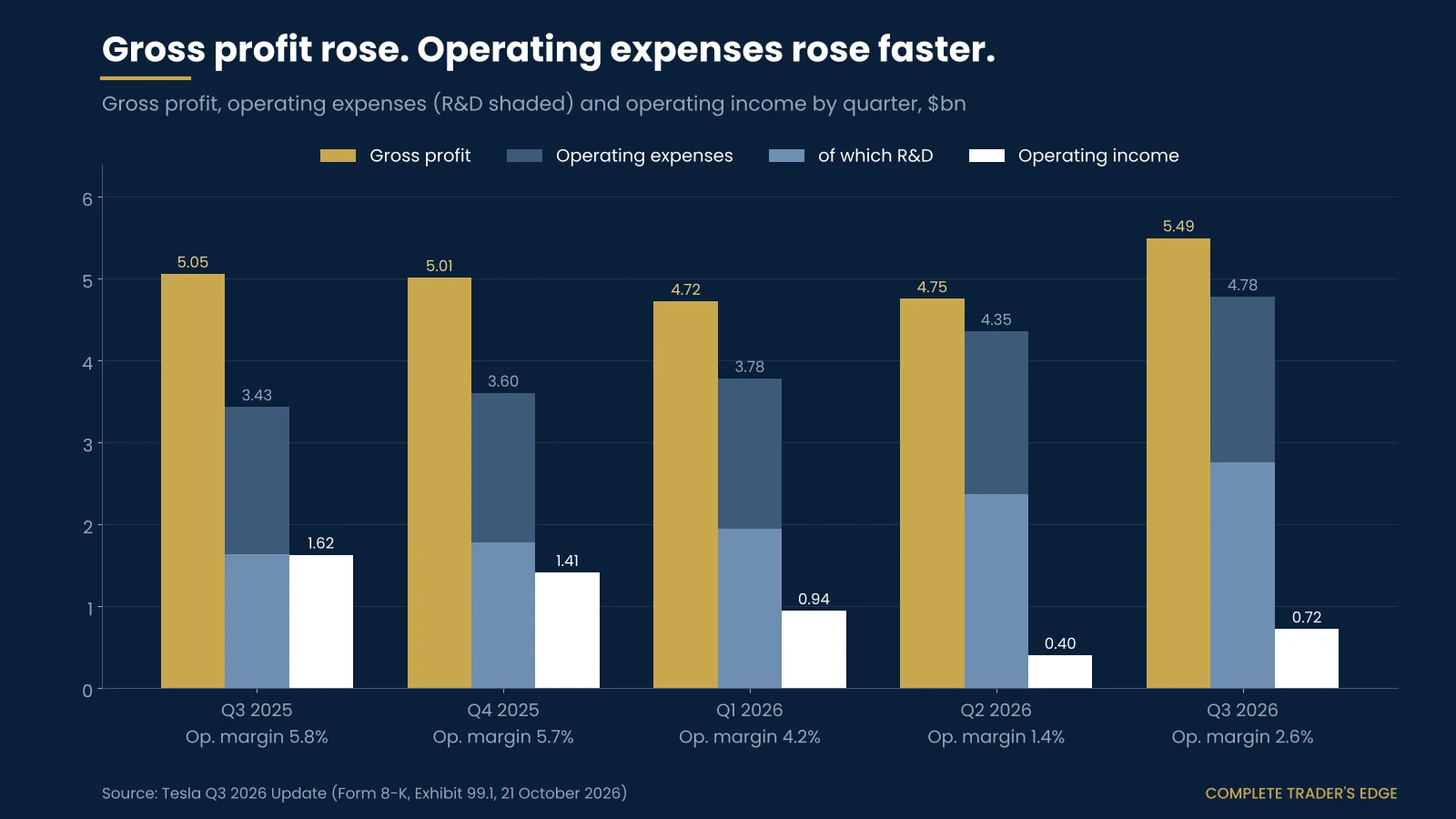
Gross margin rose to 19.6% from 18.0%. Operating margin fell to 2.6% from 5.8%, as operating income dropped 56% to $718 million.
CASH
Operating cash flow of $6.26 billion, capex of $4.73 billion, free cash flow of $1.53 billion. Cash and short-term investments rose $1.9 billion to $45.45 billion.
Q3 2026 against consensus
| Metric | Reported | Consensus | Difference |
|---|---|---|---|
| Revenue | $28.05bn | $27.88bn–$28.34bn | −1% to +1% |
| Non-GAAP EPS | $0.48 | $0.43–$0.45 | +$0.03 to +$0.05 |
| Gross margin | 19.6% | 17.9% | +1.7 pts |
| Operating margin | 2.6% | 2.5% | In line |
| Operating cash flow | $6.26bn | $3.27bn | +$3.0bn |
| Capital expenditure | $4.73bn | $7.77bn–$7.95bn | −$3.0bn |
| Free cash flow | $1.53bn | −$4.51bn | +$6.0bn |
Consensus sources: Benzinga Pro, StockStory and Tesla’s company-compiled consensus via GuruFocus (revenue); StockStory, Stocktwits and CNBC-TV18 (EPS); company-compiled consensus via GuruFocus (margins, cash flow, capex); CNBC-TV18 (capex upper figure). Providers differ; figures are indicative.
Gross Profit Up, Operating Profit Down
On the surface, the car business improved. Automotive gross margin rose to 18.5% from 17.0% a year ago, and to 18.1% from 15.4% once regulatory credits are stripped out. RBC’s Tom Narayan called the auto margin much stronger than consensus and pointed to FSD subscriptions as a likely driver. Group gross profit was $5.49 billion, the highest in at least five quarters.
Almost none of it reached the operating line. Operating expenses rose 39% year on year to $4.78 billion. Research and development alone rose 69% to $2.76 billion. Tesla attributed the increase in operating expenses to Super Intelligence and other R&D projects, stock-based compensation including the 2025 CEO Performance Award, and SG&A.
Regulatory credit revenue, once a reliable cushion, fell to $113 million from $417 million a year ago. That is $304 million of almost pure profit that has gone, and there is little reason to expect it back.
Profit and cost lines, $m
| Line | Q3 2025 | Q2 2026 | Q3 2026 |
|---|---|---|---|
| Total revenue | 28,095 | 28,236 | 28,046 |
| Gross profit | 5,054 | 4,751 | 5,494 |
| Automotive gross margin | 17.0% | 16.9% | 18.5% |
| Regulatory credits | 417 | 146 | 113 |
| Research and development | 1,630 | 2,371 | 2,761 |
| SG&A | 1,562 | 1,982 | 2,015 |
| Income from operations | 1,624 | 398 | 718 |
| Stock-based compensation | 663 | 1,151 | 1,165 |
| Net income (GAAP) | 1,373 | 1,114 | 787 |
| Net income (non-GAAP) | 1,770 | 1,153 | 1,697 |
Source: Tesla Q3 2026 Update, statement of operations and GAAP to non-GAAP reconciliation.
The principle: gross margin tells you whether the product makes money. Operating margin tells you whether the company does. When the two move in opposite directions, the company is spending today’s product profit on tomorrow’s product, and the share price is a bet on tomorrow.
Tesla Q3 Earnings: Where the Cash Came From
The $1.53 billion of free cash flow is the number most bullish coverage will lead with. It is real. It is also not what it looks like.
Operating cash flow of $6.26 billion includes $2.59 billion from changes in working capital. Accounts payable and accrued liabilities rose by $3.99 billion in the quarter, and deferred revenue rose by $1.26 billion. In plain terms, Tesla took longer to pay its suppliers and collected more cash from customers ahead of delivering the product. Days payable outstanding rose to 66 from 58 in Q2.
Strip that out and operating cash before working capital was about $3.67 billion. Set against $4.73 billion of capex, the underlying business consumed roughly $1.06 billion in the quarter rather than generating $1.53 billion.
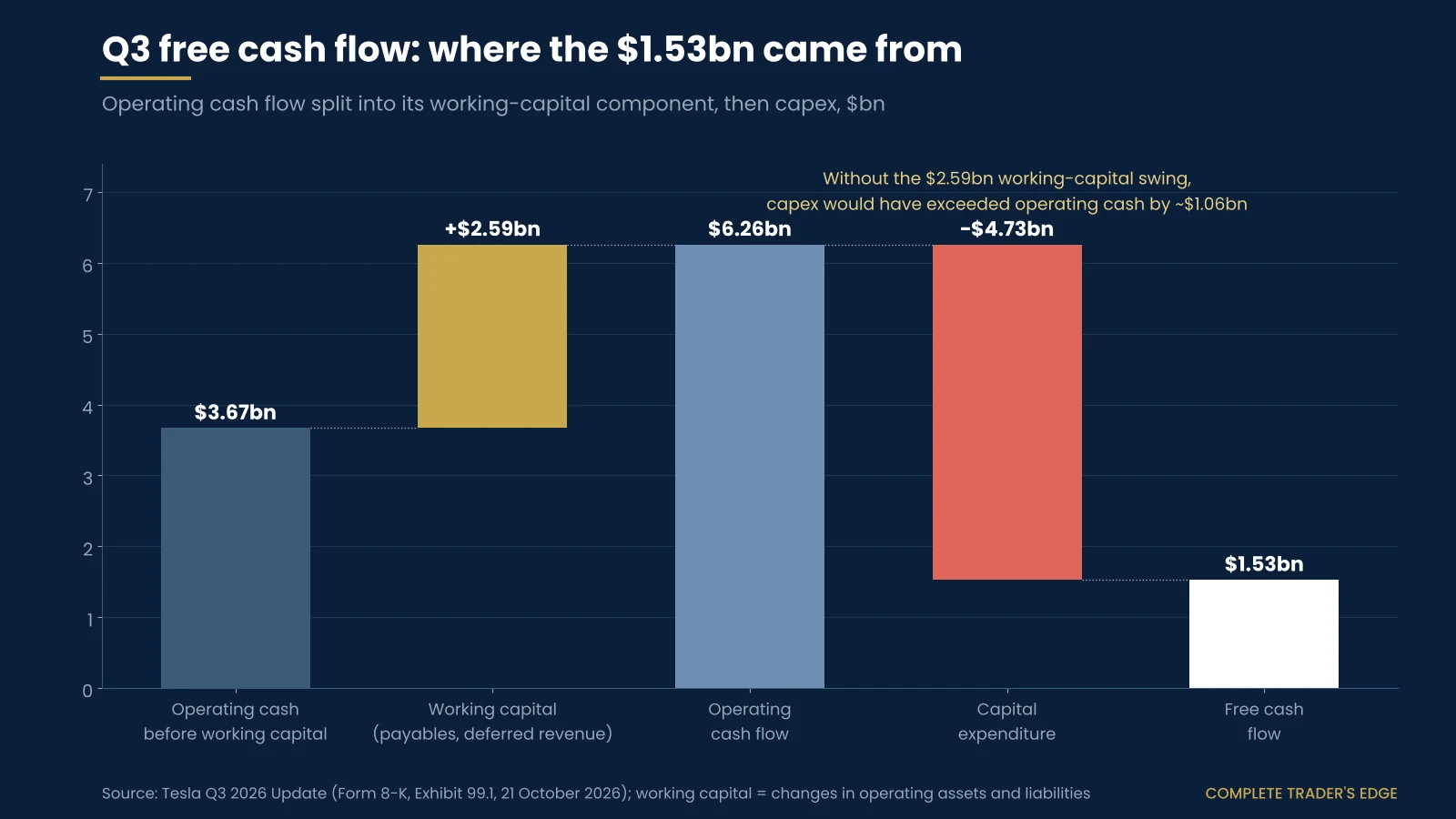
Working capital swings reverse. Payables get paid, and pre-sold product has to be built and delivered. Analyst Dhierin Bechai, writing on Seeking Alpha, made the same point on the night: the cash strength came from lower than expected capex and working capital tailwinds, and should not be assumed to repeat.
None of this means Tesla is short of money. It has $45.45 billion of cash and investments against $9.5 billion of debt and finance leases, almost all of it non-recourse, and has arranged up to $30 billion of new borrowing capacity that the CFO said it does not plan to draw this year. The point is narrower: the free cash flow beat tells you about timing, not about a business that has suddenly become more cash-generative.
The Capex Reversal
In April, on the Q1 call, CFO Vaibhav Taneja raised 2026 capex guidance from about $20 billion to more than $25 billion and warned free cash flow would be negative for the rest of the year. The stock fell 3.6% the next day.
Six months later the guidance is back to about $20 billion, which Taneja attributed to managing capital deployment efficiently. Q3 capex of $4.73 billion came in roughly $3 billion below the $7.8 billion to $8.0 billion the Street expected.
There are two readings, and analysts raised both on the night, according to CNBC-TV18. Either Tesla is spending more carefully, or projects are ramping more slowly than planned and the spending is simply moving into later quarters. The arithmetic leans towards the second. Nine-month capex was $13.01 billion, so a $20 billion year implies roughly $7.0 billion in Q4, more than any quarter so far. Taneja also said capex will keep expanding over the next few years as Tesla scales Robotaxi, Optimus, solar manufacturing, compute and a semiconductor fab.
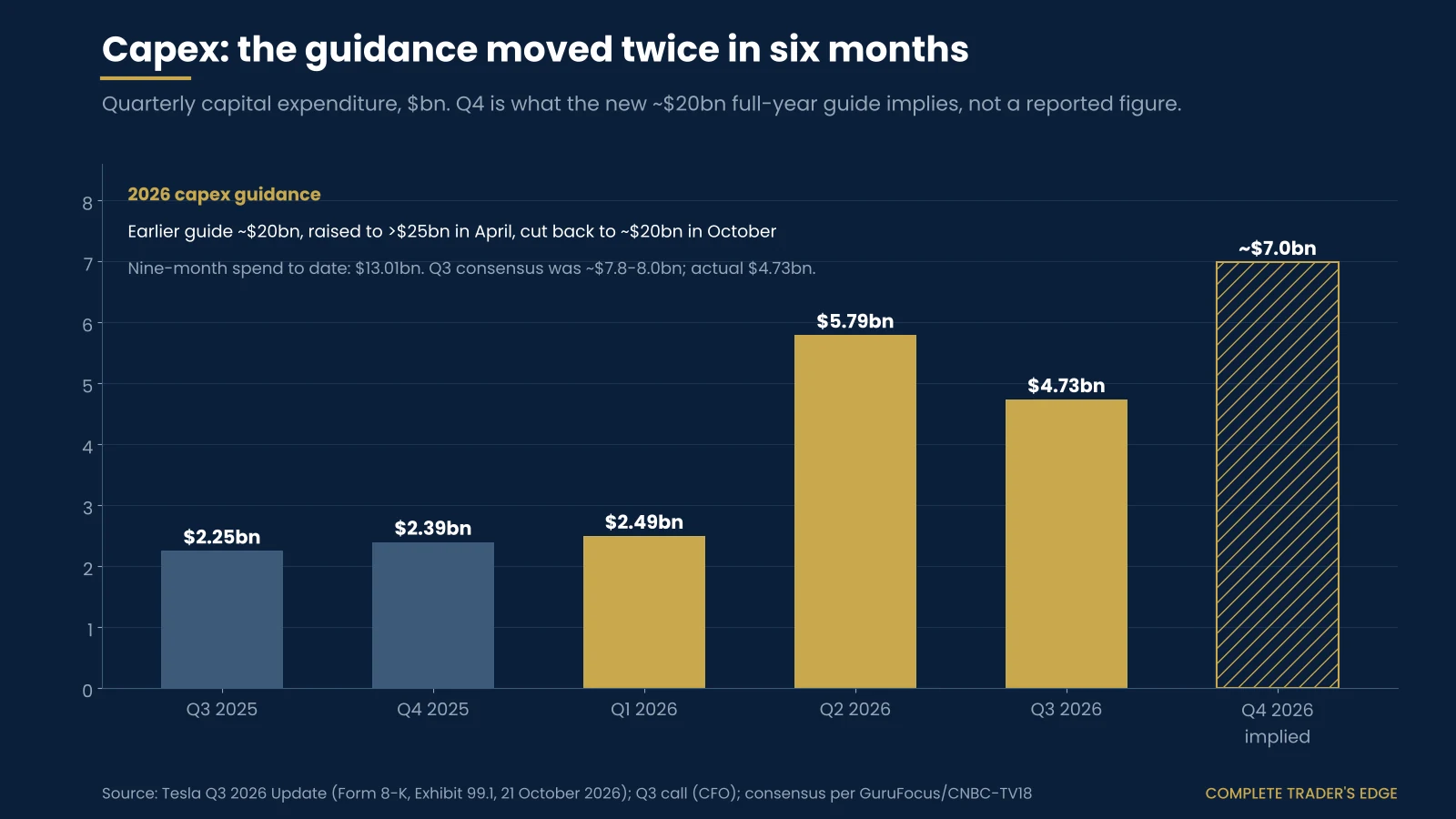
Capex that slips is still capex. If you read the guidance cut as a reduced bill rather than a delayed one, Q4 is where that view gets tested.
FSD Is Now a Real Revenue Line
The clearest operating improvement in the quarter was software. Active FSD subscriptions, which include upfront purchases and monthly plans and exclude free trials, reached 1.74 million, up 67% year on year and 18% from Q2. Tesla reported a nearly twenty percentage point sequential rise in the share of North American deliveries that included FSD, and the WSJ reported the company saying 75% of deliveries included FSD subscriptions.
- FSD (Supervised) is now approved in nine EU countries, with four added since the end of Q2: Croatia, Slovenia, the Czech Republic and Slovakia. Musk said he would be surprised if EU-wide approval takes longer than Q1 2027, having previously pointed to October.
- Cybercab, the dedicated Robotaxi with no steering wheel or pedals, began carrying passengers in Austin on 3 September. Cumulative unsupervised Robotaxi miles grew eightfold in the quarter to nearly two million.
- Tesla said Dallas is next for Cybercab, and that it may enable unsupervised driving on customer cars around Q2 2027.
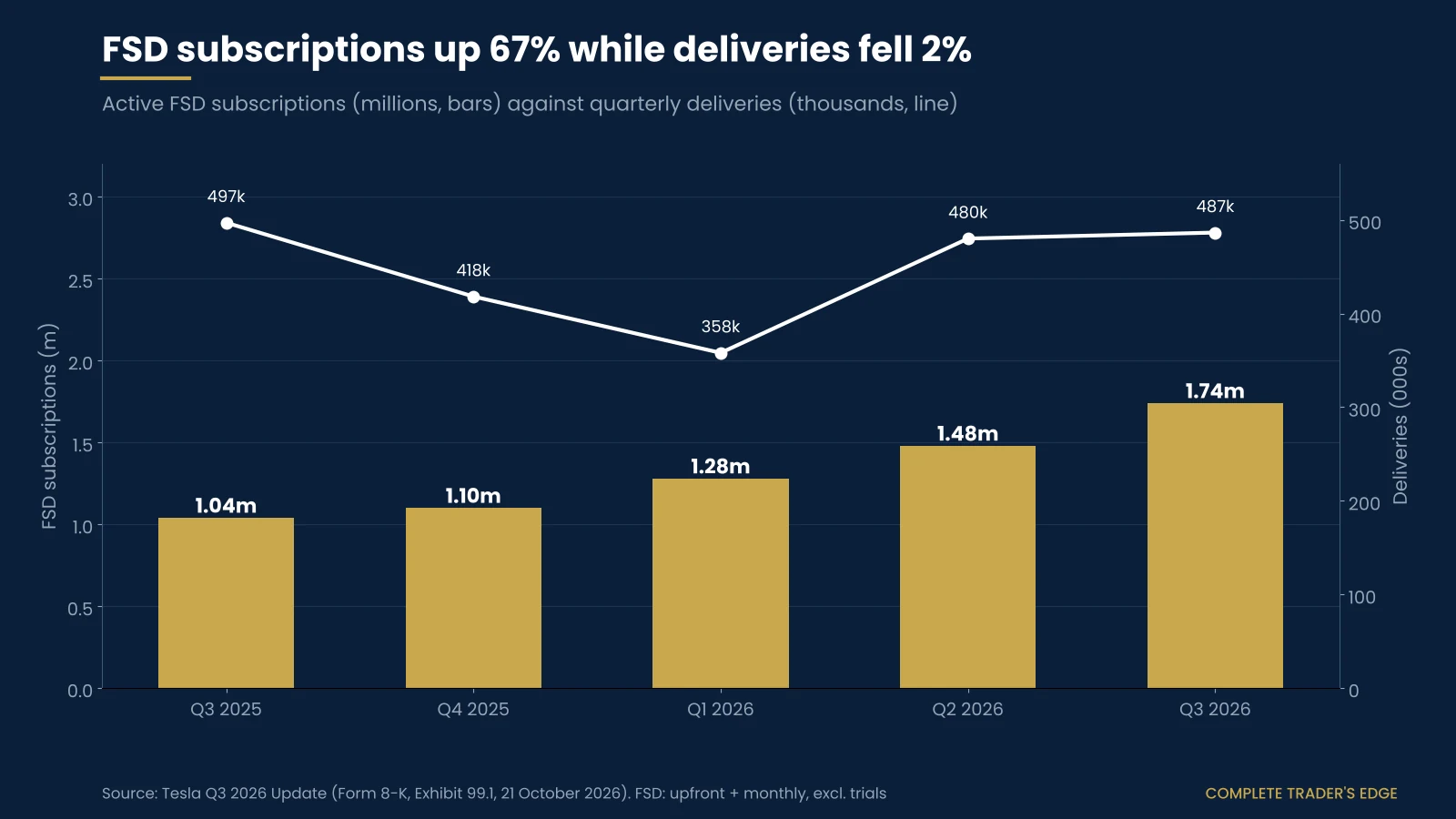
Deliveries were 486,532, down 2% on a year ago, even though production rose 4% and inventory was just 11 days of supply. Tesla said battery availability was again the limit on vehicle output, and that it ended the quarter with its largest passenger-vehicle backlog in four years. A demand problem and a supply problem produce the same delivery number. They do not produce the same next year.
Energy: The Weak Spot
Energy generation and storage revenue fell 16% to $2.88 billion even though storage deployments rose to 13.7 GWh from 12.5 GWh. Tesla attributed part of the drop to tariff-related customer refunds. Segment gross margin recovered to about 33% from 20% in Q2, when a warranty provision weighed on results.
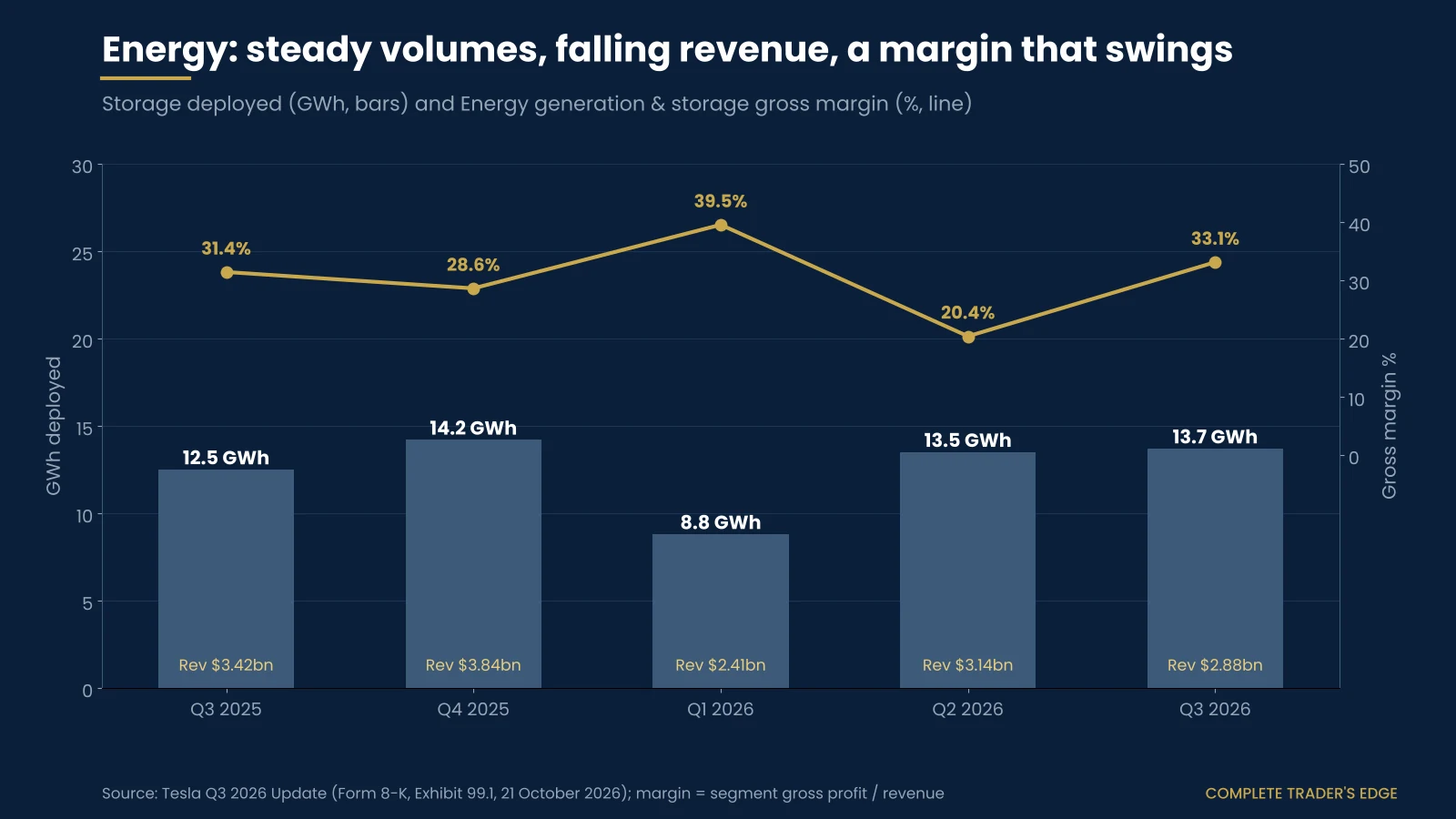
The order book is the bull case. Tesla reported its highest-ever order rate and backlog for storage, started production at Megafactory Texas with a planned 50 GWh of capacity, and shipped the first Megapacks built entirely with its own LFP cells from Nevada. The company is pitching Megapack directly at data-centre power demand, the same AI build-out that is filling SpaceX’s order book. Bechai called Energy the quarter’s biggest disappointment against Tesla’s own collected consensus. Both can be true for another quarter or two.
Optimus, Semi and the Chip Fab
Three hardware programmes moved into production, all at the very start of their ramps.
- Optimus production began on high-volume lines in Fremont, and Tesla said the bots coming off them are its first production-quality units. On the call Musk described the ramp as an S-curve with a shallow, bumpy start, and said reaching about 20,000 units a week will probably take at least a year. External customer deliveries are targeted for around the end of 2027.
- Tesla Semi started volume production in Nevada, with 25,000 units of annual capacity.
- Construction continues on the Austin Fab, with equipment commissioning planned for 2027. Musk said the goal is to be making a useful chip at volume around Q3 2028.
None of these contributes meaningful revenue yet. All of them are in the capex line.
The SpaceX Question
Tesla is no longer just adjacent to SpaceX. It owns a piece of it. The cash flow statement shows a $2.0 billion purchase of SpaceX equity in Q1 2026. That stake produced a $1.0 billion unrealised gain in Q2 and a $142 million unrealised loss in Q3, both of which Tesla strips out of its non-GAAP numbers.
On SpaceX’s own call on Tuesday, Musk confirmed that special committees at both companies are discussing a possible combination and said he thought it would be a good idea. SPCX rose 7.8% on Wednesday to $159.31, and TSLA rose 3.4%. On Tesla’s call a day later, according to CNBC-TV18, Musk said answering questions on it felt like tapdancing through a minefield and called the required approval of Tesla shareholders a high hurdle. No terms, structure or valuation have been agreed.
For traders, the merger is a headline risk in both directions, and it now sits on top of SpaceX’s own supply calendar. Up to about 1.3 billion SPCX shares become eligible for sale on Thursday 22 October under the lock-up schedule we covered in our SPCX lock-up breakdown. If the two companies are pricing off each other, that supply is not only a SpaceX issue.
What the Last Four Reports Did to the Stock
Over the last four reports, the next-day move has not lined up neatly with the EPS result. Tesla beat on adjusted EPS in January and April and the stock fell both times. The July miss produced the largest move of the year.
TSLA next-session move after results
| Report | Date | Close before | Close after | Move |
|---|---|---|---|---|
| Q3 2025 | 22 Oct 2025 | $438.97 | $448.98 | +2.3% |
| Q4 2025 | 28 Jan 2026 | $431.46 | $416.56 | −3.5% |
| Q1 2026 | 22 Apr 2026 | $387.51 | $373.72 | −3.6% |
| Q2 2026 | 22 Jul 2026 | $374.01 | $319.69 | −14.5% |
| Q3 2026 | 21 Oct 2026 | $386.47 | — | About −3% after hours |
Regular-session closes from TradingView (NASDAQ:TSLA). After-hours figure is indicative and will change by the open.
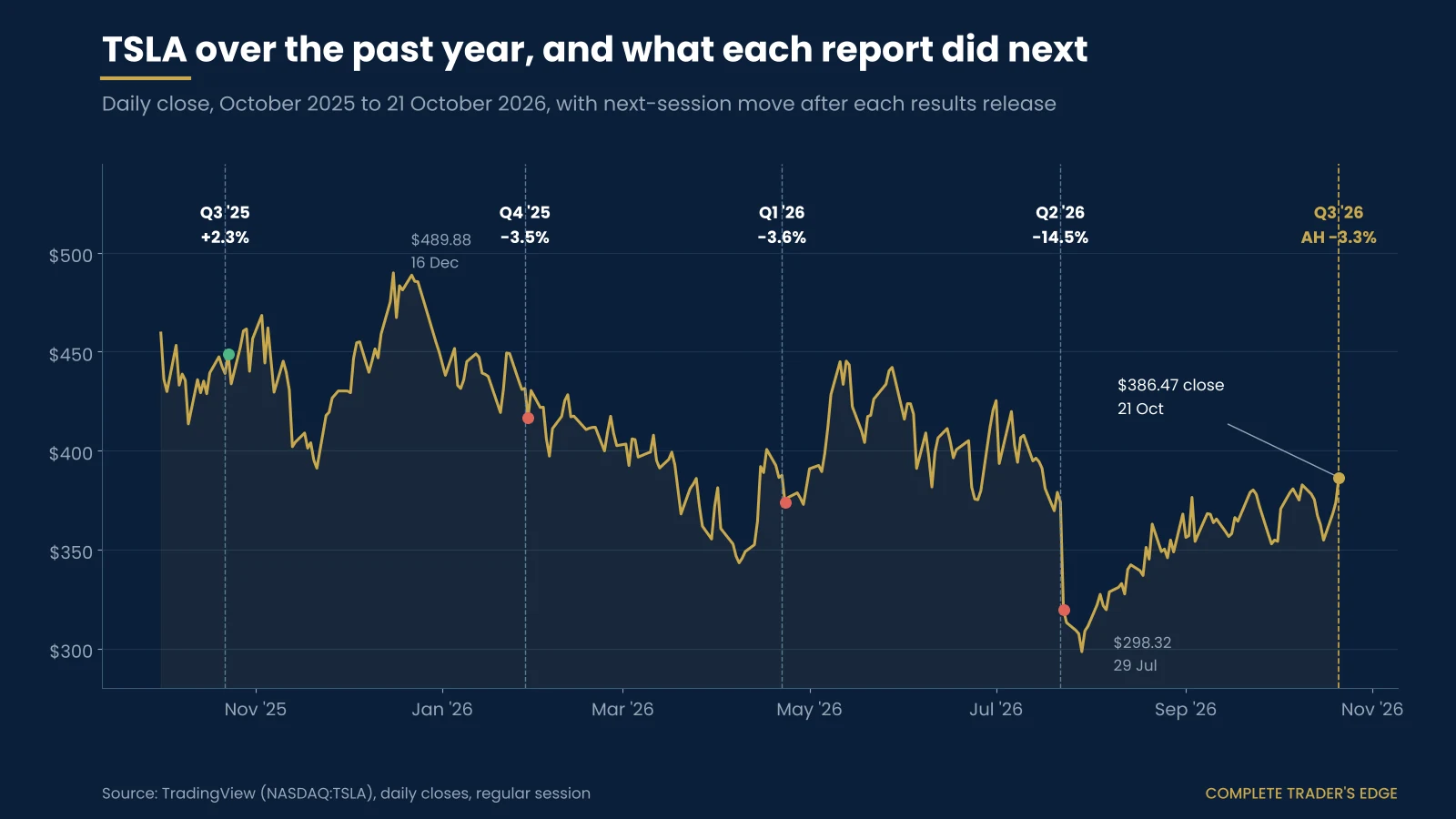
The July report is the useful reference. Revenue beat by $2 billion or more, adjusted EPS missed by about 18 cents, and the stock lost 14.5% the next session, then made its low close of $298.32 a week later. Since then it has recovered about 30%, which is part of why Wednesday’s 3.4% rally into the print left little room.
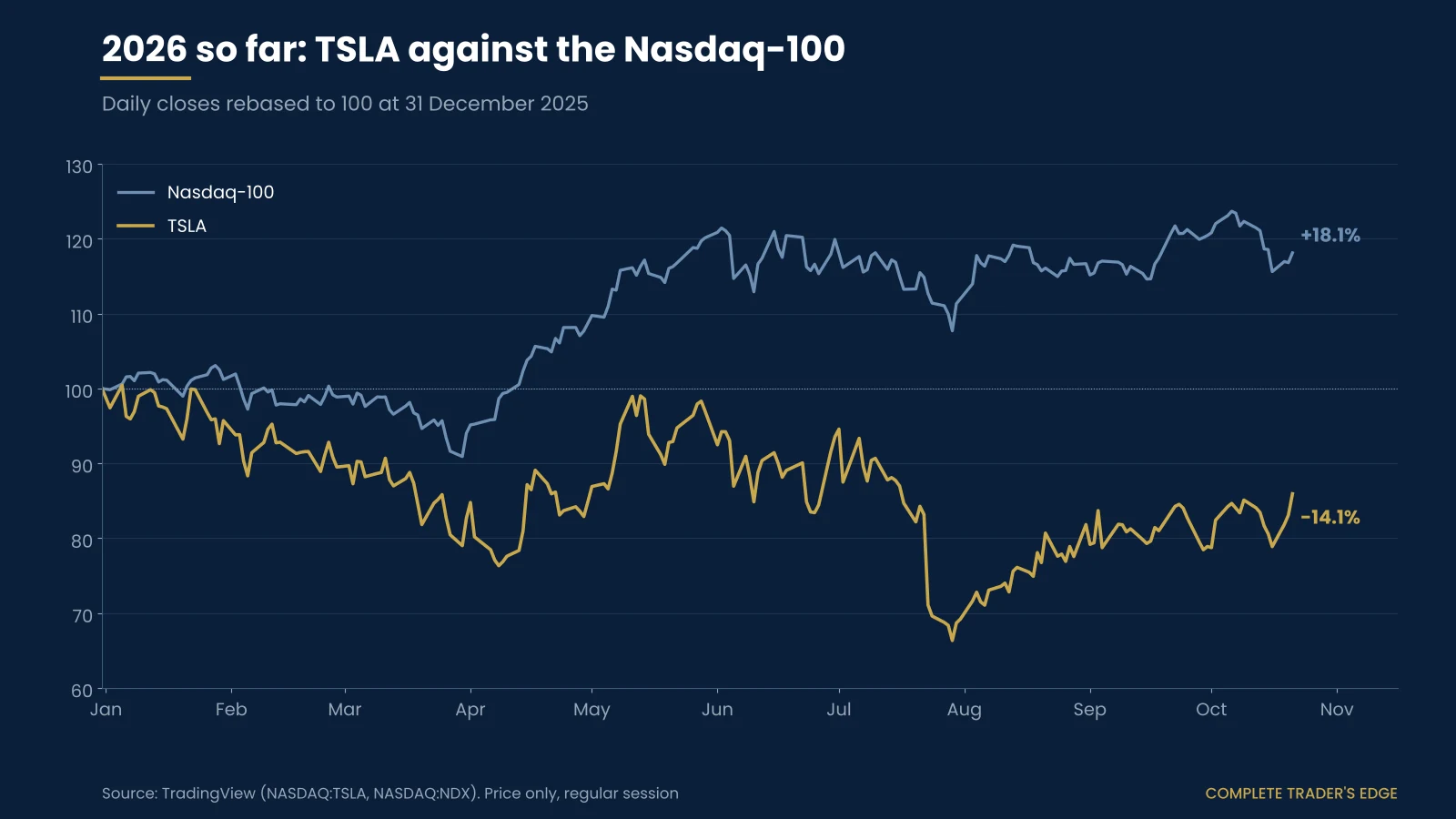
For scale: at $386.47 TSLA has a market value of roughly $1.5 trillion. Trailing twelve-month GAAP diluted EPS is $0.91, which puts the stock on about 425 times earnings. On the non-GAAP figure of $1.72 it is about 225 times. That is a valuation for Robotaxi, Optimus and Energy, not for a car company with a 2.6% operating margin. Our piece on 1973 and the Nifty Fifty covers what happens to stocks priced for perfection when the macro backdrop turns.
What the Headlines Get Wrong
Earnings-night coverage is written in minutes, and Tesla’s quarter is easy to describe badly. A few examples from the first hours.
Beat, in line or miss: same number. Benzinga and CNBC-TV18 called revenue a beat against roughly $27.9 billion. StockStory called it in line against $28.17 billion. Stocktwits compared it with $28.3 billion, a slight miss. The revenue was $28.05 billion in all three. Published consensus figures span about $460 million.
Profit rose, and profit fell. One headline said profit rose; another said the bottom line declined. GAAP net income fell 43% on a year ago and 29% on Q2. Non-GAAP net income rose 47% on Q2 but fell 4% on a year ago. Each headline picked a measure and a comparison period. Check which one before you react.
A change is not a level. One automated summary of the release described Tesla’s GAAP gross margin as 160 basis points. That is the year-on-year change. The margin itself was 19.6%.
How big was July? You will see the Q2 reaction quoted as 12%, 12.7% and nearly 15%. The close-to-close move on TradingView data was 14.5%. Check whether a figure is close-to-close or intraday before you compare it with anything.
The Q3 Update is free on the SEC’s website the moment it is filed, with five quarters of statements side by side. If a number moves you, find it there first.
Tesla Q3 Earnings Through Mind, Method and Money
Mind. Tesla is a stock people hold views about before they read the numbers. A bull will see 1.74 million FSD subscriptions, Cybercab rides and $1.53 billion of free cash flow. A bear will see a halved operating margin, falling GAAP profit and a cash beat built on payables. Both are reading the same filing. The useful question is which of these facts would change your mind, and if the answer is none of them, you are not analysing the stock, you are supporting it. Our profile of Cathie Wood and the Tesla conviction trade shows what that looks like over a full cycle, in both directions.
Method. The last four reports produced next-day moves of +2.3%, −3.5%, −3.6% and −14.5%. Beats were followed by falls, and in April and July the moves tracked what management said about spending and margins. On Wednesday the stock rose 2% after hours on the numbers and turned lower during the call, the same pattern as April. If your setup depends on the release alone, Tesla has spent a year telling you the call matters more.
Money. A stock that fell 14.5% in a session three months ago can do it again, and the merger headlines add a second source of gaps. Size for the move that has already happened, not the one you expect. Our trading calculators will tell you what 1% risk allows on a stock with that range, before the open rather than after it.
The Short Version
Tesla’s Q3 was a better product quarter and a weaker company quarter. Gross margin improved, FSD subscriptions rose 67%, Cybercab is carrying passengers and Energy has a record backlog. Operating income fell 56%, GAAP profit fell 43%, and R&D is growing far faster than revenue.
The cash beat was real but borrowed from timing: $2.6 billion of working capital and about $3 billion of capex that has moved, by the company’s own guidance, towards a Q4 that now needs roughly $7 billion of spending.
The pattern is one we trace across four centuries in Market Mayhem: a valuation built on the next business, carried by the cash of the current one, and a share price that reacts to the story about spending long before the spending pays back.
Related Reading
- SpaceX Q3 Earnings: The First Real Profit, and the Bill Underneath It – the other half of this week’s Musk earnings.
- SpaceX Q2 Earnings: The Beat That Cost $18 Billion – why a beat can still send a stock lower.
- SPCX Stock: The IPO That Fell Below Its Price, and the Calendar That Explains Why – the lock-up schedule.
- Cathie Wood: ARK Invest, the Tesla Conviction Trade, and the Disruptive Innovation Thesis – conviction investing in Tesla, up and down.
- When the Bond Market Spoke First: CoreWeave, AI Debt and the Telecom Bust – capex booms and how they end.
- The History of Bitcoin – Tesla still holds 11,509 bitcoin, carried at $962 million.
- The M·M·M Assessment – find your weakest link before the next earnings gap does.
Frequently Asked Questions
What did Tesla report for Q3 2026?
Revenue of $28.05 billion, flat on a year ago. Non-GAAP diluted EPS was $0.48 and GAAP diluted EPS was $0.22. Operating income was $718 million, an operating margin of 2.6%, and GAAP net income was $787 million. Operating cash flow was $6.26 billion, capex $4.73 billion and free cash flow $1.53 billion.
Did Tesla beat earnings expectations?
On adjusted EPS, yes: $0.48 against consensus of roughly $0.43 to $0.45. On revenue it depends on the source. Estimates ranged from about $27.88 billion to $28.34 billion, so $28.05 billion was described as a beat, in line or a slight miss.
Why did Tesla stock fall after hours?
The stock rose about 2% after the release, then turned lower during the call, finishing about 3% down in after-hours trading. Coverage tied the reversal to the capex guidance cut to about $20 billion, which some analysts read as delayed rather than reduced spending, and to a measured timeline for Optimus.
What is Tesla’s 2026 capex guidance?
About $20 billion, down from more than $25 billion given in April. Tesla spent $13.01 billion in the first nine months, which implies roughly $7.0 billion in Q4. Management said capex will keep rising over the next few years.
How many FSD subscriptions does Tesla have?
1.74 million active FSD subscriptions at the end of Q3 2026, up 67% year on year. The figure includes upfront purchases and monthly subscriptions and excludes free trials.
The takeaway. Tesla beat on adjusted EPS, and its free cash flow looked far better than the business underneath it. The product side improved; the company side is paying for a future that has not arrived yet, and the cash beat bought time rather than proving the spending pays.
Size for the gap, not the narrative. The CTE trading calculators will show you what your risk rules actually allow.
This article is educational and is not financial advice. It does not recommend buying or selling Tesla, TSLA, SpaceX, SPCX or any security. Figures are taken from Tesla’s Q3 2026 Update (Form 8-K, Exhibit 99.1, 21 October 2026), TradingView price data, and contemporaneous reporting by CNBC-TV18, Seeking Alpha, Stocktwits, Benzinga, StockStory, GuruFocus, TIKR and the Wall Street Journal. Consensus figures vary between providers. After-hours prices are indicative. Prices change constantly; verify current figures against primary sources before making any decision. Trading and investing carry risk, including the loss of capital.
 The Complete Trader's Edge
The full Mind · Method · Money framework. 70 chapters.
View on Amazon →
 Market Mayhem
400 years of bubbles, crashes, and the pattern that keeps repeating.
Buy on Amazon →
 Greatest Companies
How the world's greatest companies were built — and what traders learn from them.
View on Amazon →
 Greatest Traders
Eighty-six lives that explain the markets — Livermore to Madoff, told with the losses left in.
View on Amazon →