

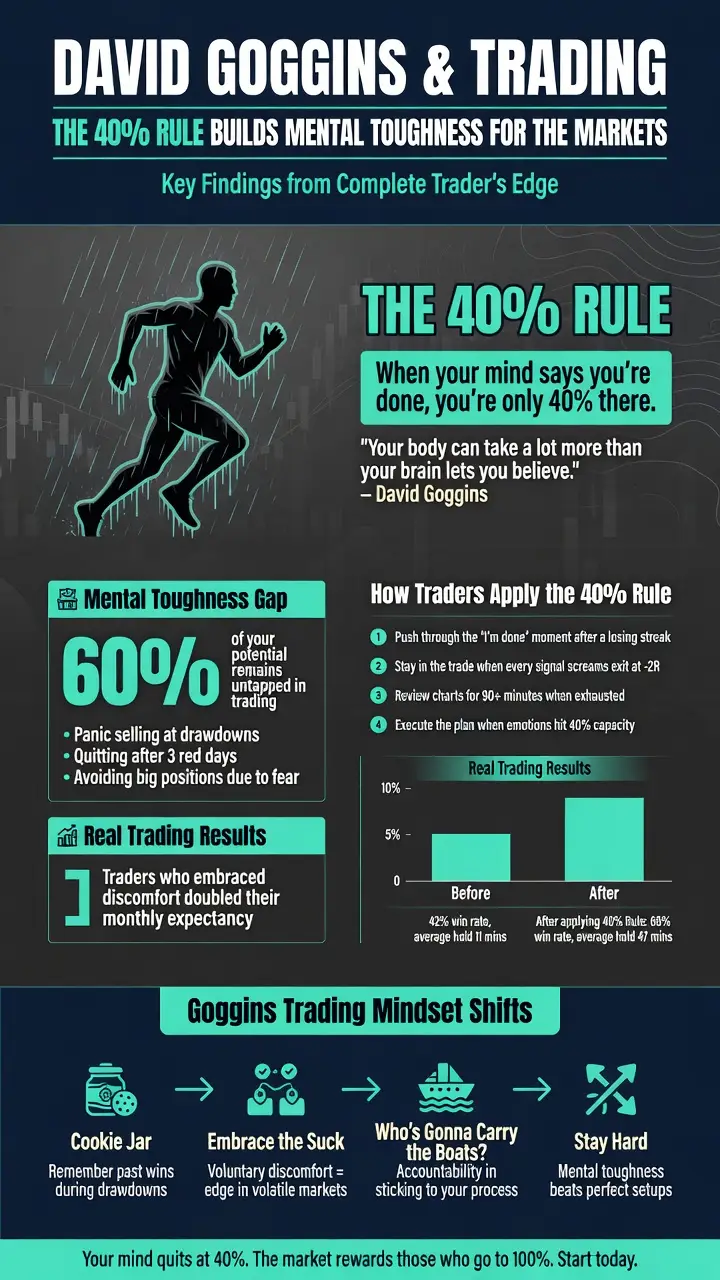
David Goggins ran 100 miles on broken feet. He completed Navy SEAL training three times. He set the world record for pull-ups at 4,030 in 17 hours. And the lesson he draws from all of it is not about physical toughness. It is about the mind. Specifically, it is about the gap between what you think your limit is and where your actual limit sits. Goggins calls this the 40% Rule: when your mind tells you that you are done, you are only 40% of the way to your true capacity.
For traders, this is not about grinding through pain for its own sake. It is about recognising that the moments when you most want to quit, to abandon your plan, to stop following rules, to give up on the process, are precisely the moments that define your trading career. The discomfort you feel during a drawdown is not a signal to stop. It is a signal that you are approaching the threshold where real development begins.
The 40% Rule, the accountability mirror and the callused-mind method, in Goggins’ own account.

The 40% Rule: You Are Nowhere Near Your Trading Limit
Goggins’ central thesis is that the human mind has a governor, like a device on an engine that prevents it from reaching maximum RPM. When discomfort arrives, the governor kicks in and tells you to stop. But the governor is conservative. It triggers at 40% of your actual capacity, leaving 60% untapped.
| Key Concept | Original Context | Trading Translation |
|---|---|---|
| Growth vs fixed mindset | Abilities can be developed through effort and learning | A losing month does not mean you are a bad trader. It means you have data to learn from. |
| Embrace challenges | Difficulties are opportunities to grow, not threats to avoid | Take your drawdown protocol seriously. The review after a hard period builds more skill than any winning streak. |
| Effort is the path | Talent without effort produces nothing | 1,000 hours of chart time, backtesting, and journalling beats any “natural talent” for pattern recognition. |
| Learn from criticism | Feedback reveals blind spots that self-assessment misses | Share your journal with a trading peer. External perspective catches patterns you cannot see yourself. |
In trading, the governor fires during drawdowns. After three consecutive losses, your mind says: “The strategy is broken. Switch to something else.” After a week of flat performance, your mind says: “You are wasting your time. This will never work.” After a month of grinding, disciplined execution with mediocre results, your mind says: “You do not have what it takes.”
Goggins would say: that voice is the governor. It is lying. The strategy is probably not broken. The drawdown is probably within normal statistical variance. The breakthrough is probably closer than you think. The probability mindset confirms this mathematically: a system with genuine edge will produce extended losing streaks as a mathematical certainty. Surviving them is not optional. It is the job.
Callusing the Mind: Building Mental Toughness Through Repetition
Goggins describes mental toughness not as something you are born with but as something you build through deliberate exposure to discomfort. He calls this “callusing the mind,” the same way hands develop calluses through friction. Each time you push through discomfort, you build a slightly thicker psychological callus for the next time.
For traders, every session where you follow your rules despite wanting to deviate is a rep. Every loss you take cleanly without revenge trading is a rep. Every time you close the platform at your daily loss limit instead of taking “one more trade” is a rep. These reps build the callus. After six months of reps, the same situations that used to trigger emotional breakdowns become routine operational decisions.
This is the practical mechanism behind what building trader identity describes: each disciplined action is a vote for the identity you are constructing. Goggins would add that each vote should be deliberately uncomfortable. Seek the friction. The callus only forms through contact with resistance.
The Accountability Mirror: Radical Honesty in Your Trading Journal
One of Goggins’ signature practices is the accountability mirror: standing in front of a mirror and telling yourself the brutal truth about where you are, what you are doing wrong, and what needs to change. No excuses. No softening. Pure, uncomfortable honesty.
The trading equivalent is the trading journal used with radical honesty. Not the journal where you record setups and P&L. The journal where you write: “I moved my stop because I was afraid of being wrong.” “I took that trade because I was bored, not because it met my criteria.” “I increased my size because I was trying to make back yesterday’s loss.” “I did not follow my pre-session routine because I was lazy.”
Most traders journal their trades. Few journal their behaviour. Goggins would say that the behavioural journal, the one where you hold yourself accountable for every deviation, every emotional decision, every shortcut, is worth more than any technical analysis you will ever learn.
Taking Souls: Outworking Every Other Trader in the Room
Goggins uses the phrase “taking souls” to describe outworking competitors so thoroughly that they lose their will. In trading, your competitors are not other traders. They are your own worst impulses: the urge to overtrade, the temptation to skip preparation, the desire to chase setups instead of waiting for them.
“Taking souls” in trading means outworking your own laziness. It means doing the pre-session routine when you do not feel like it. Marking levels on the weekend when you would rather relax. Reviewing your journal on Friday night instead of going out. It is not glamorous. It is not exciting. And it is exactly what separates the 10% of traders who survive from the 90% who do not.
This connects to what the trading routine is built for: creating a structure so robust that discipline is not a daily decision but a default operating mode.
Embracing Suffering: Why the Hardest Periods Are the Most Valuable
Goggins’ most controversial teaching is that suffering is not something to minimise but something to seek. Not masochistic suffering. Purposeful suffering that expands your capacity. The cold plunge, the extra mile, the training session that your body is begging you to skip.
For traders, the equivalent is the drawdown endured with discipline. The three-month period where your system is flat and every part of your psychology is screaming to switch strategies. The session where you sit for four hours and take zero trades because no valid setup appeared. The moment you close a position at a loss exactly where your plan said to, even though “it is about to turn around.”
These are the suffering sessions that build trading careers. Not the winning days. Any amateur can trade well on a winning day. The professional is forged in the sessions where everything hurts and the process holds anyway.
The Cookie Jar: Drawing Strength from Past Discipline
Goggins maintains a mental “cookie jar” of his toughest accomplishments. When current suffering threatens to overwhelm him, he reaches into the jar and remembers a time when he pushed through worse. The memory provides evidence that he has survived before and can survive again.
Build a trader’s cookie jar. Write down every time you honoured a stop on a trade that went on to win without you. Every time you walked away after hitting your daily loss limit. Every time you waited patiently for your A+ setup while the market moved without you. Every time you survived a drawdown that felt like it would never end.
When the next drawdown arrives, open the jar. You have been here before. You survived. You will survive again. The evidence is in your own history.
Putting It All Together: Goggins’ Framework for Traders
Recognise the governor. When your mind tells you to quit, switch strategies, or abandon your rules, understand that this is the 40% signal, not the 100% signal. Push through.
Build the callus. Every disciplined action under discomfort is a rep. Seek the reps. They compound into the psychological resilience that no course or book can give you.
Use the accountability mirror. Journal with brutal honesty. Write what you actually did, not what you wish you had done. Confront the gap between your intentions and your actions.
Outwork your impulses. Do the preparation when you do not want to. Follow the routine when it feels pointless. Execute the plan when every emotion says otherwise.
Fill the cookie jar. Record your moments of discipline. When the next crisis arrives, reach into the jar and remember that you have survived worse.
Goggins’ message is not comfortable. It is not meant to be. Trading is not a comfortable profession. The traders who embrace that discomfort, who build their mental calluses through deliberate discipline, are the ones who are still standing when the market has broken everyone around them. That is the Mind pillar at its most demanding and its most rewarding.
Continue Reading: The Inner Edge
▶ Tony Robbins & Trading Psychology
The Complete Trader’s Edge
This article is part of The Inner Edge series, exploring peak performance principles for traders.
Frequently Asked Questions
What is the 40% Rule and how does it apply to trading?
The 40% Rule states that when your mind tells you to quit, you are only at 40% of your true capacity. For traders, this means the psychological pain of a drawdown or losing streak is not a signal that the strategy is broken. It is the governor firing prematurely. Pushing through disciplined execution during these periods is where genuine trading development happens.
How do you build mental toughness for trading?
Mental toughness is built through repetition under discomfort, what Goggins calls “callusing the mind.” Every time you follow your rules during a losing session, honour a stop loss that hurts, or walk away at your daily limit, you build psychological resilience. These reps compound over months until situations that once triggered emotional breakdowns become routine operational decisions.
What is the accountability mirror in trading?
The accountability mirror is Goggins’ practice of confronting yourself with brutal honesty. In trading, this means journalling not just your trades but your behaviour: why you really took that trade, whether you followed your rules, and where you made emotional rather than systematic decisions. Radical honesty in the journal is the fastest path to behavioural change.
How does the cookie jar concept help during trading drawdowns?
The cookie jar is a mental collection of your toughest moments of discipline. When a drawdown threatens to break your resolve, you reach into the jar and remember times you pushed through similar adversity and survived. This provides concrete evidence that you can endure the current challenge, replacing fear with confidence rooted in your own proven track record.
Is David Goggins’ extreme approach realistic for everyday traders?
You do not need to run ultramarathons to apply Goggins’ principles. The trading application is about embracing necessary discomfort rather than avoiding it. Following your pre-session routine on tired mornings, taking clean stop losses, sitting through quiet sessions without forcing trades. These are the everyday acts of discipline that build the mental toughness Goggins describes, applied proportionally to the demands of trading.
 The Complete Trader's Edge
The full Mind · Method · Money framework. 70 chapters.
View on Amazon →
The Complete Trader's Edge
The full Mind · Method · Money framework. 70 chapters.
View on Amazon →
 Market Mayhem
400 years of bubbles, crashes, and the pattern that keeps repeating.
Buy on Amazon →
Market Mayhem
400 years of bubbles, crashes, and the pattern that keeps repeating.
Buy on Amazon →
 Greatest Companies
How the world's greatest companies were built — and what traders learn from them.
View on Amazon →
Greatest Companies
How the world's greatest companies were built — and what traders learn from them.
View on Amazon →
 Greatest Traders
Eighty-six lives that explain the markets — Livermore to Madoff, told with the losses left in.
View on Amazon →
Greatest Traders
Eighty-six lives that explain the markets — Livermore to Madoff, told with the losses left in.
View on Amazon →