

The inside bar is the quietest pattern on the chart, and that is exactly why it is powerful. It is a candle that does nothing – a small range sitting entirely inside the previous candle – and that stillness is the message. Markets breathe in and out, contracting before they expand, and the inside bar is the visible held breath before the move. Traded with location and confirmation, it is one of the cleanest, lowest-risk setups available.
This guide covers what an inside bar is, what the compression really signals, how to trade the breakout, and how to avoid the fakeout it so often produces.
What an Inside Bar Is
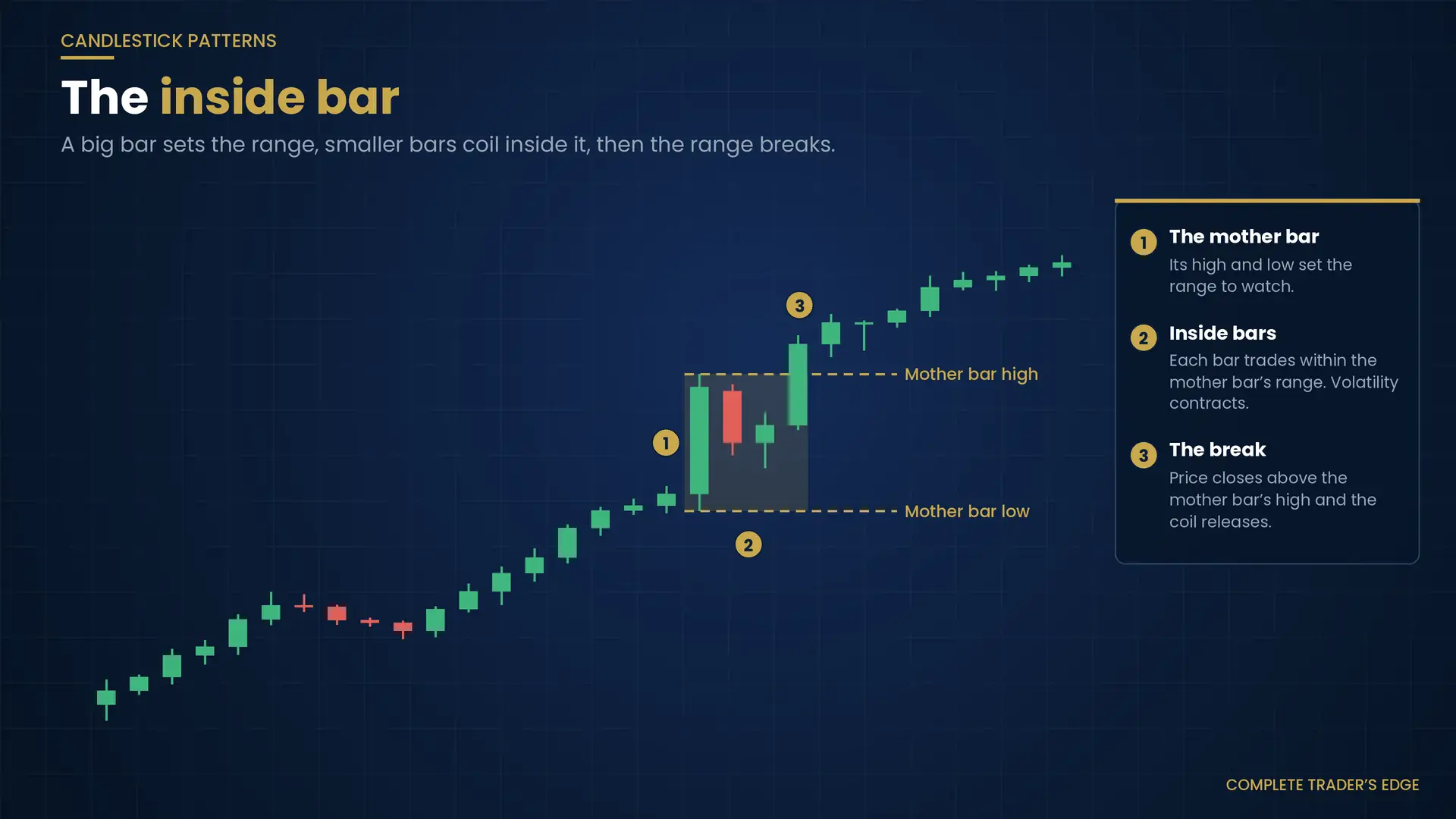
An inside bar is a candle whose entire range – high to low – fits within the range of the candle before it, known as the mother bar. Price made a lower high and a higher low than the previous candle: the market coiled tighter. You will often see several inside bars in a row, each nested within the same mother bar, as the market compresses further before it releases.
What It Really Means
An inside bar is a compression of volatility – the market pausing, coiling, storing energy. Ranges do not stay narrow forever; contraction is almost always followed by expansion, and the inside bar marks the moment of that contraction. It is the calm that precedes the move.
Through a smart-money lens, that pause is where positions are built quietly before a push, and the mother bar’s high and low become two obvious levels that everyone watching the coil is leaning on. That makes them a magnet for liquidity – and the perfect place to engineer a false break. Price often pokes beyond one side of the mother bar, sweeps the breakout traders and the stops, and then makes the real move in the other direction. The inside bar is the setup; the sweep is the trap laid inside it.
How to Trade It
Continuation, in context. The inside bar is at its most reliable as a continuation setup within a clear trend – a brief pause before the trend resumes. In a strong uptrend, an inside bar that then breaks its mother bar’s high, ideally with the higher-timeframe structure behind it, is a high-probability entry.
Entry. Trade the break of the mother bar in the direction of the trend, ideally on the retest. If price sweeps one side of the mother bar and reverses, that sweep-and-reclaim is often the cleaner signal.
Stop and target. A natural stop sits on the opposite side of the mother bar (or the inside bar), giving you a tight, defined risk – one of the pattern’s biggest advantages. Target the next liquidity pool or structural level, and risk no more than 1% of your account.
Contraction precedes expansion. The inside bar’s value is the tight, defined risk it hands you: a small coil means a nearby stop and, when the move comes, an excellent reward-to-risk. That asymmetry is the whole appeal.
When It Fails
The inside bar’s classic failure is the false break of the mother bar – a poke beyond one side that sweeps the breakout traders and reverses. It is also weak when traded counter-trend or in a directionless, choppy market, where inside bars form constantly and break randomly. The defences are the same as ever: favour trend-direction breaks, demand a decisive move rather than a marginal poke, and use the retest or sweep-and-reclaim to confirm before committing.
Key Takeaways
- An inside bar sits entirely within the previous candle (the mother bar) – a coil of compression.
- Contraction precedes expansion; the inside bar is the pause before the move.
- It works best as a continuation in a clear trend; the mother bar’s edges attract false breaks.
- Trade the trend-direction break or the sweep-and-reclaim; stop on the far side of the mother bar.
- The tight, defined risk is the pattern’s greatest strength – excellent reward-to-risk when the move comes.
Frequently Asked Questions
Is an inside bar bullish or bearish?
Neither on its own – it is a neutral compression pattern. Its direction comes from context: in an uptrend it usually resolves upward as a continuation, in a downtrend downward. You trade the break in the direction the market chooses (usually the direction of the prevailing trend), not a fixed bias.
What is a mother bar?
The mother bar is the larger candle whose range fully contains the inside bar. Its high and low are the key levels for the setup: the breakout of the mother bar triggers the trade, and its opposite side provides a natural stop. Several inside bars can nest within the same mother bar as the coil tightens.
The inside bar is a core price-action setup, covered further in our guides to price action trading and candlestick patterns.
Learn to read compression and expansion through the lens of liquidity and structure with the Mind · Method · Money framework in The Complete Trader’s Edge by Louw van Riet.
 The Complete Trader's Edge
The full Mind · Method · Money framework. 70 chapters.
View on Amazon →
The Complete Trader's Edge
The full Mind · Method · Money framework. 70 chapters.
View on Amazon →
 Market Mayhem
400 years of bubbles, crashes, and the pattern that keeps repeating.
Buy on Amazon →
Market Mayhem
400 years of bubbles, crashes, and the pattern that keeps repeating.
Buy on Amazon →
 Greatest Companies
How the world's greatest companies were built — and what traders learn from them.
View on Amazon →
Greatest Companies
How the world's greatest companies were built — and what traders learn from them.
View on Amazon →
 Greatest Traders
Eighty-six lives that explain the markets — Livermore to Madoff, told with the losses left in.
View on Amazon →
Greatest Traders
Eighty-six lives that explain the markets — Livermore to Madoff, told with the losses left in.
View on Amazon →