

Greatest Companies · Episode 14 · Nike
▶ Watch on YouTube🎵 Listen on Spotify
Also available on Apple Podcasts · Amazon Music · iHeart Radio
In the spring of 1975, the most exciting young company in American footwear was, by the cold arithmetic of its bank, insolvent.
Nike was doing something that should have been a triumph: doubling its sales almost every single year. Running was going mainstream, the shoes could not be made fast enough, and every report showed a company racing upward. And yet the bank looked at the same numbers and saw something terrifying. Every surge in sales required a bigger loan to pay for inventory, and the company’s cash reserves were always scraped to the bone. Bigger sales meant bigger loans meant bigger risk. The bank reached the end of its patience, pulled the roughly one-million-dollar credit line, and froze the company’s accounts. For a few days, Nike could not pay its bills. It could have ended right there, a promising footnote in the history of shoes.
What saved it was a Japanese trading house called Nissho Iwai, which looked at the same frightening numbers, saw the awesome potential instead of only the risk, and stepped in with the money to bridge the gap. Nike lived. And the lesson of that spring is the central paradox of this entire story: growth is not the same as cash, a company can be wildly successful and nearly die of it, and the difference between a giant and a footnote can be a single partner who sees the potential when everyone else sees only the danger.
📄 Free Download · Company Research Sheet
Nike Research Sheet (PDF)
The moat, the meltdown, the Legendary Scorecard, the timeline, and the Move, Money and Mind lessons from this story. Free, no email required.
The world before Nike
In the early 1960s, athletic shoes were an afterthought, cheap and heavy and made without much thought for the people who ran in them, mostly by a few European firms who treated the category as a sideline. Phil Knight was a middling miler at the University of Oregon, coached by a demanding, inventive man named Bill Bowerman who was obsessed with shaving weight off his runners’ shoes. Knight went on to Stanford business school, where he wrote a paper arguing that the Japanese could do to the German shoe industry what they were doing to the German camera industry: make a better product for less, and take the market.
In 1962 he flew to Japan and, more or less on nerve, talked his way into the Onitsuka company, makers of the Tiger shoe, and secured the right to distribute their shoes in the United States.
The founders: the product genius and the gambler
In 1964 Knight and Bowerman each put in five hundred dollars to found Blue Ribbon Sports, and Knight began selling Tigers out of the trunk of his car at track meets across the Pacific Northwest. First-year revenue was about eight thousand dollars. He kept his day job as an accountant, because the shoe company could not pay him.
It worked because the two founders were a complete creature in two bodies. Bowerman was the obsessive product genius, the man who would eventually pour rubber into his wife’s waffle iron to invent a new kind of sole. Knight was the relentless, anxious, all-in operator who would borrow whatever he had to in order to keep the thing alive and growing. And grow it did, doubling and doubling, until in 1969 sales passed a million dollars and Knight finally quit his other jobs. But the whole enterprise rested on a fragile foundation: Nike did not make anything. It sold someone else’s shoes, under someone else’s control. And in 1971, that blew up.
The founder’s bet: the betrayal that forced it
By 1971 the partnership with Onitsuka was curdling. Blue Ribbon was selling more than a million dollars of Tigers a year, but shipments were unreliable, and Knight discovered that an Onitsuka executive was quietly shopping for a new American distributor to replace him, even as the contract was supposedly being renewed. He was about to be cut out of the business he had built.
Decision Point – 1971. You are Phil Knight.
Your supplier is secretly looking to replace you, and you sell only their shoes. You have spent a decade building the American market for a product you do not own. Do you:
A. Fight to save the distribution deal and keep the steady, proven business?
B. Find another existing brand to distribute and start over as a reseller?
C. Make your own shoes under your own brand, betting everything on an identity you would finally control?
Knight chose C. He found a manufacturer, paid a student $35 for the swoosh, and let an employee’s dream supply the name: Nike. This is a thought experiment about ownership and leverage, not investment advice.
So Knight did the only thing that could save him, which was also the most dangerous thing he could do: he decided to make his own shoes. He needed a manufacturer, which Nissho Iwai helped him find, and a brand of his own. His first employee, Jeff Johnson, supplied the name in a dream: Nike, the Greek goddess of victory. A design student named Carolyn Davidson was paid thirty-five dollars to draw the swoosh. With that, a distributor of Japanese shoes became a brand, betting its survival on the proposition that Americans would buy a shoe with a made-up name and a checkmark on it because of what it stood for.
Knight did not just gamble on a product; he gambled, repeatedly and with everything he had, on the idea that he was selling something larger than footwear. He ran the company at what amounted to a hundred percent debt to assets, borrowing to the absolute limit, betting the farm every single year on the belief that demand would keep doubling. It was a strategy with no buffer, which is exactly why the spring of 1975 nearly finished him. The bet and the near-death were the same decision, viewed from two angles.
The near-death moment, and the one after it
The 1975 cash crisis was the existential one. Having survived the bank, Knight took the company public in 1980, finally raising real equity, around twenty-two million dollars, and ending the years of betting the farm on borrowed money.
And then, with money in the bank at last, Nike nearly lost the war anyway. In the early-to-mid 1980s the company missed one of the biggest shifts in its industry, the aerobics boom, the explosion of fitness culture that sent millions of people, especially women, looking for soft, stylish workout shoes. Nike, built by and for serious runners, dismissed it and fumbled its response, and a rival named Reebok came from nowhere to take the US market lead by around 1988. Nike, the great disruptor, had been disrupted, and was dumping millions of dollars of unsold shoes at a dollar a pair.
The inflection: a rookie named Jordan
What saved Nike the second time looked, at the time, like a modest gamble on a rookie. In 1984 the company signed a basketball player out of North Carolina named Michael Jordan, who had never worn Nikes and had hoped to sign with Adidas, to a deal worth about five hundred thousand dollars a year. The next year it built him his own shoe and his own line, the Air Jordan, the first time the company had wrapped an entire product around a single human being.
It was not really a basketball shoe. It was a story, about flight and greatness and a man who seemed to defy gravity, and it sold more than a hundred million dollars’ worth by the end of 1985. The Air Jordan did not just rescue Nike’s numbers. It revealed what Nike actually was: not a maker of shoes, but a seller of aspiration.
What everyone got wrong
Mistake #1: The distributor is replaceable; the value is in the shoes. Reality: Onitsuka tried to cut Knight out in 1971 and instead created its own most dangerous competitor, handing him the motivation to build the brand that would dwarf them. The value was the man who had built the market, not the factory.
Mistake #2: A company always short of cash is fragile. Reality: Nike was short of cash because it was growing so fast, not because it was failing. The banks optimized to avoid risk and missed one of the great growth stories of the century, which a Japanese trading house was willing to see.
Mistake #3: Nike is a running-shoe company. Reality: That belief made Nike dismiss the aerobics boom and nearly lose everything to Reebok. It was saved only when it rediscovered, through Jordan, that it was in the business of selling identity and belonging, the feeling of being an athlete.
Mistake #4: The brand is so strong it can be milked. Reality: The recent assumption that endless direct-to-consumer selling, discounting, and a thinner innovation pipeline could coast on brand strength has been punished hard. Nike is now in a painful turnaround precisely because it drifted from the thing that saved it in 1985. By October 2026 the market had a name for what it was watching: a cost-cutting story, not a demand story.
The moat
Nike sits in the Founder’s Bet pillar because its existence is owed entirely to a man who repeatedly risked everything, but its enduring moat is Brand, of a specific and powerful kind.
Coca-Cola’s brand is comfort and ubiquity. Disney’s is childhood and story. LVMH’s is status and scarcity. Nike’s is aspiration: the promise, sold to the ordinary person, that to wear the shoe is to share in the greatness of the athlete who wears it too. The swoosh on a pair of sneakers connects a teenager on a public court to Michael Jordan in flight, to a marathon champion, to the idea of victory itself. That is why Nike spends so relentlessly on athletes and on advertising that barely mentions the product, the “Just Do It” campaigns that sell a feeling about yourself rather than a feature of the shoe. The moat is the emotional transfer from hero to wearer, and it is deep because it attaches to identity rather than function.
But Nike’s moat carries a vulnerability this whole pillar is built to teach: a brand of aspiration must keep being fed with genuine innovation and authentic heat, or it slowly becomes a logo on a discounted shelf. The aspiration is real only as long as the company keeps earning it. When Nike forgets that, as it did before Reebok and as it has more recently, the moat does not vanish, but it thins, and the market notices fast.
The wealth created, and the cycle that proves it
The two founders put in five hundred dollars each in 1964. When the company went public in 1980, Knight’s stake was worth something on the order of a hundred and seventy-eight million dollars, and over the following four decades Nike compounded into one of the most valuable consumer companies on Earth. The numbers are hard to believe. On TradingView’s split-adjusted monthly data, $1,000 of Nike stock bought at the end of December 1980, the month of the IPO, would have been worth about $1.03 million at its best month-end close in November 2021. Even after everything since, it was still worth about $206,000 at the 2 October 2026 close, before counting four decades of dividends.
Try your own numbers. Pick any month since the IPO and see what a Nike purchase would be worth now, and what it was worth at its best.
Bought at the month-end close of the month you choose. Price return only: excludes dividends, fees and taxes. Split-adjusted monthly closes from TradingView, . Educational illustration, not investment advice.
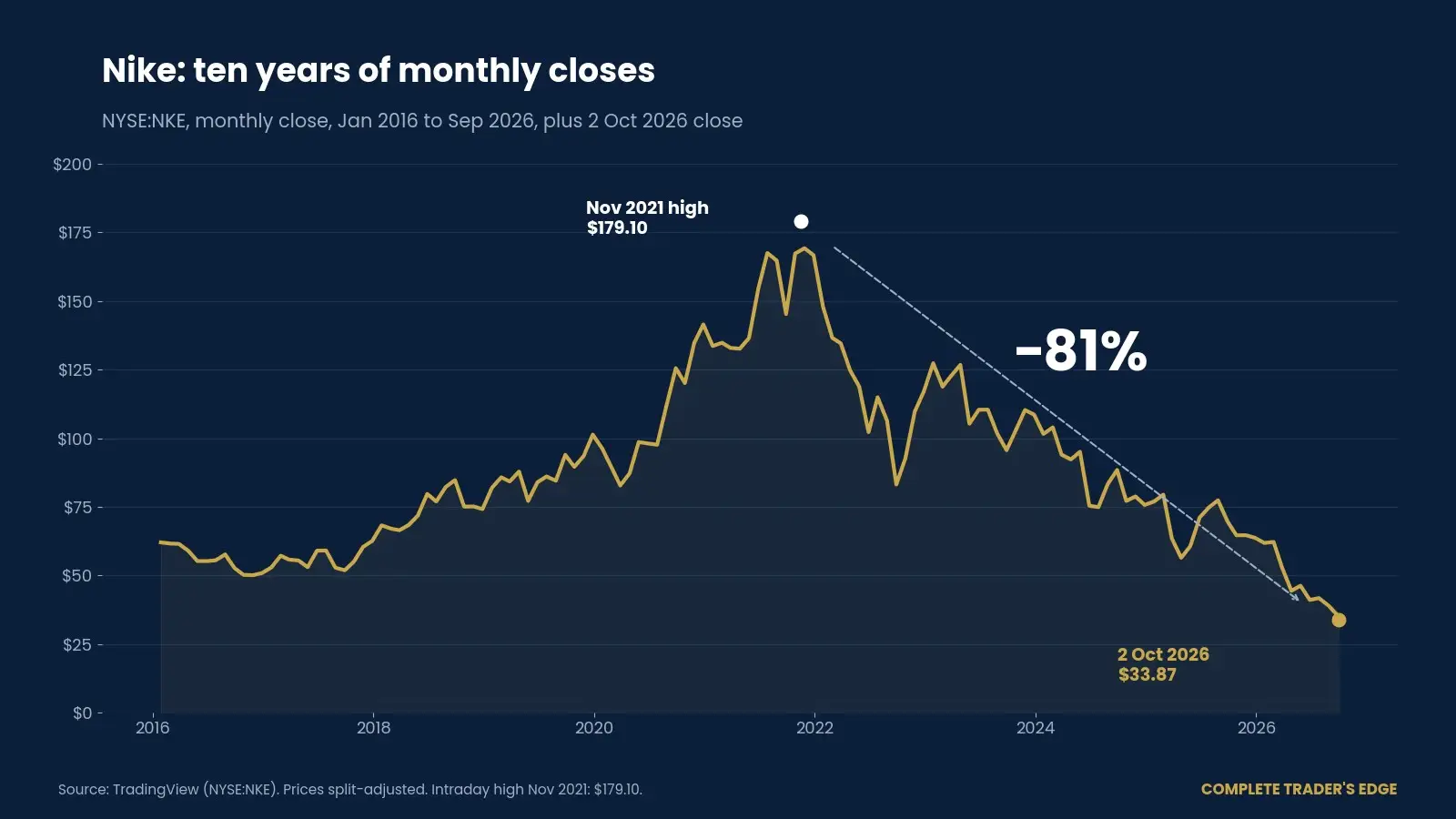
But the honest version, again, is the cycle, because Nike is living it right now. Nike shares peaked at $179.10 in November 2021, then entered a brutal slump. By 2 October 2026 it closed at $33.87, about 81% below that peak and at a 13-year low, dragged down by weakness in China, the cost of tariffs, and self-inflicted wounds from over-distribution and discounting. A new chief executive, a Nike veteran named Elliott Hill, returned in late 2024 to run a turnaround he called “Win Now,” telling his own staff he was tired of talking about fixing the business, and he put his own money behind it, buying about $1 million of Nike shares in December 2025 (CNBC) and roughly another $1 million at $42.27 a share in April 2026 (SEC Form 4). Director Tim Cook, whose own company once came within months of collapse (see Apple), bought alongside him both times. The stock kept falling anyway.
Alternative Timeline (hypothetical).
What if Nissho Iwai had declined to step in when the bank froze Nike’s accounts in 1975? With no buffer, no equity, and a bank that had cut it off, the company that was doubling sales every year could simply have run out of cash before it ever became Nike as we know it. No swoosh on a billion feet, no Air Jordan, no “Just Do It.” The point is not the counterfactual numbers, which we will not invent, but the fragility: the most successful young company in its industry was one financing decision away from disappearing. What the real history shows is that the right partner, willing to see growth where a bank saw only risk, made all the difference.
The drawdowns you would have had to survive
Nike has handed its owners three distinct kinds of near-death and drawdown. Would you have held?
| Episode | What happened | The test |
|---|---|---|
| 1975 cash crisis | The bank froze Nike’s accounts; only Nissho Iwai stood between the company and collapse. (Private; no public shareholders yet.) | Could you back a company that nearly died of its own growth? |
| Late-1980s Reebok defeat | Complacency about its own identity cost Nike the US lead; only the Jordan bet pulled it back. | Could you hold a fallen leader betting on an unproven rookie? |
| 2022–2026 slump | The stock fell about 81% from its $179.10 peak (November 2021) to $33.87 (2 October 2026), a 13-year low, amid China weakness, tariffs, over-distribution and a guidance cut. | Could you hold the best brand in sports through a multi-year reset with no promised end date? |
The question lands hard here, because the answer is not yet known. Would you hold Nike through this, on faith that the deepest brand in athletics will find its footing again, the way it did after Onitsuka, after 1975, after Reebok? The history says the company has clawed back from worse. Other giants have too: Amazon fell 94% after the dot-com bust, Nvidia fell about 90% before the AI age, and Microsoft spent a lost decade before its comeback. But Intel shows the other path. The history does not promise Nike will recover this time. That uncertainty, honestly held, is what owning a great company through a drawdown actually feels like.
Where Nike stands now: October 2026
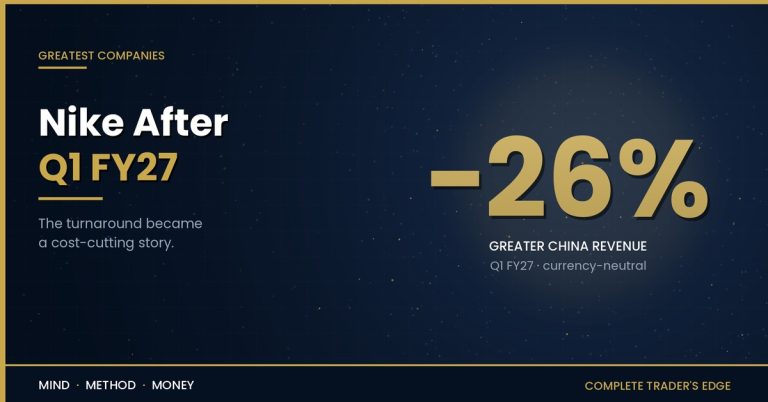
The latest chapter was written on 1 October 2026, when Nike reported its first quarter of fiscal 2027. Revenue fell 4% to $11.2 billion. Gross margin improved to 42.8% and earnings per share of $0.48 beat expectations. Then came the part the market cared about: Nike now expects full-year revenue to fall by a high-single-digit percentage, far worse than the roughly 2% decline analysts had expected. Sales in Greater China fell 26% on a currency-neutral basis, and Converse fell 28% (Nike).
Alongside the results, Nike announced Pace, an overhaul of how the company operates, targeting about $2.5 billion of cumulative savings through fiscal 2031, with further job cuts from 2027. Citi summed up the reaction in one line: Nike is turning into a cost-cutting story. The stock fell for two straight sessions, to its lowest level in 13 years.
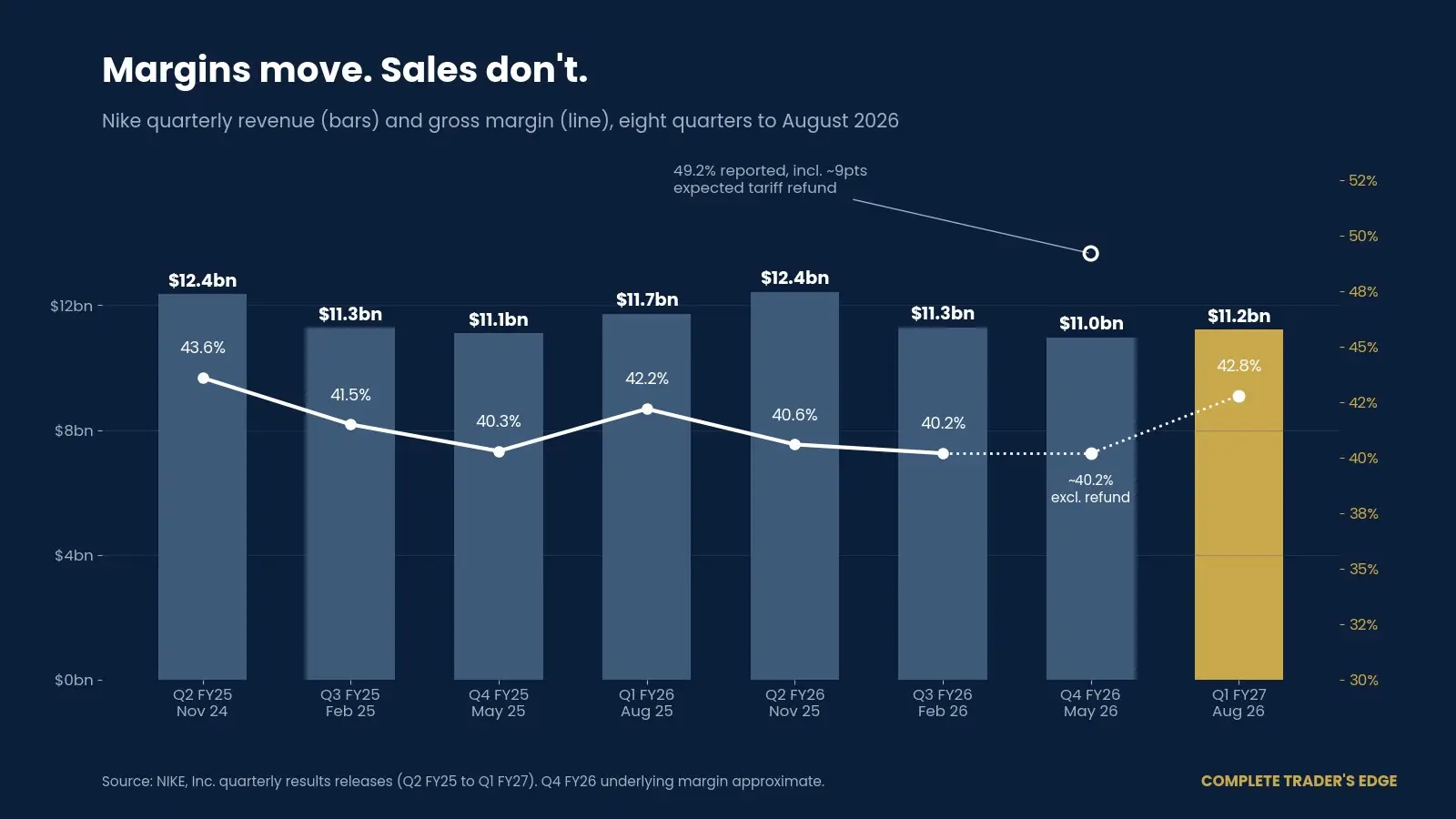
The chart is the whole problem in one picture. Margins have moved up and down with tariffs, discounts and cost control. Sales have gone nowhere. Read in the light of this company’s history, that matters, because Nike has never cut its way out of trouble. It recovered from Reebok by finding something people wanted, not by spending less. The thing to watch is whether demand returns: China declines narrowing, NIKE Direct growing again, and revenue guidance raised rather than cut. Nike’s Investor Day, its first since 2017, is scheduled for mid-November.
We cover the quarter in detail in Nike After Q1 FY27: The Turnaround Became a Cost-Cutting Story, and how the stock got here in Nike Stock Decline: Anatomy of a 79% Collapse.
Why this matters to investors
The Greatest Companies Thesis
Every legendary company begins with an idea that looks improbable.
Every one survives a stretch where failure looks inevitable.
Every one eventually reaches a point where success looks obvious.
The opportunity exists only in the space between the second and third.
Nike fits the thesis almost too well, because it has run the loop several times. The improbable idea was that a made-up brand with a checkmark could outsell the established giants by selling a feeling instead of a feature. The stretches where failure looked inevitable were many and genuine: the 1971 betrayal, the 1975 insolvency, the near-fatal Reebok years, and the slump it is grinding through today. The points where success looked obvious, the Jordan era, the “Just Do It” dominance of the 1990s, the global juggernaut of the 2010s, all arrived only after a stretch when serious people wondered whether the company would make it.
Study Nike alongside the other brand giants and you see the Founder’s Bet and the Brand moat fused into one organism. The brand exists because a founder bet everything, repeatedly, on the idea that he was selling identity rather than rubber. The asymmetry that makes legendary companies legendary is here visible as a temperament that borders on recklessness: Knight’s willingness to run with no safety margin, to bet the farm every year, which is exactly why the company nearly died so often and exactly why it grew so fast when it did not. The greatest opportunities almost always looked terrible before they looked inevitable, and a perpetually cash-strapped shoe distributor whose own bank had just frozen its accounts looked, in 1975, like a textbook example of a company to avoid.
Lessons in order of depth
On the surface, the Method. Own the brand, not just the product, and sell the feeling rather than the feature. The 1971 break with Onitsuka was forced, but it made Nike, because it turned a reseller into an owner of its own identity. Control the asset that carries the emotional value, and compete on meaning where you cannot win on specification.
Below the surface, the Money. Hyper-growth eats cash, and the financing structure is part of the strategy, not a detail. Nike nearly died not from weak demand but from too much of it, because growth must be funded before it pays. Respect working capital and the cost of growth, and understand that the right capital partner can be the whole difference between triumph and a frozen account.
Below that, the Mind. Know what business you are actually in, and never let success make you forget it. Nike’s worst stumbles, Reebok and the present slump, both came from believing it was a maker of shoes rather than a seller of aspiration. The deadliest error is not ignorance but the complacency of past success, the slow drift away from the thing that created the edge.
At the deepest level, the question it leaves us. Nike’s moat is the transfer of a feeling, the borrowed greatness of an athlete flowing into the person who laces up the shoe. But that transfer only works while the brand stays authentic. So the deepest question Nike poses is one every brand, and every person who has ever succeeded, must face: when the thing you built was powered by hunger and the willingness to risk everything, can it survive its own success? The danger arrives when a company grows rich enough that it no longer has to bet anything, and starts protecting what it has instead of earning it anew. The bet is never finished.
The Legendary Scorecard
| Category | Score | Note |
|---|---|---|
| Founder Vision | 10 / 10 | Knight saw that selling shoes was really selling the feeling of being an athlete. |
| Innovation | 9 / 10 | Bowerman’s waffle sole and Nike Air; later, the athlete-as-product Air Jordan model. |
| Execution | 8 / 10 | Brilliant at its peak, but repeatedly stumbled, Reebok then the current slump, through complacency. |
| Moat | 9 / 10 | Aspiration transferred from hero to wearer; deep, but it thins when innovation lapses. |
| Capital Allocation | 8 / 10 | Survived on debt and the right partner early; strong buybacks and a long record of dividend increases later. |
| Wealth Creation | 9 / 10 | $500 stakes in 1964 to one of the most valuable consumer companies on Earth. |
| Durability | 8 / 10 | Survived betrayal, insolvency, and a lost lead; now testing durability again in a deep slump. |
| Historical Importance | 9 / 10 | Defined modern sports marketing and the athlete endorsement; the swoosh is a global symbol. |
| Overall | 9.0 | Editorial verdict, not a weighted average. |
At a Glance
| Origin | Founded as Blue Ribbon Sports in 1964 by Phil Knight and Bill Bowerman, each investing $500 |
| The first model | Distributed Japan’s Onitsuka Tiger shoes; Knight sold them from his car at track meets |
| The break | Split from Onitsuka in 1971; renamed Nike; Carolyn Davidson designed the swoosh for 35 dollars |
| The savior | Japanese trading house Nissho Iwai financed Nike’s manufacturing and rescued it in 1975 |
| The near-death | Spring 1975: the bank froze Nike’s accounts; the company was days from collapse |
| The IPO | Went public in 1980, raising ~22 million dollars and ending the “bet the farm” debt years |
| The inflection | Signed Michael Jordan in 1984; Air Jordan (1985) made over 100 million dollars by year-end |
| The moat | Brand as aspiration: the borrowed greatness of the athlete, transferred to the wearer |
| The current slump | Down about 81% from the November 2021 peak to a 13-year low (October 2026); turnaround under CEO Elliott Hill, plus the Pace cost programme |
| Pillar | Part VII, the Founder’s Bet |
| Status | Public (NYSE: NKE) |
Company timeline
- 1962 – Phil Knight tours the Onitsuka factory in Japan and arranges to distribute Tiger shoes in the US.
- 1964 – Knight and his old coach Bill Bowerman found Blue Ribbon Sports, each investing 500 dollars.
- 1967 – Bowerman’s Tiger Cortez becomes a hit.
- 1969 – Sales pass 1 million dollars and Knight goes full-time.
- 1971 – The break with Onitsuka; Blue Ribbon becomes Nike; Carolyn Davidson designs the swoosh for 35 dollars.
- 1975 – The bank freezes Nike’s accounts; Nissho Iwai bridges the gap and saves the company.
- 1980 – Nike goes public, raising ~22 million dollars.
- 1984 – Nike signs rookie Michael Jordan.
- 1985 – Air Jordan launches and earns over 100 million dollars by year-end.
- Late 1980s – Nike misses the aerobics boom and loses the US lead to Reebok, before clawing it back.
- 1988 – The first “Just Do It” campaign.
- November 2021 – Shares peak at $179.10.
- 2022–2026 – A deep slump; Elliott Hill returns as CEO in October 2024 to lead the “Win Now” turnaround.
- October 2026 – Q1 FY27 results, a full-year revenue guidance cut and the $2.5 billion Pace programme; the stock closes at $33.87 on 2 October, about 81% below its peak and a 13-year low.
Key numbers
Founded: 1964 (as Blue Ribbon Sports) • Founding stakes: 500 dollars each • First-year revenue: ~8,000 dollars • Swoosh design fee: 35 dollars • 1975 frozen credit line: ~1 million dollars • 1980 IPO: ~22 million dollars raised • Jordan deal: ~500,000 dollars a year (1984); Air Jordan >100 million dollars by end of 1985 • Peak share price: $179.10 (November 2021) • 2 October 2026 close: $33.87, about 81% below the peak • Q1 FY27 revenue: $11.2 billion, down 4% • Pace savings target: ~$2.5 billion through FY2031 • $1,000 at the IPO month-end close: ~$206,000 on 2 October 2026, price only
Related reading
- Nike After Q1 FY27: The Turnaround Became a Cost-Cutting Story – the October 2026 results, the guidance cut and what the market sold.
- Nike Stock Decline: Anatomy of a 79% Collapse – how the stock fell from $179 to the high $30s.
- SpaceX – the other great Founder’s Bet: a company that also came within one failure of disappearing.
- Apple – ninety days from death to the world’s most valuable company, the comeback Nike’s bulls are hoping to repeat.
- Coca-Cola – another brand whose moat is a feeling, and which also faces the question of whether a stock can be a poor buy at a great price.
- The Walt Disney Company – another beloved brand grinding through a multi-year drawdown while the affection stays intact.
- LVMH – the brand moat at the level of an entire portfolio, and the cycle that proves even the best can fall.
From the book. Nike sits in Part VII, the Founder’s Bet, in the Greatest Companies series, the proof that hyper-growth is a cash furnace and that a brand of aspiration must keep being earned. Explore how the world’s most durable companies were built, and what their drawdowns teach every investor, in Greatest Companies.
★ Now in Kindle, Paperback & Hardcover
Greatest Companies
This story is one of fifty-one. The full book reads every legendary company through a single lens — Moat, Meltdown, Machine — from Standard Oil to SpaceX. Fifty-one companies, eight kinds of moat, one framework.
Kindle · $9.99 →
Paperback · $24.99 →
Hardcover · $34.99 →
Explore the Book →
This article is part of the Greatest Companies series, adapted from the book Greatest Companies, now available on Kindle.
Frequently asked questions
How did Nike start, and what was it called first?
Nike began in 1964 as Blue Ribbon Sports, founded by University of Oregon runner Phil Knight and his former coach Bill Bowerman, each investing 500 dollars. It distributed Japan’s Onitsuka Tiger shoes, which Knight sold from the trunk of his car at track meets, before splitting from Onitsuka and becoming Nike in 1971.
Why did Nike almost go bankrupt in 1975?
Nike was doubling its sales every year, but that growth devoured cash: each surge in sales required a bigger loan for inventory. In the spring of 1975 the bank froze the company’s accounts and pulled its roughly one-million-dollar credit line. Nike was rescued by the Japanese trading house Nissho Iwai, which financed the gap when the bank would not.
How did the Michael Jordan deal change Nike?
In 1984 a struggling Nike signed rookie Michael Jordan, and in 1985 launched the Air Jordan, the first shoe built entirely around one athlete. It earned over 100 million dollars by the end of 1985 and revealed Nike’s true nature: not a maker of shoes, but a seller of aspiration and identity.
What is Nike’s competitive moat?
Nike’s moat is brand as aspiration: the promise that wearing the shoe lets the ordinary person share in the greatness of the athlete who wears it too. It is deep because it attaches to identity rather than function, which is why a cheaper, technically equal shoe does not threaten it. The vulnerability is that the brand must keep being fed with genuine innovation, or it thins.
Why has Nike stock fallen so much recently?
After reaching all-time highs in the early 2020s, Nike fell about 81% from its November 2021 peak of $179.10 to $33.87 on 2 October 2026, a 13-year low, hurt by weakness in China, the cost of tariffs, and self-inflicted wounds from over-distribution and heavy discounting. CEO Elliott Hill, who returned in late 2024, is running a turnaround called “Win Now.” In October 2026 Nike cut its full-year revenue outlook to a high-single-digit decline and launched the $2.5 billion Pace cost programme. Whether and when the turnaround succeeds is not yet settled.
How much would $1,000 invested in Nike at its IPO be worth today?
Nike went public in December 1980. On TradingView’s split-adjusted monthly data, $1,000 invested at the December 1980 month-end close would have been worth about $206,000 at the 2 October 2026 close, price only, excluding dividends. At its best month-end close, in November 2021, the same holding would have been worth about $1.03 million. Use the calculator above to try any month since the IPO.
 The Complete Trader's Edge
The full Mind · Method · Money framework. 70 chapters.
View on Amazon →
The Complete Trader's Edge
The full Mind · Method · Money framework. 70 chapters.
View on Amazon →
 Market Mayhem
400 years of bubbles, crashes, and the pattern that keeps repeating.
Buy on Amazon →
Market Mayhem
400 years of bubbles, crashes, and the pattern that keeps repeating.
Buy on Amazon →
 Greatest Companies
How the world's greatest companies were built — and what traders learn from them.
View on Amazon →
Greatest Companies
How the world's greatest companies were built — and what traders learn from them.
View on Amazon →
 Greatest Traders
Eighty-six lives that explain the markets — Livermore to Madoff, told with the losses left in.
View on Amazon →
Greatest Traders
Eighty-six lives that explain the markets — Livermore to Madoff, told with the losses left in.
View on Amazon →