

Professional traders rarely enter or exit a position all at once. Scaling in and out is the art of managing conviction, risk, and capital deployment across the life of a trade.
Most retail traders treat entries and exits as binary events. They put the entire position on at one price and take the entire position off at another. This all-or-nothing approach forces every decision to be perfect — the exact right price, the exact right moment. Professionals have a different approach. They build into positions as conviction increases and take profits progressively as the trade reaches its targets.
Scaling does not change your edge. It changes your execution. It reduces the psychological pressure of any single entry decision, improves your average entry price in trending markets, and allows you to lock in profits while still maintaining exposure to further gains.
Scaling In: Building a Position
Scaling in means entering a position in multiple parts rather than all at once. You establish a starter position, then add to it as the market confirms your thesis. This approach has several advantages over a single full-size entry.
Your initial risk is smaller. If the trade immediately goes against you, you lose less because only a fraction of your intended position was on. As the market provides confirmation, you add more. This means your average entry is closer to the confirmation point rather than the initial hypothesis point.
Method 1: Pre-planned Scaling
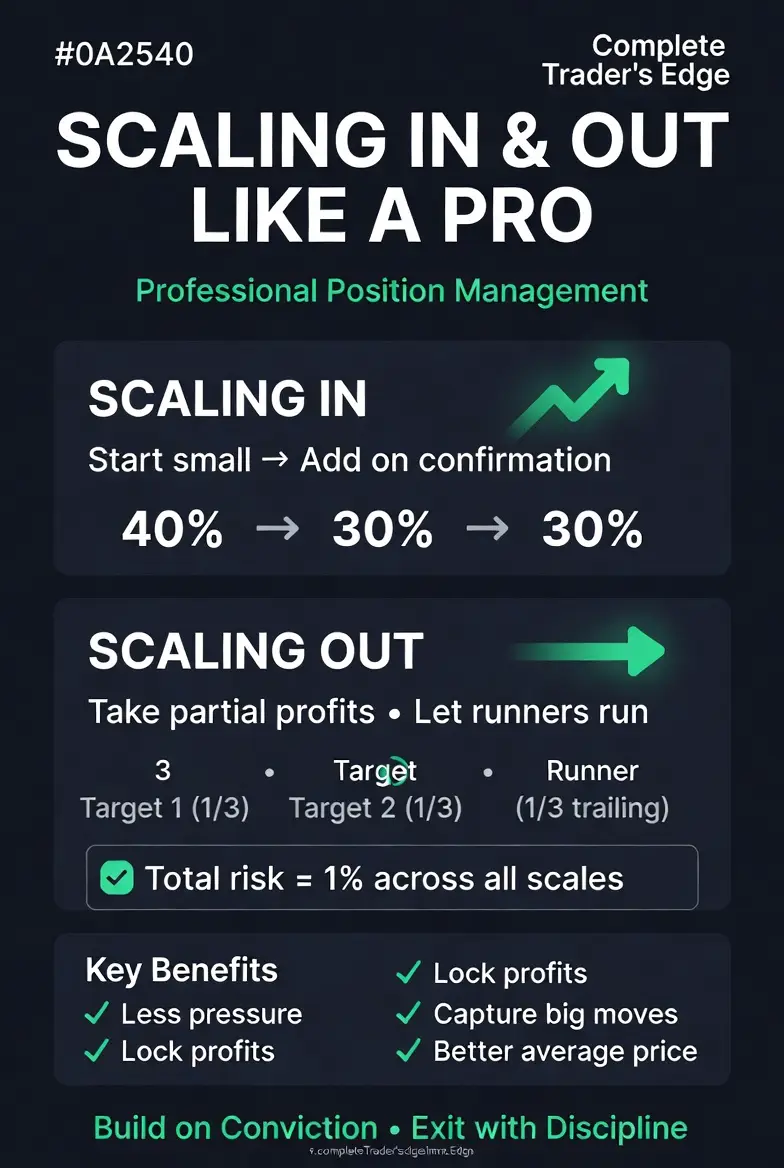
Before entering, you decide exactly where and how much you will add. For example, you might enter 40% at the initial signal, add 30% after the first break of structure in your favour, and add the final 30% on a retest of the new support. Every level is pre-defined. There is no discretion during execution.
Method 2: Confirmation-Based Scaling
You enter a starter position and only add when specific confirmation criteria are met. This might be a higher low forming on the entry timeframe, a fair value gap being created in your direction, or cumulative delta confirming aggressive institutional activity. If confirmation never arrives, you stay with the smaller position or exit altogether.
The Critical Rule: Never Add to Losers
Scaling into a position that is moving against you is not scaling. It is averaging down, and it is one of the most destructive habits in trading. Every add should occur when the trade is already in profit or at worst at breakeven. Adding to a losing position increases your risk at exactly the moment the market is telling you that your thesis may be wrong.
Scaling Out: Taking Profits Progressively
Scaling out means taking profits in stages rather than closing the entire position at a single target. This solves the universal trading dilemma: take profit too early and you miss the big move; hold too long and you give back gains.
The Three-Target System
A proven scaling-out framework uses three targets. At Target 1, typically 1R to 1.5R, you close one-third of the position and move your stop to breakeven. This eliminates risk from the trade and locks in a small profit. At Target 2, typically 2R to 3R, you close another third. The remaining third is your runner, a free trade that you let ride with a trailing stop for the possibility of catching an extended move.
This system guarantees that every trade that reaches Target 1 is a profitable trade, even if the runner gets stopped at breakeven. It also keeps you in the trade with exposure to capture the occasional outsized move that transforms a good month into a great one.
Trailing the Runner
The runner should be trailed with a structural stop, not a fixed pip distance. This means moving your stop behind each new higher low in an uptrend or lower high in a downtrend. Alternatively, trail behind each new fair value gap that forms in your direction. Structural trailing keeps you in trends that extend while protecting profits when the trend actually ends.
Position Sizing When Scaling
The total risk across all entries must not exceed your pre-defined risk per trade. If you risk 1% of your account per trade and plan to scale in three times, each entry should risk approximately 0.33% of your account. The sum of all your positions should never exceed the risk limit you would have used for a single full-size entry.
This is where most traders make errors with scaling. They treat each scale-in as a separate trade with its own 1% risk allocation, which means the fully scaled position represents 3% risk. This defeats the purpose of risk management and creates dangerous concentration.
When to Scale vs When to Enter Full Size
Not every trade requires scaling. High-conviction setups with strong confluence, clear structure, and a tight stop should be entered at full size. Scaling is most valuable when entering in uncertain conditions where you want market confirmation before committing fully, when trading volatile instruments where the optimal entry zone spans a range rather than a point, or when managing larger positions where filling at one price would cause slippage.
If your setup has a clear order block, a fair value gap, and multi-timeframe alignment, enter full size with a structural stop. If you see a potential setup forming but want to see how price reacts at a key level first, start with a starter and scale in on confirmation.
📚 Related Articles:
This article is adapted from The Complete Trader’s Edge
70 chapters covering Mind · Method · Money — the most comprehensive trading education framework available.
 The Complete Trader's Edge
The full Mind · Method · Money framework. 70 chapters.
View on Amazon →
The Complete Trader's Edge
The full Mind · Method · Money framework. 70 chapters.
View on Amazon →
 Market Mayhem
400 years of bubbles, crashes, and the pattern that keeps repeating.
Buy on Amazon →
Market Mayhem
400 years of bubbles, crashes, and the pattern that keeps repeating.
Buy on Amazon →
 Greatest Companies
How the world's greatest companies were built — and what traders learn from them.
View on Amazon →
Greatest Companies
How the world's greatest companies were built — and what traders learn from them.
View on Amazon →
 Greatest Traders
Eighty-six lives that explain the markets — Livermore to Madoff, told with the losses left in.
View on Amazon →
Greatest Traders
Eighty-six lives that explain the markets — Livermore to Madoff, told with the losses left in.
View on Amazon →