

What Scalping Actually Is · The Hidden Cost Most Scalpers Ignore · The Core Scalping Setup · Risk, Stops & the Hard Daily Limit · The Screen-Fatigue Tax · A Scalping Session, Honestly · Who Should and Should Not Scalp · Mind, Method, Money · FAQs
Scalping looks like the purest form of trading: tiny moves, fast in and out, dozens of chances a day. It is also the style where the market takes the least and your costs take the most. Before you fall in love with a scalping strategy, you need to understand that your real opponent is not price. It is the spread, the commission, and your own attention span.
This guide gives you a workable scalping framework built on our blended method, and then does the thing most scalping content refuses to do: shows you the maths that beats most scalpers before they ever place a trade. We are not here to sell you a dream. We are here to tell you the truth and give you a process honest enough to survive it.
What Scalping Actually Is
Scalping means taking many small trades, holding seconds to a few minutes, aiming for a handful of points or ticks each time. You operate on the 1M and 5M charts, you trade only when volume is high, and you are flat constantly. It is the fastest, most demanding style on the spectrum, the opposite end from swing trading.
The only instruments worth scalping are deeply liquid with tight spreads: NQ and ES (Nasdaq and S&P futures) are the classic choices because their spread is a single tick and execution is fast. Scalping a wide-spread instrument is a losing game before you start, because the spread eats the small move you are trying to catch.
The Hidden Cost Most Scalpers Ignore
This is the section other guides skip, and it is the most important one. When you target only a few points per trade, your transaction costs are no longer a rounding error. They are a meaningful slice of your target on every single trade.
Think about it as a tax on each round trip. Every scalp pays the spread to get in and out, plus commission on both sides. If your profit target is small and your costs are fixed, costs can quietly consume a large share of your gross edge. Take a hundred scalps a week and that tax compounds into a number that can turn a profitable-looking strategy into a flat or losing one. The move was right; the maths still beat you.

The practical rule that follows: scalp only the tightest-spread instruments, only with a broker or prop firm whose commissions you have actually calculated, and only when the expected move is several times your total cost per trade. If the move you are hunting is not clearly bigger than the spread plus commission, it is not a trade, it is a donation.
Run your own numbers
Enter your tick value, spread, commission and win rate. The calculator shows how much of every winner your costs eat, and the win rate you actually need to break even once they are in.
Scalping Cost & Break-Even Calculator
See the spread + commission tax, and the win rate you actually need after costs.
The Core Scalping Setup
You still need a real edge, not just fast fingers. The setup is a compressed version of the same liquidity-sweep logic we use across the site, executed on the lowest timeframes inside a high-volume window.
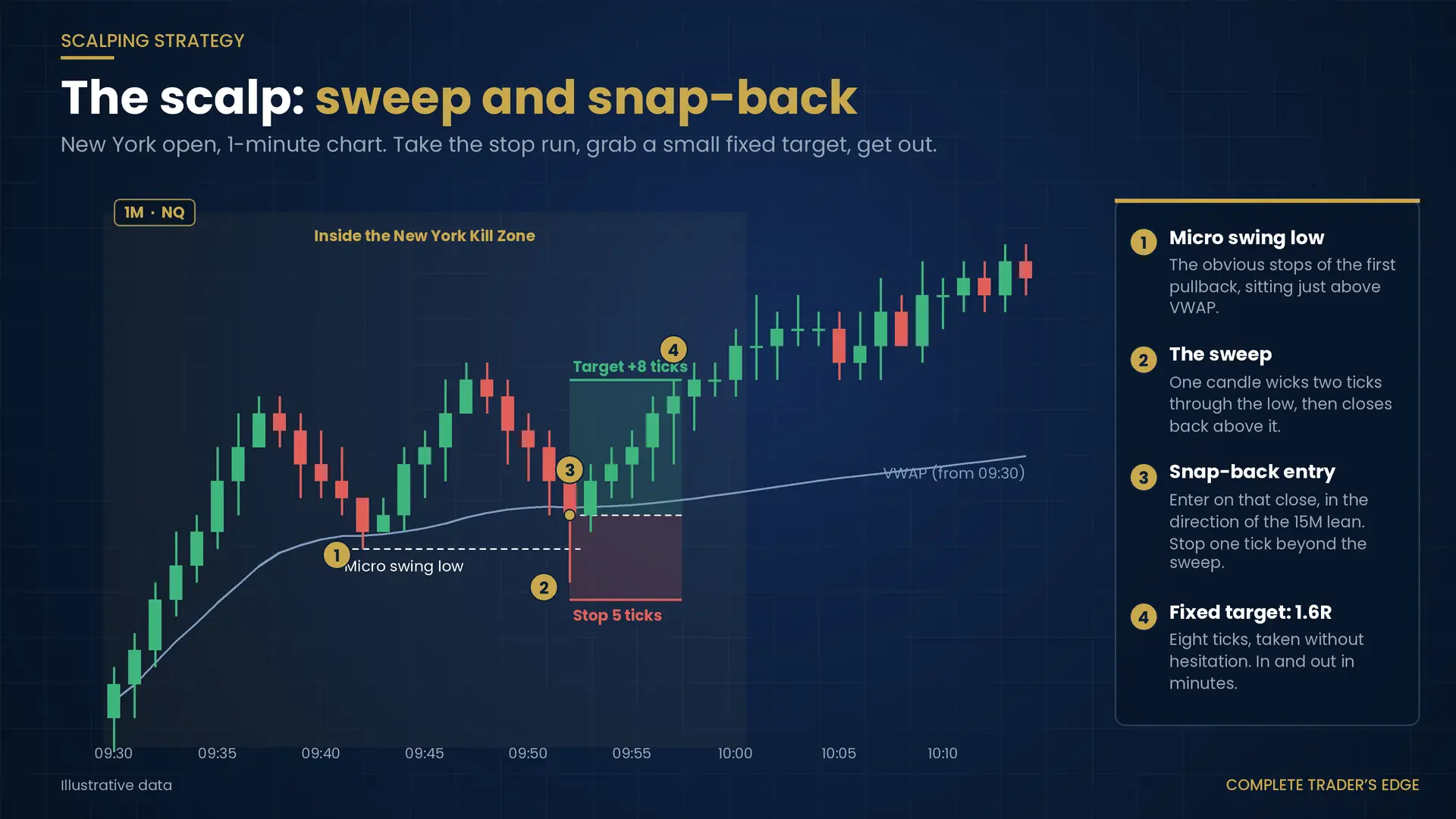
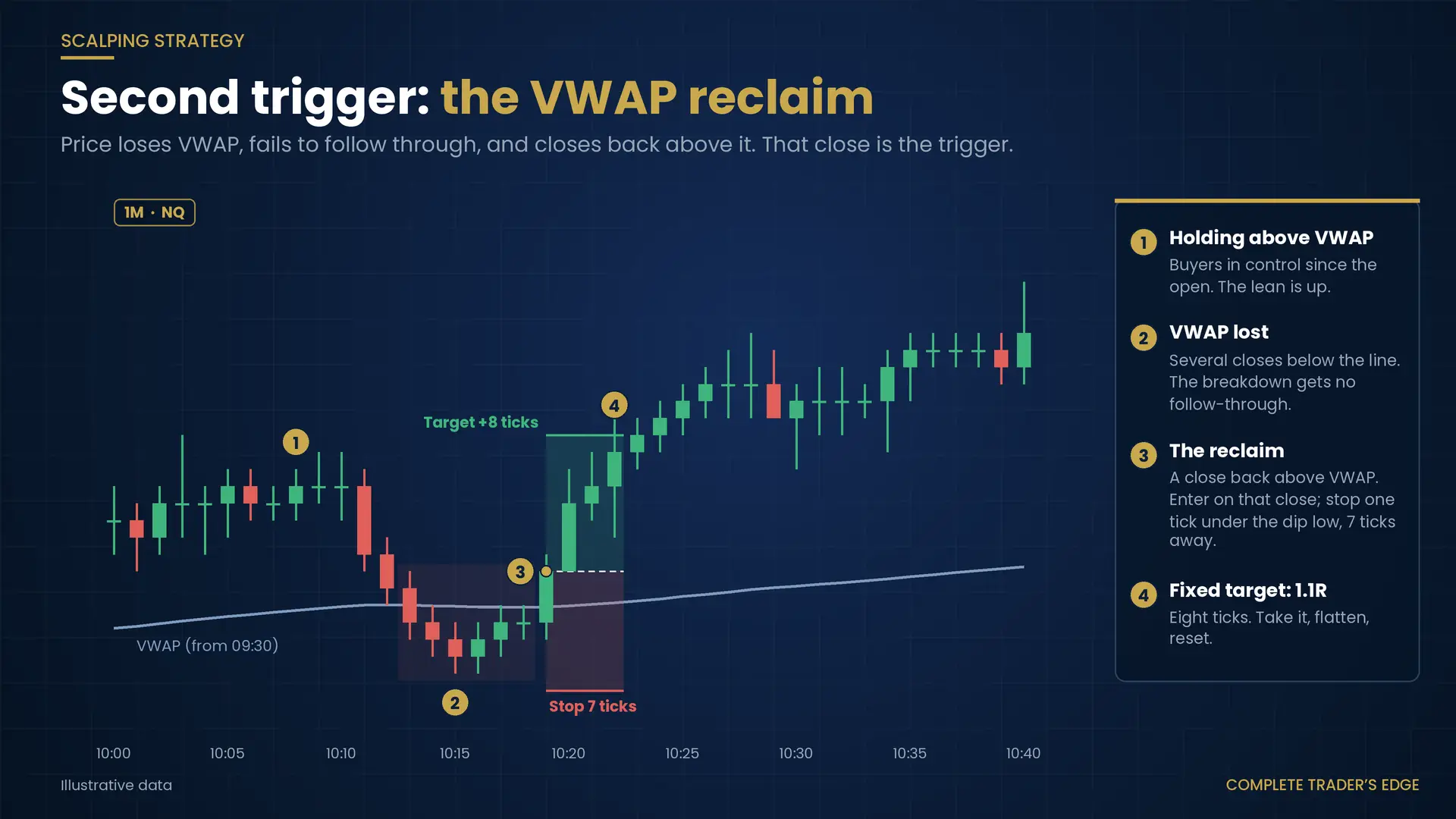
Form a quick directional lean from the 15M and the daily pivot, then drop to the 1M and 5M. Mark the immediate intraday levels: the session VWAP, the prior swing high and low, and any micro Order Block. When price sweeps one of those levels, taking out the obvious stops, and snaps back, you take the scalp in the direction of your lean, with the sweep extreme as a tight stop and a fixed small target. In and out. You are harvesting the snap-back from a stop run, nothing more elaborate than that.
Risk, Stops & the Hard Daily Limit
Risk discipline matters more in scalping than anywhere else, because the trade count is so high that small leaks become large fast. The 1% per trade rule still applies, and with tight scalping stops your position size will often be larger than in swing trading. Size from the stop, always.
The rule that saves scalpers is a hard daily limit, and it should be tighter than in day trading because the temptation to over-click is stronger. Set a maximum number of trades and a maximum loss for the session, for example a 2% daily loss or a fixed trade count, and when you hit either, you stop. Most scalping accounts are not killed by one bad trade. They are killed by the fortieth trade of a frustrated afternoon.
The Screen-Fatigue Tax
There is a second cost that never shows on a brokerage statement: your attention. Scalping demands unbroken focus, and human focus degrades fast. The fourth hour at the screen does not make the same decisions the first hour did.
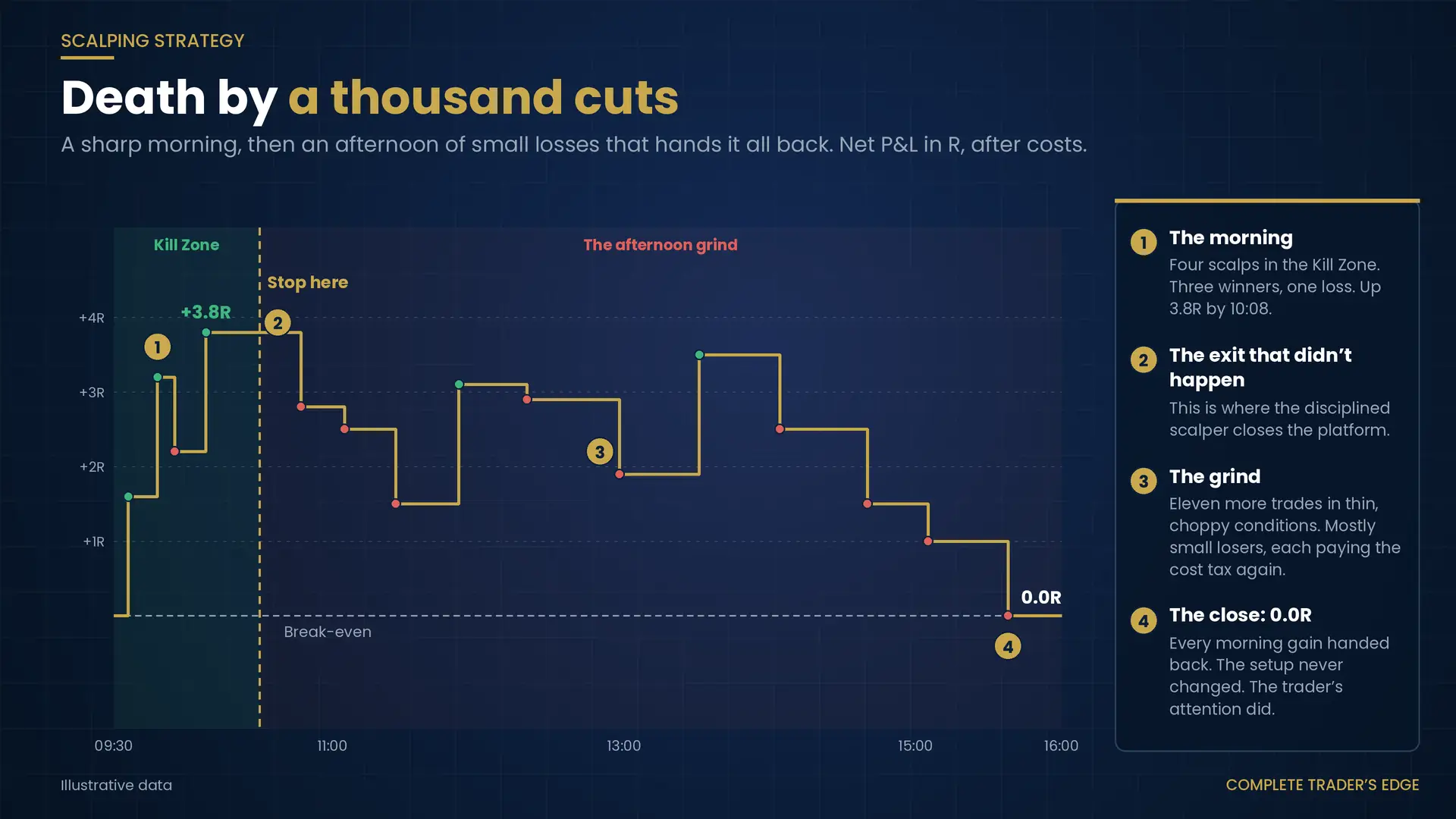
Decision quality falls as the session drags on, and tired traders widen stops, chase entries, and revenge-click. This is why the strongest scalpers trade one Kill Zone and walk away, rather than grinding all day. Your edge has a battery life. Trading past it is not discipline, it is denial, and it shows up in the equity curve as the slow afternoon bleed that erases the sharp morning gains.
A Scalping Session, Honestly
A disciplined scalper trades the New York open and nothing else. Bias is up on the 15M. In the first half hour, NQ sweeps the prior swing low, reclaims it, and the scalper takes the snap-back for a small fixed target. Two clean scalps land, each a tidy multiple of the cost tax.
Here is the part that defines the strategy: a third setup looks tempting but is marginal, the expected move barely clears the spread and commission. The disciplined scalper skips it. Then the trade count and the Kill Zone both end, and the platform closes. Green morning, banked, no afternoon give-back. The trades that made the money were ordinary. The decision that kept it was refusing the marginal trade and walking away. That refusal is the strategy.
Who Should and Should Not Scalp
Let us be blunt, because this is where most people get hurt. Scalping is the wrong place to start, and the wrong place to be if you are undercapitalised, paying retail spreads, or prone to revenge trading. The cost tax and the fatigue tax punish exactly those weaknesses hardest.
Scalping can suit a very specific trader: someone with fast, low-cost execution, the discipline to honour a tight trade count, the focus to trade one window and stop, and the emotional control to skip marginal setups all day. If that is not you yet, you are not failing; you are choosing a smarter style. A day trading or swing approach gives the same edge more room per trade, which forgives the costs and the fatigue that scalping does not.
How This Fits Mind, Method, Money
Scalping is the Mind, Method, Money framework with the volume turned all the way up. The Method is a compressed liquidity-sweep setup on the 1M and 5M inside one Kill Zone. The Money is the brutal arithmetic: 1% risk, a hard daily and trade-count limit, and a cost calculation that has to clear before any trade qualifies. The Mind is the deciding factor, because scalping exposes a lack of discipline faster than any other style.
If your psychology and your systems are not already strong, scalping will find that out and charge you for the lesson. If they are, it can be a precise, repeatable edge. Either way, the cost maths and the fatigue limit are not optional extras. They are the strategy.
Scalping demands the Mind and Money pillars most of all. Build them properly in The Complete Trader’s Edge, compare the slower styles in swing and day trading, and check your execution costs against the brokers on our Trading Tools page.
Frequently Asked Questions
Is scalping a good strategy for beginners?
Generally no. Scalping punishes the exact weaknesses beginners have: thin discipline, retail-level costs, and a tendency to overtrade. Most traders are better served learning on slower timeframes first, then scalping later if their psychology and costs support it.
What is the best timeframe for scalping?
The 1M and 5M for execution, with a quick 15M read for directional lean. Anything slower is no longer scalping; anything faster than the 1M is usually order-flow territory that most retail platforms do not serve well.
How much can you make scalping?
There is no honest fixed figure, and your costs matter as much as your win rate. Because each trade targets only a few points, transaction costs take a large share of gross profit, so net results are often far below what the raw setup suggests. Calculate your cost per round trip before you believe any income claim.
Why do most scalpers lose money?
Three reasons stacked on top of each other: the spread and commission tax on a high volume of small trades, screen fatigue that degrades decisions through the session, and overtrading driven by the constant temptation to click. The setup is rarely the issue.
What is the best instrument to scalp?
Deeply liquid, tight-spread instruments such as NQ and ES futures. A single-tick spread and fast execution are essential, because a wide spread eats the small move a scalp is trying to capture before the trade even moves in your favour.
 The Complete Trader's Edge
The full Mind · Method · Money framework. 70 chapters.
View on Amazon →
The Complete Trader's Edge
The full Mind · Method · Money framework. 70 chapters.
View on Amazon →
 Market Mayhem
400 years of bubbles, crashes, and the pattern that keeps repeating.
Buy on Amazon →
Market Mayhem
400 years of bubbles, crashes, and the pattern that keeps repeating.
Buy on Amazon →
 Greatest Companies
How the world's greatest companies were built — and what traders learn from them.
View on Amazon →
Greatest Companies
How the world's greatest companies were built — and what traders learn from them.
View on Amazon →
 Greatest Traders
Eighty-six lives that explain the markets — Livermore to Madoff, told with the losses left in.
View on Amazon →
Greatest Traders
Eighty-six lives that explain the markets — Livermore to Madoff, told with the losses left in.
View on Amazon →