

Explore all 80 books in the Trader’s Library →
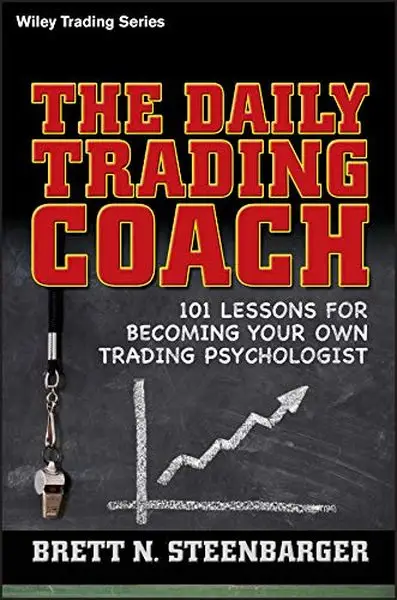
Not every trader can afford a performance coach, and even those who can are alone at the screen when the pressure hits. Brett Steenbarger’s answer is to make you your own coach. The Daily Trading Coach is built as 101 short, self-contained lessons, each one a practical technique you can apply to your own trading the same day you read it.
What sets this apart from the rest of the psychology shelf is Steenbarger’s background. He is a clinical psychologist who spent years coaching professional and prop traders, and the lessons draw on real therapeutic methods rather than motivational slogans. This is the closest thing to having a trading psychologist on retainer, in book form.
At a Glance
| Author | Brett N. Steenbarger |
| First Published | 2009 |
| Pages | ~350 (101 lessons) |
| Genre | Trading psychology / self-coaching |
| Difficulty | Beginner to intermediate — modular and approachable |
| Best For | Traders who want a practical, do-it-yourself coaching toolkit |
| Skip If | You want one big theory rather than many small, applied techniques |
OVERALL RATING: 8.5 / 10
Who Should Read This Book
| Reader | Verdict | Why |
|---|---|---|
| New trader (0–1 year) | Read it | The bite-sized lessons build good habits before bad ones set in |
| Intermediate (1–3 years) | Read it | Use it as a working manual to fix the specific leaks you have already identified |
| Advanced / professional | Keep it on the desk | A reference to dip into when a particular issue resurfaces, rather than a one-time read |
| Prop-firm candidate | Read it | The self-coaching routines are exactly what you need to hold discipline through a challenge |
| Trader who journals | Perfect fit | Many lessons turn your journal into an active coaching tool rather than a passive log |
| Reader who wants theory | Look elsewhere | This is a toolkit of techniques, not a single unifying framework |
The Book in Context
Steenbarger occupies a rare position in trading literature: a genuinely credentialed clinical psychologist who also coached working traders at proprietary firms. That dual background runs through the book. The techniques are drawn from established therapeutic traditions, brief and solution-focused therapy, cognitive and behavioural methods, but translated into the language and rhythm of a trading day.
The format is the genius of it. Rather than one long argument, the book delivers 101 standalone lessons, each a few pages, each ending with something to do. You can read it cover to cover, or open it to the lesson that matches the problem you are having today. It is designed to be used, not just read.
The Core Idea: Be Your Own Trading Psychologist
Steenbarger’s central claim is that the skills a coach would use on you are skills you can learn to use on yourself. Self-observation, pattern recognition, and deliberate technique can replace the outside coach you may never have. The trader who can step back, see their own behaviour clearly, and apply a specific intervention is, in effect, coaching themselves in real time.
This is empowering precisely because it is practical. You are not waiting to become disciplined through willpower. You are learning concrete methods, drawn from real psychology, to change your patterns one at a time. Discipline becomes a set of skills you build, not a virtue you either have or lack.
“The goal is to become the observer of your own patterns, and then their author.”
— The self-coaching premise of the book
What You Actually Get
| Area | What the Lessons Cover |
|---|---|
| Changing emotional patterns | Techniques for interrupting frustration, fear, and tilt before they drive bad decisions |
| Building best practices | Turning your strongest trades into repeatable processes you can deliberately reproduce |
| Using the journal as a coach | Methods that convert a trading journal from a passive record into an active feedback tool |
| Sustaining motivation | Practical ways to stay engaged and disciplined through drawdowns and plateaus |
Where the Book Falls Short
- Breadth over depth. With 101 lessons, some are inevitably thinner than others. A few feel like filler next to the genuinely excellent ones.
- It requires you to do the work. The exercises are the active ingredient. Read passively and you will get a fraction of the value.
- Some examples have dated. The 2009 market references feel of their time, though the psychological techniques have not aged.
- It assumes you have a method. Like all psychology books, it sharpens execution. It will not give you an edge you do not already have.
How the Book Fits the Mind · Method · Money Framework
| Pillar | Contribution | What the Book Delivers |
|---|---|---|
| MIND | PRIMARY | A practical toolkit of self-coaching techniques for changing trading behaviour |
| METHOD | INDIRECT | The best-practices lessons help you systematise and reproduce your strongest trades |
| MONEY | SECONDARY | Managing tilt and frustration directly protects your risk rules from emotional override |
This is a Mind-pillar book built for daily, practical use. It pairs naturally with the Mind · Method · Money framework as the hands-on companion that keeps your psychology in working order while you trade your method.
Read This Instead Of / Read This After
| Relationship | Book | Why |
|---|---|---|
| Read alongside | The Mental Game of Trading by Jared Tendler | Tendler gives the diagnostic system; Steenbarger gives the daily exercises to act on it |
| Read after | Trading in the Zone by Mark Douglas | Douglas sets the mindset; Steenbarger gives you the drills to build it |
| Read instead of | Generic mindset quotes online | These are structured, psychology-based exercises, not affirmations |
Final Verdict: Should You Read This Book in 2026?
Yes, especially if you trade without access to a coach. The Daily Trading Coach is one of the most useful working manuals in the psychology canon, precisely because it is built to be applied rather than admired. The credibility of a clinical psychologist behind 101 practical techniques is a rare combination.
Buy it, keep it on the desk, and work through it as a programme rather than a read. Pick the lessons that match your current weaknesses, do the exercises, and return to it whenever an old pattern resurfaces. Used that way, it does the job its title promises.
CTE Rating Breakdown
8.5/10
Your Coach in Book Form
| Readability | 9 | |
| Actionability | 10 | |
| Timelessness | 8 | |
| Beginner-Friendly | 9 | |
| Reference Value | 10 |
Frequently Asked Questions
What is The Daily Trading Coach about?
It is a collection of 101 practical lessons that teach you to coach yourself through the psychological challenges of trading, using techniques drawn from clinical psychology. The aim is to make you your own trading psychologist.
How should I read it?
As a working manual rather than a one-time read. Many traders treat it as a programme, applying one lesson and its exercise at a time, and return to specific lessons whenever a relevant issue arises.
Is the author actually qualified?
Yes. Brett Steenbarger is a clinical psychologist who coached traders at proprietary trading firms. That combination of clinical training and real trading-floor experience is rare and is what gives the book its credibility.
Is it suitable for beginners?
Yes. The modular, lesson-based format is approachable, and starting these habits early helps prevent bad patterns from forming. It does assume you are developing an actual trading method alongside it.
How does it compare to The Mental Game of Trading?
Tendler offers a single diagnostic system for finding root causes; Steenbarger offers a broad toolkit of daily techniques. They complement each other well, with Tendler providing the framework and Steenbarger the drills.
What is the single most important takeaway?
You can coach yourself. With self-observation and concrete techniques, you can change your own trading patterns rather than waiting for discipline to appear. Improvement is a set of skills you practise.
About the Author
Brett N. Steenbarger
Brett Steenbarger is a clinical psychologist who became one of the best-known trading performance coaches, working with proprietary and professional traders. He brought rigorous, evidence-based psychological methods into a field often dominated by slogans.
Related work: The Psychology of Trading, Enhancing Trader Performance, and Trading Psychology 2.0, which together form one of the most respected bodies of work on the mental side of trading.
Continue Learning
- Trading Psychology: The Complete Guide
- The Mental Game of Trading Book Review (2026)
- Trading in the Zone Book Review (2026)
- The Three Pillars: Mind, Method, Money
- The Complete Trader’s Edge — The Book
 The Complete Trader's Edge
The full Mind · Method · Money framework. 70 chapters.
View on Amazon →
 Market Mayhem
400 years of bubbles, crashes, and the pattern that keeps repeating.
Buy on Amazon →
 Greatest Companies
How the world's greatest companies were built — and what traders learn from them.
View on Amazon →
 Greatest Traders
Eighty-six lives that explain the markets — Livermore to Madoff, told with the losses left in.
View on Amazon →