

Options are the most versatile financial instruments available to retail traders. They can be used to speculate on direction, hedge existing positions, generate income, or express complex views on volatility. They do all this with precisely defined risk, which is the property that makes them genuinely interesting to anyone trained in Forex or futures, where leverage is real and stops can slip in fast markets.
This guide is written for a particular reader: a trader who already understands price action, market structure, and risk management from Forex, indices, or crypto, and who wants to understand whether options belong in their toolkit. It covers what options actually are, the four basic positions, three foundational strategies, the Greeks at a level you actually need, and an honest assessment of when options make sense for a price action trader and when they don’t.
What Is an Option?
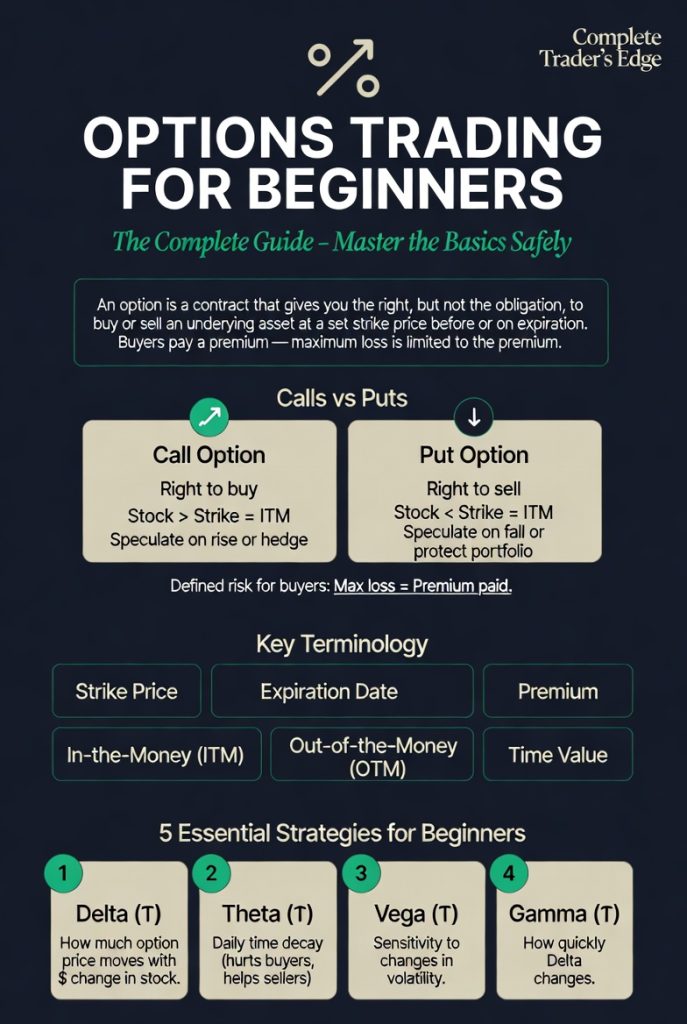
An option is a contract that gives the buyer the right, but not the obligation, to buy or sell an underlying asset at a specific price (the strike price) before or on a specific date (the expiration date). The buyer pays a one-time premium for this right. The maximum the buyer can lose is the premium paid. The maximum the seller can lose is, in some cases, theoretically unlimited.
That single asymmetry — defined risk for buyers, defined premium for sellers — is the engine that makes options strategically useful. Every other complexity in options trading is built on top of it.
Why Should an ICT or Forex Trader Care About Options?
If you trade Forex or indices using ICT or Smart Money Concepts, options will not replace your core trading. They serve a different purpose. Three situations where options become genuinely useful for the price action trader:
- Defined-risk speculation when you need exact-loss certainty. A long call or long put caps your loss at the premium. If you’re trading a high-conviction directional view on a stock or index, an option lets you size the position by maximum acceptable loss rather than by stop-loss placement.
- Hedging an existing position. Long a portfolio of equities? A put option on the S&P 500 ETF (SPY) provides drawdown protection without requiring you to sell. This is meaningful for funded traders trading equity portfolios and for long-term investors who want short-term insurance.
- Generating income on stocks you already hold. A covered call (covered below) sells the upside potential of a stock you already own in exchange for premium income. Done systematically, this can add 6–15% annualised return on a long equity position.
Note: options trading is primarily a stock and ETF market. They exist for FX, but liquidity is poor outside the major pairs and the listed FX options market is small compared to the spot FX market most retail traders use. For Forex traders, options are most useful as a tool for the equity side of your account, not as a replacement for spot trading.
The Two Building Blocks: Calls and Puts
Call Options
A call option gives the buyer the right to buy the underlying at the strike price. You buy a call when you expect price to go up. Concrete example: stock XYZ trades at $100. A call with a $105 strike, expiring in 30 days, costs $2 (so $200 per contract since each contract represents 100 shares).
- If XYZ rises to $115 by expiration: the call is worth at least $10 ($115 − $105). Profit: $10 − $2 = $8 per share = $800 per contract.
- If XYZ stays at $100 or falls: the call expires worthless. Loss: the $200 premium paid.
- If XYZ rises to $107 (just above the strike): the call is worth $2 at expiration. Roughly breakeven.
Put Options
A put option gives the buyer the right to sell the underlying at the strike price. You buy a put when you expect price to go down. Same example, stock XYZ at $100. A put with a $95 strike, expiring in 30 days, costs $2.
- If XYZ falls to $85: the put is worth at least $10 ($95 − $85). Profit: $800 per contract.
- If XYZ stays at $100 or rises: the put expires worthless. Loss: the $200 premium paid.
- If XYZ falls to $93: breakeven.
Key Options Terminology
| Term | Definition |
|---|---|
| Strike Price | The price at which the option can be exercised |
| Expiration Date | The date the option expires worthless if not exercised |
| Premium | The price paid by the buyer to the seller |
| In the Money (ITM) | A call is ITM when stock price is above the strike; a put is ITM when below |
| At the Money (ATM) | Stock price is at or very near the strike |
| Out of the Money (OTM) | The option has no intrinsic value (call above market, or put below market) |
| Intrinsic Value | The amount by which an option is in the money |
| Time Value | Premium beyond intrinsic value, reflecting time-to-expiry and volatility |
| Contract | Standard size for US equity options: 100 shares of underlying per contract |
The Greeks: What Drives Option Prices
Option prices change as a function of several variables. The “Greeks” are the sensitivities to those variables. For a beginner, the only two that matter every day are Delta and Theta. Add Vega to your awareness once you’re trading actively. Skip Gamma until you’re trading short-dated options regularly.
| Greek | What It Measures | Practical Implication |
|---|---|---|
| Delta (Δ) | How much the option price moves per $1 move in the underlying | An ATM call has roughly 0.50 delta. If the stock moves $1 up, the call gains ~$0.50. |
| Theta (Θ) | Time decay — how much the option loses per day, all else equal | Works against buyers, in favour of sellers. Options decay faster as expiration approaches. |
| Vega (ν) | Sensitivity to implied volatility changes | Higher IV = higher option premiums. Buying when IV is elevated is expensive even if you’re right on direction. |
| Gamma (Γ) | The rate of change of delta | Most relevant for short-dated options near expiration. Causes delta to change rapidly. |
The single most important lesson from the Greeks is this: time is the enemy of option buyers. Every day, your long option loses value through theta decay. To make money buying options, you need price to move in your direction faster than time can erode your premium. This is the inverse of holding a long equity position, where time is generally on your side.
The Five Essential Strategies for Beginners
1. Long Call (Bullish, Defined Risk)
Buy a call option on a stock you believe will rise. Maximum loss is the premium paid. Maximum profit is theoretically unlimited.
Best for: traders who are bullish but want to define maximum loss in dollar terms rather than relying on a stop loss. Particularly useful before earnings or major catalysts where overnight gaps could blow through a regular stop.
Worst for: traders with no specific timing thesis. Time decay punishes patience.
2. Long Put (Bearish, Defined Risk)
Buy a put option on a stock you believe will fall. Maximum loss is the premium. Maximum profit is large but capped at the strike price minus premium (if the stock goes to zero).
Best for: hedging an existing long position, or speculating on a decline with limited downside. Most powerful when used as portfolio insurance against systemic events.
3. Covered Call (Income Generation)
Own 100 shares and sell a call option against them. You receive the premium immediately. If the stock stays below the strike at expiration, you keep the premium and the shares. If the stock rises above the strike, your shares are called away at the strike price (you sell them at that price).
Best for: generating regular income on stocks you already hold and would be willing to sell at the strike price. Returns of 1–2% per month are achievable in normal market conditions.
The trade-off: you cap your upside. If the stock makes a big move higher, your shares are called away at the strike and you miss the rest of the rally.
4. Cash-Secured Put (Income + Acquisition)
Sell a put option while holding enough cash to buy the shares if exercised. You collect the premium. If the stock stays above the strike, you keep the premium and the cash. If the stock falls below the strike, you are obligated to buy the shares at the strike price.
Best for: generating income while creating an opportunity to acquire a stock you actually want to own at a lower price than the current market. Many systematic investors use this as their primary entry mechanism for new long positions.
5. Bull Call Spread (Defined Risk, Defined Reward)
Buy a call at a lower strike and sell a call at a higher strike, same expiration. The premium received from the short call partially offsets the premium paid for the long call.
Maximum profit: the difference between strikes minus the net premium paid. Maximum loss: the net premium paid. Both are known at trade entry.
Best for: a moderately bullish view with a specific price target. Cheaper than a long call (because of the offsetting short premium) but with capped upside.
The Biggest Mistakes Beginners Make with Options
- Ignoring implied volatility. Buying options when IV is very high means overpaying. Even if you’re right on direction, you can lose money if IV contracts (the “IV crush” that destroys post-earnings options trades).
- Buying too far OTM. Deep OTM options are cheap for a reason: they require enormous moves to become profitable. Most expire worthless. They are lottery tickets, not trades.
- Not accounting for time decay. Every day the option loses value due to theta. Buyers of options are fighting time constantly. If your thesis takes 60 days to play out but you bought 30-day options, you lose even if the thesis was right.
- Over-sizing positions. A “small” options position can represent significant directional exposure due to leverage. One contract = 100 shares of underlying. Always size by total notional exposure, not by premium paid.
- No clear thesis. What is the move? In which direction? By how much? By when? Every options trade needs clear answers. If you can’t articulate all four, you don’t have a trade.
- Trading options on illiquid stocks. Wide bid-ask spreads on options of low-volume stocks destroy returns. Stick to high-volume names with tight options markets: SPY, QQQ, the FAANG names, and major sector ETFs.
Should a Forex or ICT Trader Trade Options?
An honest take. Options are a useful tool for specific situations: hedging, income generation on stocks you own, and defined-risk speculation when timing is precise. They are not a substitute for your core price action trading. The skills required to trade options well (volatility analysis, Greeks management, complex multi-leg position management) are substantially different from the skills required to trade Forex or ICT well.
If you are profitable with your current spot trading, adding options on the side is a reasonable evolution. If you are not yet profitable, options will not solve that problem. The same psychological and discipline issues that cost you money in Forex will cost you more in options, because the leverage and complexity are higher.
Master the basics in this guide. Paper-trade for 30–60 days before risking real capital. Start with simple long calls and long puts on liquid ETFs (SPY, QQQ) before considering anything more complex. Most importantly: do not let options become a distraction from the trading you are already getting good at.
Options and the Trader’s Edge Framework
Options fit naturally into the Mind · Method · Money framework. The Method is understanding the mechanics and selecting the right strategy for your view and the market environment. The Money is the defined risk and rigorous position sizing: never letting one options trade exceed your standard 1% account risk, regardless of the apparent leverage available. The Mind is managing the unique psychological challenges that options introduce: the time pressure of expiration, the volatility of premium swings, and the complexity of multiple variables moving simultaneously.
Master the basics before attempting complex structures. Iron condors and ratio spreads can wait. Long calls, long puts, covered calls, and cash-secured puts will handle 90% of what a price action trader ever needs from the options market.
Frequently Asked Questions
What is an option in trading?
An option is a contract that gives the buyer the right, but not the obligation, to buy (call) or sell (put) an underlying asset at a specified strike price before or on an expiration date. The buyer pays a premium for this right. Maximum loss for the buyer is the premium paid. Options are used for speculation, hedging, and income generation.
Can I trade options as a Forex or ICT trader?
Yes, but they serve a different purpose. Options will not replace your core Forex or ICT trading. They are most useful for hedging equity positions, generating income on stocks you already own, or speculating with defined risk before earnings and major catalysts. Stick to liquid US equity options (SPY, QQQ, major stocks) where bid-ask spreads are tight. The listed FX options market exists but is too thin for most retail use.
What’s the difference between a call and a put?
A call gives you the right to buy the underlying at the strike price; you buy a call when you expect price to rise. A put gives you the right to sell at the strike price; you buy a put when you expect price to fall. Both have a maximum loss equal to the premium paid. Both expire on a specific date.
What is time decay (theta) and why does it matter?
Time decay is the daily erosion of an option’s value due to the passage of time. Every day, all else equal, an option loses some of its premium. Theta accelerates as expiration approaches. For option buyers, time decay is the constant enemy: you need the underlying to move in your direction fast enough to outpace it. For option sellers, time decay is the friend: every day you hold a short option that’s not moving against you, you collect a small profit.
Are options safer than buying stocks?
Not necessarily. Buying a single option (long call or long put) has limited loss, which can be safer than holding the equivalent number of shares. But options expire — a stock at the wrong price never expires; an option at the wrong price becomes worthless. Selling uncovered options can have unlimited loss potential. The defined-risk property of buying options is real, but the time risk is also real. Compare both before deciding.
How much money do I need to start trading options?
Most US brokers require approval for options trading and have account minimums of $2,000–$25,000 depending on the strategies you want to use. Basic long calls and puts on liquid ETFs can be done with as little as $1,000–$5,000 in capital, but you’ll burn through that quickly if you trade poorly. Start with paper trading for at least 30–60 days before risking real money.
What’s the most common mistake new options traders make?
Buying out-of-the-money options because they are cheap. A $0.25 OTM call feels like a low-risk lottery ticket. In reality, it has a low probability of ending profitable, decays rapidly, and is hard to sell back at any meaningful value if your timing is off by even a few days. Most beginners would be better off buying fewer at-the-money or slightly in-the-money contracts that have realistic delta and a reasonable chance of working.
Continue Reading
▶ Position Sizing: The Most Important Decision
Go Deeper
The full Mind · Method · Money framework that underpins every trading discipline, including options, is covered in The Complete Trader’s Edge.
 The Complete Trader's Edge
The full Mind · Method · Money framework. 70 chapters.
View on Amazon →
The Complete Trader's Edge
The full Mind · Method · Money framework. 70 chapters.
View on Amazon →
 Market Mayhem
400 years of bubbles, crashes, and the pattern that keeps repeating.
Buy on Amazon →
Market Mayhem
400 years of bubbles, crashes, and the pattern that keeps repeating.
Buy on Amazon →
 Greatest Companies
How the world's greatest companies were built — and what traders learn from them.
View on Amazon →
Greatest Companies
How the world's greatest companies were built — and what traders learn from them.
View on Amazon →
 Greatest Traders
Eighty-six lives that explain the markets — Livermore to Madoff, told with the losses left in.
View on Amazon →
Greatest Traders
Eighty-six lives that explain the markets — Livermore to Madoff, told with the losses left in.
View on Amazon →