
Watch any Olympic final and you will see a familiar figure in the stands or at the side: the coach. The fastest swimmers on earth, athletes who have done the same stroke millions of times, still pay someone to watch them and tell them what they cannot see. The same is true of elite musicians, surgeons, and chess players. Mastery and coaching go together at the very top of every demanding field.
Then there is trading, possibly the most psychologically brutal performance discipline of them all, where the standard model is a lone person in a room trying to fix themselves with no outside eyes at all. That gap is not a small thing. It is one of the quiet reasons so many talented traders plateau for years. This guide makes the case for a trading coach, explains exactly why solo self-review hits a ceiling, and shows you how to build a coaching system even if you never hire anyone.
This is Mind pillar work, the part of the Mind, Method, Money framework most traders skip because it is uncomfortable. The strategy is rarely the bottleneck. The feedback loop is.
Why self-coaching has a ceiling
You should absolutely review your own trades. The trading journal is the foundation of all improvement, and no coach replaces it. But self-review has three hard limits, and no amount of effort gets you past them alone.
- You cannot see your own blind spots. By definition, the errors that hurt you most are the ones you do not perceive. You grade your own exam with the same brain that made the mistakes. An outside observer spots in ten trades what you have missed for two years.
- You have no real accountability. When you are the only person who knows you broke your rules, the cost of breaking them drops to almost nothing. A quiet “I will do better tomorrow” is not accountability. Someone who will ask you, out loud, why you moved your stop, is.
- Emotion distorts your own data. After a painful loss you are the worst possible judge of what just happened. Frustration rewrites the story. A neutral third party sees the trade you actually took, not the one your ego is describing.
None of this means you are weak or undisciplined. It means you are human, and humans have a structural disadvantage when they are both the performer and the only judge. Every other elite field solved this with coaching. Trading mostly has not.
What a trading coach actually does
First, clear up a dangerous confusion. A trading coach is not a signal service, and the difference matters enormously. A signal seller hands you fish and keeps you dependent. A real coach teaches you to fish and works to make themselves unnecessary. We are firmly against the first and firmly for the second.
A genuine coach does four things you cannot reliably do for yourself:
- Provides an objective outside view. They watch your execution without your emotional attachment and name the patterns you are too close to see.
- Holds you accountable to your own rules. Not their rules, yours. The plan you already wrote and keep quietly breaking.
- Compresses your learning curve. They have seen your specific mistake a hundred times in other traders and can hand you the fix, saving you the years of expensive trial and error.
- Works on the trader, not just the trades. The best coaching is mostly psychological. It targets the fear, the impatience, the revenge patterns, the identity, because that is where the money is actually lost.
But I cannot afford a coach
Most retail traders cannot, and a good one is a real investment. The encouraging news is that you can capture most of the benefit by building a coaching system from parts you already have access to. The function matters more than the person. You need an outside view, accountability, and an honest feedback loop, and there is more than one way to assemble those.
1. Build a peer review pod
Find two or three serious traders, not a noisy chatroom, and agree to review each other’s journals weekly. Each person presents their worst trade of the week and the group asks hard questions. Three outside perspectives catch blind spots fast, and presenting your mistakes out loud creates real accountability. Choose people committed to process, not tip-swappers.
2. Use your journal as a self-coach
Turn your journal into a coaching tool by separating the two roles in time. Trade in the moment as the performer. Then, the next morning, review yesterday as the coach, calm and detached. Ask the questions a coach would: Was that trade in my plan? Did I size correctly? What would I tell another trader who took it? The time gap restores the objectivity emotion destroyed.
3. Record and rewatch your sessions
Athletes live on game tape. Screen-record your trading sessions and watch them back. You will see hesitation, impulsive clicks, and rule breaks that vanished from memory the moment they happened. The screen recording does not flatter you, and that is exactly its value.
4. Use AI as a sparring partner
Modern tools let you paste your trade log and ask for patterns without ego or judgment. It is not a substitute for human accountability, but as an always-available second opinion on your own data it is a genuine piece of the system. Our guide to using ChatGPT as a trading coach covers how to use it as a thinking partner rather than a crutch.
The standard you should hold
Whichever route you choose, the principle is the same one every Olympian already lives by: you cannot reach your ceiling judged only by yourself. Performance improves fastest inside an honest feedback loop, and the lonelier your trading, the slower your growth.
So build the loop deliberately. It might be a paid coach, a tight peer pod, a disciplined next-morning review, or a combination. What matters is that someone or something outside your own emotional state is looking at your trading and telling you the truth. That outside eye is not a luxury for traders who have already made it. It is one of the things that gets them there. Risk management still comes first, the 1% and the 1:2 never move, but a coaching loop is what makes you actually follow your own rules under pressure.
Build your feedback loop
The Trading Journal: The Complete System
The Trading Routine: Complete Guide
The Complete Trader’s Edge is built to be exactly this kind of outside view, a structured framework across Mind, Method, and Money that holds your trading to a professional standard.
Frequently asked questions
Do traders really need a coach?
Not necessarily a paid one, but every trader needs an outside feedback loop. Self-review has hard limits: you cannot see your own blind spots, you have no real accountability when you are the only judge, and emotion distorts your reading of your own trades. Every elite performance field uses coaching to solve exactly this, and trading is no different.
What is the difference between a trading coach and a signal service?
A signal service hands you trades and keeps you dependent. A real coach teaches you to trade and works to make themselves unnecessary, focusing on your execution, your rules, and your psychology rather than feeding you positions. The first creates dependency, the second builds independence.
How can I get coaching benefits without paying for a coach?
Build a coaching system from parts you already have: a small peer review pod of serious traders, a disciplined next-morning journal review where you play the coach, screen recordings of your sessions to watch back, and AI tools as a judgment-free second opinion on your trade data.
Why is reviewing my own trades not enough?
Because you grade your own exam with the same brain that made the mistakes. The errors that hurt most are the ones you cannot perceive, accountability is near zero when only you know you broke a rule, and after a painful loss you are the worst possible judge of what happened. An outside view fixes all three.
Can AI act as a trading coach?
AI works well as a sparring partner and a second opinion on your own logged data, spotting patterns without ego. It is not a full substitute for human accountability, but used as one piece of a wider feedback loop it is a genuinely useful coaching tool.
 The Complete Trader's Edge
The full Mind · Method · Money framework. 70 chapters.
View on Amazon →
The Complete Trader's Edge
The full Mind · Method · Money framework. 70 chapters.
View on Amazon →
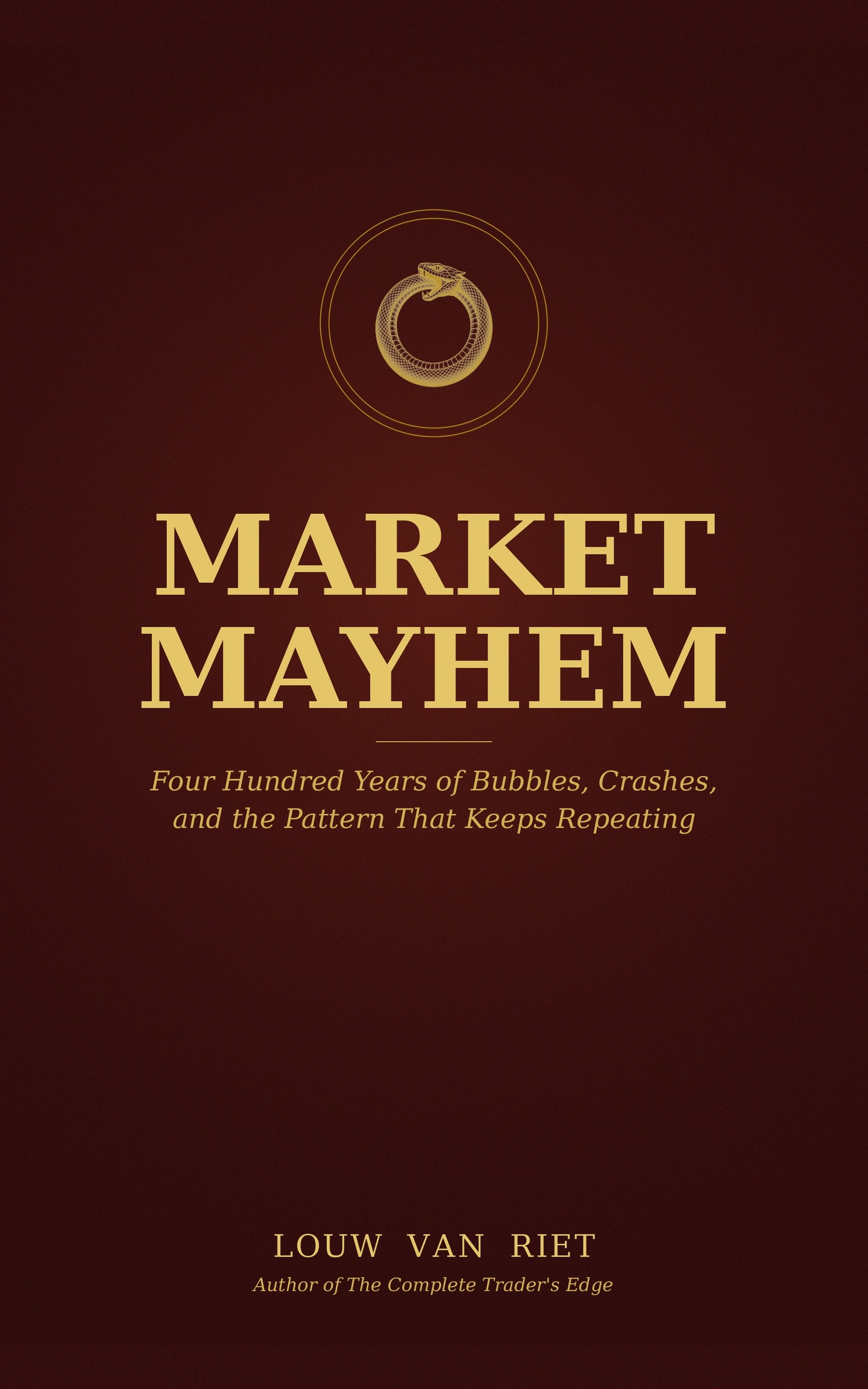 Market Mayhem
400 years of bubbles, crashes, and the pattern that keeps repeating.
Buy on Amazon →
Market Mayhem
400 years of bubbles, crashes, and the pattern that keeps repeating.
Buy on Amazon →
 Greatest Companies
How the world's greatest companies were built — and what traders learn from them.
View on Amazon →
Greatest Companies
How the world's greatest companies were built — and what traders learn from them.
View on Amazon →
 Greatest Traders
Eighty-six lives that explain the markets — Livermore to Madoff, told with the losses left in.
View on Amazon →
Greatest Traders
Eighty-six lives that explain the markets — Livermore to Madoff, told with the losses left in.
View on Amazon →