

Risk Management:
The Career-Length Edge
Risk management is more important than your strategy. A mediocre strategy with great risk management produces a slow, compounding equity curve. A great strategy with bad risk management produces a single catastrophic drawdown that wipes out a year of work. Markets do not care how good your read is — they care whether you sized correctly when the rare bad outcome arrived.
Step 1 · The Foundation
The Three Articles That Save Accounts
If you only read three articles from this entire pillar, make it these three. Position sizing, stop losses, and risk-to-reward are 80 percent of the work. Get those right and the rest is refinement.
Required reading
The Three Articles This Month
Get these right and 80 percent of risk management work is done. The rest is refinement.
Position sizing
Size Every Trade Right
The single decision that separates amateur risk-taking from professional capital management.
Read the math →Survival math
Risk of Ruin
The probability your account hits zero given win rate, R:R, and risk per trade. Most uncomfortable article on this site.
Run the numbers →The metric
Trading Expectancy
The math behind a profitable strategy. Expressed in R-multiples. The only metric that matters.
Read the formula →Step 2 · The Three Non-Negotiables
Rules You Do Not Break
Three rules. They are non-negotiable. They are the difference between a 10-year career and a 10-week one. The trader who breaks any of these rules has not learned them yet.
0.5–2% Per Trade
Never risk more than 1 to 2 percent of capital on any single trade. Most professionals sit at 0.5 to 1 percent. At 1 percent, ten consecutive losses puts you down 9.6 percent — recoverable. At 5 percent, ten losses puts you down 40 percent. Most accounts do not survive that math.
Position Sizing Mastery →3–5% Daily Stop
Define a maximum daily loss at which all trading stops. No exceptions. No “one more setup to get it back.” The platform closes; you walk away. This rule takes the worst decision of the trading day out of the trader’s hands.
Weekly Loss Limit →R-MULTIPLES Not Dollars
Express every trade outcome as a multiple of initial risk. A 1R win means you made what you were willing to lose. This framework strips out the emotional charge of dollar amounts. Two traders with $10K and $500K trade identically when both think in R.
Expectancy in R →The Position Sizing Formula
The Math That Makes It Real
Position sizing is not “how big a position can I take.” It is the answer to: given account size, stop distance, and max risk percent — exactly how many units? The formula is non-negotiable. Every trade gets its size from this calculation.
For a $50,000 account, 1% risk, and a 50-pip stop on EUR/USD: $500 risk ÷ $5 per pip per standard lot = 1.0 lot. The number is non-negotiable. Every trade gets its position size from this formula. Every trade.
Step 3 · The Building Blocks
Six Concepts That Compound
Beyond the three non-negotiables, six concepts separate professional capital management from amateur risk-taking. Each one builds on the last.
The Drawdown Protocol
The 3-Tier System That Saves Careers
Every trader has drawdowns. The professional trader has a protocol that prevents drawdowns from becoming career-enders. Most retail traders do the opposite — they double size after a drawdown trying to make it back. The math punishes this.
TIER 01
Down 3–5%
Normal review. Continue trading at full size. The trade journal entries get more attention. Identify pattern in losses.
TIER 02
Down 5–10%
Reduce position size by half. Continue only A-tier setups. No experiments, no new strategies.
TIER 03
Down 10–15%
Stop trading entirely. Mandatory week off. Full review of every loss. Resume at quarter-size, scale up over 2-4 weeks.
Step 4 · For Funded Account Traders
Prop Firm Risk Math Is Different
Prop firm rules — daily loss, total drawdown, consistency, time stops — make conventional risk management partially inadequate. Funded traders have to manage two risk models simultaneously: the firm’s rules and their own.
Step 5 · Specific Risk Topics
The Edge Cases That Catch Traders Out
Specific situations where standard risk rules need adjustment — overnight gaps, news events, multi-timeframe stacking, and the subtle ways exposure builds without you noticing.
The Common Questions
Frequently Asked Questions
The questions traders actually ask about risk management — and the honest answers.
What percentage of my account should I risk per trade?
Most professional traders sit at 0.5 to 1 percent per trade. Beginners should start at 0.25 to 0.5 percent until they have 100+ trades of journaled data confirming their edge. The trader risking 5 percent per trade is gambling, not trading. The math of risk of ruin is unforgiving — read Risk of Ruin and run your own numbers.
How do I calculate position size?
Position Size = (Account × Risk %) ÷ (Entry − Stop). For a $25,000 account, 1 percent risk, and a 100-point stop on NQ futures: $250 risk ÷ ($5 per point × 100 points) = 0.5 micro NQ contracts. Round down to 0 — the position is too small for one micro. Either reduce stop distance, increase account, or skip the trade. Never round up. Use the Trading Calculators to do this in one click.
Should I move my stop to break-even after a partial profit?
Sometimes yes, sometimes no. Moving to break-even reduces win rate slightly (some breakeven trades would have continued to target if left alone) but eliminates the chance of a winner turning into a loser. Most professional discretionary traders move to break-even after capturing 1R of profit on swing trades, and after structural confirmation on day trades. Mechanical movement of stops is rarely the right answer.
What is a healthy maximum drawdown?
For prop firm trading: respect the firm’s rule, full stop. For personal accounts: most professional discretionary traders cap their personal max drawdown at 15 to 20 percent. Beyond that, the recovery math gets brutal — a 30 percent drawdown requires a 43 percent gain to break even; a 50 percent drawdown requires a 100 percent gain. The drawdown protocol in Drawdown Protocol is the prevention framework.
Is the Kelly Criterion safe to use?
Full Kelly: no, almost never, for retail traders. Fractional Kelly (one-quarter or one-half Kelly): yes, with caveats. The Kelly formula assumes you know your edge with certainty. You do not. Most traders overestimate their win rate and average R, which means full Kelly sizes them too aggressively. Fractional Kelly bakes in a margin of safety. Even then, do not use Kelly until you have at least 200 journaled trades documenting your real edge. Until then, use fixed-percentage sizing. Full breakdown: Kelly Criterion for Traders.
How do I manage risk when news hits?
Three rules. First: do not hold positions through scheduled high-impact news (NFP, CPI, FOMC) unless the strategy specifically targets news volatility. Second: if news creates an unscheduled volatility spike during a trade, do not panic — your stop is already in the market and the math is already in your favour. Third: keep a watchlist of upcoming events and treat the 30 minutes before high-impact news as a no-new-trades window. Tactical guide: Trading Tariff Announcements.
Can I increase position size after a winning streak?
This is one of the most consistent ways traders give back gains. After a winning streak, the trader’s confidence increases, but the underlying edge has not changed. Increasing size based on confidence rather than data leads to larger losses when the inevitable losing streak arrives. The professional approach: size up only when account size has materially grown (recompute the dollar value of 1 percent risk and use that), and never as a confidence-based decision.
The Complete Capital Management Curriculum
17 Chapters Dedicated to the Money Pillar
Position sizing math, R-multiples and expectancy, drawdown management, the psychology of losing, and the framework for thinking about trading capital across decades, not days. The Money pillar is what separates careers from cautionary tales.
Get The Complete Trader’s Edge →Continue the Framework
Where to Go Next
Risk math is downstream of strategy quality and upstream of psychology execution. The full framework comes together when all three pillars work in alignment.
 The Complete Trader's Edge
The full Mind · Method · Money framework. 70 chapters.
View on Amazon →
The Complete Trader's Edge
The full Mind · Method · Money framework. 70 chapters.
View on Amazon →
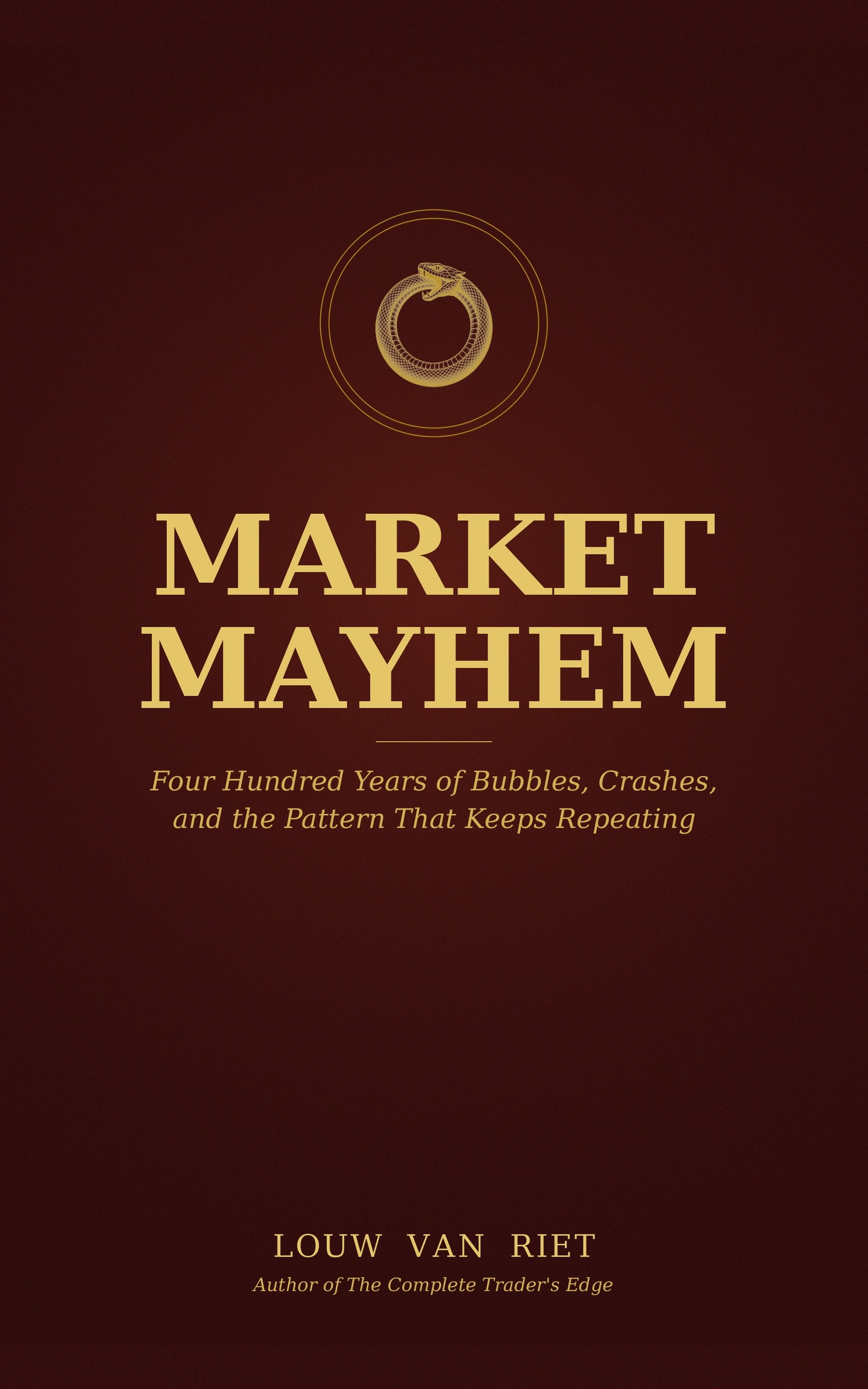 Market Mayhem
400 years of bubbles, crashes, and the pattern that keeps repeating.
Buy on Amazon →
Market Mayhem
400 years of bubbles, crashes, and the pattern that keeps repeating.
Buy on Amazon →
 Greatest Companies
How the world's greatest companies were built — and what traders learn from them.
View on Amazon →
Greatest Companies
How the world's greatest companies were built — and what traders learn from them.
View on Amazon →
 Greatest Traders
Eighty-six lives that explain the markets — Livermore to Madoff, told with the losses left in.
View on Amazon →
Greatest Traders
Eighty-six lives that explain the markets — Livermore to Madoff, told with the losses left in.
View on Amazon →