

Every morning, somewhere in the world, a trader sits down at their desk with a vague intention to “find some setups” and no specific plan for what they will do, how they will do it, or when they will stop. Two hours later, they have taken four unplanned trades, moved a stop loss, and are staring at a P&L that reflects the quality of their preparation: chaotic. Brian Tracy would diagnose the problem in seconds. They ate the wrong frog.
Brian Tracy is the author of Eat That Frog!, one of the most practical productivity books ever written, along with over eighty other books on goal-setting, time management, and the psychology of achievement. His central message is deceptively simple: identify the most important task, do it first, and do it with your full focus before anything else competes for your attention. The “frog” is the task you are most likely to procrastinate on, the one that will have the greatest positive impact on your results. Eat it first thing in the morning, and the rest of the day takes care of itself.
For traders, the frog is not a trade. It is the preparation that makes trades possible. The pre-session routine. The journal review. The level marking. The bias determination. The plan writing. These are the tasks that most traders skip, rush, or half-complete because they are not exciting. They do not feel like trading. But they are the foundation on which every profitable session is built, and Tracy’s framework ensures they happen first, fully, and without compromise.
Tracy’s case for doing the hardest thing first. Goals! is the companion volume behind the goal-setting section below.
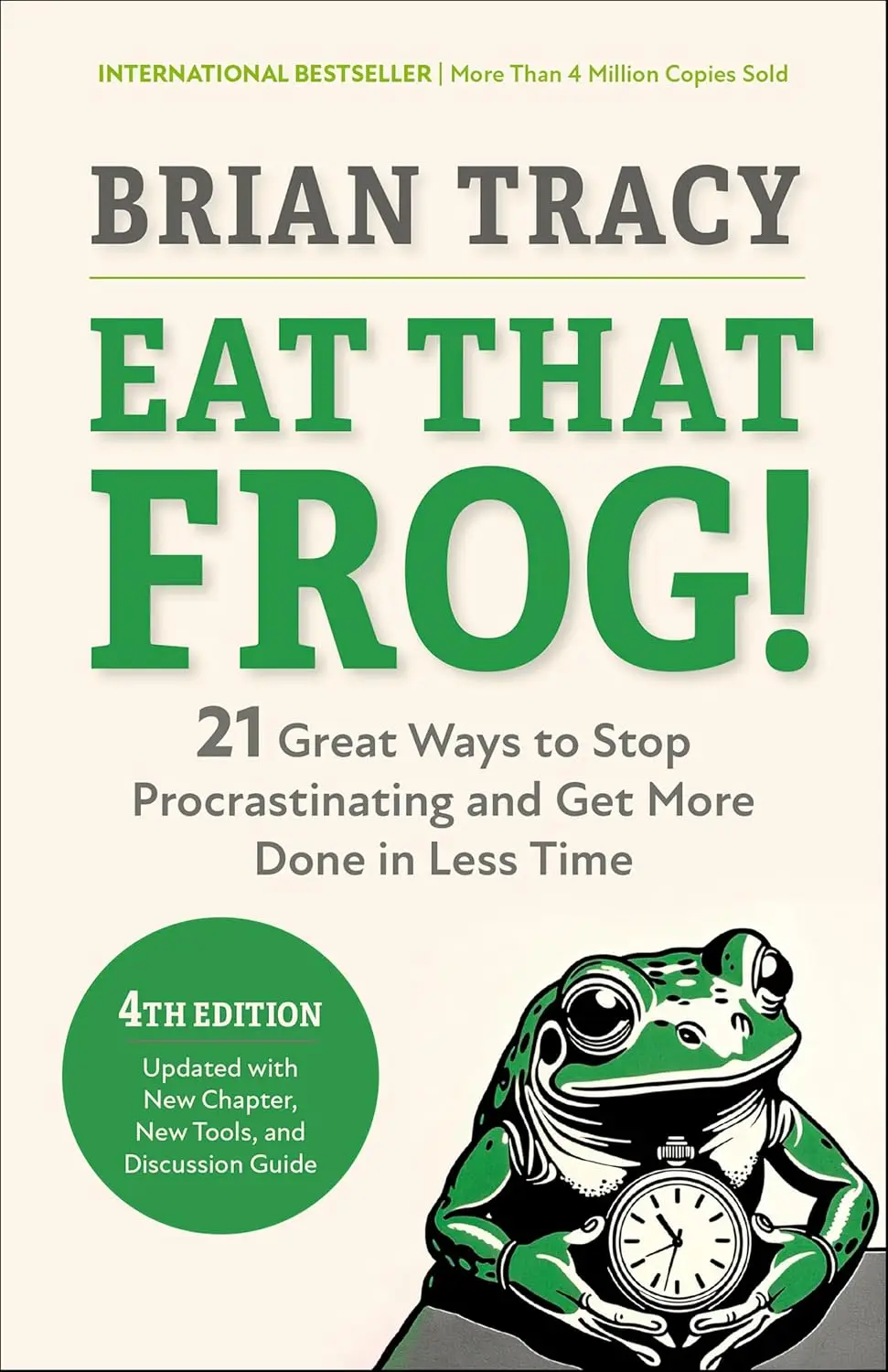

Eat That Frog: Do the Hard Work Before the Market Opens
Tracy’s principle is based on a Mark Twain observation: if the first thing you do each morning is eat a live frog, you can go through the rest of the day knowing the worst is behind you. The “frog” is your most important, most impactful, most resistance-generating task.
| Key Concept | Original Context | Trading Translation |
|---|---|---|
| Eat the frog first | Do the hardest, most important task at the start of the day | Pre-session preparation is the frog. Do it first, before checking P&L or social media. |
| ABCDE prioritisation | Rank tasks by consequence, not urgency | A-tasks: mark levels, define bias. B-tasks: check economic calendar. C-tasks: review watchlist. Do A first. |
| Single handling | Work on one task until complete before starting another | Analyse one instrument fully before moving to the next. Scattered analysis produces scattered results. |
| Continuous learning | Dedicate time daily to improving your professional skills | 30 minutes of chart study or trading education daily compounds into mastery over years. |
In trading, the frog is your pre-session routine. Not the trading itself. The preparation. Specifically: reviewing yesterday’s journal entries for patterns, marking today’s key levels on the daily and 4-hour timeframes, determining your directional bias, writing your trading plan for the session with specific setups and risk parameters, and completing your psychological check-in to ensure you are in a fit state to trade.
Most traders skip straight to the charts. They want the excitement of live price action. The preparation feels tedious. So they skip it, or rush through it, and then spend the session making decisions that a fifteen-minute preparation block would have made obvious. Tracy would say: the reason you are losing money is not your strategy. It is your sequence. You are doing the easy thing first (watching charts) and avoiding the hard thing (preparing systematically). Reverse the order, and the results reverse with it.
The ABCDE Method for Trade Prioritisation
Tracy’s ABCDE Method is a prioritisation framework that assigns every task a letter based on its importance and consequences.
A tasks: Must do. Serious consequences if not completed. In trading: follow the trading plan, honour the stop loss, journal every trade.
B tasks: Should do. Mild consequences if not completed. In trading: review the economic calendar, check correlation between your instruments, update your weekly performance tracker.
C tasks: Nice to do. No consequences. In trading: read trading Twitter, watch a market commentary video, check what other traders are doing.
D tasks: Delegate. In trading: automate alerts for your levels rather than watching the screen constantly.
E tasks: Eliminate entirely. In trading: scrolling social media during the session, watching random YouTube analyses, checking your P&L between trades.
Tracy’s rule: never do a B task when an A task is undone. Never do a C task when a B task is waiting. The discipline of sequencing, doing the highest-impact tasks first and eliminating the lowest-impact ones entirely, transforms trading from a reactive, scattered activity into a structured professional practice.
The connection to Tim Ferriss’s 80/20 principle is direct: your A tasks are the 20% of activities that produce 80% of your results. Everything else is noise. Tracy makes the prioritisation explicit and actionable.
Goal Setting: The Clarity That Most Traders Lack
Tracy has written extensively about goal setting, and his framework is more rigorous than most. He prescribes writing goals that are specific, measurable, time-bound, and written in the present tense as though already achieved. He then requires breaking each goal into specific action steps and working on at least one step every single day.
Most traders have vague goals: “become profitable,” “make money trading,” “quit my job.” Tracy would dismantle these immediately. They are wishes, not goals. A goal looks like this:
“By December 31, 2026, I am a consistently profitable swing trader averaging 3% monthly return on a $30,000 account, following my ICT + Volume Profile system during London and New York sessions, risking 1% per trade with a minimum 1:2 reward-to-risk ratio, and maintaining a complete trading journal for every session.”
That goal is specific enough to measure, time-bound enough to create urgency, and detailed enough to generate a clear action plan. Tracy would then require you to write the daily actions: complete pre-session routine, take only A+ setups, journal every trade, review weekly, study one chapter of trading education per day. These daily actions, executed consistently, compound into the goal’s achievement. This is Jim Rohn’s daily disciplines given mathematical precision.
The Psychology of Achievement
Tracy’s broader body of work, particularly The Psychology of Achievement, addresses the mental frameworks that separate high performers from average performers. Several of his principles apply directly to trading.
The Law of Correspondence
Tracy teaches that your outer world is a reflection of your inner world. Your trading account is a mirror of your internal psychology. If your account is chaotic, with wild swings, inconsistent results, and periodic blowups, your internal state is chaotic. If your account shows steady, disciplined growth, your internal state is ordered. You cannot fix the account without fixing the psychology. This echoes Bob Proctor’s paradigm and Eker’s money blueprint: the external results always match the internal programming.
The Corridor Principle
Tracy observes that once you commit to a path and begin moving forward, new opportunities and doors appear that were invisible from the starting line. In trading, this means that the trader who commits to a single methodology and practises it for six months will discover nuances, edge refinements, and personal insights that the strategy-hopper who switches every two weeks will never see. Commitment opens corridors. Hesitation keeps you in the lobby.
Continuous Learning
Tracy prescribes reading for one hour every day in your field. For traders, this means one hour of deliberate education: trading books, journal review, backtesting, or studying specific concepts from the Method pillar. Over a year, this compounds into 365 hours of focused study, the equivalent of a university semester. Over three years, you have invested over 1,000 hours in your trading education, more than most traders accumulate in a decade of scattered, unfocused screen time.
Time Management for Traders
Tracy’s time management principles are particularly relevant for traders who struggle with overtrading, screen addiction, and the inability to step away from the platform.
Time Blocking
Tracy advocates blocking specific times for specific activities and protecting those blocks from interruption. For traders: Block 1 is preparation (pre-market, no trading). Block 2 is execution (live session, no analysis or learning). Block 3 is review (post-session, no trading). Block 4 is education (separate from all trading activities). This is the same batching principle Tim Ferriss teaches, and it prevents the cognitive contamination that comes from mixing preparation, execution, and review into one unfocused session.
The Law of Forced Efficiency
Tracy teaches that there is never enough time to do everything, but there is always enough time to do the most important thing. For traders who feel overwhelmed by the number of instruments, timeframes, and setups they “should” be monitoring: you do not need to trade everything. You need to trade the one or two setups that your journal proves are your highest-probability, highest-expectancy edges. Everything else is distraction disguised as opportunity.
Tracy and the Mind · Method · Money Framework
Mind: Tracy’s “eat the frog” principle addresses the procrastination and avoidance behaviours that prevent traders from doing the preparation work that makes disciplined execution possible. His goal-setting framework provides the clarity that transforms vague trading aspirations into specific, measurable, actionable plans. His Psychology of Achievement principles connect internal state to external results.
Method: The ABCDE prioritisation system helps traders distinguish between high-impact activities (following the plan, journaling) and low-impact ones (checking social media, watching random videos). Applied to method development, it ensures that the time spent on trading is directed at the activities that actually improve performance rather than the ones that merely consume time.
Money: Tracy’s time management principles directly serve capital preservation. The trader who has clear session boundaries, who stops trading when the plan is complete, and who eliminates the low-priority screen time that leads to overtrading will naturally take fewer but higher-quality trades, reducing unnecessary risk exposure and protecting the account from the death of a thousand marginal setups.
Continue Reading: The Inner Edge
▶ Jim Rohn: Daily Disciplines for Trading Success
▶ Tim Ferriss: The 80/20 Principle for Traders
▶ Robin Sharma: The 5 AM Club for Traders
The Complete Trader’s Edge
This article is part of The Inner Edge series. The psychology principles explored here are covered in depth across the 22 chapters of the Mind pillar in The Complete Trader’s Edge.
Frequently Asked Questions
What does “eat that frog” mean for traders?
The frog is your most important, most resistance-generating task. For traders, this is the pre-session preparation: reviewing yesterday’s journal, marking today’s levels, determining bias, and writing the session plan. Doing this first, before looking at live charts, ensures that every trading decision is made from a foundation of preparation rather than reaction.
How does the ABCDE Method help with trading prioritisation?
The ABCDE Method ranks trading activities by impact: A tasks (follow the plan, honour stops, journal) must be done first. B tasks (check economic calendar, review correlations) come second. C tasks (browse trading Twitter) are optional. E tasks (scrolling social media during sessions) are eliminated entirely. The rule is never to do a lower-priority task when a higher-priority one remains incomplete.
How should traders set goals according to Brian Tracy?
Trading goals should be specific, measurable, time-bound, and written in present tense. Instead of “become profitable,” write “By December 31, I am averaging 3% monthly on a $30,000 account following my defined system.” Then break this into daily actions: complete pre-session routine, take only A-grade setups, journal every trade, review weekly. The daily actions compound into the goal.
How does time blocking improve trading performance?
Time blocking separates preparation, execution, review, and education into distinct non-overlapping sessions. This prevents the cognitive contamination of analysing while trading, journaling while the session is open, or studying while watching live charts. Each block receives full focus, producing higher quality in every activity.
What is the Law of Forced Efficiency in trading?
There is never enough time to trade every instrument and every setup, but there is always enough time to trade your highest-probability edge with full preparation and focus. This principle cuts through the overwhelm that many traders feel and directs their limited time and energy toward the activities that actually produce results.
 The Complete Trader's Edge
The full Mind · Method · Money framework. 70 chapters.
View on Amazon →
The Complete Trader's Edge
The full Mind · Method · Money framework. 70 chapters.
View on Amazon →
 Market Mayhem
400 years of bubbles, crashes, and the pattern that keeps repeating.
Buy on Amazon →
Market Mayhem
400 years of bubbles, crashes, and the pattern that keeps repeating.
Buy on Amazon →
 Greatest Companies
How the world's greatest companies were built — and what traders learn from them.
View on Amazon →
Greatest Companies
How the world's greatest companies were built — and what traders learn from them.
View on Amazon →
 Greatest Traders
Eighty-six lives that explain the markets — Livermore to Madoff, told with the losses left in.
View on Amazon →
Greatest Traders
Eighty-six lives that explain the markets — Livermore to Madoff, told with the losses left in.
View on Amazon →