
You are the average of the five traders you spend the most time with. If those five traders overtrade, blame the market, skip their journals, and treat stop losses as suggestions, you will absorb those behaviours regardless of what your trading plan says. If those five traders respect their process, manage risk with precision, and treat every session as a professional engagement, you will rise to that standard without conscious effort.
Jim Rohn did not say this about traders. He said it about people. “You are the average of the five people you spend the most time with” is one of the most quoted lines in personal development history, and it came from a man who spent four decades distilling the principles of success into language so clear and direct that it has survived unchanged for over fifty years.
Jim Rohn was the original personal development philosopher. He mentored Tony Robbins. He influenced virtually every major self-help figure of the last half-century. His teachings on personal responsibility, the seasons of life, daily disciplines, and the philosophy of wealth were never flashy. They were true. And they apply to trading with a precision that Rohn himself, who passed away in 2009, might not have anticipated but would certainly have recognised.
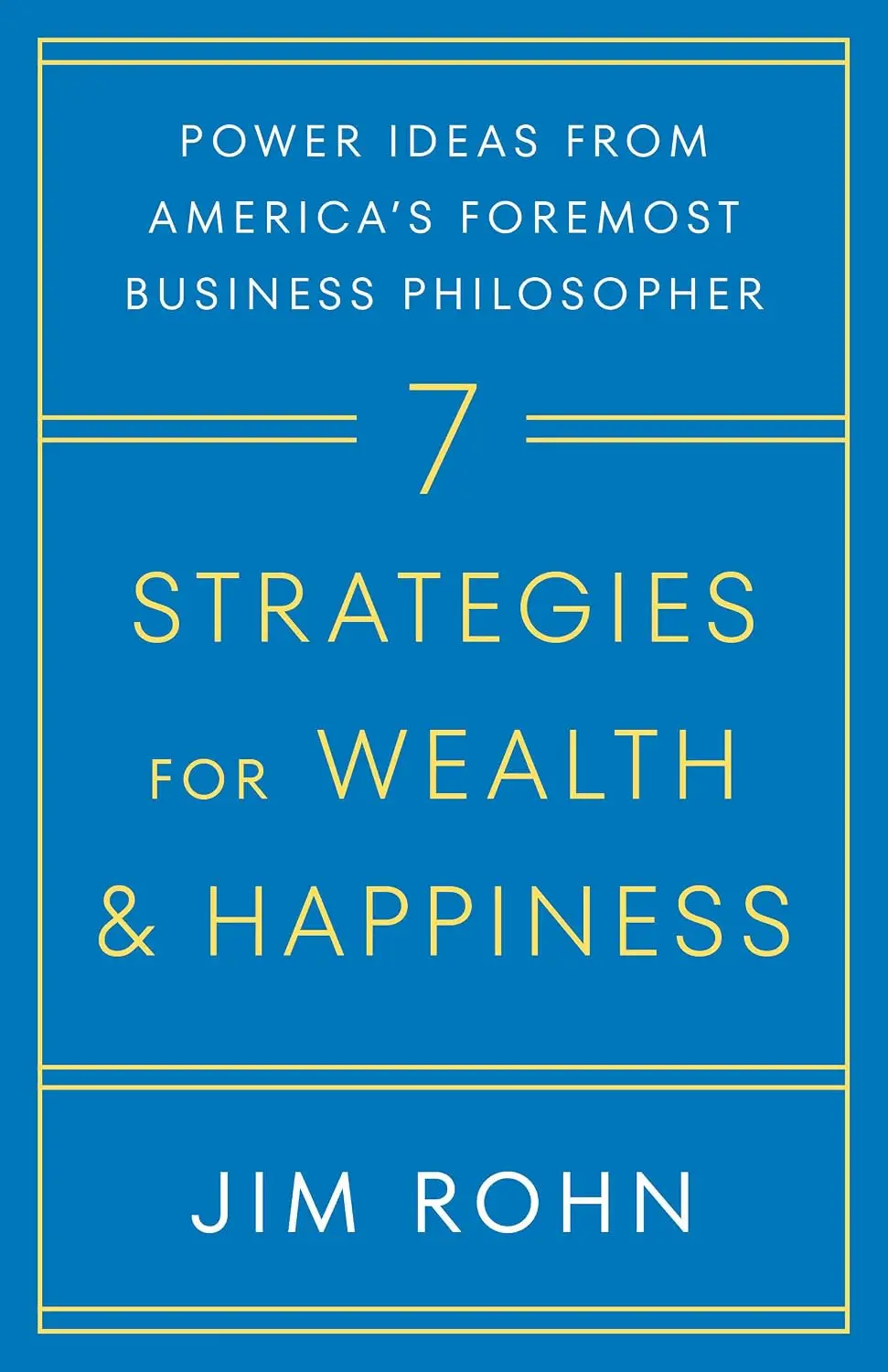
Rohn’s seasons metaphor in full. 7 Strategies for Wealth & Happiness is the companion volume on daily disciplines.

The Philosophy of Personal Responsibility
Rohn’s starting point is absolute personal responsibility. He taught that the conditions of your life are the result of the philosophy you hold, the habits you practise, and the disciplines you maintain. Not the economy. Not the government. Not your circumstances. You.
His famous statement captures it: “Don’t wish it were easier. Wish you were better.” For traders, this is the dividing line between the amateur and the professional. The amateur wishes the market were easier, more predictable, less volatile, more forgiving. The professional wishes they were better: better at reading structure, better at managing risk, better at controlling their emotions, better at following their plan.
Rohn would say that every trader has exactly the account size their current level of skill and discipline produces. Not the account size they deserve. Not the account size that luck has given them. The account size that is the precise mathematical result of every decision they have made. If you do not like the result, change the decisions. And changing the decisions starts with changing the philosophy that produces them.
This connects to every article in the Inner Edge series because every author, from Peterson’s radical responsibility to Proctor’s paradigm shifts, is saying the same thing in different words: you are the variable. The market is the constant. Work on the variable.
“You Are the Average of the Five People You Spend the Most Time With”
This is Rohn’s most famous teaching, and for traders in 2026 it requires a modern interpretation. Your “five people” are not just the humans you physically sit with. They include the Twitter accounts you follow, the YouTube channels you watch, the Discord servers you participate in, the podcasts you listen to, and the trading mentors whose content you consume daily.
If your daily information diet consists of accounts that post cherry-picked winning trades, promote unrealistic returns, glorify massive position sizes, and treat trading like a game, your subconscious is absorbing a model of trading that will destroy your account. You will unconsciously calibrate your expectations, your risk tolerance, and your definition of “normal” to match the content you consume.
Conversely, if you deliberately curate your information environment to include traders who share both wins and losses honestly, who discuss process rather than outcomes, who treat risk management as non-negotiable, and who approach trading with the seriousness of a professional practice, your own standards will rise to match. Not through conscious effort but through osmosis.
Rohn’s practical advice: audit your five. List the five sources of trading content you spend the most time with. For each one, ask: is this source making me a better trader, or is it feeding my worst impulses? Replace any source that degrades your thinking with one that elevates it. This single change, which takes five minutes to execute, can shift your entire trajectory over the following months.
The Seasons of Life: Trading’s Natural Cycles
One of Rohn’s most enduring frameworks is the Seasons of Life, the observation that life, like nature, moves through predictable cycles: spring (opportunity and planting), summer (growth and nurturing), autumn (harvest and reward), and winter (challenge and preparation). Each season serves a purpose. None can be skipped. The quality of each season depends on how well you used the previous one.
Trading Winter: The Drawdown
Winter in trading is the drawdown. The losing streak. The period when your system is in its normal statistical variance, producing losses that are mathematically expected but psychologically brutal. Winter is not evidence that your system is broken. It is evidence that you are in a cyclical low, and the question is not whether winter will come but whether you are prepared for it.
Rohn taught that winter is for preparation, reflection, and strengthening. The trader who uses a drawdown period to review their journal, study their patterns, tighten their execution, and deepen their understanding of their method will emerge from winter stronger. The trader who panics, switches strategies, or increases size to “make it back” will extend the winter indefinitely.
The critical mindset shift: winter is not happening to you. It is happening for you. Every serious trader who has achieved sustained success has endured multiple winters. The winter is the filter. It removes the traders who lack the discipline, patience, and preparation to survive it, and it strengthens the ones who do.
Trading Spring: The Setup Phase
Spring is when conditions begin to align. Your method is starting to show positive results again. The market is offering setups that match your edge. This is the time to plant: take every valid setup your system presents. Do not hesitate out of lingering winter fear. Do not reduce size because of recent losses. The system is designed to capture these opportunities, and hesitation during spring means missing the very moves that make the annual return.
Trading Summer: The Growth Phase
Summer is the period of consistent, compounding returns. Your system is in its sweet spot. The market environment aligns with your method. Wins are outpacing losses. The account is growing. Summer requires nurturing: maintain the same discipline that got you here. Do not become complacent. Do not increase risk because “everything is working.” Do not stop journaling because the results are positive. Summer feels good, but it is also where overconfidence plants the seeds of the next winter.
Trading Autumn: The Harvest
Autumn is when you reap the rewards of the work done in the previous seasons. In trading, this is when you can take a partial withdrawal, acknowledge your growth, raise your performance targets, or simply appreciate the compound curve that disciplined execution has produced. Rohn taught that you must harvest in autumn, because winter is coming again. In trading terms: bank some profits, celebrate the milestone, and prepare for the next cycle.
Understanding that these seasons are cyclical and inevitable is one of the most psychologically stabilising frameworks a trader can adopt. You are not failing during winter. You are not invincible during summer. You are moving through a natural cycle that every successful trader has navigated before you, and will navigate again.
“Work Harder on Yourself Than You Do on Your Job”
This is perhaps Rohn’s most important teaching for traders. He argued that the value of achievement is not the thing achieved. It is the person you become in the process of achieving it. The income follows the person. If you develop yourself into someone capable of earning $100,000 per year, the $100,000 follows naturally. If you try to earn $100,000 without developing yourself into that person, the money either never arrives or does not stay.
In trading, “working on your job” means studying charts, backtesting strategies, and analysing setups. “Working on yourself” means studying your psychology, examining your beliefs about money, processing the emotions that interfere with execution, and building the daily disciplines that produce consistency.
Most traders spend 95% of their development time on method and 5% on psychology. Rohn’s principle suggests inverting that ratio, at least temporarily, until the psychological foundation is solid enough to support the method. Because the method is only as good as the person executing it. A brilliant system operated by a psychologically undeveloped trader produces mediocre results. A simple system operated by a psychologically mature trader produces excellent results.
This is why the Mind pillar comes first in the Mind, Method, Money framework. It is not a philosophical choice. It is a practical one. Psychology is the foundation. Method is the structure. Money management is the roof. Build in any other order and the building collapses.
The Daily Disciplines
Rohn was obsessed with daily disciplines. He taught that success is not the result of dramatic actions but of small disciplines practised every day. The discipline of journaling. The discipline of reviewing. The discipline of preparing. The discipline of following the plan. None of these are exciting. None of them produce visible results on any given day. But compounded over months and years, they produce results that appear extraordinary to anyone who does not understand the process.
| Key Concept | Original Context | Trading Translation |
|---|---|---|
| Daily disciplines | Small daily actions compound into extraordinary results over years | Journal every trade. Review weekly. Backtest monthly. In 3 years, you have a skill most traders never build. |
| You are the average of 5 people | Your environment shapes your standards and behaviours | Surround yourself with disciplined traders, not FOMO-driven Discord groups. Your circle determines your ceiling. |
| Seasons of life | Every pursuit goes through planting, tending, harvesting, and winter | Year 1 is planting (learning). Year 2 is tending (testing). Year 3 is harvest (consistent profitability). Do not skip seasons. |
| Work harder on yourself than on your job | Self-development produces all other results | Psychology, routine, and self-awareness improve your trading more than a new indicator ever will. |
Rohn’s famous quote: “Success is a few simple disciplines, practised every day; while failure is simply a few errors in judgment, repeated every day.” For traders, the simple disciplines are: complete the pre-session routine, follow the trading plan, honour the stop loss, journal every trade, review the week on Sunday. The errors in judgment are: skip the routine, override the plan, move the stop, forget to journal, never review.
Both paths are easy. It is easy to journal and easy not to journal. It is easy to follow the stop and easy to move it. The difference is that one set of “easy” actions compounds into success, and the other compounds into failure. And the compounding happens so gradually that you do not notice which path you are on until the results become undeniable.
This is the same principle James Clear articulates in Atomic Habits: tiny behaviours, repeated daily, produce identity-level change over time. Rohn was teaching this decades before Clear, and his emphasis on the unglamorous reality of daily discipline is the perfect antidote to the trading industry’s obsession with dramatic breakthroughs and secret strategies.
“Formal Education Will Make You a Living; Self-Education Will Make You a Fortune”
Rohn distinguished between formal education (what you are taught by others) and self-education (what you teach yourself through reading, observation, and reflection). He believed that self-education was the primary driver of extraordinary results because it is self-directed, continuous, and driven by genuine curiosity rather than external requirements.
For traders, the implication is clear: no course, no mentor, no paid signal group can replace the education you give yourself through your own trading journal, your own backtesting, and your own honest self-examination. These external resources can provide frameworks and starting points. But the edge you build is always personal. It comes from the patterns you discover in your own data, the adjustments you make based on your own experience, and the self-knowledge you develop through thousands of hours of deliberate practice.
Rohn read voraciously, and he prescribed reading as the primary self-education tool. For traders, reading the essential trading books is the equivalent: one chapter per day, every day, compounding into an education that most traders never acquire because they spend that time scrolling social media instead.
The Value of Disgust
One of Rohn’s most provocative teachings is that lasting change often begins with disgust, the moment when you look at your results and say “I’ve had enough. This is not acceptable. I will not live like this anymore.” He argued that mild dissatisfaction produces mild effort. Disgust produces transformation.
In trading, this moment often comes after a particularly painful blowup, a drawdown that was entirely self-inflicted, or the realisation that years have passed without meaningful progress. The disgust is not pleasant. But it is productive, because it generates the emotional energy needed to actually change, not just to want to change.
If you have reached that point, if you are genuinely disgusted with your trading results and ready to do whatever it takes to change them, Rohn would say: good. Channel that energy. Do not waste it on self-pity. Use it to build the disciplines, install the habits, and do the psychological work that produces different results. The disgust is the fuel. The disciplines are the engine.
Jim Rohn and the Mind · Method · Money Framework
Mind: Rohn’s philosophy of personal responsibility, the power of environment, and the necessity of daily disciplines provides the philosophical foundation beneath all tactical trading psychology. His seasons framework normalises the inevitable cycles of trading and removes the catastrophic interpretation of drawdowns. His emphasis on self-education over external instruction empowers traders to build genuine, personal edges rather than depending on others.
Method: “Work harder on yourself than you do on your job” reframes the relationship between method and psychology. The method serves the person, not the reverse. A trader who has developed themselves psychologically can execute any sound method with consistency. A trader who has not will undermine even the best method with emotional interference. Rohn’s hierarchy places personal development as the prerequisite for professional performance.
Money: The daily disciplines framework is risk management expressed as philosophy. Honouring the stop loss is a daily discipline. Maintaining consistent position sizing is a daily discipline. Reviewing weekly performance is a daily discipline. None are dramatic. All are essential. And the compound effect of maintaining them produces the kind of steady, sustainable equity growth that dramatic gambles never achieve.
Continue Reading: The Inner Edge
▶ Tony Robbins: Peak Performance Principles for Traders
▶ Bob Proctor: Why Your Money Thermostat Controls Your Account
▶ T. Harv Eker: How Your Money Blueprint Controls Your Account
The Complete Trader’s Edge
This article is part of The Inner Edge series. The psychology principles explored here are covered in depth across the 22 chapters of the Mind pillar in The Complete Trader’s Edge.
Frequently Asked Questions
How does Jim Rohn’s philosophy apply to trading?
Rohn’s core principles of personal responsibility, daily disciplines, environmental influence, and the seasons of life map directly to trading psychology. His emphasis that results are produced by habits rather than dramatic actions explains why consistency in journaling, risk management, and routine produces far more than searching for the perfect strategy. His seasons framework normalises drawdowns and provides psychological stability through the inevitable cycles of trading.
What does “you are the average of the five people” mean for traders?
Your trading behaviour is heavily influenced by the content you consume and the community you participate in. If your five most-consumed trading sources promote reckless risk-taking and unrealistic returns, your own standards will calibrate downward. If they promote disciplined process, honest sharing of both wins and losses, and respect for risk management, your standards will rise. Auditing and curating your information environment is one of the highest-leverage changes a trader can make.
What are the seasons of trading?
Trading moves through cyclical seasons: Winter (drawdowns and losing streaks requiring patience and preparation), Spring (conditions improving, requiring courage to take setups despite recent losses), Summer (consistent returns requiring maintained discipline to avoid complacency), and Autumn (harvesting rewards, banking profits, and preparing for the next cycle). Understanding these seasons as inevitable and natural prevents the catastrophic interpretation of drawdowns that causes most traders to abandon viable strategies.
What daily disciplines do successful traders practise?
The daily disciplines that compound into trading success include completing a pre-session routine, following the trading plan without deviation, honouring every stop loss, journaling every trade before the day ends, and conducting a weekly performance review. None of these are dramatic or exciting. All of them compound over months into the kind of consistent execution that produces sustainable profitability.
How does self-education differ from formal trading education?
Formal trading education through courses and mentors provides frameworks and starting points. Self-education through your own journal analysis, backtesting, and honest self-examination produces the personal, specific edge that no external source can give you. Rohn taught that self-education produces fortunes because it is driven by genuine curiosity and directed at your specific challenges, making it far more relevant and actionable than generic instruction.
 The Complete Trader's Edge
The full Mind · Method · Money framework. 70 chapters.
View on Amazon →
The Complete Trader's Edge
The full Mind · Method · Money framework. 70 chapters.
View on Amazon →
 Market Mayhem
400 years of bubbles, crashes, and the pattern that keeps repeating.
Buy on Amazon →
Market Mayhem
400 years of bubbles, crashes, and the pattern that keeps repeating.
Buy on Amazon →
 Greatest Companies
How the world's greatest companies were built — and what traders learn from them.
View on Amazon →
Greatest Companies
How the world's greatest companies were built — and what traders learn from them.
View on Amazon →
 Greatest Traders
Eighty-six lives that explain the markets — Livermore to Madoff, told with the losses left in.
View on Amazon →
Greatest Traders
Eighty-six lives that explain the markets — Livermore to Madoff, told with the losses left in.
View on Amazon →